





















































Here’s the uncomfortable truth about most “brilliant insights”: somebody else already had them. Naming the problem feels like the hard part, the flash of genius you tell at dinner parties. It isn’t. It’s the cheapest step in the whole process, and if you’re serious about finding startup problems worth building around, you need to stop treating the naming as the achievement.
The Forty-Dollar Late Fee That Wasn’t the Real Story
The Netflix origin story goes like this: Reed Hastings racks up a forty-dollar late fee on a forgotten VHS copy of Apollo 13, feels embarrassed on the drive to the gym, and notices he pays one flat fee there no matter how often he shows up. Eureka. Netflix is born.
It’s a great story. It’s also, by most honest accounts, not the whole story. Netflix co-founder Marc Randolph has publicly described the tidied-up version as a “convenient fiction,” and reporters who’ve gone digging have struggled to independently confirm the specific late-fee incident or that Blockbuster’s own records ever turned it up. Hastings has repeated the anecdote for years, but “repeated for years” and “verified” are not the same thing, and it’s worth being honest about that gap rather than pretending the napkin-sketch version is documented history.
Here’s what doesn’t depend on the anecdote being true: late fees were a real, well-documented sore point for Blockbuster customers, and the company faced genuine class-action litigation over them in the early 2000s. Commentators and business writers have cited figures in the neighborhood of hundreds of millions of dollars in annual late-fee revenue — a sizable share of Blockbuster’s total business — along with reports of dozens of separate lawsuits filed by furious customers. Those specific numbers circulate widely but trace back to secondary sources rather than audited financial filings, so treat the exact figures as directionally right, not gospel. What isn’t in dispute is the shape of the story: the friction was public, it was litigated, and it went unsolved for years.
That’s the actual takeaway, and it lands before we even get to strategy: the myth of the eureka moment matters far less than the paper trail proving the friction was real. You don’t need a perfect origin story. You need evidence the pain was already showing up somewhere — in complaints, in lawsuits, in behavior nobody wanted to admit was a pattern.

Why Naming the Problem Never Paid Anyone
Here’s the subhead that should be tattooed on every first-time founder’s forearm: naming the problem never paid anyone. Late fees weren’t a secret. Customers named the problem constantly — in complaints, in reviews, allegedly in courtrooms. Everyone who ever paid one knew exactly what was wrong with the system. Blockbuster’s own executives almost certainly knew, too.
The friction was never hidden. It just took someone willing to build an entire company around removing it.
That’s the whole thesis of this piece, and it’s worth sitting with because it cuts against the instinct every aspiring founder has, which is to hunt for a problem nobody’s ever mentioned. Wrong hunt. If you can find your idea already complained about — in reviews, in forums, in lawsuits, in one-star ratings — treat that as confirmation, not disqualification. A problem with a paper trail is a problem people are already paying an emotional or financial tax on. Your job isn’t to discover it. Your job is to be the first one willing to build the removal.
How to See the Invisible Problem: Three Practices
This is where problem-first thinking actually becomes a method instead of a slogan. Three practices, in order.
Watch behavior, not opinions. What people do under real constraints tells you more than what they say when you ask them directly. Blockbuster could have run customer satisfaction surveys for a decade and heard “mildly annoying, but fine.” The lawsuits told the real story — people were angry enough to litigate, not just grumble. Practical version: don’t run a survey. Look for the lawsuit, the subreddit rant, the support-ticket pattern that keeps recurring even though nobody’s fixed it.
Read for emotional texture, not logistics. More on this below — it’s the practice that separates a surface complaint from the real, submerged problem.
Be willing to state the obvious. The best-protected ideas are often not hidden at all — they’re sitting in plain sight, dismissed as too simple to be worth building. If a problem feels almost embarrassingly basic to name out loud, that’s frequently the signal you’re looking at the real one. Sophistication is not a prerequisite for value.
The Feeling Underneath the Complaint
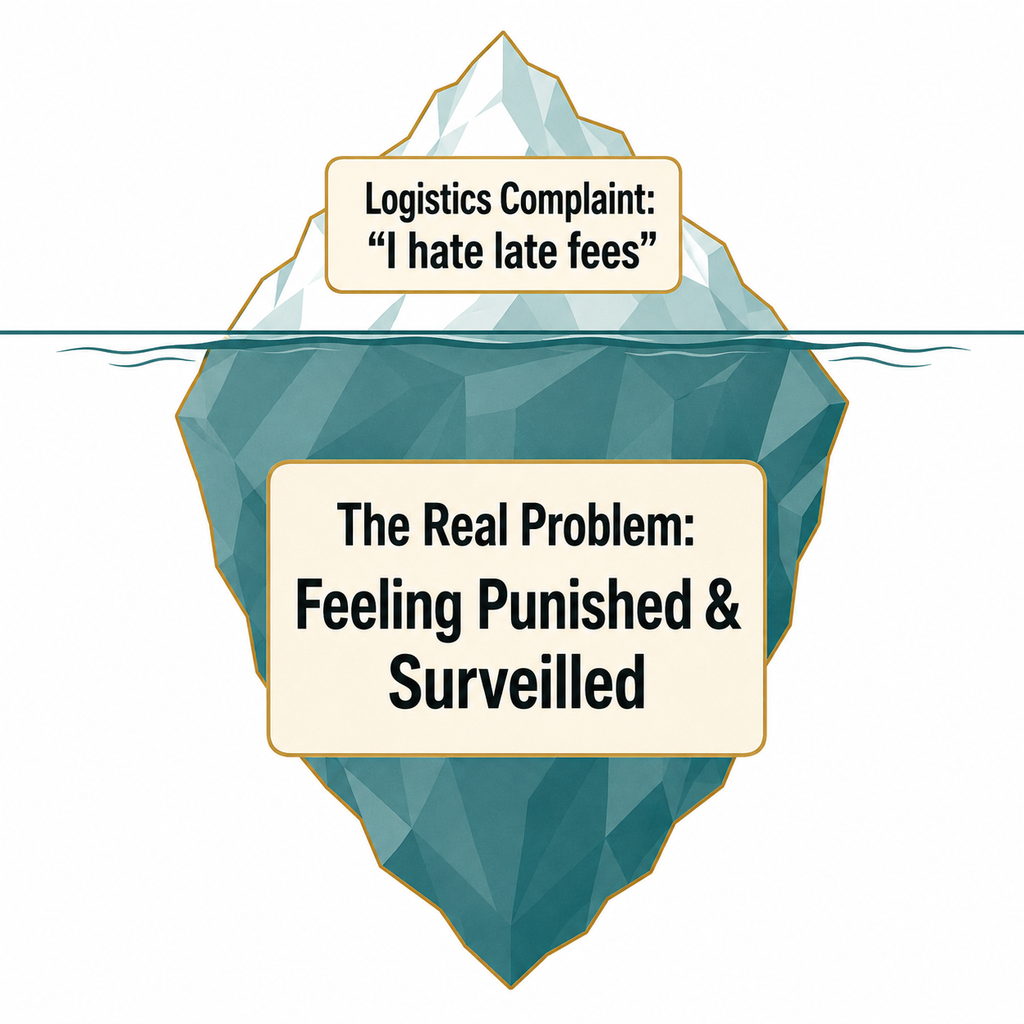
A complaint about “late fees” is a logistics problem. Somebody’s mad about a charge. Fine, refund it, move on.
But the feeling of being punished — the quiet resentment a customer carries every single time they interact with a company, the low-grade dread of “did I return that on time” — that’s the submerged mass underneath the logistics complaint. That feeling is what a founder is actually solving for. Nobody built Netflix to fix a forty-dollar charge. They built it to remove a recurring feeling of being surveilled and penalized by a business relationship that was supposed to be entertainment.
The reframe exercise is simple, even if it’s uncomfortable: take the logistics complaint at face value first (“customers hate late fees”), then ask what emotion is actually driving it. Punishment? Humiliation? A sense of being nickel-and-dimed? Do that reframing before you build anything, because a feature that solves the logistics problem without touching the emotional one will get copied in a quarter. A product that removes the feeling is much harder to replicate, because competitors are still busy solving the surface complaint.
Why the Same Friction Keeps Reappearing Across Life Stages
Here’s a pattern-recognition trick worth stealing: the deepest invisible problems don’t stay in one life phase. They shapeshift.
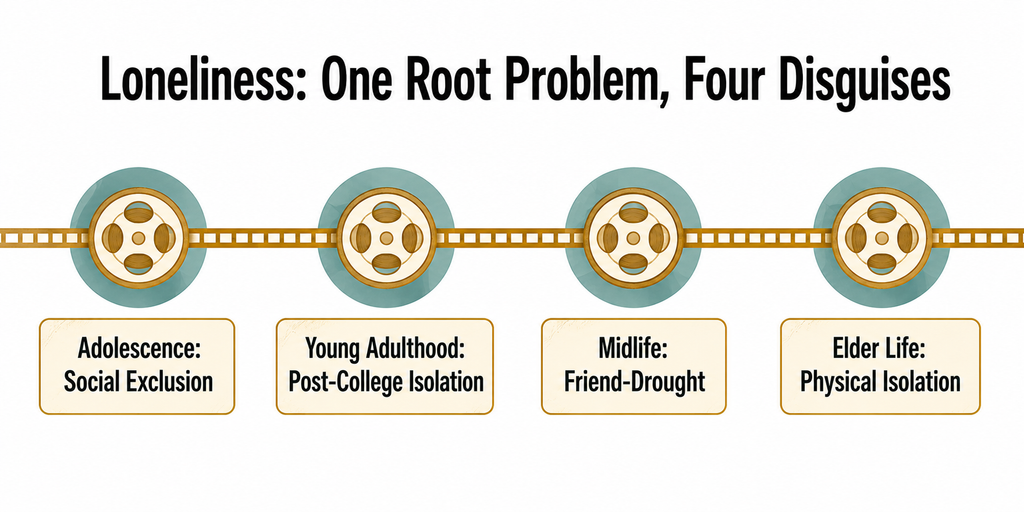
Loneliness is the clean example. It shows up in adolescence as social exclusion, in young adulthood as post-college isolation, in midlife as the friend-drought that hits people once careers and kids eat the calendar, and in elder life as literal, physical isolation after a spouse or peer group thins out. Five different surface symptoms. One invisible problem underneath all of them.
Companies that solve loneliness at the root level — rather than chasing one age bracket’s version of it — build something that works across multiple life phases at once. That’s not a coincidence; it’s exactly why those companies tend to scale further than single-phase solutions built for, say, “lonely college freshmen” alone. So test your own problem statement the same way: does it show up in a recognizable form at three genuinely different life stages? If you can only describe it for one narrow group, you may have found a symptom of something bigger, not the root problem itself.
Three Invisible Problems Sitting in Plain Sight Right Now
The “obvious” naming of a problem is usually the wrong-level naming — accurate enough to nod along with, shallow enough that nobody builds the real fix. Three examples worth sitting with.
Take teenagers and phones. The obvious framing is “teenagers spend too much time on their phones,” which produces obvious, mostly useless solutions — screen-time limits, parental controls, another dashboard nobody checks. The deeper version: digital-native teenagers have no reliable method for building a coherent identity when their entire social environment is algorithmically optimized to fragment and destabilize identity for the sake of engagement. That’s not a time-management problem. It’s an identity-formation problem wearing a screen-time costume, and it’s the loneliness pattern from the section above showing up in its adolescent form.
Take aging past retirement. The obvious framing is “old people have health problems,” which funnels money into medical devices and eldercare logistics. The deeper version: people now living two or three decades beyond traditional retirement age have no social, financial, or psychological framework for what that stretch of life is even for. That’s not a health problem. It’s a meaning problem, and it’s mostly unbuilt-for.
Take women in their forties and fifties in the workforce. The obvious framing is “gender pay gap,” which is real but treats the issue as a compensation spreadsheet problem. The deeper version: this group has accumulated a huge amount of expertise and leadership capacity that most organizations systematically fail to recognize, retain, or leverage — wasting one of the most potent intellectual resources sitting inside their own walls. That’s an organizational-design failure, not a payroll line item.
Notice what all three share: the obvious framing isn’t wrong, exactly. It’s just naming the problem at the wrong altitude — specific enough to sound insightful, shallow enough that nobody’s actually forced to build the harder, better answer.

What This Means If You’re Hunting for Your Own Problem
Naming is cheap. The market has never once paid someone simply for noticing that a thing is annoying. It pays the person willing to build the removal — slowly, unglamorously, often years after everyone already agreed the problem existed.
If you’re doing the founder-brain exercise of scanning the world for what to build next, here’s the compact version of everything above: find where a friction has already left a paper trail — complaints, reviews, litigation, the digital equivalent of twenty-three angry customers filing suit — because a documented paper trail beats a hunch every time. Restate the complaint emotionally, not logistically, until you can name what feeling it’s actually removing. Check whether it shows up in recognizable form across at least three different life stages, because that’s usually the line between a real root problem and a narrow symptom. And then ask yourself the only question that actually matters: are you willing to be the one who builds it, not just the one who names it.
For a longer walk through this same framework — including how to spot a billion-dollar blind spot before the lawsuits force the issue — it’s worth reading the invisible problem framework laid out in more depth.
Naming the problem was never the finish line. It was the entry fee.
Turning Complaints Into Something Worth Building
What is the “invisible problem framework”?
It’s a way of separating the surface-level complaint people voice out loud from the deeper, often emotional friction underneath it — and using that gap to spot problems worth building a company around, rather than problems people are merely mentioning.
What’s the actual repeatable test for whether a complaint is worth building a company around?
Four checks, in order: does the friction already have a paper trail — complaints, reviews, litigation? Have you restated it emotionally rather than logistically, until you can name the real feeling underneath? Does it show up in recognizable form across at least three different life stages? And the one that actually separates builders from noticers — are you willing to be the one who removes it, not just the one who names it?
How is this different from generic “finding startup problems” advice?
Most advice tells you to go find an unmet need. This framework argues the opposite: the need is almost never unmet in the sense of being unnoticed. It’s usually already complained about publicly. The actual skill is problem-first thinking applied to what people already say, filtering logistics complaints down to the emotional problem underneath, then being willing to build for it.
Why does “naming the problem” feel like an accomplishment if it isn’t one?
Because naming produces a satisfying flash of clarity, and clarity feels like progress. But clarity is available to anyone who reads the complaints. Building the removal is the part that actually costs something — time, capital, risk — which is why it’s the part that gets rewarded.
Key Takeaways
- Naming a problem is cheap; almost everyone affected by a friction has already named it in some form.
- The Netflix origin anecdote is partly disputed, but the underlying Blockbuster late-fee friction was real and well-documented through customer litigation and complaints, even if exact dollar and lawsuit figures circulating online trace back to secondary sources rather than audited filings.
- Watch behavior over stated opinion, read for the emotional texture under a logistics complaint, and don’t be afraid to state an obvious-sounding problem plainly.
- Invisible problems tend to reappear in different forms across life stages — testing a problem statement against multiple life phases helps separate root causes from symptoms.
- The market rewards the builder, not the namer. If you’ve found your invisible problem, the only question left is whether you’re willing to build for it.
Sources
- The Human Constant — The Problem That Was Always There
- Claim that Reed Hastings has repeated a version of the VHS/late-fee/gym origin story for years
- Claim/figure that Blockbuster’s late fees amounted to roughly hundreds of millions of dollars in annual revenue (commonly cited, unverified against primary filings)
- Claim/figure that Blockbuster faced dozens (around twenty-three, per commonly repeated accounts) of separate class-action lawsuits over late fees
- General claim that Blockbuster faced class-action litigation over late fees in the early 2000s
- Characterization that Hastings noticed a flat monthly gym membership fee as part of the inspiration for Netflix’s subscription model
