













































A four-year-old asks why the sky is blue, and if you answer honestly, you’d better clear your schedule. The follow-ups don’t stop. Children don’t accept the world as given — they interrogate it, relentlessly, compulsively, until it makes sense. That’s not a personality quirk. It’s a developmental drive, and it happens to be the raw material behind some of the largest industries on earth.
In 1969, a group of television producers looked at that drive and made a genuinely strange bet: what if you built a children’s show the way you’d build a commercial? Same repetition, same pacing, same hooks advertisers use to make a jingle stick in a six-year-old’s head for a decade — except aimed at the alphabet instead of a cereal brand. The show was Sesame Street. The bet paid off so completely that it’s easy to forget how radical it was, and how directly it set the template for the modern EdTech industry now valued in the hundreds of billions of dollars. Understanding how Sesame Street learning actually worked tells you almost everything you need to know about why that industry exists at all.
For readers, the underlying point is worth sitting with before we get to the history: children’s compulsive curiosity isn’t noise to be managed or medicated down. It’s the material any learning product has to work with, not against.
Before Sesame Street: Froebel’s Kindergarten Bet
The instinct to build something around a child’s natural drive to learn, rather than drilling it out of them, is older than television by well over a century.
In 1837, a German educator named Friedrich Froebel opened what’s generally credited as the world’s first kindergarten, in Bad Blankenburg. His premise was simple and, for the era, close to heretical: children weren’t small workers who needed discipline beaten into them. They were growing things, and the job of an educator was to nurture that growth through directed play rather than suppress it. The idea unsettled enough people in power that Prussia banned kindergartens outright in 1851, reportedly out of concern the whole movement was cover for socialist organizing.
The ban didn’t stick. Froebel’s model spread, mutated, and eventually became the default starting point for early childhood education worldwide — an approach now anchoring a global industry estimated at over $300 billion annually. Sesame Street didn’t invent the idea that children learn best through something that looks like play. It inherited it. What Sesame Street added was a delivery mechanism built for a screen instead of a circle of blocks.
The Hypothesis: Teach Like You Sell
By the late 1960s, American children were watching hours of commercial television a week, and advertisers had gotten disturbingly good at making that time count. A jingle heard a dozen times became unforgettable. A mascot’s face became instantly recognizable. Nobody was “teaching” kids these things in a classroom sense — the format itself was doing the work through repetition, rhythm, and reward.
The Children’s Television Workshop looked at that machinery and asked an uncomfortable question: if advertising could lodge a soda brand permanently in a child’s head, why couldn’t the same format lodge the alphabet there instead? In 1969, they launched Sesame Street on PBS built on exactly that hypothesis — that kids could absorb academic content the same way they absorbed a commercial jingle.
At the time, this was closer to provocation than pedagogy. Educators broadly treated entertainment and education as opposing forces: one rotted the brain, the other built it. Building a show that used the actual grammar of advertising — quick cuts, catchy repetition, characters designed to be as sticky as a mascot — to teach preschoolers letters was, to a lot of people in the room, a category error.
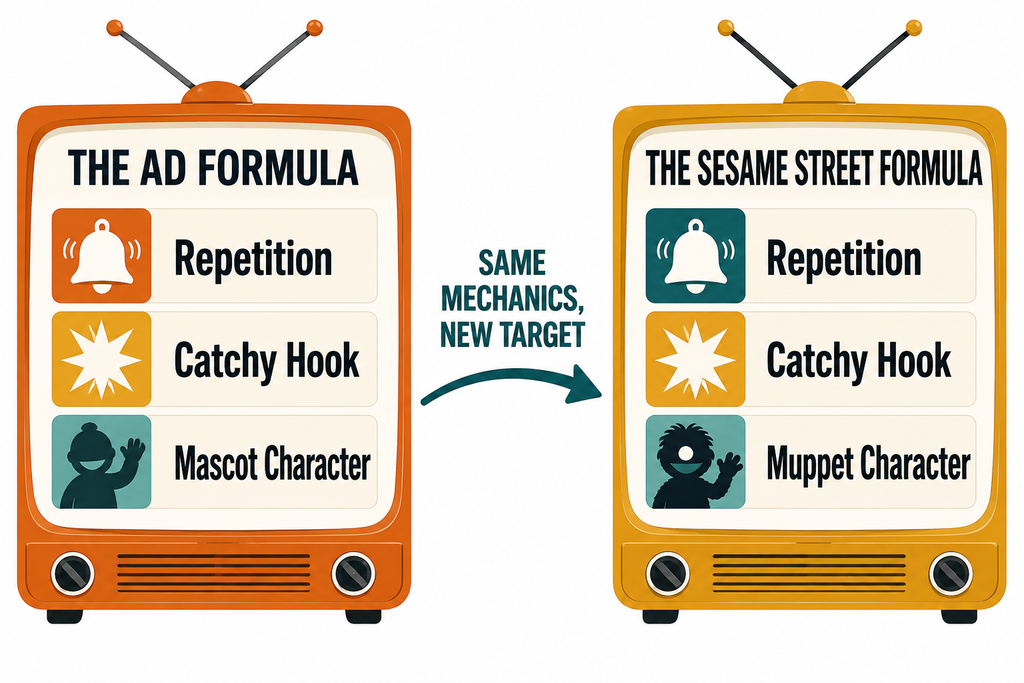
The takeaway for anyone building something for kids today: repetition, pacing, and hook structure aren’t manipulative tricks that belong exclusively to advertisers. They’re attention mechanics, and any educational format is free to borrow them.
Did It Work? The Evidence and the Aftershock
The Children’s Television Workshop’s own research on the show reported that children who watched consistently showed higher letter and number recognition than non-viewers — the specific numbers behind that finding have been cited and re-cited over the decades since, though for a claim this old and this widely repeated, readers evaluating it today should treat the exact figures as something to verify against the original CTW research rather than take as settled trivia.
The bigger result wasn’t the test score, though. It was the proof of concept: that education and entertainment weren’t opposites fighting for a child’s attention, but two settings on the same dial. You could build something as narratively engaging as a cartoon and still leave a kid meaningfully smarter for having watched it.
That single reframe reshaped every category of children’s media that came after it, from PBS’s own later shows to the first generation of “edutainment” software in the 1990s. For anyone building or buying learning products now, the lesson isn’t “add cartoons to the lesson.” It’s “design for the reward loop kids already respond to” — the same loop that made a jingle sticky, redirected toward something worth remembering.
From One Show to a $200 Billion Industry
Trace the line forward from 1969 and you land somewhere surprising: a modern EdTech industry now valued at over $200 billion, built on a premise Sesame Street proved rather than invented. That’s the real short history of the EdTech industry in one sentence — it didn’t start with software, it started with the discovery that a screen could teach if it was built like something a child actually wanted to watch.
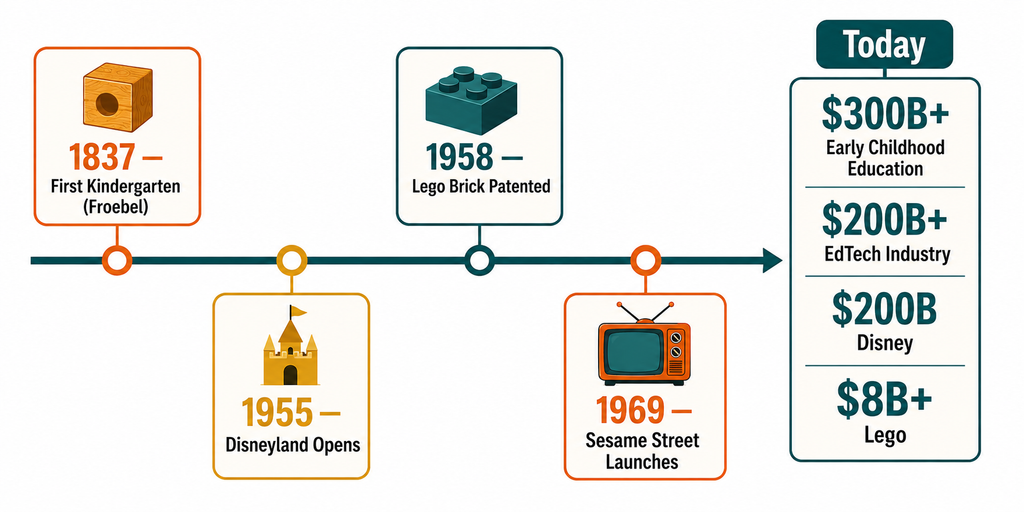
Sesame Street wasn’t alone in that pattern. Lego’s stud-and-tube brick, patented in 1958 by Godtfred Christiansen, solved a problem every child building with blocks had faced — that anything you build, you build knowing it will collapse. That mechanical fix, small as it sounds, turned a struggling Danish toymaker into a company now worth over $8 billion. Disneyland, opened in 1955, worked on a similar insight: kids don’t primarily want thrill rides, they want to feel like they’re inside a story. The company built on that bet is now worth roughly $200 billion.
None of these were originally sold as “child development” products in a clinical sense. They were built from the child’s point of view first, and the monetization came second, once the design was already working. That sequencing — kid-first, business-model-second — is the throughline connecting a Danish carpenter’s brick, a theme park, and a PBS pilot with puppets. If you want the more general version of how a piece of friction like this turns into an entire industry, the anatomy of an idea from friction to industry lays out that pattern step by step.
What This Means for Parents, Educators, and Builders Today
Nobody needs another headline saying screen time is bad or screen time is fine — both are too vague to act on. The useful question Sesame Street learning actually raises is narrower: is this thing built around a real engagement loop, or is it just occupying a child’s eyes?
A genuine engagement loop has a few concrete features you can actually check for: it rewards curiosity instead of punishing wrong answers, it repeats core concepts across different framings instead of once and done, and it has something resembling narrative — a reason to come back tomorrow, not just a button to press. That’s what Sesame Street had that a lot of the passive kids’ content flooding phones and tablets today doesn’t.
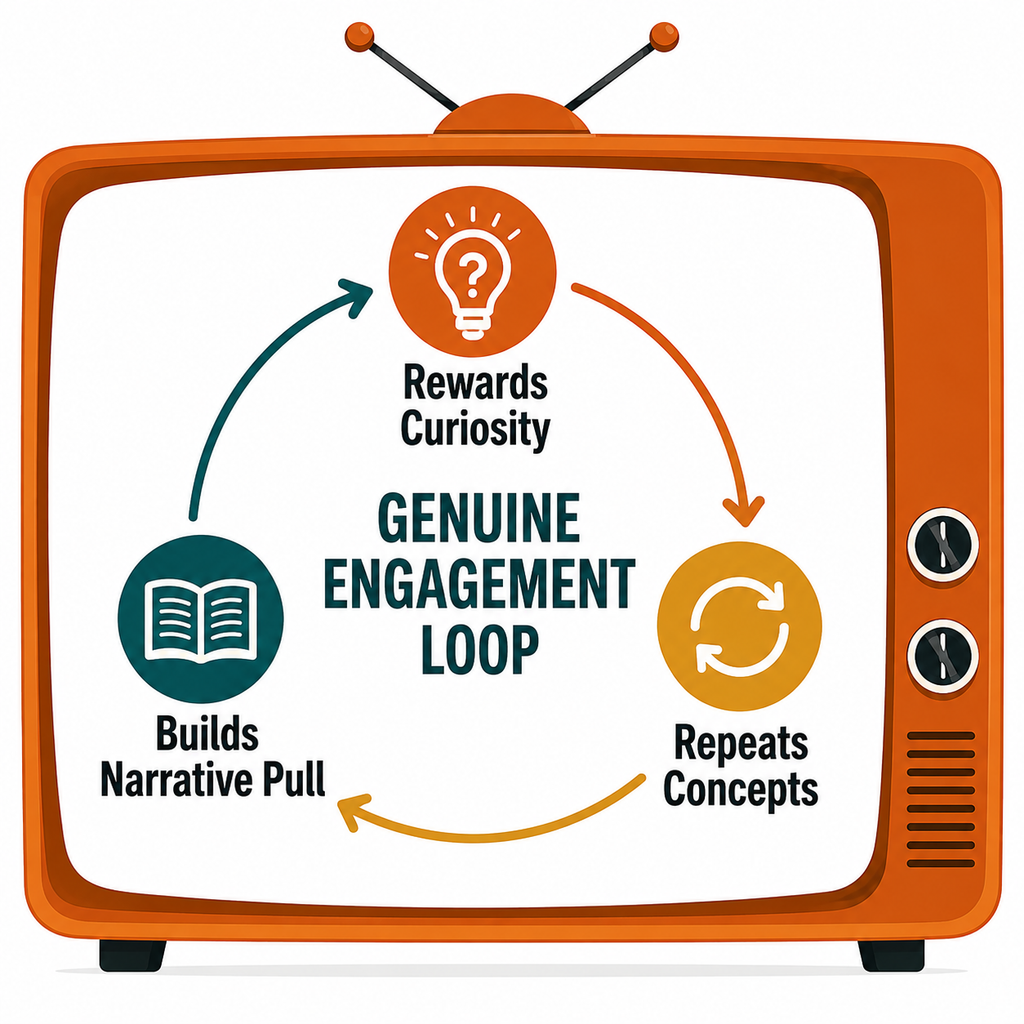
Concretely: before handing something to a kid, or building the thing yourself, ask whether it’s designed around the reward loop children already respond to, or whether it’s just borrowing the aesthetics of one. That distinction is the entire legacy of the 1969 bet.
FAQ: Sesame Street, Learning, and the EdTech Connection
Did Sesame Street actually work, or is that mostly nostalgia talking?
The Children’s Television Workshop’s own research reported measurable gains in letter and number recognition among regular viewers. The exact figures are worth checking against the original studies rather than treating as folklore, but the direction of the finding — kids who watched learned more than kids who didn’t — is the part that held up and reshaped how children’s media got made afterward.
Is the “teach like you sell” model still how kids’ shows and apps are built?
Largely, yes, though the medium has shifted from broadcast television to apps, YouTube, and adaptive software. The mechanics Sesame Street pioneered — short repeated segments, character-driven hooks, spaced repetition of a concept — are baked into most EdTech products aimed at young children, even ones that never mention the show.
How does one 1969 TV show connect to a $200 billion EdTech industry?
Sesame Street didn’t build the industry itself — it supplied the proof that the industry’s core assumption was sound. Once it was demonstrated that entertainment-format content could produce real learning gains, investment and design effort poured into extending that idea across new formats, from CD-ROMs in the 1990s to today’s adaptive learning apps.
What should I actually look for in a kids’ learning product today?
Skip the marketing copy and check the mechanics: does the content reward genuine curiosity, does it repeat and build on concepts rather than presenting them once, and does it give the child a reason to return that isn’t just habit or notifications. Products missing all three are usually occupying attention, not building it.
Key Takeaways
- Children’s compulsive question-asking is a developmental drive, and it’s the raw material every learning product — from Froebel’s kindergarten to modern EdTech — has had to design around.
- Sesame Street’s 1969 bet was that kids could absorb academic content the way they absorbed advertising jingles — a genuinely radical idea for its era, when education and entertainment were treated as opposites.
- The Children’s Television Workshop’s own research reported higher letter and number recognition among regular viewers; treat the specific figures as worth verifying against the original source rather than repeated trivia.
- Sesame Street, Lego’s 1958 brick redesign, and Disneyland all share the same sequencing: design from the child’s point of view first, monetize second — a pattern that scaled into industries worth hundreds of billions of dollars.
- Evaluating any kids’ media or EdTech product today comes down to one question: is it built around a genuine engagement loop, or just borrowing the look of one?
Sources
- The Human Constant (source chapter for this piece)
- Claim that Friedrich Froebel opened the world’s first kindergarten in Bad Blankenburg in 1837
- Claim that Prussia banned kindergartens in 1851 over concerns the movement was linked to socialism
- Figure that early childhood education is a global industry worth over $300 billion annually
- Claim that Children’s Television Workshop launched Sesame Street on PBS in 1969 based on the hypothesis that kids absorb content like advertising jingles
- Claim that CTW’s own research found regular viewers had higher letter and number recognition than non-viewers
- Figure that the EdTech industry is valued at over $200 billion
- Claim that Godtfred Christiansen patented the stud-and-tube Lego brick design in 1958
- Figure that Lego is now a company worth over $8 billion
- Claim that Disneyland opened in 1955 and was designed from a child’s point of view around narrative immersion rather than thrill
- Figure that the Disney enterprise built from Disneyland is now worth approximately $200 billion
