


















































The Anatomy of an Idea: The 8 Steps From Friction to Industry

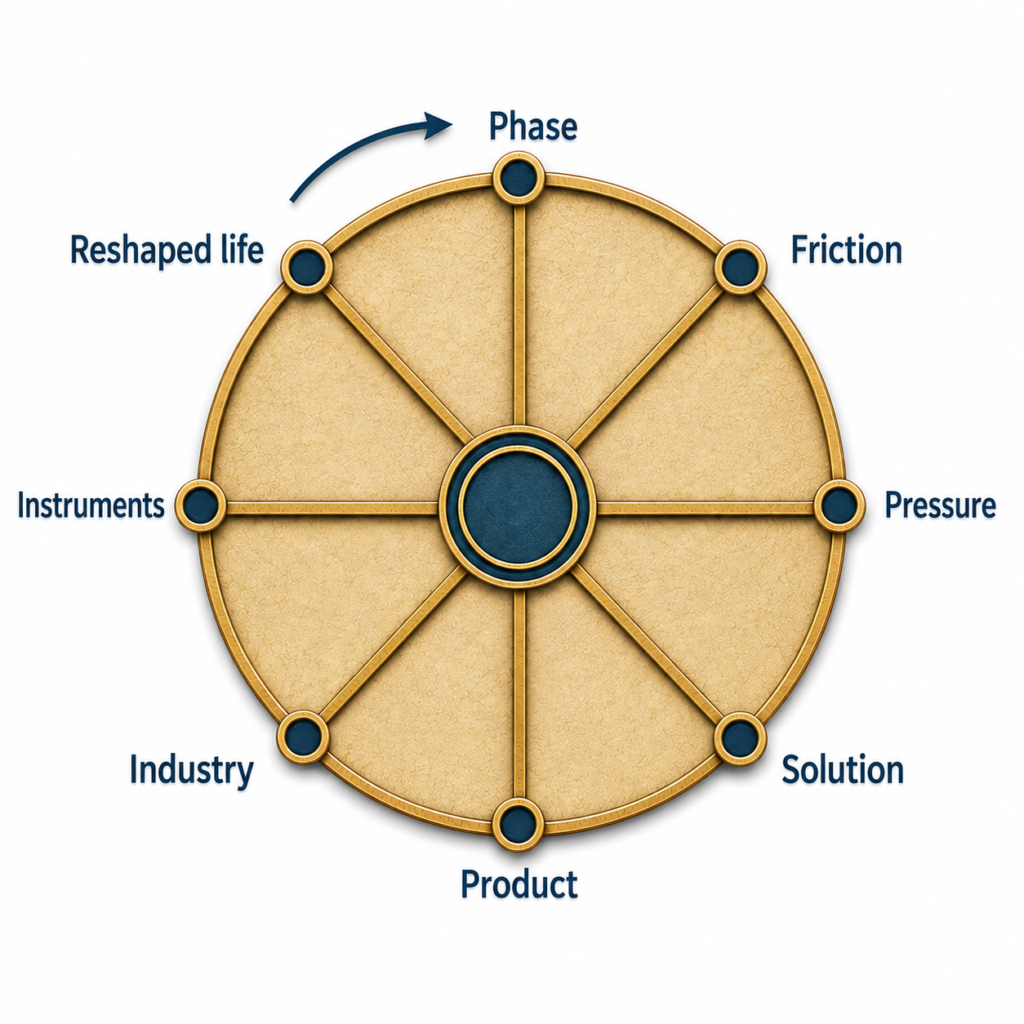
Every idea in history, from the earliest stone tool to the latest artificial intelligence, shares the same anatomy. A human in a specific phase of life encounters friction. The friction creates pressure. The pressure generates a solution. The solution becomes a product. The product becomes an industry. The industry generates financial instruments. Those instruments reshape human life — and the cycle begins again. That’s not a metaphor. It’s an observable pattern that repeats across every culture, every geography, every economic system in recorded history. This is how ideas become industries, laid out in full. (We covered where this chain actually starts — the friction itself — in our 73,000 Years Ago, Someone Solved the Same Problem You’re Solving Today piece. This one picks up from there and follows the chain the rest of the way.)
Key takeaways
- Every idea follows the same eight-step chain: phase, friction, pressure, solution, product, industry, financial instruments, reshaped life — then the cycle repeats.
- Most people who talk about “having an idea” have really only reached step four. The chain has four more steps most ideas never complete.
- The clearest full example is writing itself: a temple’s memory problem became cuneiform, became record-keeping institutions, became contracts and law, and reshaped civilization.
- The practical takeaway: don’t ask whether your idea is good. Ask which step of the chain it’s actually stuck on — that’s a different, more useful question.
How ideas become industries: the chain in full
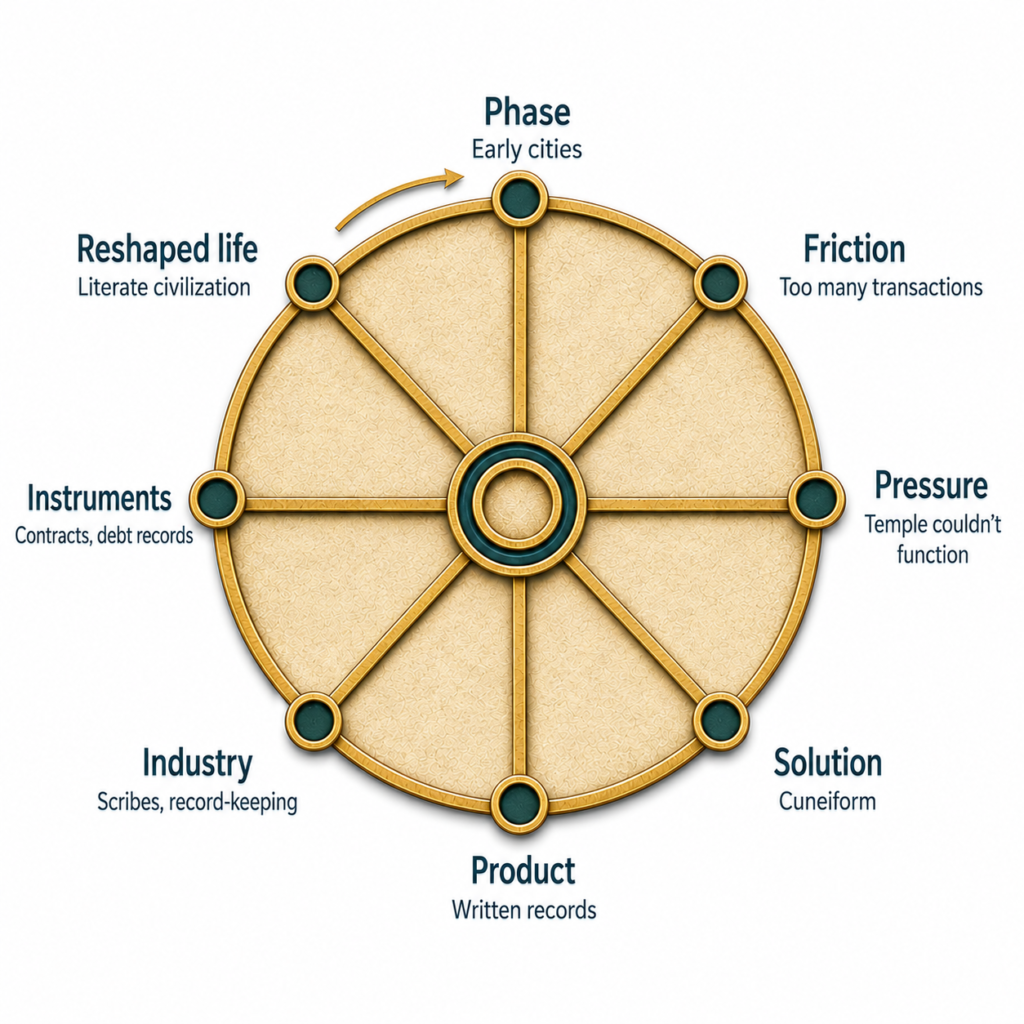
Around 3400 BCE, in the Mesopotamian city of Uruk, someone pressed a reed stylus into a tablet of wet clay to record how much barley had gone into that week’s beer. Not a poem. Not a prayer. A receipt — jars counted, grain measured, workers’ rations tracked, because a temple administrator could no longer keep a growing city’s accounts in his head. Run that moment through all eight steps and you get the clearest complete chain there is.
Phase: early urban administration. Friction: too many transactions, not enough memory — the same problem a small business owner feels today. Pressure: a temple that couldn’t function without a fix. Solution: a system of marks that stood in for spoken words. Product: cuneiform script pressed into clay. Industry: professional scribes, record-keeping institutions, and eventually the administrative apparatus of entire cities. Financial instruments: written contracts, debt records, ownership claims — the ability to make an economic promise durable enough to enforce later. Reshaped life: literate civilization itself, law codes like Hammurabi’s, and every institution built on the assumption that a record can outlast a human memory.
That’s not a stretch of the imagination. The pattern that drove every subsequent human institution was already visible in that clay: the city solved the isolation of scattered farms, writing solved a temple’s memory problem, and law solved the conflict of dense, unrelated people living too close together. Every institution of civilization traces back to a human life-phase friction — usually a duller, more mundane one than we’d like to believe.
Why most ideas die before step five
Here’s the useful part of laying the chain out in full: it tells you most people who describe themselves as “having an idea” have only reached step four. They’ve found a friction, felt the pressure, and sketched a solution. That’s real, but it’s less than half the chain. Steps five through eight — turning a solution into an actual product, a product into an industry, an industry into financial instruments people can build wealth or risk around, and instruments that genuinely reshape how people live — are where almost everything that calls itself an idea actually stalls.
This isn’t a knock on stopping early. Most solutions shouldn’t become industries; most frictions aren’t big enough to justify the next four steps. But if you’re evaluating your own idea, “is this a good idea” is the wrong question at step four. The better question is which step you’re actually stuck on, because step four’s problems (is the solution complete?) and step six’s problems (can this become an industry, not just a product?) are completely different problems, and most advice aimed at one doesn’t help with the other.
Where is your idea on the wheel?
Take whatever you’re currently building or thinking about building and place it honestly on the chain. Have you actually named the friction precisely, or only the surface complaint? Do you have a complete, imagined solution, or only a sketch? If you have a product, does anything about it resemble an industry yet, or is it still a single instance? And if you’re already further along — do any financial instruments exist around what you’ve built, and what would it actually reshape if it worked at scale?
Most ideas don’t need to travel the whole chain. But knowing exactly where yours currently sits tells you what kind of problem you’re actually solving next — which is a much more useful question than whether the idea itself is good. (For a repeatable method to generate ideas at the earlier steps of this chain, see our Six-Step Framework piece.)
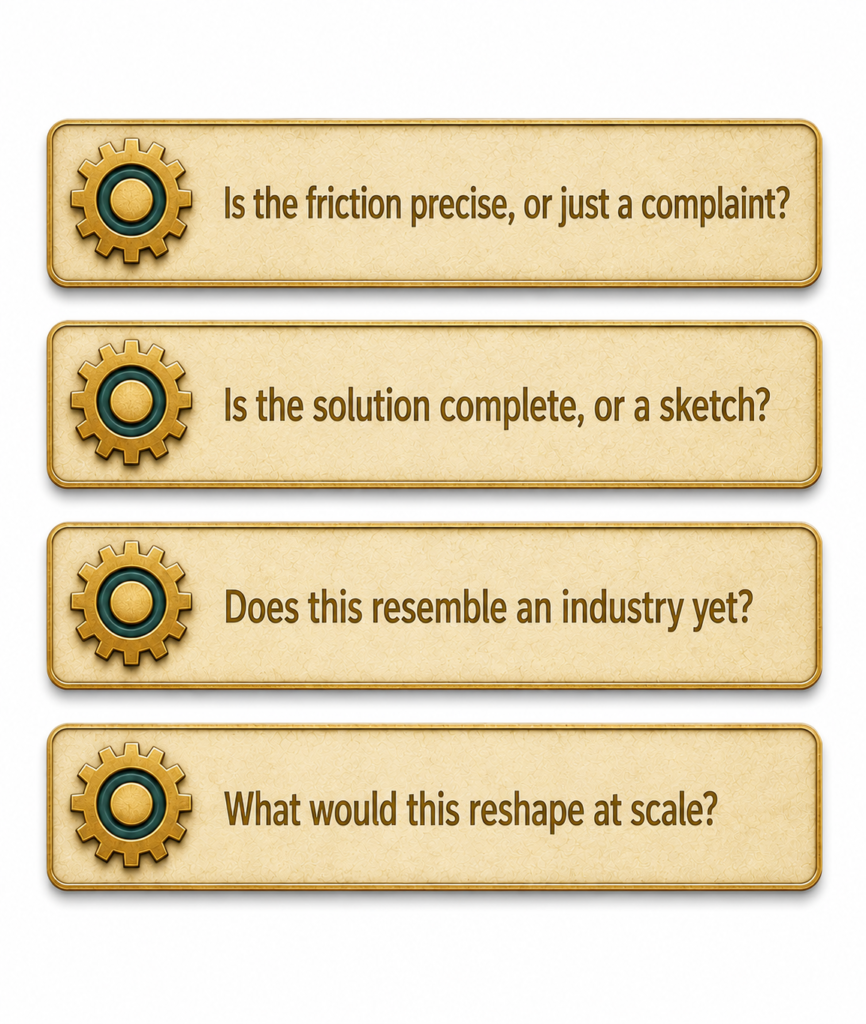
Where Your Own Idea Sits on the Chain
Does every idea really have to reach step eight to matter? No — most useful ideas stop well before industry-scale, and that’s fine. The chain isn’t a scorecard for ambition. It’s a diagnostic for figuring out which specific step is actually blocking you, whichever step that happens to be.
Isn’t “the industry generates financial instruments” backwards? Don’t instruments usually come first? Not in the pattern the book traces — instruments tend to follow an industry that already exists, formalizing and extending value that the industry created first (contracts followed trade, mortgage-backed securities followed mortgages, not the reverse). The instrument is downstream of the industry, not upstream of it.
How is this different from the six-step framework? The six-step framework is a method for generating an idea in the first place — choosing a phase, finding the friction, imagining a solution. This eight-step anatomy is what happens to an idea after that, if it keeps going: product, industry, instruments, and the reshaping of life that follows. One is a generator. The other is a map of where a generated idea can actually travel.
Try this
Pick the thing you’re currently building, however early-stage it is. Write down which of the eight steps it has actually, honestly reached — not which step you wish it had reached. Then write one sentence about what the very next step would require. That’s a smaller, more answerable question than “is this a good idea,” and it’s the one that actually moves something from one step of the chain to the next.
Sources:
- Adapted from The Human Constant, Chapter 1 — “The Anatomy of an Idea”
- 3.2 Ancient Mesopotamia — World History, Volume 1 (OpenStax)
- Code of Hammurabi — World History Encyclopedia


Leave a Reply
You must be logged in to post a comment.
Show Comments