



















































The Six-Step Framework for Turning Any Human Friction Into a Business

One investor told Airbnb’s founders exactly what he thought of their idea: “You guys are crazy. There’s going to be a murder in one of these houses. There’s going to be blood on your hands. I am not touching this with a 10-foot pole.” He wasn’t an outlier. Investor after investor turned Brian Chesky, Joe Gebbia, and Nathan Blecharczyk down. Even Paul Graham, who eventually funded them through Y Combinator, has admitted the partners didn’t especially like the idea either — what got Airbnb funded wasn’t the pitch, it was a batch of $40 novelty cereal boxes the founders sold to cover rent. “If you can convince people to pay $40 for $4 boxes of cereal,” Graham told them, “maybe, just maybe, you can convince strangers to live with each other.” No rational analysis of consumer preferences would have predicted that millions of people would eventually pay to sleep in other people’s homes. But a systematic reading of human life phases would have predicted it precisely — because the idea was never really about hospitality. It was about two broke young adults and a housing affordability crisis, and that friction turned out to be far more universal than “crazy” suggested. This six-step framework is that systematic reading, made repeatable.
Key takeaways
- Airbnb’s early investors weren’t wrong to be skeptical of the pitch. They were looking at the wrong layer of the idea entirely.
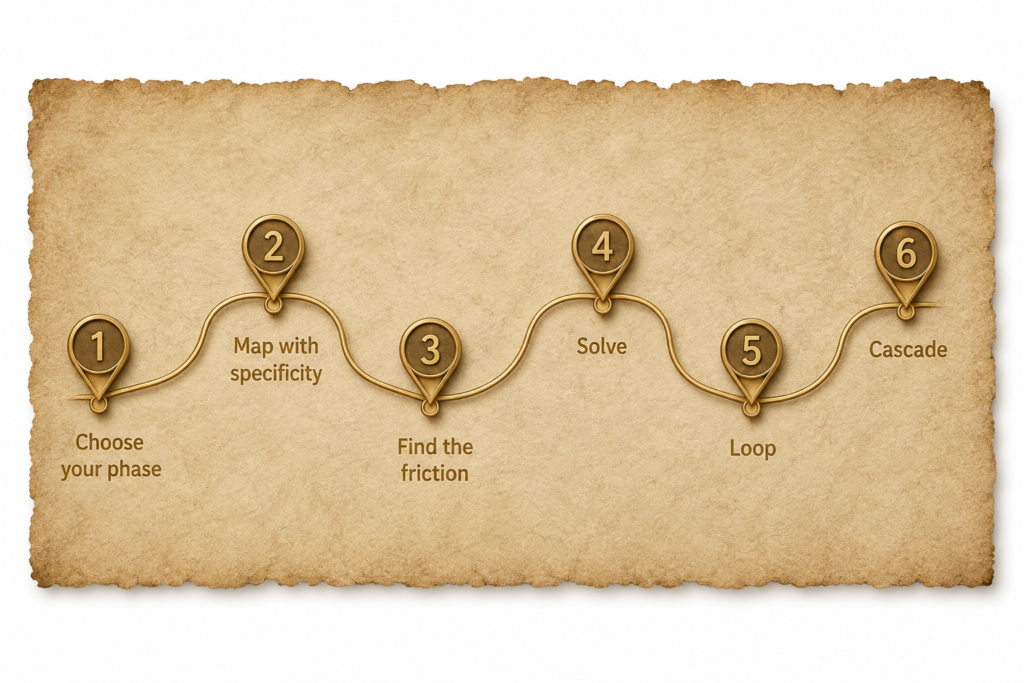
- The six-step framework runs: choose your phase, map with specificity, find the friction, then solve without constraint, map the financial loop, and trace the cascade.
- Vague problem statements produce vague ideas. “Young adults need housing” generates nothing. A precisely specified affordability equation generates Airbnb.
- The practical takeaway: pick one life phase you know intimately, and run all six steps on it this week — not as theory, as an actual exercise with a real answer at the end.

The six-step framework, step by step
Step one: choose your phase. Start with the life phase you know most intimately — through direct experience, close observation, or deep research. Personal experience of a life phase gives you the emotional texture of its needs in a way market research can’t replicate. Depth of observation matters more than whether you’ve personally lived it.
Step two: map with specificity. “Young adults need housing” is too broad to generate anything. “Young adults in cities where median rent exceeds forty percent of median income face a mathematically impossible choice between proximity to work and quality of living space” is specific enough to build against. The precision of the problem statement determines the precision of the solution.
Step three: find the friction. “I can never find a taxi” is the surface complaint that produced Uber. Underneath it: “I feel powerless and anxious when I need reliable transportation for something that matters.” The surface complaint is logistics. The real friction underneath it is emotional. You find it by asking “why does this matter?” repeatedly until you hit the emotional core, not the logistical one.
Steps four through six: solve, loop, cascade. Imagine the full solution before asking whether it’s feasible — “is this feasible?” kills more good ideas before they’re fully formed than any other question. Once you have a complete solution, map the loop: what financial instruments does this idea generate? Then trace the cascade: what does this ripple out into, three and five years downstream?
Applying it: the childcare gap
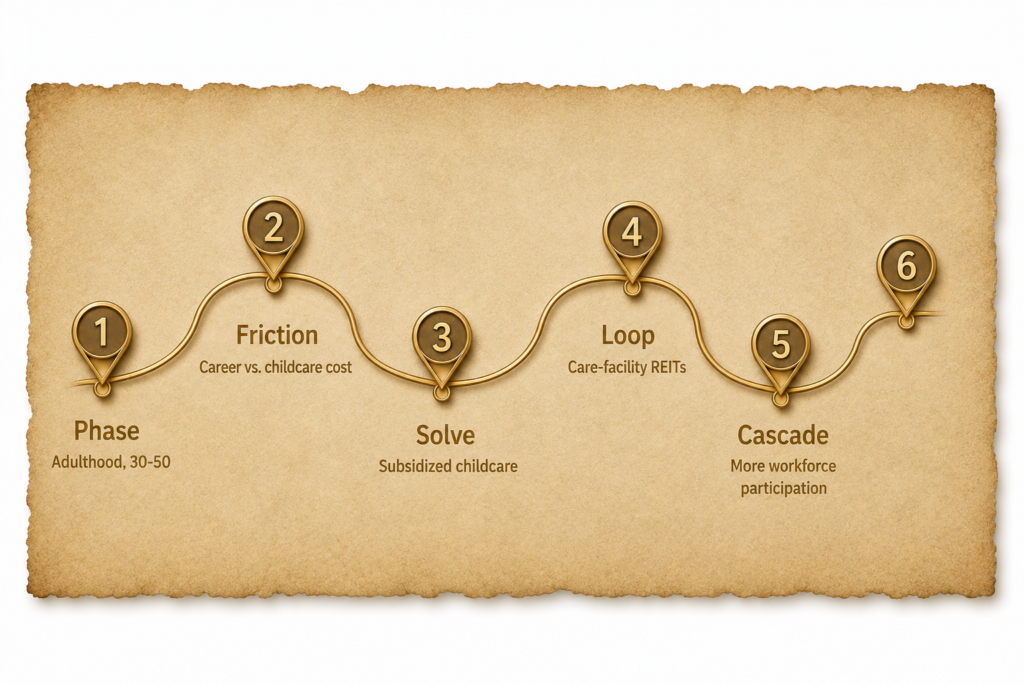
Here’s the framework run against a real case, not a hypothetical one. Phase: adulthood, roughly thirty to fifty. Friction: parents — mothers especially — are forced to choose between career and family because quality childcare frequently costs more than the income it enables them to earn. Full solution, imagined without constraint first: employer-subsidized childcare, cooperative childcare models, universal publicly-funded early education. Financial loop: childcare savings accounts, care-facility REITs, employer benefit products built specifically around this gap. Cascade: increased female workforce participation, better child developmental outcomes, and reduced social-services costs over a decade or two.
Run through all six steps and the framework doesn’t just describe an interesting social problem — it reveals a market worth hundreds of billions of dollars, with demand nobody disputes and no adequate solution currently built for it. That’s what the framework is actually for: not generating clever observations, but generating ideas precise enough to build against. (One of the clearest examples of a founder acting on exactly this kind of specific, personally-felt friction is our Founder Pain as Market Signal piece.)
Run it on your own life phase
Pick the life phase you actually know best — the one you’re living through right now, or the one you’ve watched closest. Don’t reach for a phase you find interesting in the abstract; reach for the one where you already know the specific, unglamorous texture of its frictions. Write one sentence that’s specific enough to build against, not a vague category. Ask “why does this matter” of your own answer until you hit something emotional instead of logistical. Then, before you ask whether it’s feasible, force yourself to describe the complete, unconstrained solution first.
Most people skip straight to feasibility. That’s the step that kills ideas before the framework ever gets to run. (For the fuller eight-step version of how a friction becomes an actual industry, not just an idea, see our Anatomy of an Idea piece.)

Questions Worth Asking Before You Start
Does this framework only work for consumer startups? No — the childcare-gap case study is really an institutional and policy-relevant example as much as a startup one. The six steps work anywhere a human friction is being translated into a solution, whether that’s a company, a product feature, or an internal initiative.
What if I don’t have a life phase I feel like I “know intimately”? The book is explicit that depth of observation matters more than direct personal experience — close, sustained observation of people in a phase you don’t personally occupy still works, as long as it’s genuinely deep rather than assumed.
Isn’t skipping the feasibility question until later just wishful thinking? It’s the opposite — asking feasibility first anchors your solution to what’s easy to build rather than what actually solves the problem. You still ask feasibility eventually. The order is the point: completeness first, so the feasibility question is applied to the right target.
Try this
Choose one life phase you know better than almost anyone reading this — your own right now, or one you’ve watched up close for years. Run all six steps against it today: name the phase, write one specific problem statement, dig for the emotional friction underneath the surface complaint, describe the full solution with no constraints, then map what it would generate and cascade into. Do this as a real exercise, not a thought experiment — write down an actual answer for each step before you stop.
Sources:
- Adapted from The Human Constant, Chapter 15 — “Reading the Human Map”
- Airbnb CEO says his company was rejected by investors — until a $40 box of cereal turned things around — CNBC



Leave a Reply
You must be logged in to post a comment.
Show Comments