



















































73,000 Years Ago, Someone Solved the Same Problem You’re Solving Today

In a cave overlooking the Indian Ocean, a human picked up a piece of red ochre and scratched a deliberate pattern into it — six straight lines, crossed by three curved ones. Archaeologists found it in the 1990s at Blombos Cave, South Africa. It’s the oldest known piece of intentional mark-making anyone has found, and if you’ve ever wondered where ideas really come from, this is where the answer actually starts — 73,000 years before anyone called it innovation. It’s also, if you build products for a living, the oldest case study you’ll ever read.
Key takeaways
- The Blombos ochre marking wasn’t decoration — it was identity, made visible, so strangers could answer “are you one of us?” before a word was exchanged.
- Every idea in the book’s model shares one shape: a human in a life phase hits friction, the friction creates pressure, the pressure generates a solution.
- Fire, agriculture, and writing all show the same pattern, thousands of years and continents apart — the same friction, solved again in new material.
- The practical takeaway: name the exact friction your product solves, not the demographic you’re solving it for.

The oldest idea in the world
The exact purpose of the Blombos markings can’t be proven — even Christopher Henshilwood, the archaeologist who led the excavation, is careful about that. But the surrounding evidence points somewhere specific. The same cave layer held dozens of pierced shell beads, stained with the same red pigment, worn smooth from being strung and carried. This wasn’t an isolated doodle. It was one output of a working pigment economy.
Put the pieces together and the picture sharpens: a human wearing an ochre-marked shell wasn’t decorating for its own sake. As hunter-gatherer populations spread and started running into strangers more often, a human needed a way to answer a question before a single word got exchanged — are you one of us? The mark was a wearable, visible answer. It solved a friction that had never existed before: the friction of strangers. In a world where the wrong band could mean violence or exclusion from food and shelter, that wasn’t a want. It was close to survival.
That same pressure — see me, know who I am, let me belong — is still building products today. It just wears different materials now.
Where every idea actually comes from
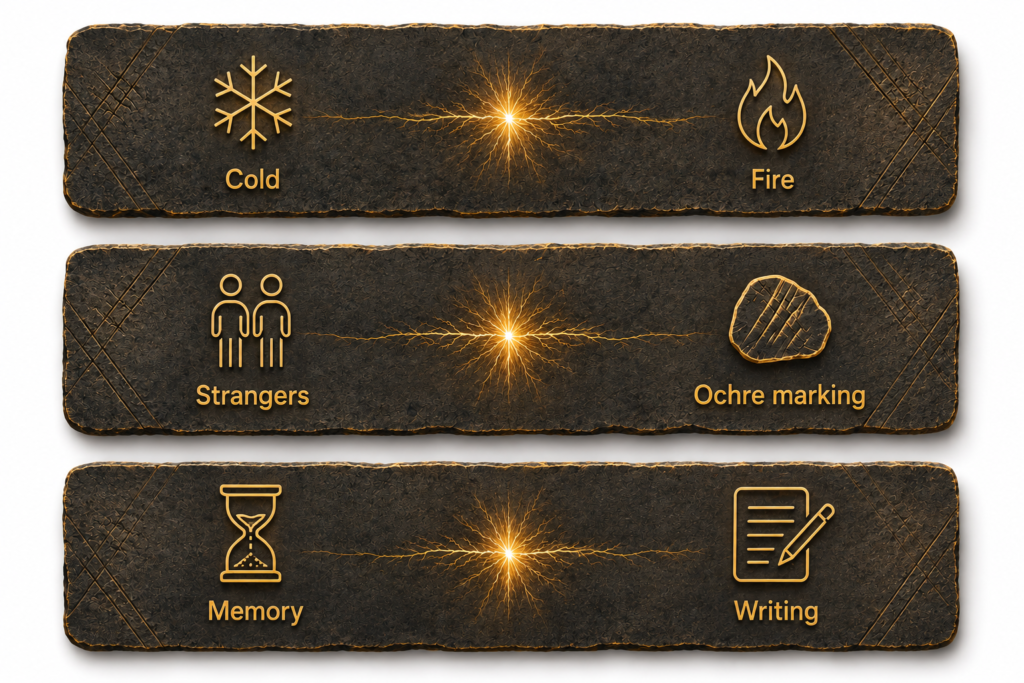
Zoom out from the ochre and a pattern holds across the rest of the book’s argument: a human in a specific life phase hits friction — a need unmet, a want unsatisfied, a problem unsolved. The friction creates pressure. The pressure generates a solution. That’s the shape underneath every case study that follows, including the three below. (This piece stops at the shape itself — for the full eight-step chain from friction to industry, see our Anatomy of an Idea piece.) It’s not a metaphor stretched to fit — it’s the same mechanism showing up in different materials.
The pattern repeats: fire, farming, writing
Three more examples, each from a completely different era, each running on the identical mechanism.
Fire solved the problem of freezing to death — a friction every human in every cold climate felt every single night for hundreds of thousands of years. Evidence of controlled fire use at Wonderwerk Cave in South Africa dates back at least a million years, the culmination of generations of suffering, observation, and trial and error. What fire actually gave humanity wasn’t just warmth: light in darkness, safety from predators, cooked food that made nutrients more available, and social life after sundown. One product, several life-phase frictions solved at once.
Agriculture wasn’t a leap of genius — it was a population running out of patience with luck. At Abu Hureyra, on the banks of the Euphrates, archaeologists found the moment a group stopped gathering wild seeds and started planting them deliberately, roughly twelve thousand years ago. The climate had shifted, animal herds had grown unpredictable, and a bad season could no longer just be waited out. That fear generated the idea of planting food instead of finding it.
Writing started as a receipt, not a poem. Around 3400 BCE in the Mesopotamian city of Uruk, someone pressed a reed stylus into wet clay to record how much barley had gone into that week’s beer — jars counted, grain measured, workers’ rations tracked. A temple administrator could no longer keep a growing city’s accounts in his head, and cuneiform was the answer. The same script would eventually record the Epic of Gilgamesh. It started as a bookkeeping problem.
Why this matters for whatever you’re building
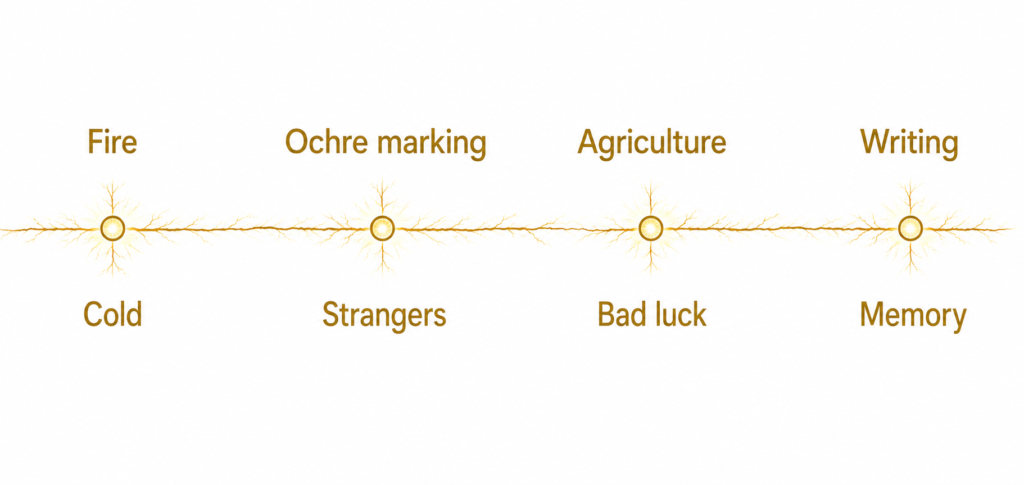
Here’s where this stops being a history lesson. Every one of these four examples names its friction precisely: strangers, cold, bad luck, memory. None of them name a demographic. Nobody solved “cold people” or “people who forget things” — they solved a specific pressure a specific group felt at a specific moment.
Most product teams skip that step. They define a target user by age bracket, income, or platform habits, then go looking for a problem to fit that description. The pattern above runs the other direction: find the friction first, precisely enough that you could say it in one sentence, and the audience for it becomes obvious afterward. (For a real example of a friction that founders found before they had a market to point at, see our Founder Pain as Market Signal piece.)
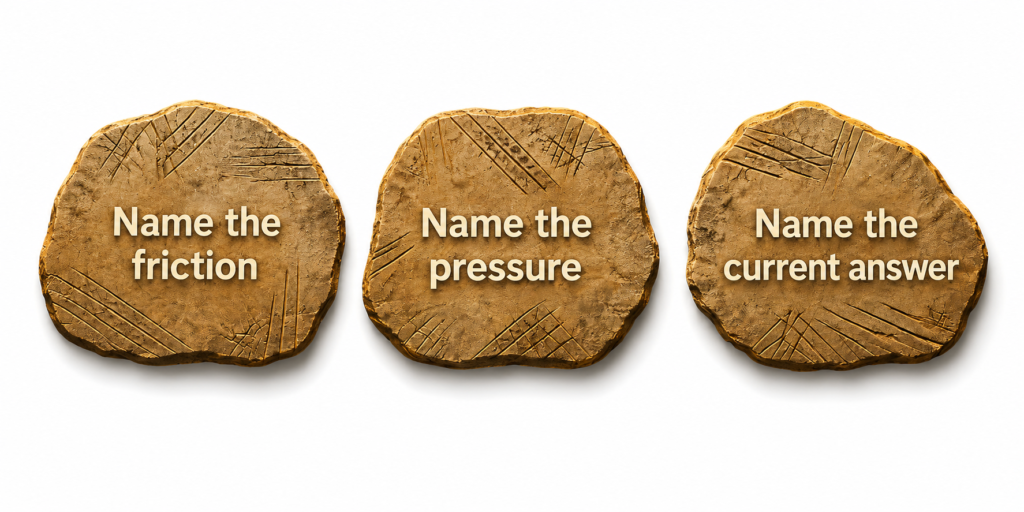
Run this audit on whatever you’re currently building: can you name the exact friction — not the market, not the persona, the actual moment of discomfort — in one sentence the way “the friction of strangers” or “the problem of freezing to death” does? If the honest answer is a demographic instead of a friction, you don’t have a product yet. You have a target list waiting for one.
What This Means for the Idea You’re Sitting On
Does this mean every idea is basically inevitable? No — the friction has to exist and someone still has to notice it and act. Blockbuster’s late fees were public for years before Netflix; the friction being real doesn’t mean someone builds for it on any particular timeline.
How is “friction” different from a customer pain point? A pain point is usually already named and complained about. Friction, in this sense, is often unnamed — the ochre wearer wasn’t filing a complaint about “insufficient identity signaling.” The friction existed before anyone had language for it.
Isn’t this just survivorship bias — we only remember the frictions that got solved? Partly, and it’s worth holding onto that caveat. But the four examples here span completely different eras, continents, and technologies, which is what makes the repeating shape worth noticing rather than a single cherry-picked story.
Try this
Pick the thing you’re building right now. Write one sentence naming the exact friction it solves — not the user segment, not the market size, the actual moment of discomfort. If you can’t do it in one sentence, that’s not a writing problem. It means the friction hasn’t been found yet, and everything downstream of it — the audience, the feature list, the positioning — is guesswork built on top of a guess.
Sources:
- Adapted from The Human Constant, Chapter 1 — “The Oldest Idea in the World”
- An abstract drawing from the 73,000-year-old levels at Blombos Cave, South Africa — Nature (2018)
- Ancient fire record: evidence of human fire use at least one million years ago — EurekAlert
- New evidence of Late Glacial cereal cultivation at Abu Hureyra on the Euphrates — ResearchGate
- The Origins of Writing — The Metropolitan Museum of Art