








































Everyone thinks they know what causes burnout: too much work, too little time, an inbox that regenerates like a hydra. Freudenberger burnout, the original clinical observation from 1974, says otherwise — and the gap between what he actually found and what the wellness industry sells you is worth $60 billion a year. Literally.
The Free Clinic Where Burnout Was Born
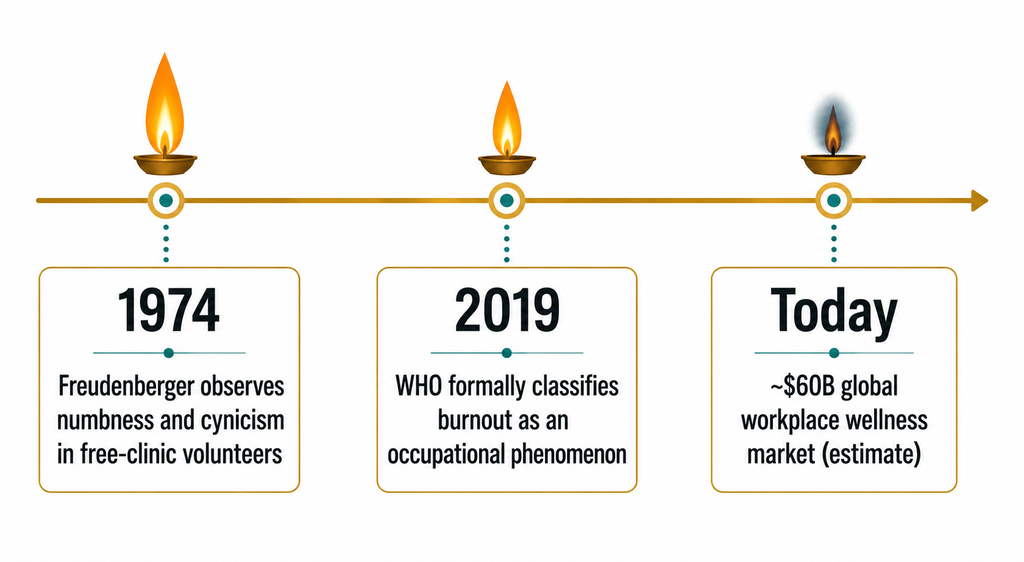
In 1974, a psychologist named Herbert Freudenberger was working at a free clinic in New York City, surrounded by volunteers who had shown up because they wanted to help people. These weren’t burned-out cogs clocking overtime for a paycheck. They were idealists — the kind of people who take on unpaid, emotionally taxing work because they believe it matters.
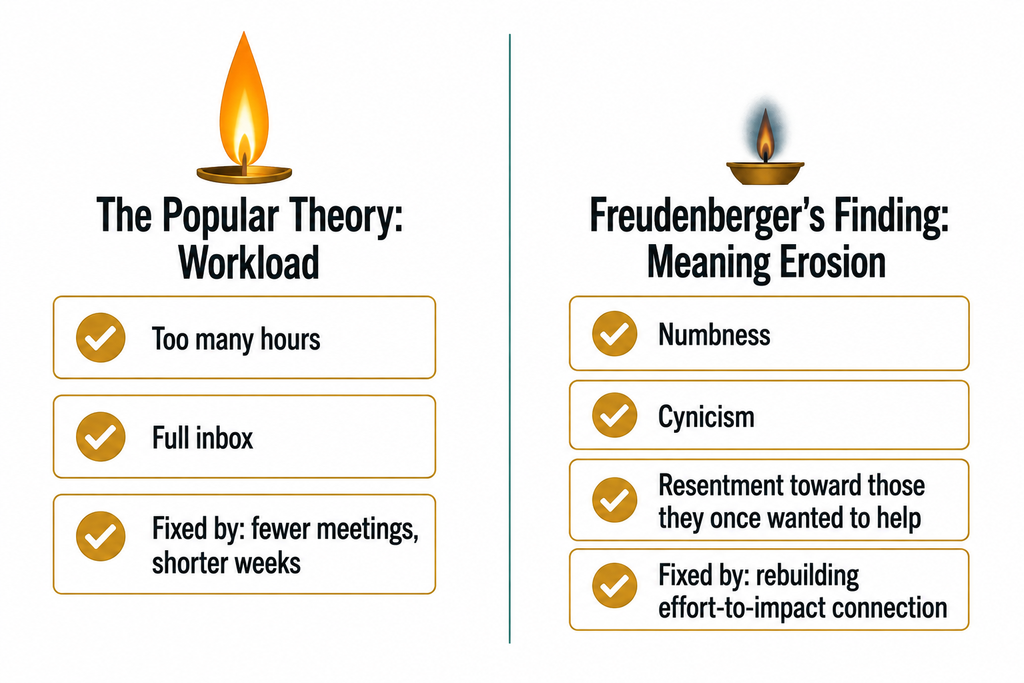
Freudenberger watched something happen to them over time. Not fatigue, exactly. Something colder. The people who’d arrived eager to help patients started to go numb. They grew cynical. Some began resenting the very patients they’d once been desperate to serve.
Before you assume this is a story about overwork, sit with that detail for a second: these were volunteers, not employees grinding a 70-hour week under a bad manager. Whatever Freudenberger was watching, it wasn’t a scheduling problem.

What Freudenberger Actually Saw: Numbness, Not Exhaustion
Here’s the pattern Freudenberger documented, stripped of decades of corporate reinterpretation: dedicated, idealistic people slowly going numb, growing cynical, resenting the patients they had once been eager to help. That’s the clinical observation, not a metaphor for a bad quarter.
Numbness and cynicism aren’t what exhaustion looks like. Exhaustion looks like wanting a nap. What Freudenberger saw looks like caring less — on purpose, almost as a defense mechanism — about the thing you used to care about most.
That distinction matters more than it sounds like it should. If burnout starts as a slow erosion of meaning and emotional investment rather than a depletion of hours in the tank, then giving someone three fewer meetings a week doesn’t touch the actual mechanism. You can shorten the workload and still leave the resentment fully intact.
Why ‘Workload’ Became the Convenient Explanation
Somewhere between 1974 and now, burnout got quietly rebranded as a hours-and-headcount problem. It’s easy to see why. Workload is measurable. You can count hours, count Slack messages sent after 7pm, count vacation days unused. It shows up cleanly on a dashboard, and it’s solvable with policy — a four-day week here, a “right to disconnect” law there.
Meaning-erosion doesn’t fit on a dashboard. You can’t easily quantify the moment a nurse stops believing her work matters, or the moment a teacher starts seeing students as obstacles instead of people. Cynicism doesn’t show up in a timesheet.
So workload won the narrative — not because it’s what Freudenberger described, but because it’s the version of the problem that’s fundable, auditable, and sellable. Freudenberger burnout was never really about the clock. It just got translated into clock language because that’s the language institutions know how to act on.
From Clinical Observation to Global Diagnosis: Occupational Burnout, WHO 2019
Occupational burnout entered the World Health Organization’s official classification in 2019, when the WHO formally recognized burnout as an occupational phenomenon — a syndrome resulting from chronic workplace stress that has not been successfully managed. That’s a long way from one psychologist watching volunteers change at a single New York clinic 45 years earlier.
The precise scale WHO or others attribute to occupational burnout globally varies by source and survey methodology, so treat any specific headcount — “hundreds of millions,” or any other round figure you see repeated online — as a widely cited estimate rather than a hard, independently confirmed number. What isn’t in dispute is the trajectory: a niche clinical term coined at a single free clinic became, within half a century, a formally recognized global occupational category.
That trajectory itself tells you something. Burnout didn’t get more real between 1974 and 2019. It got more visible — and more useful to name, once workplaces needed a diagnosis to point to.
The Wellness Industry Built on a Misdiagnosis
Somewhere along that trajectory, burnout became a product category. Industry estimates put the global workplace wellness market in the tens of billions of dollars annually — figures commonly cited around the $60 billion mark, though exact sizing varies by research firm and what counts as “wellness” — and nearly all of it is aimed at symptoms Freudenberger never actually described.
Yoga sessions. Meditation apps. Standing desks. Resilience training modules that ask you to journal about gratitude. These are treatments for exhaustion. They are not treatments for the specific thing Freudenberger watched happen to those clinic volunteers: the slow curdling of idealism into resentment.
Here’s the practical takeaway, and it’s an uncomfortable one for anyone who’s ever been handed a free meditation app subscription in lieu of an actual conversation about their job: wellness perks treat the symptom of a mismatch between effort and meaning, not the cause. You can’t app your way out of feeling like your work doesn’t matter anymore. This is the same pattern you see across almost every category built around human burden — a real friction gets identified, and then an industry forms around the most fundable, packageable version of the problem rather than the root of it, a dynamic laid out well in the anatomy of how ideas turn into industries.
What Prevention Looks Like When You Take Freudenberger Seriously
If burnout is a meaning problem wearing a workload costume, prevention has to look different than “work fewer hours.”
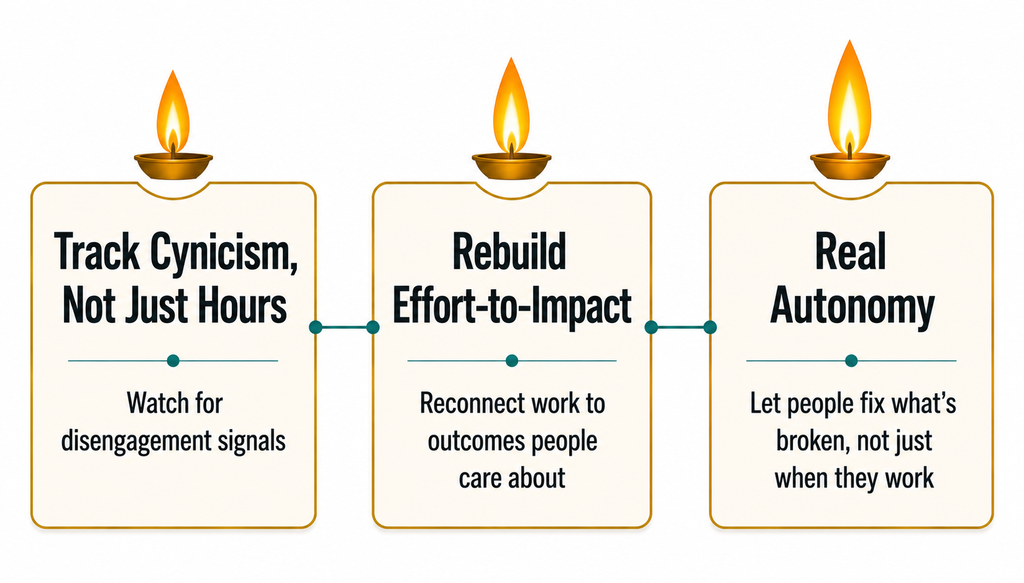
Start here: track cynicism and disengagement signals, not just hours logged. A manager who only monitors overtime is measuring the wrong variable. The earlier, more honest signal is someone going quiet in meetings they used to argue in, or someone who stops asking why decisions were made.
Second: rebuild the connection between effort and impact. Freudenberger’s volunteers didn’t burn out because they worked too many hours at the clinic — they burned out because, at some point, the connection between their effort and the outcome they cared about frayed. Prevention means protecting that connection, not just protecting people’s calendars.
Third: give people real autonomy over how they do meaningful work, not just flexibility about when they do meaningless work. Letting someone answer email from home at 9pm instead of 9am is not the same intervention as letting them redesign a broken process that’s been making their work feel pointless.
None of this means workload is irrelevant — chronic overwork is still bad for people, full stop. It means workload reduction is necessary but not sufficient, and treating it as sufficient is exactly the mistake the wellness industry has been monetizing for years.
FAQ: Freudenberger, Burnout, and the Workload Myth
Is burnout the same thing as exhaustion?
No. Exhaustion is a component of burnout, but Freudenberger’s original observation centered on cynicism and numbness — an emotional and attitudinal shift, not just physical depletion. You can be well-rested and still burned out in the Freudenberger sense.
Can reducing workload still help with burnout?
Yes, but partially. Cutting hours can relieve exhaustion and give people breathing room, which matters. It generally won’t resolve the cynicism and meaning-erosion Freudenberger documented unless it’s paired with changes to autonomy and purpose.
What did Freudenberger originally call this pattern, and where did the term come from?
He coined the term “burnout” in 1974 based on his observations of volunteers at the New York free clinic where he worked — dedicated people who grew numb and resentful toward the very patients they’d once been eager to help.
Is burnout officially recognized as a medical condition?
The WHO classifies burnout as an occupational phenomenon in its International Classification of Diseases, not as a medical condition in its own right — a distinction worth knowing before you assume it’s formally diagnosable the way a mental health disorder is.
Key Takeaways
- Freudenberger’s 1974 observation of free-clinic volunteers described numbness, cynicism, and resentment — not exhaustion from long hours.
- Workload became the dominant explanation for burnout because it’s measurable and policy-solvable; meaning-erosion isn’t.
- WHO formally recognized occupational burnout in 2019; the exact global scale often cited alongside that recognition is a widely repeated estimate, not a precisely confirmed figure.
- The workplace wellness industry, commonly estimated in the tens of billions of dollars annually, largely treats symptoms (fatigue) rather than the cause (eroded meaning and autonomy) Freudenberger actually documented.
- Real prevention means tracking cynicism and disengagement, not just hours, and rebuilding the link between effort and impact.
If you manage people, the next step isn’t another wellness stipend — it’s a real conversation with the person on your team who’s gone quiet. That’s the signal Freudenberger was actually pointing at.
Sources
- The Human Constant (source chapter for this piece)
- Claim that Herbert Freudenberger worked at a free clinic in New York City in 1974 and observed volunteers becoming numb and cynical toward patients — as stated in source excerpt, not independently verified here.
- Claim that WHO formally recognized burnout as an occupational phenomenon in 2019.
- Claim that the global workplace wellness market is worth ‘approximately sixty billion dollars annually’ — flagged in prose as an industry estimate, not a confirmed figure, with a stated range in the tens of billions.
