














































WallStreetBets and GameStop were sold to the public as a fluke — a bored, stimulus-check-flush mob that briefly broke the stock market before Wall Street’s adults restored order. That story is comforting. It’s also wrong. What happened wasn’t a glitch in the system; it was the system finally showing you what it’s always been underneath the spreadsheets.
Here’s the lens worth using instead: this was never really a story about stocks. It was a story about identity, and the stock market just happened to be where it played out.
From Amsterdam to Your Phone: A Short History of Democratized Ambition
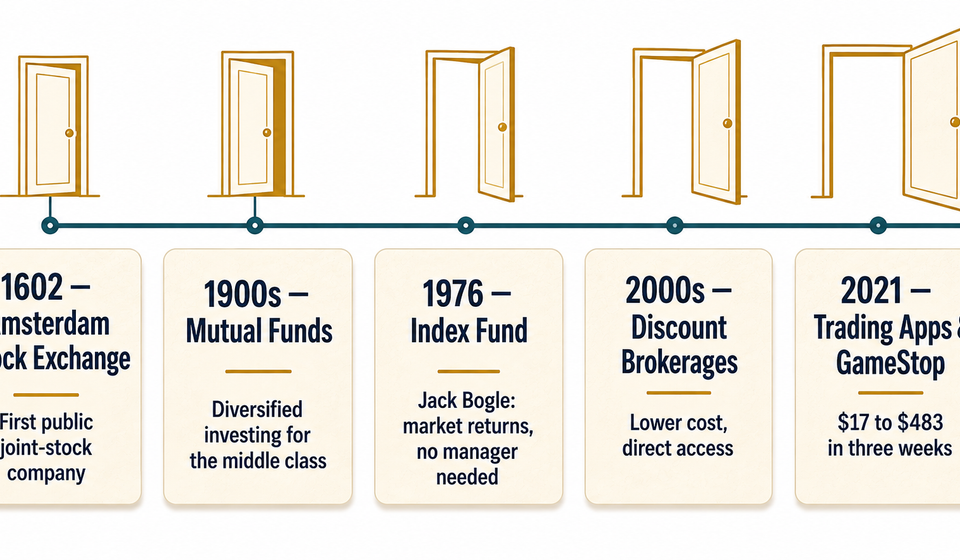
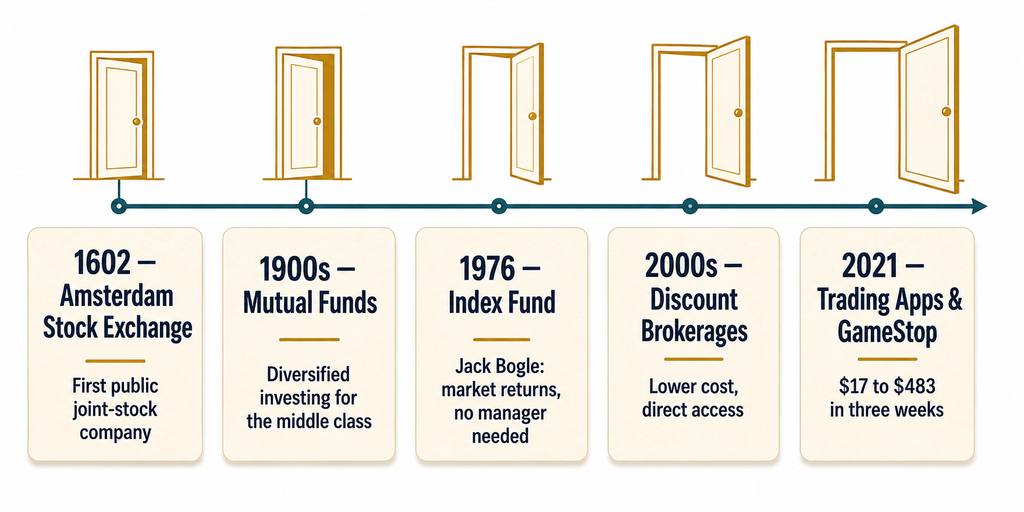
Start with the joint-stock company history, because it explains everything that came after. In 1602, the Dutch Republic had a problem money alone couldn’t solve: the Dutch East India Company needed ships, crews, and capital far beyond what any single financier could risk. The fix was structural — split ownership into shares, sell them to the public, and spread both the risk and the reward across many hands. The result, the Amsterdam Stock Exchange, is generally credited as the world’s first public equity market, and four centuries later its basic architecture still underwrites the entire global financial system.
That first move — dividing ownership so ambition wasn’t capped by any one person’s wallet — set the pattern for every democratizing wave that followed. The mutual fund handed diversified equity exposure to middle-class savers who’d never have hired a private money manager. The index fund, popularized by Jack Bogle starting in 1976, stripped out the need for active management entirely and let ordinary investors capture market-rate returns for a fraction of the cost. The discount brokerage, and later the trading app, finished the job: all you need now is a smartphone and a bank account.
Each wave did the same thing — removed one more barrier between ordinary ambition and the machinery built to serve it. Follow that line far enough and WallStreetBets isn’t a rupture in the story. It’s the next chapter. Retail coordination wasn’t a bug that snuck in through Reddit; it was the logical endpoint of four hundred years of lowering the door.
What WallStreetBets Actually Was
In January 2021, retail traders coordinating on Reddit’s WallStreetBets forum drove GameStop’s share price from around seventeen dollars to an intraday peak of four hundred eighty-three dollars — roughly a thirty-fold move in under three weeks. Financial media covered it as an anomaly, a short squeeze gone feral, a one-time collision of hedge-fund arrogance and internet chaos.
Treating it as a freak event misses what actually powered it. The GameStop run was a visible expression of social proof and collective identity operating at a specific life stage — young adults turning their native social skills on the financial system. Memes weren’t decoration; they were the coordination mechanism. In-group language wasn’t comic relief; it was the membership card. People weren’t just buying a stock. They were buying into a group, and the stock happened to be the entry fee.
Money as a Social Signal, Not Just a Number
That reframes the whole episode. Money got treated less like a private calculation and more like a public signal — a way to say I’m one of us to a crowd that mostly existed as usernames and green candlestick screenshots. Shared risk did the work that a handshake or a shared inside joke does anywhere else: it built trust fast, inside a group that had never met.
That’s also why it skewed young. Young adults are, developmentally and culturally, fluent in exactly the tools that made WallStreetBets work — memes, irony, rapid-fire group identity formation. They didn’t need to learn a new language to organize a market event; they already spoke the one that did it.
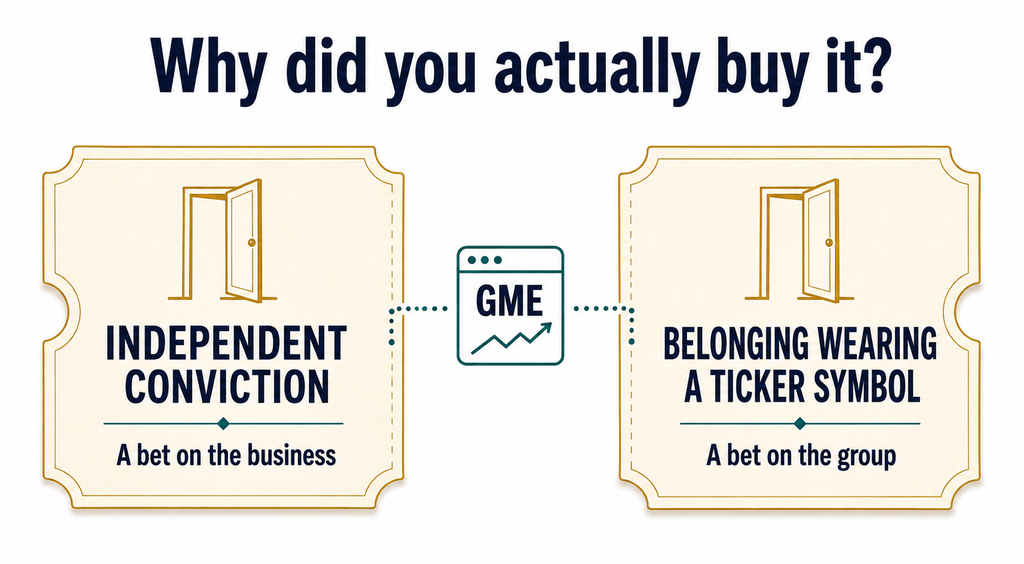
For your own trading decisions, that distinction is worth sitting with. Before you buy something because “everyone” is buying it, ask which need you’re actually meeting — is this independent conviction about a business, or is it belonging wearing a ticker symbol? Social proof investing isn’t inherently irrational, but it’s a different transaction than the one your brokerage app is pretending to offer.
Why This Wasn’t a One-Off
Extend the democratization arc from the joint-stock company through the index fund to the trading app, and the WallStreetBets moment stops looking like an aberration and starts looking like a preview. Every barrier that’s fallen — capital, information, execution speed, cost — has made it easier for large, loosely organized groups of retail investors to move in the same direction at the same time, for reasons that have as much to do with community as with earnings reports.
Nothing about that trend is reversing. If anything, the infrastructure that makes coordinated retail action possible — real-time forums, zero-commission trades, instant information sharing — keeps getting cheaper and faster, not more restricted. That’s a structural condition, not a one-time accident of the pandemic, stimulus checks, and a bored population stuck at home. The specific ticker changes. The mechanism — identity-driven crowds finding a financial expression for group belonging — doesn’t need GameStop to exist again to repeat itself somewhere else.
The practical takeaway is a personal framework, not a prediction of the next meme stock. Before you act on a crowd’s conviction, separate what you actually believe about the underlying business from what you feel about belonging to the group that believes it. Write your reasoning down before you buy, not after — if the only thing you can point to is “everyone in the thread is in,” that’s useful information about the crowd, not about the company. This same tension between individual conviction and social signal shows up outside markets too — it’s not far from how founder pain functions as a market signal in a very different context: the pressure of a real, personal stake often produces better decisions than the comfort of consensus.
FAQ: WallStreetBets, GameStop, and the Psychology of Belonging
Was the GameStop rally illegal market manipulation?
Regulators looked hard at this, and the honest answer is: it’s messier than a yes or no. Coordinated buying isn’t automatically manipulation — people are allowed to independently decide to buy the same stock, loudly, in public, on a forum with millions of members. That’s different from a coordinated scheme to defraud. Where exactly that line sits was, and arguably still is, a live legal question, not a settled one.
Why GameStop specifically, and not some other struggling retailer?
Circumstance did some of the work — a heavily shorted stock is structurally primed for a squeeze once buying pressure builds, because short sellers scrambling to cover only adds more upward force. But circumstance alone doesn’t explain the scale. GameStop also worked as a symbol: an underdog brick-and-mortar chain that hedge funds were openly betting against, which handed the crowd a story, not just a trade. Mechanics set the stage; narrative sold the tickets.
Will something like this happen again?
Bet on it. Not on GameStop specifically — that exact setup was a one-time convergence of a heavily shorted stock, a captive pandemic-era audience, and a payment-app generation with cash and time. But the underlying conditions — cheap access, instant coordination, and young investors using markets to signal identity — aren’t going anywhere. Expect the next version to look different and rhyme anyway.
Key Takeaways
- GameStop’s January 2021 run from roughly $17 to an intraday peak of $483 is commonly framed as a market anomaly — it’s better understood as social proof and group identity finding a financial outlet.
- The joint-stock company (Amsterdam, 1602) began a four-century pattern of democratizing access to markets, through mutual funds, index funds, and today’s trading apps.
- For many participants, buying a meme stock functioned as a signal of belonging to a group, not purely a bet on a company’s fundamentals.
- Expect more coordinated retail-investor movements as access keeps expanding — the mechanism is structural, not a pandemic-era fluke.
- Before joining a crowd trade, separate your independent reasoning about the business from your desire to belong to the group making the trade.
Next time a stock is suddenly everywhere in your feed, don’t ask “is this going up.” Ask “why do I want in” — and if the honest answer is that everyone else already is, you’ve learned something more useful than any price target.
Sources
- The Human Constant (source chapter for this piece)
- Claim that the Amsterdam Stock Exchange (founded 1602) is generally credited as the world’s first public equity market
- Claim that the Dutch East India Company’s formation in 1602 prompted the joint-stock structure due to capital/risk constraints
- Claim that the index fund was popularized by Jack Bogle starting in 1976
- Claim that GameStop’s stock rose from around $17 to an intraday peak of $483 in January 2021 over roughly three weeks
- Characterization that the GameStop rally is widely attributed to social proof and collective identity among young adult retail investors specifically
- Claim/implication that regulators examined the GameStop episode for possible market manipulation without a definitive settled conclusion
