














































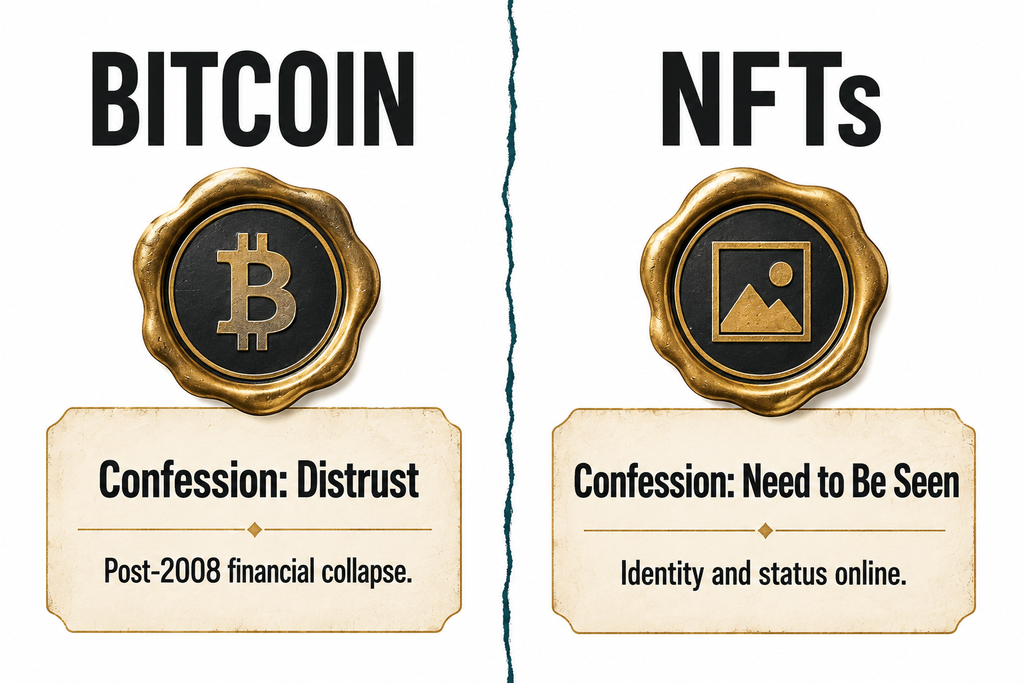
Every new financial instrument is a confession dressed up as an innovation. Bitcoin confessed distrust. NFTs confessed something quieter and, in some ways, more human: a need to be seen. Strip away the mania, the flipping, the Discord servers full of cartoon apes, and what’s left is a generation asking an old question in a new medium — how do I prove this is mine, and what does owning it say about me? That’s the real story behind digital ownership identity, and it didn’t end when the JPEG prices crashed.
Every Financial Instrument Is a Confession
Money never lies about what people actually want, even when people lie to themselves about it. Look closely at any financial tool that captures the public imagination and you’ll find an emotional need wearing a spreadsheet as a costume. Gold hoarding confessed fear of collapse. Life insurance confessed fear of leaving people behind. Cryptocurrency and NFTs are no different — they’re just confessions written in code instead of ink.
That framing matters because it changes the question we should be asking about NFTs. “Was it a bubble?” is boring and, frankly, already answered. The more interesting question is: what were millions of people trying to solve for, badly, expensively, and in public? Bitcoin and NFTs make a useful pair here, because they’re two confessions from the same decade, aimed at two very different wounds.
Bitcoin’s Confession: Distrust After 2008
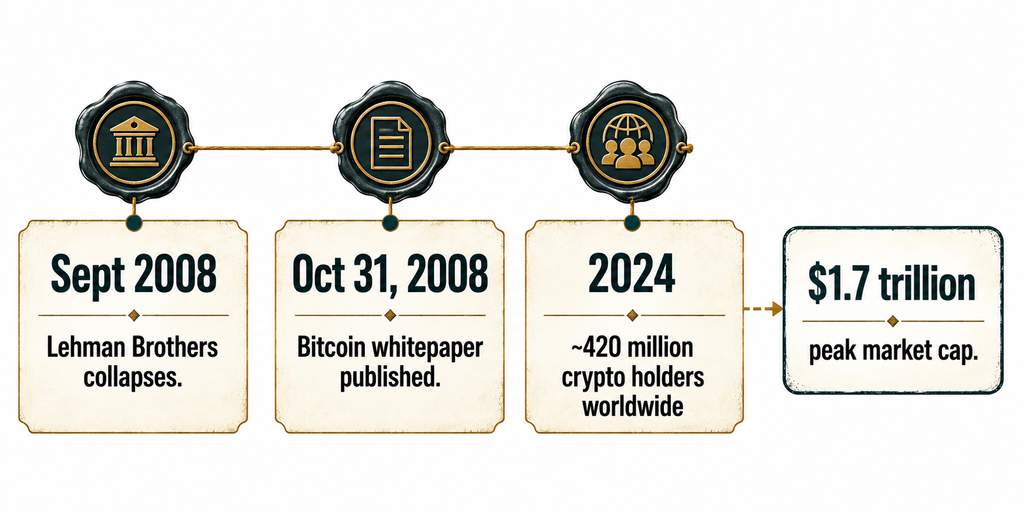
Satoshi Nakamoto published the Bitcoin whitepaper on October 31, 2008, roughly six weeks after Lehman Brothers collapsed and the global financial system came closer to falling apart than it had since the 1930s. Governments were printing money to rescue the same banks whose recklessness had caused the mess. The emotional temperature of that moment was distrust — cold, specific, and justified.
Satoshi’s real contribution wasn’t the blockchain itself; cryptographic building blocks like it had existed in academic circles for years. The insight was pairing that technology to an exact human need: the ability to transact value without asking anyone in a suit for permission. As of 2024, reportedly around 420 million people worldwide hold cryptocurrency, in a market that peaked at roughly $1.7 trillion in value — numbers big enough to suggest this wasn’t a niche obsession but a mainstream response to a shared injury.
Here’s the takeaway worth carrying forward: technology wins when it matches an emotional need, not just a technical gap. Bitcoin didn’t succeed because it was the cleverest cryptography. It succeeded because it showed up exactly when people stopped trusting the institutions holding their money. Keep that lens in your pocket, because NFTs only make sense once you apply it to a completely different emotion.
NFTs’ Confession: The Need to Be Seen Online
In March 2021, digital artist Beeple sold “Everydays: The First 5000 Days” at Christie’s for $69.3 million. The buyer got no canvas, no frame, nothing to hang on a wall — just a non-fungible token certifying that this particular digital file was, in some enforceable sense, theirs. Critics called it absurd. They weren’t wrong about the price. They were wrong about the point.
The need underneath NFTs is one of the oldest in human experience: the need to own things that express identity and confer status. People have always used possessions as signals — a car, a watch, a corner office. A generation that lives more of its social and creative life on screens than in physical rooms needed a version of that same signal built for digital space. NFTs were the first coherent attempt to solve that problem, however clumsily executed.
That’s the reframe: NFT ownership wasn’t really an investment thesis, it was digital ownership identity trying to find its infrastructure. Once you see it that way, the JPEG stops being the point. The certificate of “this is mine, provably, publicly” is the point.
Why ‘Just a JPEG’ Missed the Point
The skeptic’s line was always some version of “you paid millions for a picture anyone can right-click and save.” True, and also completely beside the point. Nobody buying status has ever cared that someone else could get a cheaper imitation. Counterfeit handbags exist. They have not dented the market for the real ones. Status has never been about access to the image — it’s about the provable, verifiable, showable fact of ownership.
NFTs let people display something in digital space the way a driveway or a designer bag displays something in physical space. The mechanics were new — smart contracts, wallets, blockchain explorers — but the need was ancient. Judging NFTs purely on file scarcity is like judging a wedding ring by the price of gold per gram. You’re measuring the wrong thing.
The practical takeaway here applies well beyond crypto: when you’re trying to evaluate any emerging technology, don’t start with what it technically does. Start with what human itch it’s scratching. The tech is disposable. The itch usually isn’t.
The Unsolved Problem: Identity Infrastructure for a Generation Raised Online
NFTs were a first draft, not a finished answer. They were the first coherent attempt to solve digital identity and ownership together — but “first attempt” is doing a lot of work in that sentence. The infrastructure was clunky, the user experience was hostile to normal people, and the entire category got dragged down by an avalanche of speculation and outright grift that had nothing to do with identity at all.
The underlying problem is still sitting there, unsolved and getting more urgent. A generation raised entirely online — on platforms, inside avatars, across screens — still doesn’t have a clean, portable way to prove who they are and what belongs to them once you leave any single app’s walled garden. Your social identity lives on servers you don’t control. Your digital possessions, in most cases, are licenses, not property. NFTs pointed at this gap without closing it.
This is the same structural mismatch showing up in other corners of life for people who grew up mediated by screens — the kind of gap explored in the three life phases nobody’s built for, where digital-native adolescence created needs that existing institutions simply weren’t designed to meet. Identity infrastructure is the financial-technology version of that same story. Whatever replaces NFTs’ clumsy first attempt won’t be about owning art. It’ll be about owning your digital self — reputation, credentials, relationships — in a form that travels with you instead of staying locked inside someone else’s platform.

FAQ: NFTs, Identity, and Digital Ownership
Are NFTs dead?
The speculative frenzy has clearly cooled since the 2021 peak, and plenty of projects have gone to zero. But the underlying need — provable digital ownership identity — hasn’t gone anywhere. Expect quieter, less speculative versions of the idea to keep resurfacing under different names.
What’s the difference between ownership and identity online?
Ownership is about who controls an asset. Identity is about who you are and how that gets recognized across digital spaces. NFTs mostly tackled ownership — Beeple’s buyer got a certificate of “this is mine,” not a system that recognized who he was across platforms. The harder, unsolved problem is identity: a system that lets someone prove their reputation, history, and possessions without depending on a single platform’s goodwill.
Will this pattern repeat with the next hot financial technology?
Almost certainly. Every new instrument tends to be a confession about an unmet need first and a financial product second. The smart move is to ask what emotional gap a new technology is filling before asking whether it’s a good investment.
Why did people spend so much on something intangible?
Because status and identity signaling have always commanded real money in the physical world too — designer goods, real estate in the right zip code, even seats at certain restaurants. NFTs simply moved that same instinct into digital space, price tags and all.
Key Takeaways
- Financial technologies succeed when they match an unmet emotional need, not just a technical one.
- Bitcoin’s real innovation was aligning cryptography with post-2008 distrust of centralized finance.
- NFTs weren’t primarily about investment returns — they answered a need to express identity and status in digital space.
- The “just a JPEG” critique misses that status has never depended on exclusive access to an image.
- The deeper problem NFTs gestured at — portable digital identity infrastructure — remains unsolved.
- Evaluate any new financial technology by asking what human need it’s confessing to, not just what it technically does.
If you want to spot the next version of this story before it’s obvious, stop asking whether a new digital asset is going up in price. Ask what confession it’s making about what people still can’t get anywhere else.
Sources
- The Human Constant (source chapter for this piece)
- Bitcoin whitepaper publication date of October 31, 2008
- Lehman Brothers collapse timing relative to the whitepaper (six weeks)
- Approximately 420 million global cryptocurrency holders as of 2024
- Approximately $1.7 trillion peak cryptocurrency market capitalization
- Beeple’s ‘Everydays: The First 5000 Days’ sold at Christie’s for $69.3 million in March 2021
- Attribution of Bitcoin’s key insight solely to Satoshi Nakamoto (identity/authorship of Satoshi Nakamoto is itself unconfirmed)
