




















































Who Insures the People Lloyd’s Never Reached? The Trillion-Dollar Insurance Gap

Every financial instrument ever invented is a confession. Coins confessed that barter was broken. Paper money confessed that coins were too heavy. Insurance confessed that no one can survive catastrophe alone. Money doesn’t get invented by geniuses staring at whiteboards — it gets invented by people who are sick of a specific, physical problem and finally do something about it.
Today there’s an unresolved confession sitting in plain sight, and it’s the size of a global economy: the insurance protection gap. Billions of people live every day with real, catastrophic risk — crop failure, medical emergency, a single storm that wipes out a livelihood — and no instrument to spread that risk across a wider pool. Lloyd’s of London solved this problem for merchant shipowners three centuries ago. It never got around to solving it for everyone else. This is the story of how that gap opened, and why it’s still open.
The Double Coincidence of Wants: Why Barter Broke
Picture a medieval marketplace. A cloth merchant has fabric. He needs fish. The fisherman needs leather. The leather worker needs grain. The grain farmer needs cloth. Everyone in this marketplace has something someone else wants — in theory it should just work.
In practice it almost never does, because the cloth merchant and the fisherman are rarely standing in the same stall at the same moment, each holding exactly what the other needs right then. Economists call this the double coincidence of wants, and it’s the specific, mundane failure that money was invented to patch. Nobody sat down and theorized currency into existence. Traders got tired of dragging fish to market on the off chance a cloth merchant happened to be hungry that day, and money was the workaround.
From Iron Coins to Paper Promises: The Weight of Friction
The earliest coins showed up independently in Lydia, China, and India around 600 BCE — not as a triumph of economic theory, but as traders agreeing on something portable, divisible, and universally recognized, because carrying raw grain or livestock to every transaction was absurd.
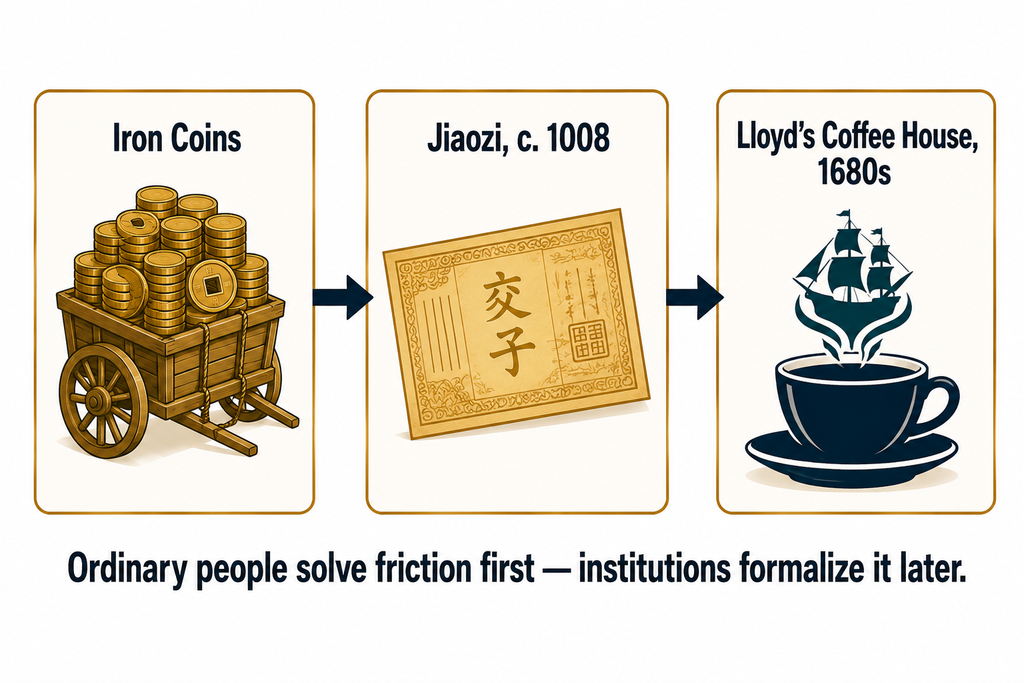
Centuries later, merchants in Sichuan hit a different wall. Their currency was iron coin, and iron is heavy in a way silver and copper aren’t — sources describing the period suggest ordinary trades required hauling coin by the cartload rather than the pocketful, though the exact weights cited for specific transactions aren’t independently confirmed and should be read as illustrative rather than precise. The point isn’t the exact poundage. The point is that carrying money became its own logistics problem.
So, reportedly around 1008, sixteen merchant houses in Chengdu stopped hauling iron and started printing paper instead — notes called jiaozi, each one redeemable for coin sitting in reserve. No emperor ordered this. Sixteen businessmen, tired of the same ache in their backs, solved it the same way at the same time. That’s the pattern worth holding onto: ordinary people solve friction first, and institutions formalize it later. Keep that pattern in mind — it’s the lens for everything that follows.
Gossip in a Coffee House: How Lloyd’s Invented Insurance
Insurance confessed something different from coins or paper. By the late 1680s, Edward Lloyd’s coffee house on Tower Street in London had become the gathering spot for ship captains, merchants, and underwriters swapping news of the sea — which vessels made it home, which were overdue, which had gone down in a storm. Lloyd started posting that shipping intelligence on his walls, and the room that carried the news started carrying the deals: merchants willing to bet, for a fee, that a given ship would arrive safely, and shipowners willing to pay rather than absorb a total loss alone.
Marine insurance didn’t launch as an industry with a charter and a mission statement. It started as gossip in a coffee house that a room full of anxious men turned into a hedge. The confession underneath it: no single owner could survive a shipwreck alone, and the future of any voyage was genuinely unknowable. That’s still the entire logic of insurance today, three-plus centuries and one enormous market later — but Lloyd’s model was built for merchants with capital and ships worth insuring. It was never built to reach a subsistence farmer or a day laborer, and it still mostly hasn’t. That’s the seed of today’s insurance protection gap: an idea built to solve catastrophic risk that quietly decided, from its very first coffee house, who was worth insuring.

The Apple Paradox: Reading Human Need at Scale
Jump forward to January 2022, when Apple briefly became the first company in history to hit a three-trillion-dollar market capitalization. Not because it invented human needs, but because it read them with unusual precision across every phase of life: the teenager using a device to signal identity, the young adult using it to manage the chaos of independent life, the parent running a household through it, the elder using it to stay connected. Apple didn’t manufacture desire. It just noticed where the friction already was and built for it, phase by phase, at scale.
That’s the reframe worth sitting with: the next trillion-dollar opportunity in finance probably isn’t a new gadget. It’s whoever reads the uninsured and the unbanked as precisely as Apple read consumers — and actually builds for them, instead of around them.
The Trillion-Dollar Gap Lloyd’s Never Reached
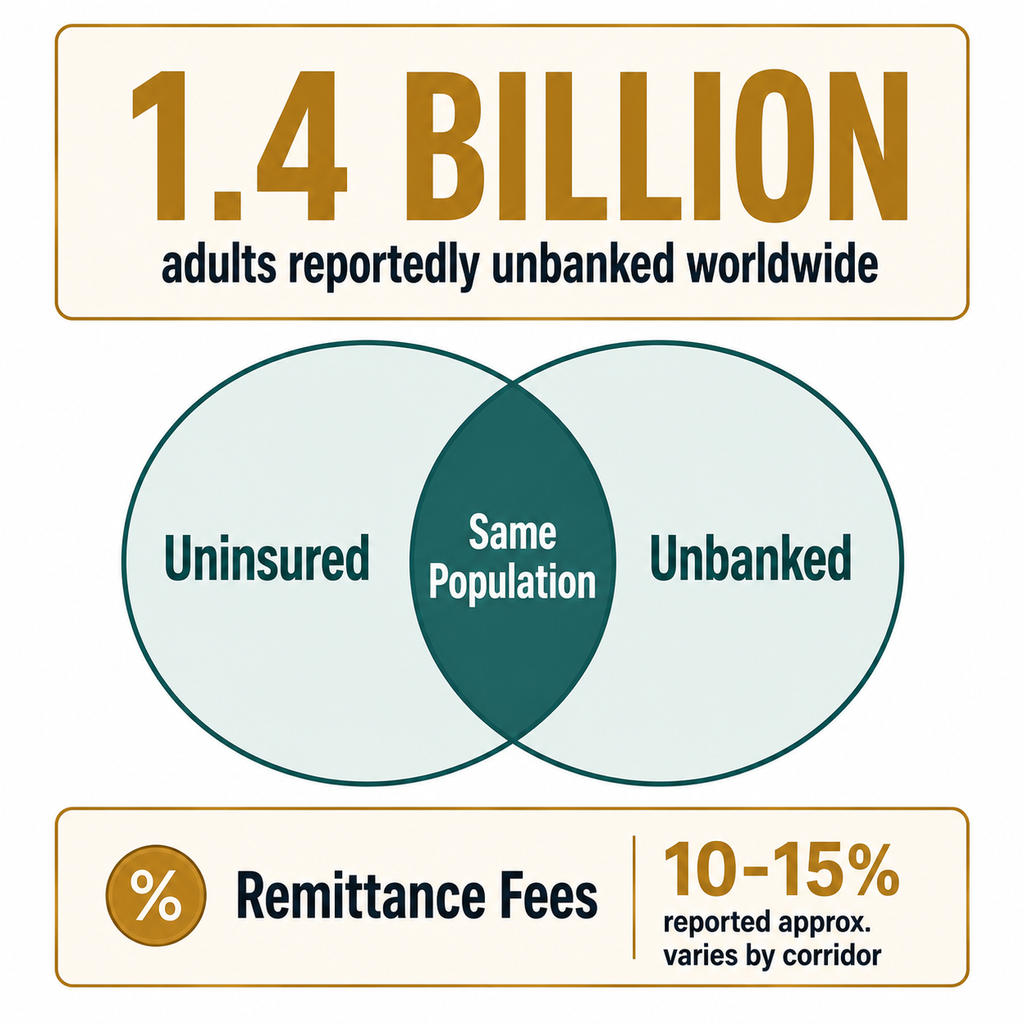
Here’s where the pattern lands. Roughly 1.4 billion adults worldwide are reportedly still unbanked — no savings account, no formal credit, no easy way into the financial system at all. That’s a financial inclusion gap sitting right next to an insurance protection gap, and they largely overlap: the unbanked population and the uninsured population are, in most of the world, the same population, described from two different angles.
Workers who send money home across borders — remittances that keep entire households afloat — reportedly pay a noticeably steep cut in fees for the privilege, though the exact percentage varies by corridor, provider, and year, and any single figure quoted for it should be treated as an approximation rather than a fixed rate. What’s not in dispute is the direction: this is friction, paid disproportionately by people who can least afford it, on money that’s already earmarked for survival.
This is the practical takeaway: the protection gap isn’t primarily a charity problem. It’s a market signal — a trillion-dollar-plus pool of unmet demand that Lloyd’s coffee house model was never architected to serve, because it priced risk for merchants with ships, not for a family with a mobile phone and no collateral. Microinsurance pilots, mobile-based coverage, pay-as-you-go premiums tied to a phone balance — these are the early, unglamorous jiaozi moments of insurance. Nobody’s declared them the new industry standard yet. That’s usually how it starts.
What This Means for the Next Financial Instrument
Run the whole arc back-to-back and the pattern is embarrassingly consistent. Barter broke, so coins confessed a need for portable, agreed-upon value. Coins got too heavy, so paper confessed a need for something lighter than metal. Shipowners couldn’t bear catastrophic loss alone, so Lloyd’s confessed a need for shared risk. Each time, the fix came from people annoyed enough by a specific friction to just build around it — not from a government decree, not from a strategy deck.
The next instrument to close the insurance protection gap will follow the same shape. It won’t look like Lloyd’s, because Lloyd’s was built for a world of ships and coffee houses, not smartphones and informal labor. It will look like whatever finally solves the friction directly for the people currently priced out — the way jiaozi solved weight, and the way a room on Tower Street solved shared risk for the merchants who happened to be sitting in it. Watch for that model. It’s not coming from a boardroom. It’s going to come from someone as annoyed by exclusion as Chengdu’s merchants were by iron.

Key Takeaways
- Every financial instrument — coins, paper money, banking, insurance — emerged to solve a specific, physical human friction, not from abstract innovation.
- Lloyd’s of London turned informal shipping gossip into the first organized marine insurance market in the late 1680s, but it was built for merchants with capital, not for universal coverage.
- Today’s insurance protection gap and the broader financial inclusion gap largely describe the same underserved population, seen from different angles.
- Roughly 1.4 billion adults are reportedly unbanked worldwide — a scale problem still waiting for its own coffee-house moment.
- The next major financial instrument likely won’t be a new gadget; it’ll be whoever reads underserved risk as precisely as Apple read consumer need.
Closing the Gap: What Actually Works
What is the insurance protection gap?
It’s the difference between the economic loss people actually face from risks like illness, natural disaster, or crop failure, and the amount of that loss actually covered by insurance. For huge swaths of the world’s population, that gap is close to total — the risk is real, but no policy exists to absorb it.
Is Lloyd’s of London still relevant today, or is this purely historical?
Very much still active — Lloyd’s remains a functioning insurance marketplace today, built on syndicates of capital backers underwriting large, calculable risks like ships and cargo. That structure is exactly why it was never built to serve small, unpredictable household-level risk, which is the same limitation behind the gap this piece is about.
Is the insurance protection gap getting better or worse?
Slowly better in absolute terms — mobile-based microinsurance products are reaching some previously excluded populations — but worse relative to overall global wealth growth, since insurance penetration in many underserved regions has grown slower than the risks people actually face, climate-driven disasters especially, have escalated.
Is the insurance protection gap the same as the financial inclusion gap?
They’re closely related but not identical. Financial inclusion covers access to banking, savings, and credit broadly; the insurance protection gap is specifically about risk coverage. In practice, the populations affected overlap heavily.
What might finally close the gap?
Likely candidates include microinsurance, mobile-based and pay-as-you-go coverage tied to phone usage, and parametric insurance products triggered automatically by measurable events like drought or flood — early-stage models that echo how jiaozi and Lloyd’s itself started small before scaling.
Sources
- The Human Constant — Why Money Is a Confession
- Earliest coins appearing independently in Lydia, China, and India around 600 BCE
- Sixteen merchant houses in Chengdu creating jiaozi around 1008 CE
- Edward Lloyd’s coffee house on Tower Street, London, becoming a marine insurance hub in the late 1680s
- Apple Inc. reaching a three-trillion-dollar market capitalization in January 2022, described as the first company to do so
- Estimate that approximately 1.4 billion adults worldwide are unbanked
- Claim that remittance fees for workers in developing economies run 10-15% — flagged as unverifiable, hedged in prose as an approximation
