














































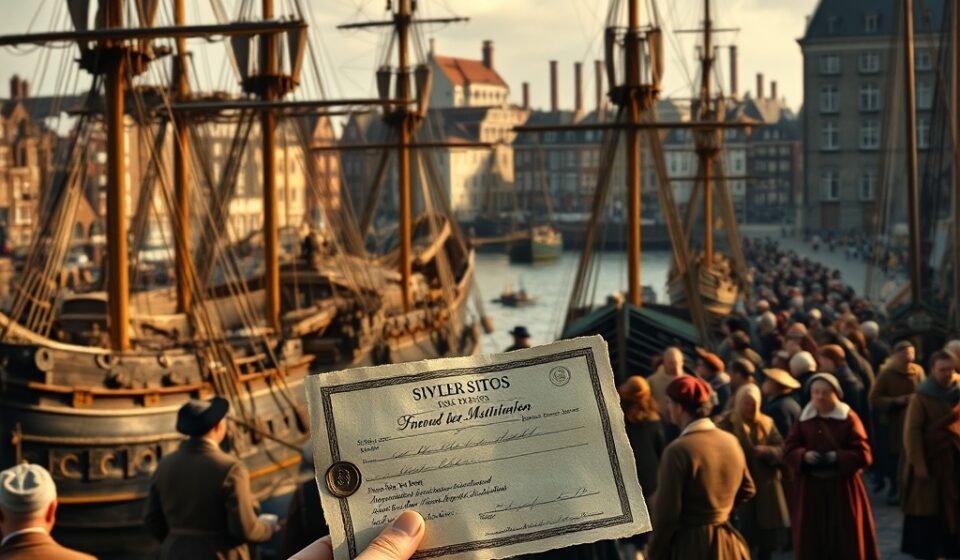

A share of stock is not a number. It’s ambition, sliced thin enough that strangers can buy a piece of it. That idea is roughly 400 years old, and the 1602 Amsterdam stock market is where it was first bolted together into something you’d recognize today — a ticker, a price, a crowd of buyers and sellers who’ve never met the crew unloading the ship.
Stocks, shares, market caps — none of it descended from pure logic. It descended from a funding problem that got solved in a very specific place, at a very specific moment, by people who needed cash more than they needed elegance. Every brokerage app on your phone is a distant descendant of that fix. Not of a financial theory. Of a workaround.
That’s the takeaway to hold onto as you read the rest of this: every share you own traces back to a 17th-century patch job, not an abstract equation dreamed up in a university seminar.
The Problem: A Venture Too Big for Any One Investor
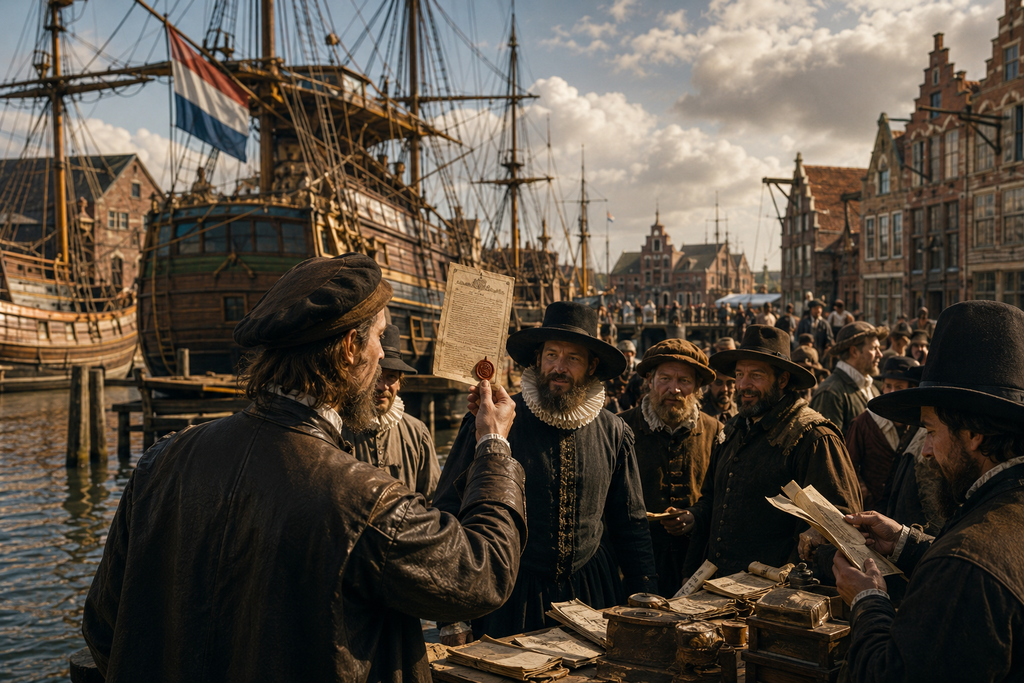
Here’s the situation the Dutch Republic was staring at in 1602. There was a venture worth doing — trade with Asia — and it was too large and too risky for any single financier to bankroll alone. Ships sink. Crews mutiny or starve. Cargo gets seized. A voyage to Asia and back could take years, and any one of a dozen things could turn the investment to zero before a single spice made it to a Dutch warehouse.
The Dutch East India Company needed ships, crews, supplies, capital — all at once, all up front, with no guarantee of return for a long stretch of time. No merchant, however wealthy, wanted to carry that risk solo. It’s the same math a modern founder faces before a Series A round, just with more scurvy involved.
So the problem wasn’t ambition. Amsterdam had plenty of that. The problem was concentration of risk — too much of it sitting on too few shoulders.
The Solution: Splitting Ownership Into Shares
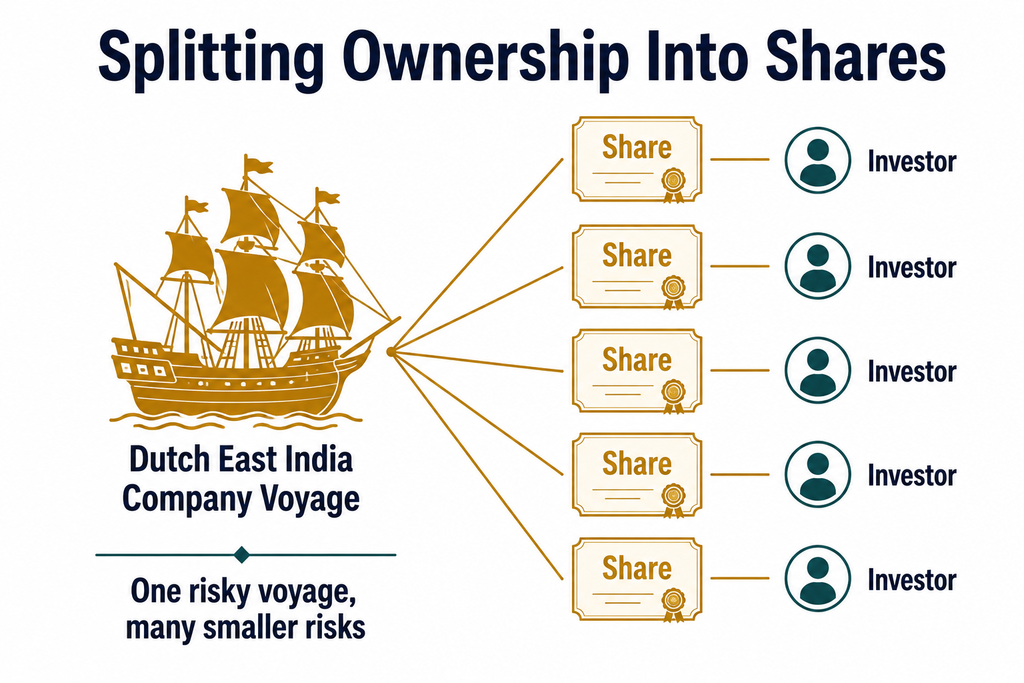
The fix was almost embarrassingly simple, which is usually the sign of a genuinely good idea. Divide ownership into shares, sell them to the public, and distribute both risk and reward across many investors. Nobody has to bet the whole farm. Everybody gets a slice proportional to what they’re willing to risk.
That structure — the joint-stock company — is the whole invention. The Amsterdam Stock Exchange grew up around it almost immediately, becoming the world’s first public equity market, a place where those slices of ownership could actually be resold to someone else instead of locked away until the ship came home.
What it means for you, scrolling a trading app four centuries later: the core architecture of today’s stock market hasn’t changed since 1602. Companies still sell fractional ownership to spread risk. Exchanges still exist to let people trade those fractions. Everything since has been refinement, not reinvention.
The Democratization of Ambition
Once ownership could be split, the only question left was how small the slices could get and how many people could reach them. That’s been the story of finance ever since — not new architecture, just lower doors.
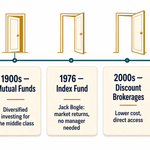
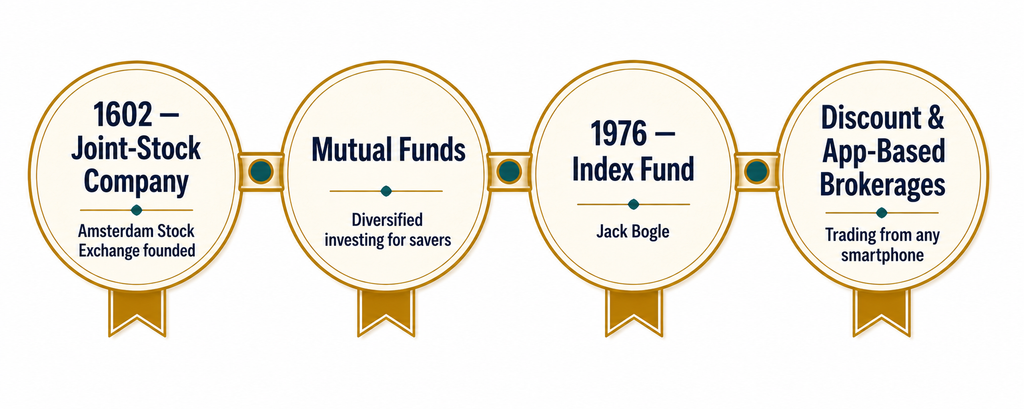
The joint-stock structure first removed the constraint that big projects were limited by the wealth of a handful of individual financiers. Then the mutual fund made diversified equity investment accessible to middle-class savers who’d never have gotten a seat at a merchant’s table. The index fund, credited to Jack Bogle in 1976, made market-rate returns accessible without paying someone to actively (and often badly) manage your money. The discount brokerage, and later the free trading app, made equity trading accessible to anyone with a smartphone and a few dollars of spare cash.
Each wave did the same job: it removed another barrier between ordinary human ambition and the financial instruments built to serve it. Takeaway worth sitting with — each innovation didn’t reinvent the mechanism, it just lowered the entry price to participate in the same 1602 mechanism.
Meme Stocks: Ambition Goes Social
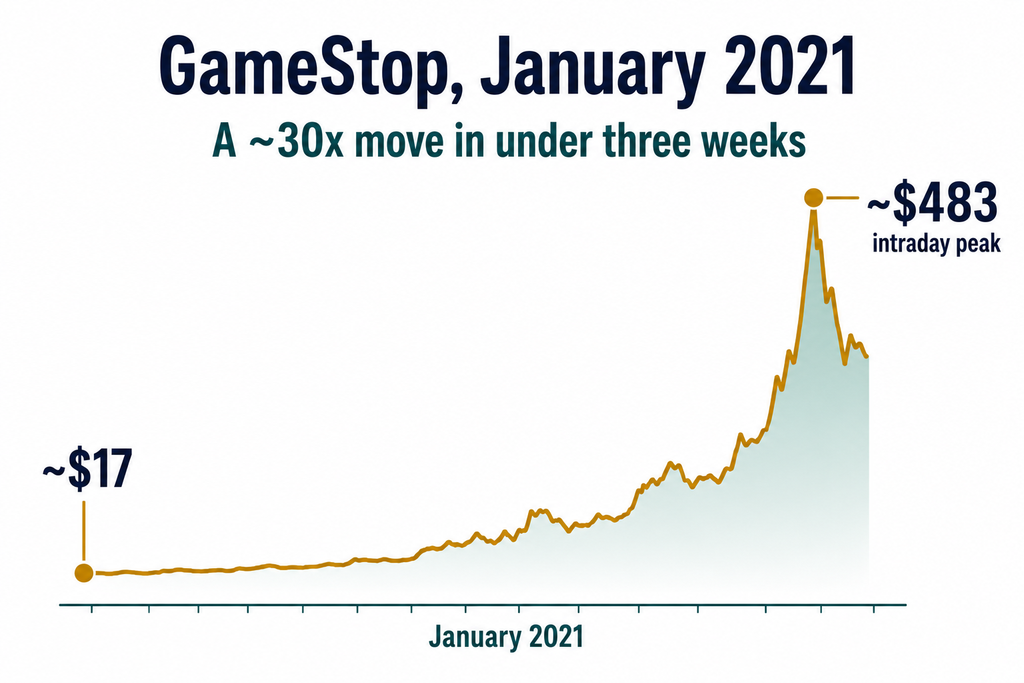
Which brings us to January 2021, when retail investors coordinating on Reddit’s WallStreetBets drove GameStop’s stock from around seventeen dollars to an intraday peak reportedly near four hundred eighty-three dollars — something like a thirty-fold move in under three weeks.
Most coverage at the time treated it as a freak event, a glitch in the market’s operating system. It wasn’t. It was the 1602 mechanism running through a message board instead of a coffee house on the Amsterdam waterfront. Strangers pooling conviction, buying shares of something they believed in (or wanted to see burn short-sellers), and moving a price collectively — that’s not new behavior wearing a new coat. That’s the same behavior the joint-stock company was built to channel in the first place, just running at internet speed.
It’s also, more specifically, a visible expression of social proof and collective identity among investors clustered at a particular life stage — young adults applying the exact social competencies they’d built online to a financial system that had never had to reckon with that kind of coordinated, identity-driven crowd before. If you want a deeper look at how that specific generational wiring shows up well beyond the stock market, the three life phases nobody’s built for is worth a read.
Takeaway: GameStop wasn’t a market malfunction. It was the same 1602 mechanism, running through Reddit instead of a coffee house.
From Amsterdam to Your Phone: What Actually Changed
Lay the whole timeline side by side — 1602 Amsterdam, the mutual fund, Bogle’s index fund, the discount brokerage, GameStop — and a pattern falls out. The technology changed constantly. The invention underneath it didn’t.
What Amsterdam actually invented wasn’t a piece of technology. It was a social and legal arrangement: a way to let strangers share risk and reward without trusting each other personally, backed by an exchange that made the arrangement liquid. Everything after that — paper certificates, ticker tape, electronic trading, apps with confetti animations when you buy your first share — is packaging. The mechanism inside the box is still the one built to fund ships in 1602.
That reframe matters for how you read volatility today, meme stocks included. It’s not evidence the system is broken or newly irrational. It’s evidence the system is doing exactly what it was built to do — channel collective human ambition into a tradable number — just with a much bigger, much faster crowd than the merchants of Amsterdam ever had to manage. The 1602 Amsterdam stock market didn’t anticipate Reddit. It didn’t need to. It just built a container flexible enough to hold whatever showed up next.
Key Takeaways
- The joint-stock company was invented in Amsterdam in 1602 to solve a funding problem: the Dutch East India Company’s venture was too risky for any one investor to finance alone.
- Splitting ownership into shares and selling them publicly gave rise to the Amsterdam Stock Exchange, widely credited as the first public equity market.
- Mutual funds, the 1976 index fund, and discount brokerages didn’t change the mechanism — each just lowered the cost of entry to it.
- The January 2021 GameStop episode was a modern, socially coordinated expression of the same mechanism, not a break from it.
- What changed over 400 years was access and speed. What didn’t change was the underlying architecture: shared risk, shared reward, priced publicly.
FAQ: The Origins of the Stock Market
Why did the 1602 Amsterdam stock market happen in Amsterdam specifically, and not somewhere else?
Amsterdam had the trade networks, capital, and mercantile appetite for overseas ventures, and the Dutch East India Company needed a funding model that no single merchant could supply alone. The joint-stock solution and the exchange to trade it grew up together in that specific commercial environment.
What exactly is a joint-stock company?
It’s a business structure where ownership is divided into shares that can be sold to multiple investors, spreading both the financial risk and any eventual profit across everyone who buys in — rather than resting on one financier’s shoulders.
Was the GameStop meme-stock episode really unprecedented?
Not structurally. The mechanics — collective buying moving a price sharply — are as old as public markets. What was arguably new was the scale and speed of coordination, made possible by social platforms rather than trading floors.
Is the Amsterdam Stock Exchange really the “first” stock market?
It’s commonly described that way because it was the first exchange built around continuously tradable public shares of a joint-stock company. Earlier forms of commercial partnership and debt trading existed before it, so “first” here refers specifically to public equity trading, not to finance in general.
Does the 1602 origin story still matter for how I invest today?
Practically, yes — it’s a useful reminder that market structure is old and tested, even when headlines make current volatility feel unprecedented. The container has held for four centuries; the contents just keep changing.
Sources
- The Human Constant (source chapter for this piece)
- Claim that the joint-stock company and the Amsterdam Stock Exchange originated in Amsterdam in 1602 in connection with the Dutch East India Company
- Attribution of the index fund’s creation to Jack Bogle in 1976
- Claim that GameStop’s stock rose from around $17 to an intraday peak of about $483 in January 2021
- Characterization of the GameStop/WallStreetBets episode as driven primarily by young-adult investors’ social coordination and identity dynamics
