












































James Dean died on a California highway on September 30, 1955, driving his own silver Porsche to a weekend race. He was twenty-four. Four weeks later, Rebel Without a Cause hit theaters, and a generation of teenagers discovered — all at once, in the dark, in movie houses across the country — a character who felt exactly the way they did. Dean never saw it happen. He was already gone. But the moment he left behind is arguably the real birth of modern adolescent identity-seeking: the discovery that belonging and rebellion aren’t opposites, they’re the same appetite wearing two different jackets.
Seventy years later, that appetite runs an entire industry. This piece is about the difference between recognition vs engagement social media design — one built to make teenagers feel accurately seen, the other built to make them scroll one more time — and why almost nothing on the market today is built for the former.
Why Teen Brains Can’t Tell Belonging From Survival
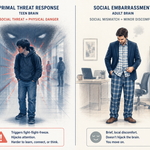
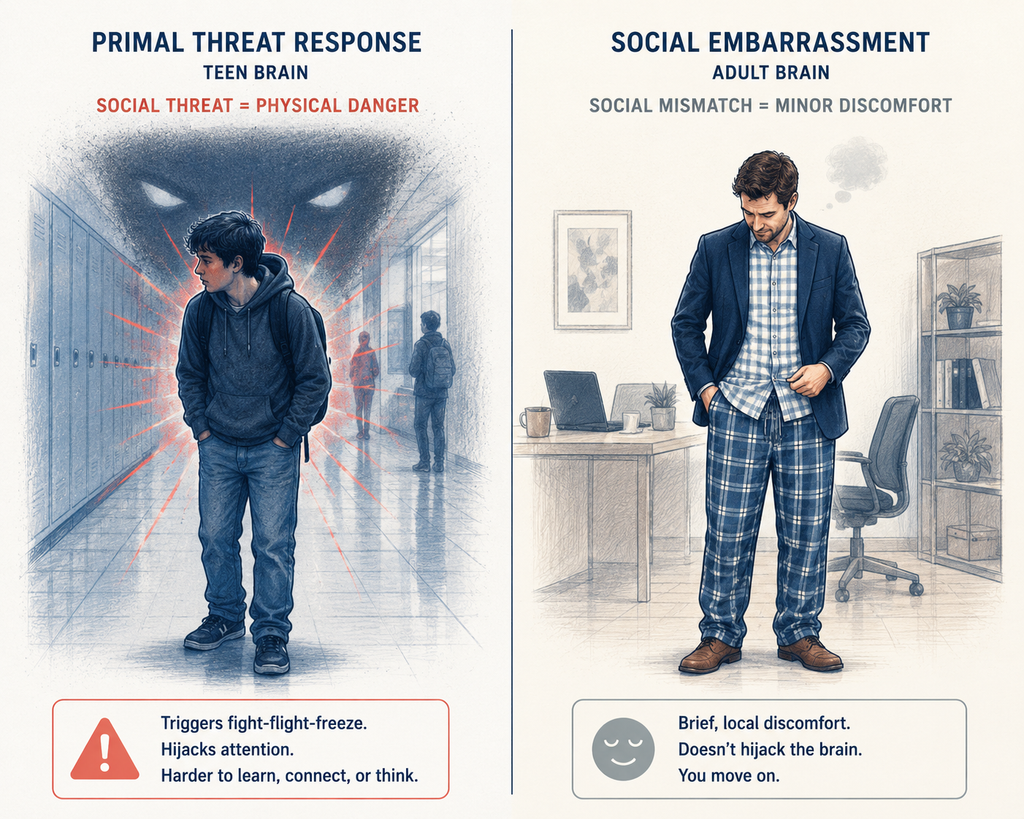
Here’s the uncomfortable biology: the adolescent brain cannot reliably distinguish social exclusion from physical danger. An adult who shows up to a work event in the wrong outfit feels a flicker of embarrassment and moves on. A teenager who wears the wrong brand to school can experience it as something closer to an existential threat — the nervous system treating a social slight like a predator at the tree line.
That asymmetry isn’t a quirk. It’s a feature, if you’re a company that knows how to price it.
For readers, this is the piece worth holding onto: understanding this asymmetry explains why engagement-optimized design doesn’t just annoy teenagers the way it annoys adults — it lands somewhere deeper, in the part of the brain that hasn’t yet learned exclusion won’t kill you. An adult scrolling Instagram is mildly bored by a bad photo. A teenager scrolling the same feed is running a live threat-assessment on their own social survival.
From Jeans to TikTok: The Belonging Machine Evolves
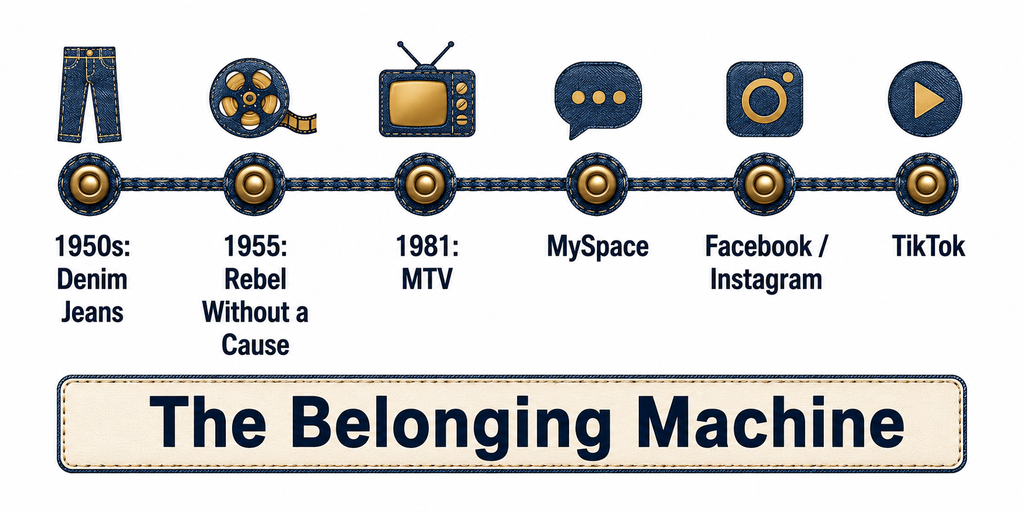
This isn’t the first time an industry figured out how to monetize the need to belong. In the early 1950s, denim jeans were workwear — the kind of thing you’d wear to fix a tractor. Then Marlon Brando wore them in The Wild One in 1953, and James Dean wore them in Rebel Without a Cause in 1955, and jeans stopped being clothing and became a uniform: the visible signal of a generation defining itself against its parents. Denim’s evolution since then is basically a seven-decade map of adolescent identity politics, stitched in indigo.
Then the belonging machine went digital. MTV launched in 1981 as the first visual identity broadcast platform built for teenagers. From there the line runs straight — MTV to MySpace to Facebook to Instagram to TikTok — and it’s a single consistent logic at every stop: teenagers need somewhere to perform identity, signal belonging, and get validated for it. Each generation of platform did that job a little more efficiently than the last. TikTok’s algorithm, which serves content matched with unsettling precision to a user’s revealed preferences, is arguably the most sophisticated belonging machine ever built.
Efficient at what, though? That’s the question the industry doesn’t like to sit with. Efficient at generating attention, which is not the same thing as efficient at generating the feeling of actually being known. Engagement optimization is simply the current, most refined end state of that decades-long evolution — the belonging machine finally running at full throttle.
The Cost of Optimizing for Engagement
In 2021, leaked internal Facebook research reported by the Wall Street Journal showed the company’s own researchers had found that among teen girls who already struggled with body image, roughly one in three said Instagram made those feelings worse. Meta pushed back on how the finding was framed in press coverage, pointing out the research measured girls already experiencing difficulty, not teen girls broadly. That distinction is worth holding onto — and it doesn’t get Meta off the hook. Even the narrower, more defensible version of that finding is damning on its own terms.
Meanwhile, the global mental health market is projected — estimates here vary by source and should be read as directional rather than precise — to reach roughly six hundred billion dollars by 2030. It’s tempting to draw a straight line from that number to the teenagers scrolling comparison loops built by design, but that connection isn’t something any market report actually establishes, and this piece won’t pretend otherwise. What’s fair to say is narrower and still damning: engagement metrics reward the exact comparison mechanics — more time on app, more scrolling past curated bodies and curated lives — that researchers have tied to worsened self-image in vulnerable teens. The problem isn’t a rogue algorithm having a bad day. It’s structural. The metric and the harm are the same behavior, measured twice.
What Recognition-Optimized Design Would Actually Change
So picture the alternative. Not a feel-good rebrand of the same feed with softer colors — an actual different optimization target.
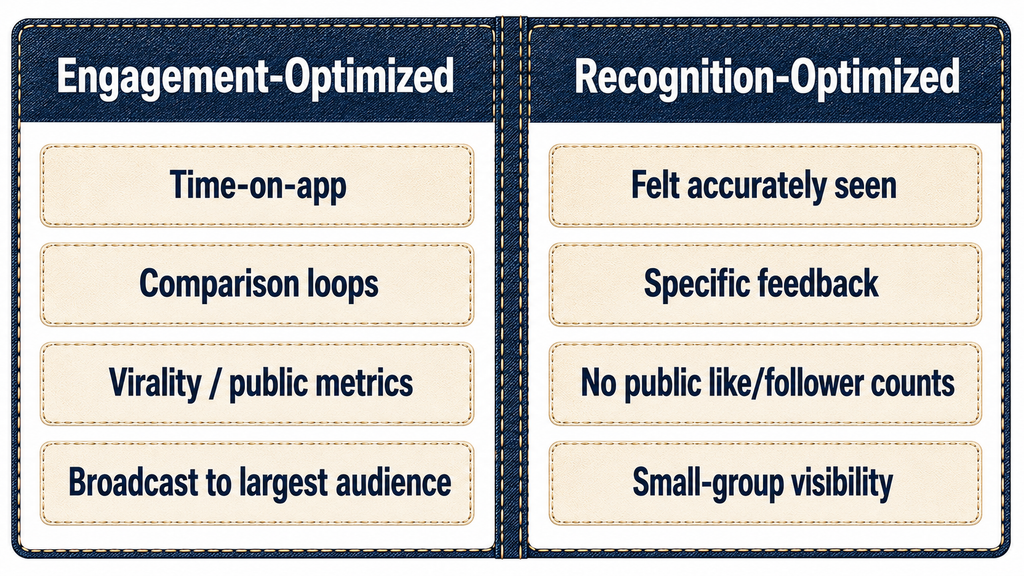
Engagement-optimized platforms measure time-on-app, comparison loops, and virality — content spreading because it triggers a reaction, positive or negative, doesn’t matter which. Recognition-optimized platforms would measure something almost opposite: whether a person felt accurately seen, whether feedback was specific rather than a public tally, and whether the design reduced the surface area available for comparison instead of maximizing it.
In practice, that means concrete, unglamorous design choices:
- Feeds that prioritize acknowledgment — a friend responding to you, specifically — over virality that rewards the most extreme post in the room.
- Removing public metrics like follower counts and like totals, which turn every post into a scoreboard instead of a conversation.
- Favoring small-group visibility over broadcast, so a post reaches the twelve people who actually know you rather than an anonymous audience optimized to be as large as possible.
None of this is complicated engineering. It’s a values decision disguised as a product decision — which is exactly why no major platform has made it. The technology to build a recognition-first feed already exists. What’s missing is a business reason to want it.
Objections: Would Teens Even Use It?
The obvious pushback: teenagers would abandon a recognition-first platform in a week, because virality and social comparison are precisely what make apps sticky, and stickiness is what pays the bills. Fair. Engagement mechanics work because they’re engineered against exactly the neurological asymmetry described earlier — and asking a platform to stop exploiting that is asking it to stop doing the thing that made it profitable in the first place.
But “sticky” and “large” aren’t the same requirement, and conflating them is where most of these conversations go wrong. A platform doesn’t need three billion users to be a viable business — it needs a monetization model that isn’t entirely dependent on ad-driven scale. Smaller, higher-trust networks — subscription-based, school- or community-anchored, priced for parents or institutions rather than advertisers — could plausibly work at a fraction of the size, because they’re not selling attention by the second. They’re selling something closer to what recognition actually requires: a bounded space small enough that being seen in it means something.
Is that a smaller, less venture-friendly business than the current giants? Almost certainly. Is “smaller and less venture-friendly” the same as “impossible”? No — it’s just a different bet, one nobody with the current market’s incentives has strong reason to place.
FAQ
What does “recognition over engagement” actually mean in practice?
It means the platform is graded on a different scoreboard. Instead of asking “how long did this person stay, and how many times did they come back,” it asks “did this person leave feeling more accurately known than when they arrived.” Concretely: fewer public metrics, more specific feedback, smaller visible audiences. Think of the difference between a birthday card someone actually wrote in and a mass “happy birthday” post on a wall everyone can see — same occasion, wildly different feeling.

Has anyone actually built this?
Smaller, closed, or invite-only social apps pitched around closer friend groups have come and gone over the years, and it’s fair to say none has reached anything close to the scale of the platforms this piece is critiquing. Rather than claim a track record that isn’t well documented, the honest answer is: nothing has proven this model works at scale yet, which is different from proving it can’t.
Is this realistic, given how ad-based business models work?
Not under the current dominant model, no — ad-driven platforms are paid by advertisers to hold attention, so recognition, which by design reduces time spent scrolling, is a direct threat to that revenue line. It’s realistic under a different model: subscription, institutional, or community-funded, where the product being sold isn’t attention but something closer to trust. That’s a smaller business. It might also be a saner one.
Key Takeaways
- Adolescent identity-seeking isn’t new — it runs from James Dean and denim jeans through MTV, MySpace, and Facebook to TikTok, each iteration a more efficient belonging machine than the last.
- Teenagers’ brains process social exclusion as closer to physical danger than adults’ do, which is exactly the asymmetry engagement-optimized platforms are built to exploit.
- Leaked Facebook research found that among teen girls already struggling with body image, about one in three said Instagram made it worse — a narrower finding than headlines suggested, and still serious.
- A recognition vs engagement social media redesign would trade time-on-app and public metrics for acknowledgment, specific feedback, and smaller visible audiences.
- The likely business model isn’t a bigger, better feed — it’s a smaller, higher-trust network funded by something other than advertising.
If there’s a teenager in your life currently caught in the comparison loop this piece describes, that’s worth treating as more than a design critique — a school counselor, a pediatrician, or a helpline are reasonable first steps, and none of them require things to reach crisis level before you reach out. And if you’re the one thinking about what comes after adolescence for the generation that grew up inside these platforms, the identity questions don’t stop at eighteen — they just change shape.
Sources
- The Human Constant (source chapter for this piece)
- James Dean died on September 30, 1955, driving his own Porsche to a weekend race.
- James Dean was twenty-four at the time of his death.
- Rebel Without a Cause opened in theaters four weeks after Dean’s death.
- Marlon Brando wore jeans in The Wild One (1953), cited as part of denim’s shift into youth identity symbol.
- James Dean wore jeans in Rebel Without a Cause (1955).
- MTV launched in 1981 as described.
- 2021 leaked internal Facebook research, reported by the Wall Street Journal, found roughly one in three teen girls already struggling with body image said Instagram made those feelings worse.
- Global mental health market projected to reach approximately $600 billion by 2030 (presented as a hedged, variable estimate).
- General claim that smaller, invite-only/closed social apps focused on close friend groups have existed but not reached major-platform scale (presented as unverified/undocumented in the piece).
