













































Every financial instrument ever created is humanity admitting a problem. Not solving one triumphantly, not innovating for its own sake — admitting one. Coins, paper money, insurance, banks, credit cards: strip away the branding and each is a confession that something about being human, in groups, across time, doesn’t work smoothly on its own. That’s the frame this piece runs with, and once you see it, you can’t unsee it in your own wallet.
We like to tell the history of money as a march of progress — clever inventions, rational markets, an arrow pointing up. It’s a better story if you flip it. Money isn’t a triumph. It’s a paper trail of things that kept breaking.
The Double Coincidence of Wants: Why Barter Failed
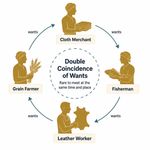
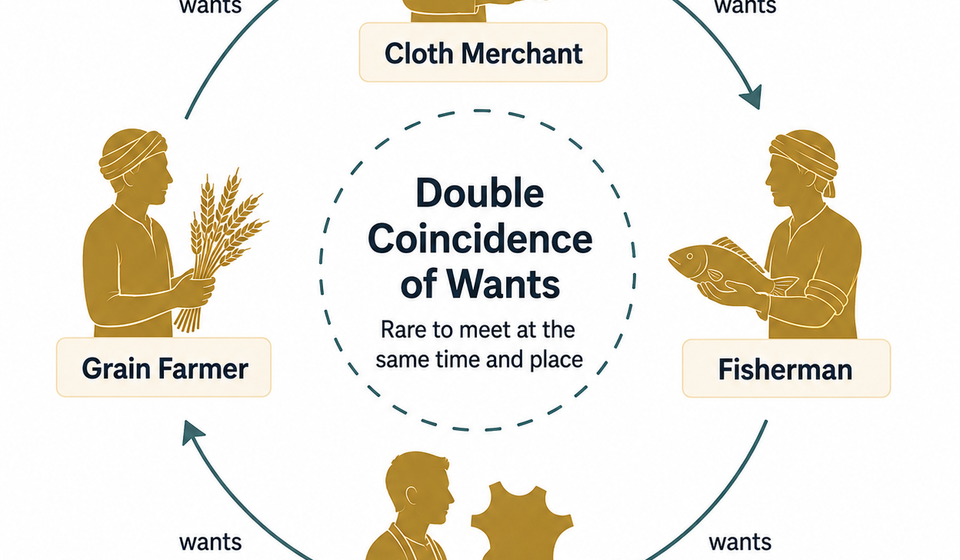
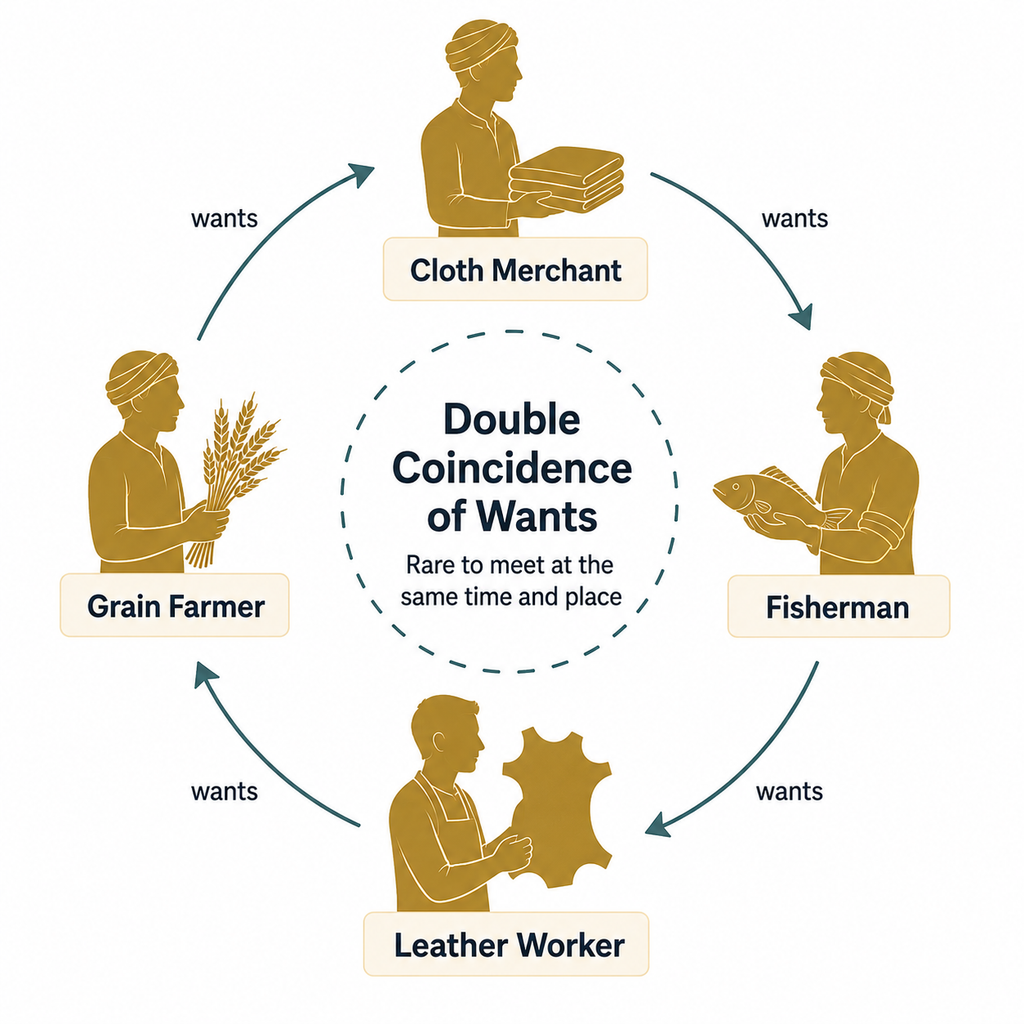
Picture a medieval marketplace. A cloth merchant has fabric and wants fish. The fisherman wants leather. The leather worker wants grain. The grain farmer wants cloth. Everyone in this square has something someone else wants — on paper, it’s a closed loop, elegant enough to sketch on a napkin.
In practice it almost never closes. The cloth merchant needs the fisherman to be standing right there, at that moment, wanting cloth specifically, not fish or wine or a favor owed. Economists call this the double coincidence of wants: two people each holding exactly what the other needs, at the same time, in the same place. It’s rare enough that entire market days could end in nothing but conversation.
Money didn’t emerge because someone had a flash of genius about liquidity theory. It emerged because barter kept failing, publicly and repeatedly, and enough people got tired of hauling fish home unsold. That’s the pattern worth holding onto: the instrument shows up after the friction, not before it.
The First Confession: Coins
The earliest coins appeared independently in Lydia, China, and India around 600 BCE — three civilizations with no contact, arriving at the same fix. That’s not a coincidence of genius; it’s a coincidence of frustration. Traders everywhere needed something portable, divisible, and universally recognized, and barter offered none of the three.
The coin wasn’t a celebration. It was an admission: we need something better, and we need everyone at this table to agree on what it is. What this means for you, reading this on a phone that can move money across a continent in seconds, is that even the earliest currency in human history was a bottom-up admission of daily annoyance — not a government decree, not a scholar’s theory. That same pattern — ordinary friction forcing a workaround that later gets dressed up as innovation — repeats with every instrument that follows, right up to whatever’s sitting in your pocket now.
Too Heavy to Carry: How Paper Money Confessed Coins’ Failure
By the eleventh century, the merchants of Sichuan had their own confession to make, and it was refreshingly literal: their money was too heavy.
The region ran on iron coin, and iron doesn’t have the value-density of silver or gold. A thousand large iron coins reportedly weighed something like thirty pounds. Buying a single bolt of silk could take ninety catties of coin or more — not a metaphor for a burden, an actual cart-and-porter situation. A merchant closing an ordinary trade wasn’t carrying money. He was hauling it.
Around 1008, sixteen merchant houses in Chengdu stopped hauling iron and started printing paper instead. These notes — jiaozi — were promises redeemable for a fixed amount of coin held in reserve. Nobody handed down a decree calling for monetary modernization. Sixteen businessmen were sick of the same physical problem and solved it the same way, in the same city, around the same time. Paper money’s confession wasn’t ambition. It was a sore back.
Gossip in a Coffee House: The History of Insurance at Lloyd’s of London
Insurance confessed something else entirely: that some risks are too big for one person to carry alone, no matter how careful they are.
By the late 1680s, Edward Lloyd’s coffee house on Tower Street in London had become the room where ship captains, merchants, and underwriters traded intelligence about the sea — which vessels had made it home, which were overdue, which had gone down in a storm. Lloyd started posting that shipping news on his walls. Then the same room that carried the gossip started carrying the deals: merchants willing to bet, for a fee, that a given ship would arrive safely; shipowners willing to pay rather than risk losing an entire cargo — and their livelihood — in one storm.
Marine insurance wasn’t founded as an industry. It curdled out of anxious chatter in a coffee house, the way a lot of the best (and worst) financial ideas do. What this means for you: every insurance product you own today — health, auto, renters — is an organized, spreadsheet-ed version of that same coffee-house bet. Someone is still pricing shared uncertainty; they just have actuaries now instead of gossip.

Banks and Credit Cards: Confessing Risk and Impatience
Banking confessed that holding your own cash was itself a risk — theft, fire, a lost strongbox under the floorboards — and that someone needed to guard it better than you could alone. That’s not a neutral service. It’s a polite admission that you, personally, are a liability to your own savings.
Credit cards confess something more embarrassing: we want things now that we cannot yet afford. There’s no elegant euphemism for that one. It’s impatience, monetized and given a 16-digit number.
What this means for you: your checking account and the card in your wallet aren’t neutral tools sitting there for convenience. They’re admissions of two very specific human weaknesses — one about safety, one about restraint — that financial institutions figured out how to charge you for solving.
The Apple Paradox: Reading Friction Instead of Creating It
This pattern isn’t limited to finance. In January 2022, Apple briefly became, by most accounts, the first publicly traded company to reach a three-trillion-dollar market valuation. Not by inventing new human needs — by reading old ones with unusual precision.
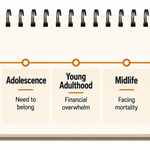
The teenager uses the device to signal belonging. The young adult uses it to navigate an independent, complicated life. The parent uses it to run household logistics. The elder uses it to stay connected to people who’ve scattered. Apple didn’t create any of those needs. It read them better than almost anyone else building products at the time.
What this means for you: the framework isn’t just about money. A product’s staying power — whether it’s a coin, an insurance contract, or a phone — depends on which real, pre-existing friction it’s confessing to solve. Invent a need and you get a fad. Read one accurately and you get a three-trillion-dollar company, or a currency that survives a thousand years.
This idea — that friction precedes product, and product precedes industry — is worth chasing further if you’re interested in it; it’s the whole spine of the eight-step path from friction to industry.

The Next Confession: 1.4 Billion Unbanked Adults
So what’s the friction nobody’s fully confessed to yet?
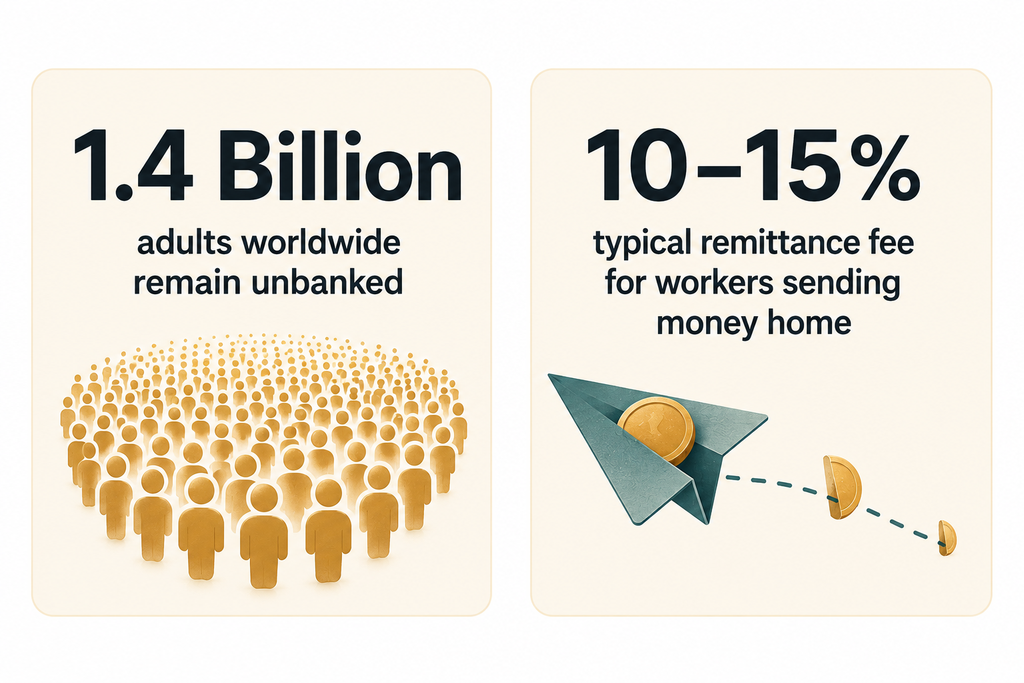
An estimated 1.4 billion adults worldwide remain unbanked, without reliable access to basic financial services. Workers sending money home to family in developing economies often pay remittance fees reported in the range of ten to fifteen percent — a toll that, for someone earning modest wages, is not a rounding error. It’s real money evaporating on the way to people who need it.
That friction is large, visible, and — so far — unsolved at any real scale. Financial instruments as confessions of friction is the whole thesis of this piece, and here it points forward instead of back: whatever wins the next great fintech breakthrough won’t be the cleverest technology. It’ll be whatever finally answers this specific, quantifiable admission of failure. Watch for that pattern the next time a new payment app or currency system gets hyped as revolutionary — ask what it’s actually confessing.
Key Takeaways
- Every financial instrument — coins, paper money, insurance, banks, credit cards — emerged as an admission of a specific human friction, not a triumphant innovation.
- Barter failed because of the “double coincidence of wants”: two people rarely hold exactly what the other needs at the same moment.
- Coins arose independently in Lydia, China, and India around 600 BCE, confessing a shared need for portable, divisible, trusted value.
- Paper money (jiaozi, circa 1008 in Chengdu) confessed that iron coins were too heavy to carry, not a mission to modernize finance.
- Marine insurance grew out of informal betting in Edward Lloyd’s London coffee house, confessing that no single shipowner could absorb total loss alone.
- Apple’s rise shows the same logic applies beyond finance: value comes from reading existing friction accurately, not inventing new needs.
- Today’s confession-in-progress: roughly 1.4 billion unbanked adults and remittance fees that eat into wages workers can’t spare.
Closing Thought
The next time you tap a card, buy travel insurance, or complain about a wire transfer fee, don’t read it as a feature. Read it as testimony. Every instrument in your wallet is a record of a problem someone else got tired of first — and somewhere right now, 1.4 billion people are waiting on the next one to be written.
Sources
- The Human Constant (source chapter for this piece)
- Earliest coins appeared independently in Lydia, China, and India around 600 BCE
- A thousand large iron coins in Sichuan weighed roughly thirty pounds (approx. twenty-five catties)
- Around 1008, sixteen merchant houses in Chengdu began printing jiaozi notes redeemable for coin
- Edward Lloyd’s coffee house on Tower Street, London, became a hub for shipping news and marine insurance deals by the late 1680s
- Apple briefly reached a three-trillion-dollar market capitalization in January 2022, described as the first company in history to do so
- Approximately 1.4 billion adults worldwide remain unbanked
- Remittance fees for workers in developing economies are cited as ten to fifteen percent
