









































Here’s the uncomfortable truth about idea generation: you don’t need a flash of genius, you need better eyes. The gap between “nothing to build” and “an idea worth building” usually isn’t a knowledge gap. It’s an attention gap. If you want to turn observation into a startup idea, the fastest route isn’t waiting for inspiration to strike in the shower — it’s running a few deliberate exercises against the life going on around you.
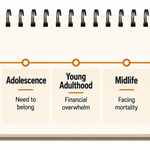
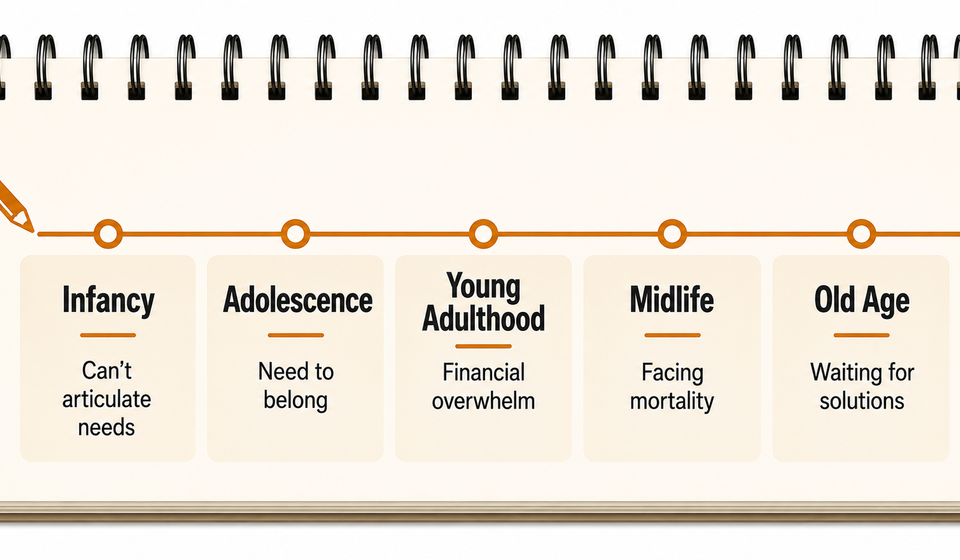
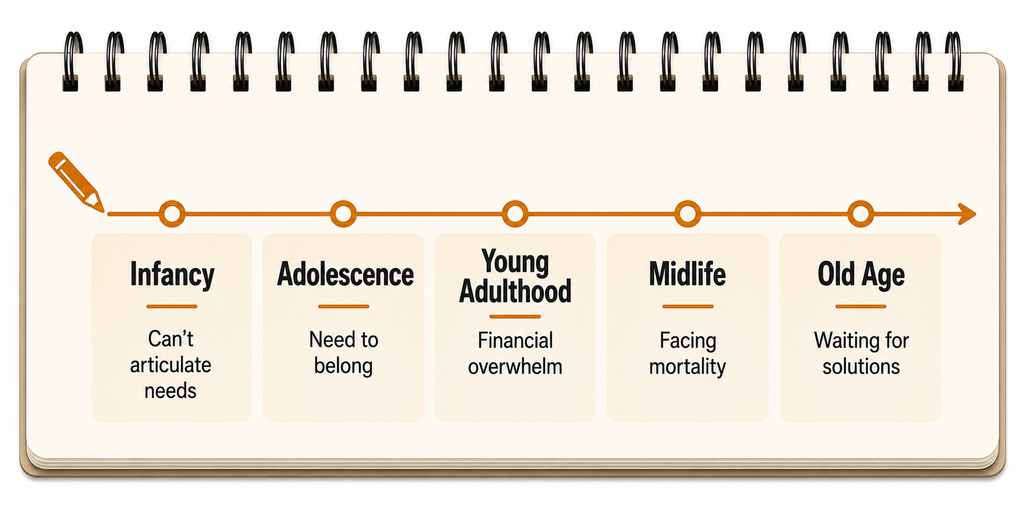
This is a framework, not a mystical claim. It’s a way of looking at the phases of human life — infancy, adolescence, young adulthood, midlife, old age — and treating each one as a source of unresolved friction. Some of that friction turns into products. Some of it turns into industries. None of it announces itself with a lightning bolt.
You Don’t Need a New Idea, You Need Better Eyes
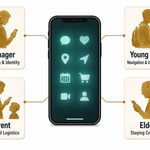
Walk through any stretch of human life and you’ll find people improvising solutions to problems nobody formally assigned them. Infants can’t articulate what they need, so entire categories of caregiving products exist to guess on their behalf. Teenagers organize their identities around belonging, and a striking share of consumer culture — social platforms, fashion cycles, status goods — seems to orbit that need, though I’d stop short of calling it a precise, countable market. Young adults stumble into financial and emotional overwhelm and cobble together workarounds that sometimes become companies. Midlife brings people face to face with their own mortality, and it’s not a stretch to say that anxiety plays some role in feeding the broader wellness industry — though the causal line from “person turns forty and gets nervous” to “billion-dollar juice cleanse market” is more suggestive pattern than proven mechanism. Elders wait, often for years, for products that still don’t exist.
None of that is a controlled study. It’s a lens. Treat it as one, and it becomes useful — a way of noticing what’s already sitting in front of you instead of hunting for something novel that doesn’t exist yet.
Stop waiting for the eureka moment. Start looking systematically at the phases of life happening around you right now — in your own house, your own commute, your own group chat.
Why Most Ideas Die Between Observation and Action
Once you start looking, you’ll notice friction everywhere. That’s the easy part. Most people who go looking for ideas actually find them — journals fill up, notes apps overflow, “what if there was an app for” conversations happen at every dinner party. What’s rare isn’t the noticing. It’s the follow-through.
In my experience, and in the experience of most people who’ve tried to build something from scratch, more ideas die in the space between observation and action than for any other single reason. Not bad ideas. Not competitive markets. Inaction. The friction gets logged, mentally filed, and never touched again. If that pattern sounds familiar, it’s because it is — analysis paralysis has a long, well-documented history in decision-making research, even if the exact mortality rate of ideas has never been formally measured by anyone.
So treat the three exercises below as commitments, not journaling prompts. A framework only works if you actually run it.
Exercise One: The Phase Journal
For one week, keep a running log of every friction you personally experience or notice in someone else. Not solutions — just friction. The moment someone sighs at a form, gives up on an app, improvises a fix with duct tape and stubbornness.
Next to each entry, note the life phase it belongs to. A parent losing patience with a feeding app belongs to early parenthood. A retiree complaining that nobody makes anything simple anymore belongs to old age. By the end of the week you’re not holding vague impressions — you’re holding a raw map of real human problems, which is closer to primary research than most idea-generation advice ever gets you.
Takeaway: Start tonight. One entry, one friction, one life phase. No editing, no judging whether it’s “good enough” to write down.
Exercise Two: The Loop Trace
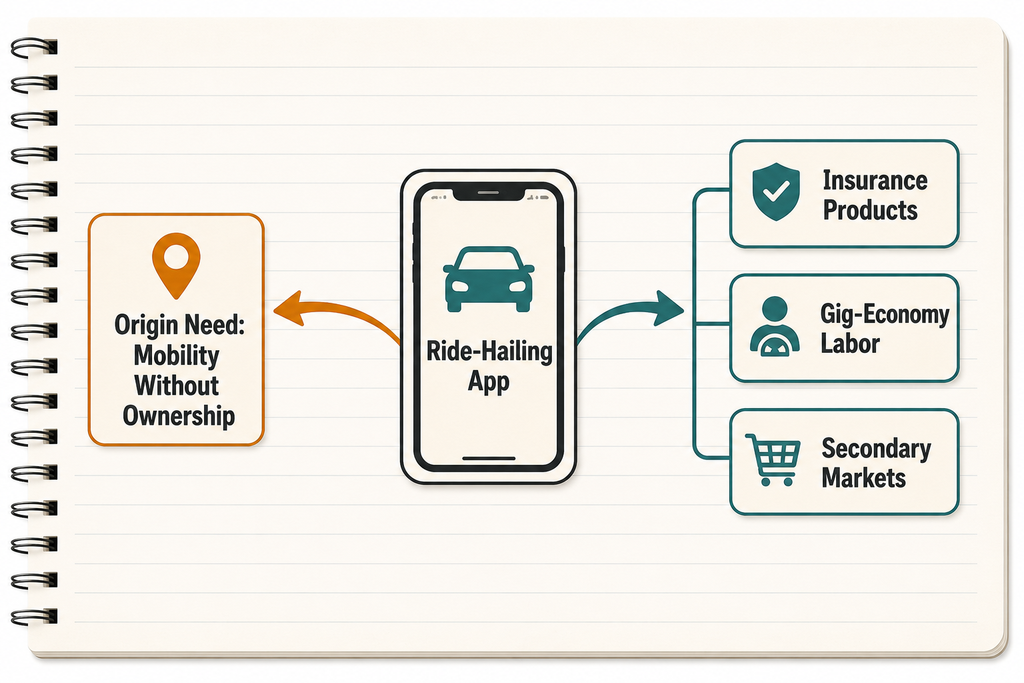
Pick a product you used today without thinking about it — your calendar app, your coffee subscription, your ride-hailing app. Now trace it backward: what human need, in what life phase, originally generated something like this? A ride-hailing app traces back to young adults needing mobility without the cost of ownership. A meal-kit service traces back to overworked adults who want to eat well but don’t have time to plan.
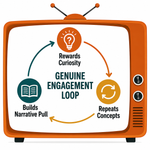
Then trace it forward. What financial instruments has this product spawned — subscriptions, insurance products, secondary markets, gig-economy labor structures? What new needs has it created that didn’t exist before it did? This is the Loop Trace method, and running it repeatedly builds a kind of instinct: you start seeing the backward-and-forward loop automatically, on everything, all the time. It’s genuinely a little annoying once it kicks in — you’ll never look at a grocery delivery app the same way again.
If you want the fuller mechanics of how a single friction expands into an entire industry with instruments of its own, The Anatomy of an Idea: The 8 Steps From Friction to Industry walks through that expansion step by step.
Takeaway: Pick one app or product you touched today. Map its full backward-and-forward loop before you go to bed.
Exercise Three: The Wishlist Audit
This is where the sharpest ideas hide. Take any group of people you know well — new parents, freelancers, your aging relatives — and build three columns.
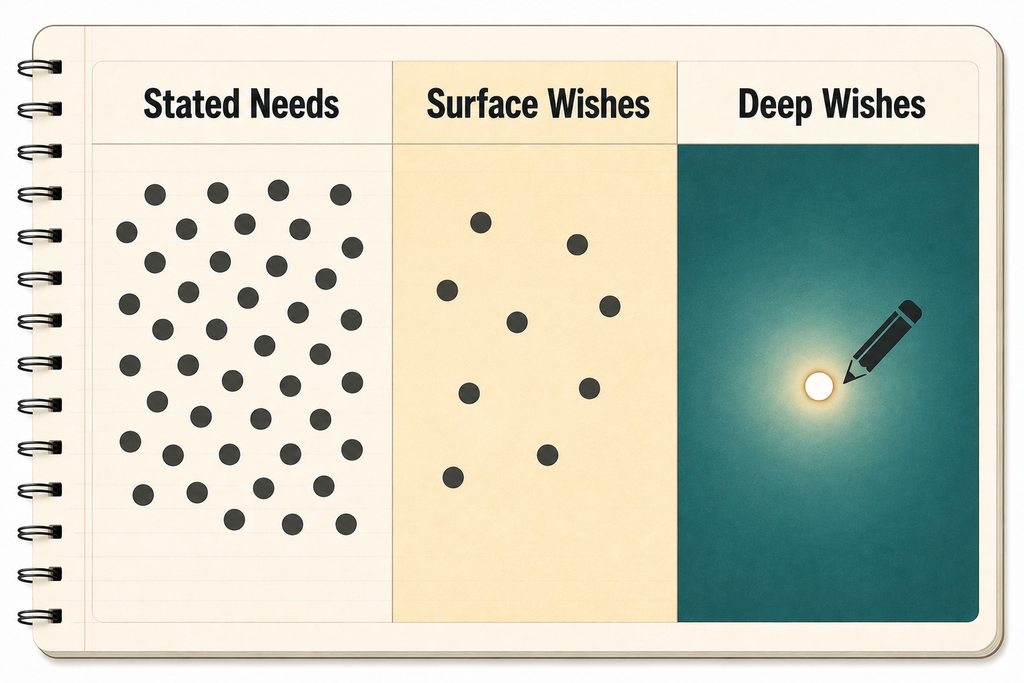
First column: stated needs. What they’d tell you outright they need. Second column: surface wishes. What they’d admit to wanting if you pushed a little. Third column: deep wishes. The ones they don’t say out loud, sometimes because they haven’t fully admitted them to themselves.
The Wishlist Audit only pays off if you’re honest in that third column. Stated needs are crowded — everyone’s already building for those. Surface wishes are a little less crowded. The deep wishes are where the biggest, least obvious ideas tend to live, because almost nobody is willing to sit still long enough to write them down.
Takeaway: For a group you know well, write the three columns today. Spend most of your time on the third.
The Human Constant Doesn’t Change — Your Attention Should
Markets shift. Technology turns over every few years. Money and culture reshape themselves constantly. The one thing that doesn’t move is the human underneath all of it — born helpless, growing curious, needing to belong, getting knocked around by young adulthood, taking on responsibility that’s heavier than expected, reckoning with mortality, and eventually growing old, wiser, lonelier, and more generous than they planned to be.
At every one of those stages, people need things they don’t have, want things they can’t quite name, and carry problems with no solution yet. That’s not a market gap you calculate — it’s a pattern you notice, if you’re paying attention. It was true before spreadsheets existed. It’ll be true after whatever comes next replaces them.
Takeaway: Revisit the three exercises every few months. Life phases around you shift — new friction shows up constantly, and last quarter’s notebook goes stale faster than you’d think.
FAQ: Putting the Exercises Into Practice
How long should I run each exercise?
The Phase Journal wants a full week minimum — fewer than seven days and you’re working with too small a sample of your own life. The Loop Trace and Wishlist Audit are faster; you can run either in a single sitting, though revisiting them monthly sharpens the pattern recognition considerably.
Which exercise should I start with?
Start with the Phase Journal. It’s the rawest material — everything else builds on it. Loop Trace and Wishlist Audit both work better once you’ve actually logged real friction instead of guessing at it from memory.
How do I know if an idea is worth pursuing?
Look for friction that shows up more than once, across more than one person, in the same life phase. A single complaint is an anecdote. A repeated one is a signal. And if you want to see how a signal like that gets tested against real market resistance rather than just journaled about, The Six-Step Framework for Turning Any Human Friction Into a Business is worth reading next.
Is this really how you turn observation into a startup idea, or just a nice mental model?
Both, honestly. It won’t hand you a business plan. What it does is force you to notice what you’d otherwise walk past — and noticing, reliably and on purpose, is most of what separates people who “have an idea” from people who never do.
Key Takeaways
- Idea generation is an observation skill, not an invention skill — the raw material is already in front of you.
- Most ideas don’t fail from lack of insight; they fail in the gap between noticing friction and doing something about it.
- The Phase Journal gives you raw material: log friction daily, tied to a life phase, for a week.
- The Loop Trace builds pattern recognition: trace one product backward to its origin and forward through what it’s created.
- The Wishlist Audit finds the biggest ideas by separating stated needs from the wishes people never say out loud.
- Run all three on a recurring basis — the phases around you keep shifting, and so does the friction worth chasing.
Sources
- The Human Constant (source chapter for this piece)
- Reference to analysis paralysis having ‘a long, well-documented history in decision-making research’ — general claim stated without a specific citation.
