


















































The Human Constant: A Field Guide to Spotting the Next Idea

Once you see the human constant, you cannot unsee it. That’s not a marketing line — it’s a warning. The human constant framework is a single question you can ask about any product, pitch, or aisle end-cap, and once you start asking it, you will not be able to stop. This is a field guide to that question: what it is, why it works, and how to use it before your competitors even know it exists.
Introduction: The Question You Will Never Stop Asking
Most idea-generation advice is a checklist. Validate the market. Talk to ten customers. Build an MVP. All useful, all downstream of a much more basic move: figuring out where the idea comes from in the first place. The human constant framework answers that. It says every product, every service, every business on earth traces back to a human being at a specific point in life, running into a specific piece of friction.
Once you understand that, something shifts in how you move through the world. You stop evaluating ideas on cleverness and start evaluating them on origin. That’s the entire trick, and it takes about a paragraph to learn and a lifetime to stop using.
How the Human Constant Changes What You Notice
Here’s the demonstration that makes it click. Walk into a grocery store and look at the cereal aisle. At adult eye level, you’ll find the bran, the low-sugar options, the “heart healthy” boxes with the muted packaging. Drop your gaze about three feet, though, and the shelf explodes into color — mascots, cartoon characters, sugar counts nobody’s advertising. That’s not an accident of inventory management. That’s toddler eye level.
Someone, somewhere, mapped exactly which humans stand at exactly which height, in exactly which phase of life — the phase where kids ride in carts and parents are distracted and pester power is a real commercial force — and built a shelf strategy around it. It solves a marketer’s problem and creates a parent’s problem in the same square foot of retail space.
Try this yourself: next time you’re in a store, don’t look at what’s for sale. Look at who the shelf is arguing with. Ask which life phase it’s targeting, and you’ll start seeing the same logic in checkout-line candy, in pharmacy displays, in the placement of reading glasses near the registers. It’s everywhere once you’re looking for it.

The Question That Reorganizes the Room
The same move works in a conference room, and it’s more useful there because the stakes are higher than snack marketing. Someone pitches a new product, and the reflexive question in most rooms is “is this innovative?” That question is nearly useless — it rewards novelty for its own sake and tells you nothing about whether anyone actually needs the thing.
Swap it for this one: which human life phase does this serve, and what friction does it solve? That question reorganizes the room. It cuts through the deck, the demo, and the buzzwords, and asks the pitch to justify its own existence in human terms. A product with no clear answer to that question is a solution hunting for a problem — dressed up, funded, and eventually dead. Use this reframed question in your next brainstorm or product review, and watch how fast it separates the ideas with a pulse from the ones that are just technically impressive.
Why This Question Never Runs Out of Answers
Here’s the part that makes the framework durable rather than clever-once. The human journey never ends. It’s not a finite dataset you can exhaust with enough research — it’s being lived, right now, in billions of simultaneous, overlapping lives, at every human life phase: infancy, adolescence, new parenthood, career peak, caregiving, decline, all of it happening at once, everywhere, constantly generating friction.
That means the question — where in the human journey does this come from? — never goes stale. It’s not tied to a season, a platform, or a funding cycle. Every phase is still generating needs, wants, fears, and half-formed wishes right now, while you read this sentence. This is why founders and marketers can return to this question indefinitely without ever exhausting it. It’s less a research tool and more a permanent lens.
What This Framework Reveals About Opportunity
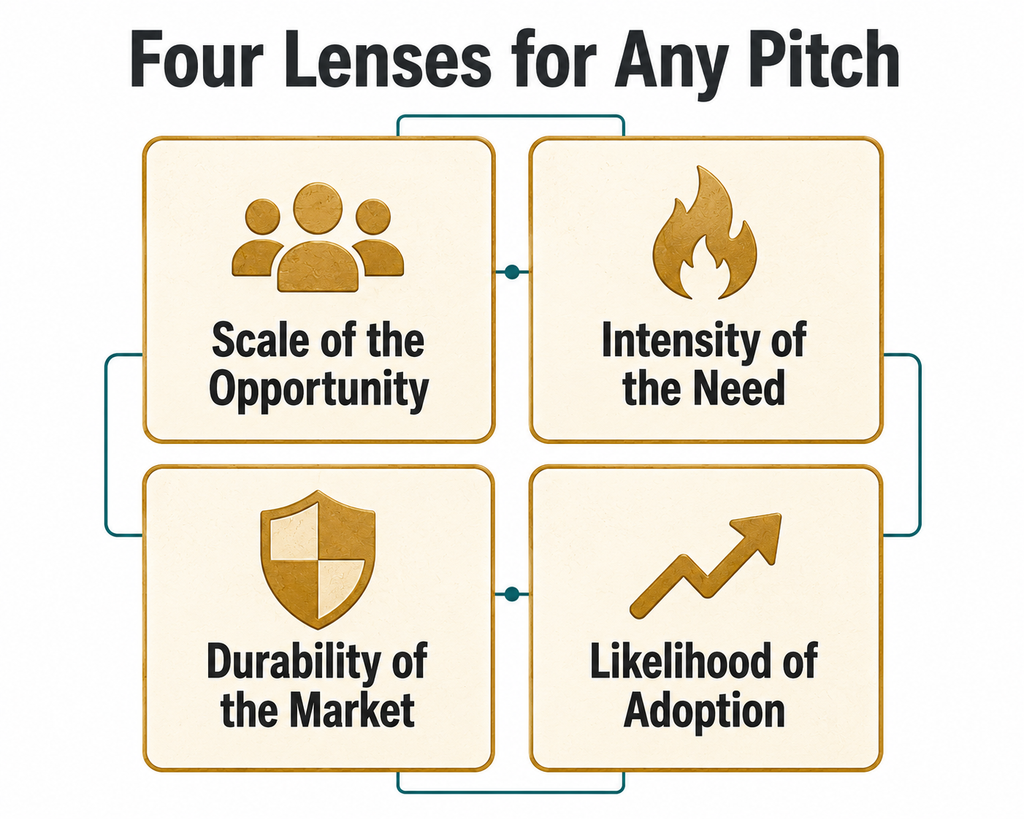
The question isn’t just diagnostic — it’s predictive. Ask “where in the human journey does this come from?” about any idea, and the answer reveals four things at once:
- Scale of the opportunity — how many people are currently living through this phase, right now, worldwide.
- Intensity of the need — whether this friction is a mild annoyance or something people will pay real money, urgently, to solve.
- Durability of the market — whether this phase of life is a permanent fixture of the human journey or a temporary cultural blip.
- Likelihood of adoption — whether the friction is acute enough that people will actually change behavior to fix it, rather than just complain about it.
Run any pitch through those four lenses before you run it through anything else. A product that scores well on all four isn’t guaranteed to win, but a product that scores badly on all four is guaranteed to struggle, no matter how well-built it is. This is the same underlying logic explored in more mechanical detail in the eight-step path from friction to industry, which traces what happens after you’ve correctly identified the friction — how it compounds into a product, then an industry, then capital.
The Human Is the Source: A Field Guide for Applying This Daily
The human is the source. The human has always been the source. The human will always be the source — not the technology, not the platform, not the funding environment. Those are the vehicles. The friction is the fuel, and the friction always starts with a person in a phase of life running into something that doesn’t work for them yet.
That’s true even as the tools around us change. It’s worth noting that the rise of AI hasn’t displaced this logic — if anything, it’s sharpened the case for it, a point worth spending more time on if you’re wondering why AI makes the human constant more valuable, not less.
So make this a habit, not a one-time insight. Start a running list — notes app, notebook, whatever sticks — of every life-phase friction you notice this week. The new parent squinting at a stroller manual. The retiree fighting with a pharmacy app. The teenager doing something inefficient out of sheer inexperience. Write it down, note the phase, note the friction. That list, kept honestly for even a month, is your idea pipeline. Most people walk past these moments a dozen times a day and never register them as data. You won’t be able to anymore.
Where the Framework Holds — and Where It Doesn’t
What is the human constant framework, in one sentence?
It’s the idea that every product or business traces back to a human being at a specific life phase encountering a specific friction — and that asking “which phase, what friction?” is a repeatable way to evaluate or generate ideas.
How is this different from typical market research?
Market research usually starts with a demographic or a product category and works backward to justify a decision already half-made. The human constant framework starts earlier — with the life phase and the friction itself — which is why it tends to surface ideas market research alone misses, especially in underserved or overlooked phases of life.
Can I use this outside product and business contexts?
Yes. It works for content ideas, nonprofit programs, internal company tools, even personal decisions about what problem is worth your time. Anywhere something is being built for humans, the question “which phase, what friction?” applies.
Does the framework guarantee an idea will succeed?
No, and be suspicious of anything that claims it does. It tells you whether an idea has a legitimate human origin and roughly how big and urgent that origin is. Execution, timing, and distribution — covered well in frameworks like the six-step path from friction to business — still decide the rest.
How often should I revisit this question?
Continuously. The framework doesn’t expire because the human journey doesn’t pause. Treat it as a permanent lens, not a one-time exercise you run before a launch.
Key Takeaways
- The human constant framework reduces to one durable question: which human life phase does this serve, and what friction does it solve?
- Life-phase logic is hiding in plain sight — grocery shelves, meeting rooms, product roadmaps — once you know to look for it.
- The question reveals four things about any idea: scale, intensity, durability, and likelihood of adoption.
- The framework never runs dry because the human journey is continuous and simultaneous across billions of lives.
- Start a running list of life-phase frictions you notice this week — that list is the beginning of your idea pipeline.
Sources
- The Human Constant — The Question You Will Never Stop Asking
- Claim that toddler-eye-level cereal shelf placement is a deliberate marketing strategy targeting children/parents (grocery example is used illustratively/paraphrased from source, not independently verified as a documented industry practice)
