


















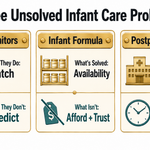
























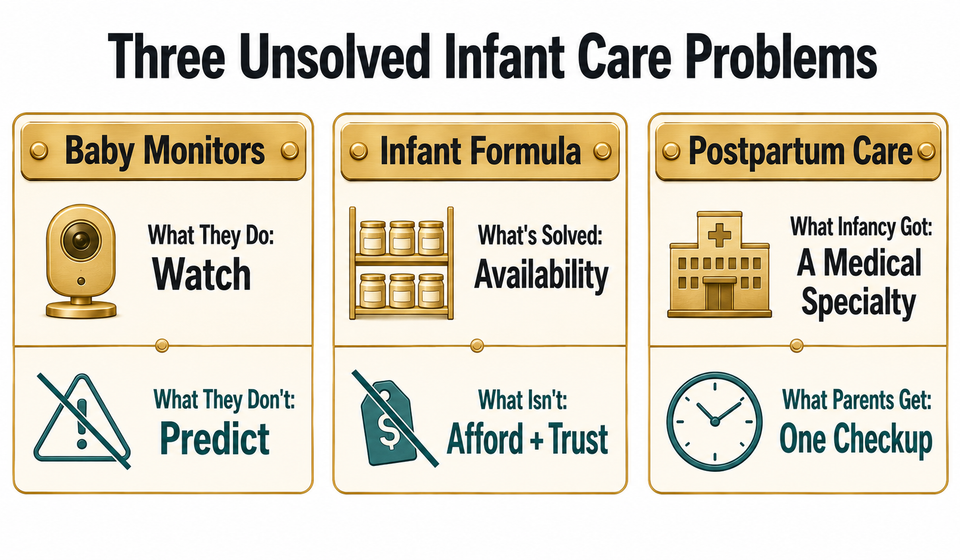

A baby cannot fill out a customer survey. It cannot rate a product one to five stars or explain, in words, why it’s crying at 3 a.m. Every industry built around infancy — formula, monitors, medicine — was invented by someone guessing at a need they could not ask about directly. That guessing game has produced genuine breakthroughs. It has also left three unsolved infant care problems sitting in plain sight, decades after the money started pouring in: monitors that watch but don’t predict, formula that’s abundant but not affordable or trusted, and postpartum care that never got the medical buildout infancy itself received.
The Consumer Who Cannot Speak
On the night of March 1, 1932, twenty-month-old Charles Lindbergh Jr. was lifted from his crib through a second-floor window while his parents slept nearby. It became the crime of the century, chased by every radio and newspaper in the country. Five years later, Eugene McDonald, president of Zenith Radio Corporation, still couldn’t shake it. He rigged a microphone-and-receiver setup so he could hear his own daughter’s room from elsewhere in the house, then handed the idea to his engineers.
That’s the origin story of the baby monitor, and it’s worth sitting with, because it explains a pattern that repeats across every product in this space. Infants can’t articulate what they need. Every solution for them starts as an adult’s translation of a wordless signal — a cry, a fear, a guess. That’s empathy-driven design at its most raw, and it’s genuinely powerful as a starting point.
It is not, however, a finishing point. Empathy gets a product to market. It doesn’t necessarily get it to solved. A monitor born from one father’s fear is still, at its core, a fear-management device — not a diagnostic one. That distinction matters more than it sounds, and it’s the thread running through all three problems below.
Problem 1: Baby Monitors Still Just Listen, They Do Not Predict
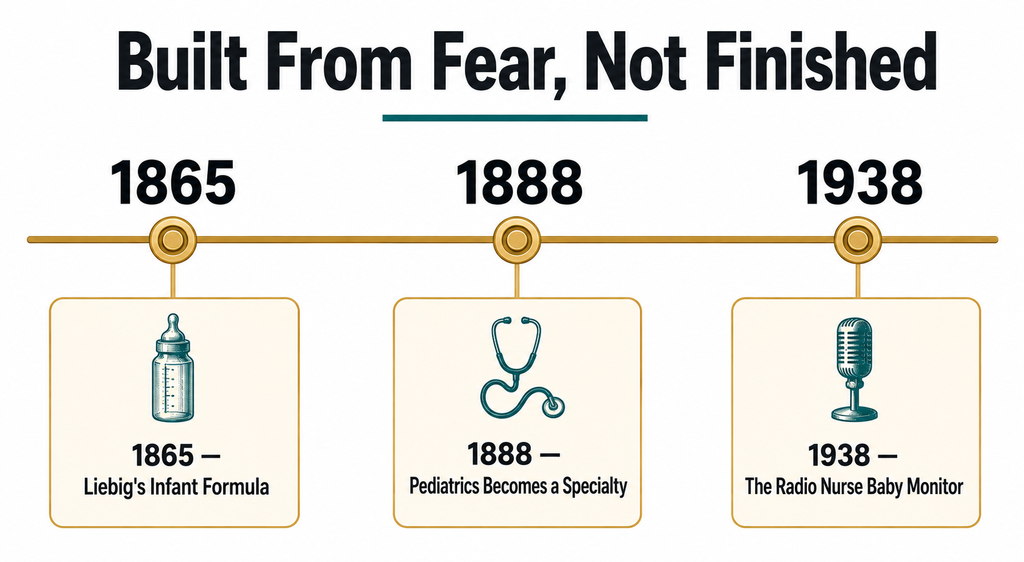
The Guardian Ear and its receiver, the Radio Nurse — styled by sculptor Isamu Noguchi into a sleek Bakelite bust that looked like a small silent nurse standing watch on a shelf — went on sale in 1938. Nearly ninety years later, walk into any baby-gear aisle and you’ll find the same basic proposition, just with better optics: a camera in the crib, a screen in your pocket, an app that tells you the room is quiet.
Quiet is not the same as safe. That’s the gap nobody in the smart-monitor business likes to advertise. Today’s devices layer on HD video, night vision, two-way audio, even movement and temperature sensors — but the fundamental transaction hasn’t moved past surveillance. You’re still watching and hoping, just with sharper resolution than Eugene McDonald had in 1938.
Predictive baby monitoring — a device that flags a real physiological risk before it becomes an emergency, not just a livestream you can panic-refresh — remains more marketing language than delivered product. Some wearables claim early-warning capability for things like irregular breathing patterns, but the category as a whole hasn’t crossed from “reassurance appliance” into genuine risk detection at scale, and regulatory caution around infant health claims is one reason that gap hasn’t closed quickly.
If you’re evaluating smart baby tech, the practical takeaway is blunt: you’re currently buying peace of mind, not prediction. Know the difference before you pay a premium for either.
Problem 2: Formula Is a 70 Billion Dollar Industry That Still Is Not Affordable or Trusted
In 1865, German chemist Justus von Liebig created the first commercial infant formula — a powder of cow’s milk, wheat flour, malt flour, and potassium bicarbonate — in response to a genuine crisis. Infant mortality from malnutrition was staggering, and the alternatives (diluted animal milk, bread-and-water pap) were nutritionally thin and often contaminated. Liebig’s Soluble Food for Babies was crude by today’s standards. It was also the first product engineered specifically for infants who couldn’t be breastfed.
More than a century and a half later, the global infant formula market is reportedly worth somewhere around seventy billion dollars a year. That number tells you the availability problem got solved a long time ago. Formula is everywhere. What it isn’t, in most households, is cheap — and what it doesn’t reliably have, in a lot of public conversation, is trust.
Cost is the more visible friction: formula-feeding a baby for a year can run into real money for families already stretched by everything else a newborn demands, and price spikes or shortages (the U.S. formula shortage of 2022 is the example still fresh in a lot of parents’ minds) expose just how fragile that supply chain actually is. Trust is the quieter friction — an industry shaped by decades of aggressive marketing controversy, contamination scandals, and formula-versus-breastfeeding guilt campaigns doesn’t earn goodwill just by existing at scale.
Here’s the useful reframe, and it’s genuinely interesting from a business-history angle: the friction in formula was never really about nutrition science. Liebig solved the biochemistry problem in the 1800s. What’s remained unsolved is affordable infant formula that families trust without reservation — a cost-and-credibility problem, not a chemistry one. It’s a pattern worth comparing to how $70 billion in baby formula has surprising overlap with $79 billion in sneakers, where a similarly enormous market still hasn’t fully earned consumer trust despite decades of scale.
Problem 3: Medicine Grew Up Around the Infant, Postpartum Care Did Not
Before the mid-1800s, there was no such thing as a pediatrician. Doctors treated children with the same protocols they used on adults, just smaller doses. Abraham Jacobi, a German émigré physician working in New York, spent close to three decades making the case that a child’s body isn’t a miniature adult’s body and deserved its own medical discipline. By 1888, when Jacobi helped found the American Pediatric Society — reportedly the country’s first medical specialty society of any kind — his argument had already reshaped hospital care for children.
That effort compounded. Today there are reportedly over 500,000 pediatricians worldwide, backed by children’s hospitals, neonatal intensive care units, and immunization programs that have wiped out diseases that once killed infants by the millions. Infancy, medically speaking, got its own kingdom.
Postpartum care never got the equivalent. In much of the U.S. system, the standard is still one six-week checkup for the parent who just gave birth — a single appointment expected to catch everything from hemorrhage risk to postpartum depression to physical recovery, compressed into a slot barely longer than a lunch break. There’s no Abraham Jacobi of postpartum medicine, no founding society that made “the recovering mother needs her own specialty” a settled argument the way pediatrics settled it for the infant.
This is one of the clearest unsolved infant care problems precisely because it isn’t really about the infant at all — it’s about the adult who produced one, and how thin the medical scaffolding around that adult still is compared to what got built for the baby.
Why the Money Never Reaches the Gaps
None of this is for lack of capital sloshing around the category. A baby doesn’t just create product demand — it triggers a financial chain reaction. Life insurance purchases spike at the birth of a first child. Education savings accounts open. College funds, estate plans, sometimes entire inheritance structures get rewritten, often before the child can sit up unassisted.
That’s a lot of money in motion. Almost none of it is aimed at the three problems above. Insurance and savings accounts are future-proofing instruments — they hedge against what might happen to this family in fifteen or thirty years. They’re not funding a predictive sensor that catches respiratory distress tonight, or a formula subsidy that makes this month’s grocery bill survivable, or a six-month postpartum care plan instead of a single six-week appointment.
Infant-adjacent spending is enormous. It’s just pointed at later, not now — which is exactly why prediction, affordability, and postpartum care have stayed unsolved even as the dollars around infancy kept climbing.
Key Takeaways
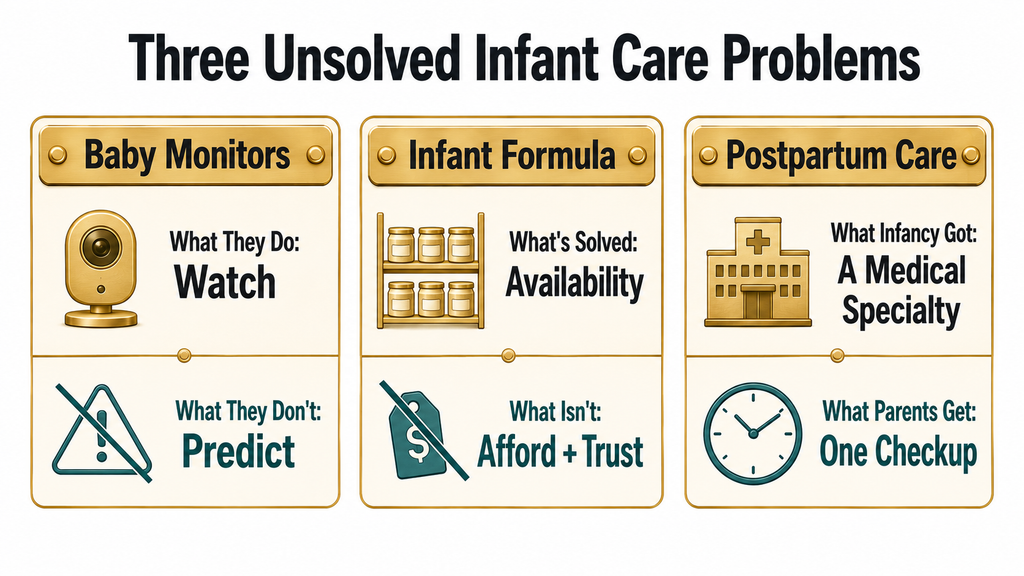
- Monitors watch, they don’t predict. Nearly ninety years after the Radio Nurse, smart baby monitors still sell surveillance and reassurance, not genuine early risk detection.
- Formula’s problem isn’t nutrition, it’s cost and trust. A roughly seventy-billion-dollar industry solved availability in the 1800s and still hasn’t solved affordability or public confidence.
- Postpartum care lags pediatrics by a century of institution-building. Infancy got its own medical specialty; the parent who just gave birth is often still working with one checkup.
- The pattern underneath all three: each industry started as empathy translated into a product — a scared father, a worried chemist, a stubborn physician. Empathy sparked the industry. None of the three matured into a full solution for the specific problem it was born to fix. That’s the underlying shape of unsolved infant care problems in general — strong starts, incomplete finishes.
FAQ: Common Questions on Infant Care Gaps
Why don’t baby monitors predict illness instead of just showing video?
Because the category was built to solve fear, not diagnosis. Modern monitors add cameras, night vision, and audio, but few reliably flag a real physiological risk before it happens — largely due to the technical and regulatory difficulty of making infant health claims, not lack of demand.
Why is infant formula still so expensive if it’s a seventy-billion-dollar industry?
Scale solved supply, not price. Manufacturing, packaging, and distribution costs, plus a market shaped by a handful of major producers, have kept formula a real financial strain for many families — a cost problem that’s separate from the nutrition science, which has been essentially settled for decades.
What’s actually missing from postpartum care?
Continuity and specialization. Pediatrics built an entire discipline, hospital infrastructure, and workforce around the infant. Postpartum care for the parent still commonly runs on a single follow-up visit, without the equivalent depth of screening, follow-through, or dedicated specialists.
Are any of these unsolved infant care problems close to being fixed?
Pieces are moving — wearable health tech, extended postpartum coverage in some healthcare policy proposals, formula-affordability programs — but none has yet closed the gap fully. That’s exactly why these count as unsolved rather than simply slow to arrive.
Infancy still runs on the same basic transaction it did in 1938 and 1865: someone who loves a baby, guessing hard, building something in response to fear or need. That’s a good starting instinct. It’s not a finished industry. If you’re a parent, a founder, or just someone who thinks about where the next real fix comes from, the opening worth taking isn’t in the monitor aisle or the formula shelf — it’s in whichever of these three gaps someone is finally willing to treat as a solvable problem instead of a permanent cost of having a baby.
Sources
- The Human Constant (source chapter for this piece)
- Date and details of the Charles Lindbergh Jr. kidnapping (March 1, 1932, taken through a second-floor window)
- Claim that Eugene McDonald, president of Zenith Radio Corporation, personally built a microphone-and-receiver setup in response to the Lindbergh kidnapping and directed engineers to productize it
- Claim that the Radio Nurse receiver was styled by sculptor Isamu Noguchi
- Claim that the Guardian Ear/Radio Nurse baby monitor went on sale in 1938
- Claim that Justus von Liebig, a German chemist, created the first commercial infant formula in 1865
- Description of Liebig’s formula ingredients (cow’s milk, wheat flour, malt flour, potassium bicarbonate) and product name ‘Soluble Food for Babies’
- Figure that the global infant formula market is worth approximately $70 billion annually
- Reference to the U.S. infant formula shortage of 2022
- Claim that Abraham Jacobi was a German émigré physician working in New York
- Claim that Jacobi helped found the American Pediatric Society in 1888 and that it was the first medical specialty society of any kind in the U.S.
- Figure that there are over 500,000 pediatricians worldwide
- General claim that standard U.S. postpartum care is limited to a single six-week checkup
