














































Nobody designed the industry you work in. Somebody found it. That’s an uncomfortable sentence if you’ve spent years believing strategy is about vision, but the evidence is under your feet — literally, in the case of the man who started this whole way of thinking.
The Man Who Waited for Snow
In 1914, Ohio State’s campus needed sidewalks, and the job of deciding where to put them fell to university architect Joseph N. Bradford. He had a choice every planner faces: guess, or watch. Bradford watched.

Instead of drawing paths from a desk, he waited for winter. When snow blanketed the campus, students didn’t stop walking — they kept cutting across the grounds on the routes they already used, and their footprints stamped a visible web into the white ground. According to campus lore, Bradford went up in a hot air balloon to sketch the pattern from above, then paved the walkways exactly where the trails already were.
He didn’t invent the sidewalks. He found them. That’s the whole premise behind the desire-path method — the idea that the most reliable design isn’t imagined, it’s discovered, because people have usually already voted with their feet.
Here’s what that means practically: if you’re building something — a product, a company, a career — stop asking “where should people go?” and start asking “where are they already going, badly, without help?” Assumptions are expensive. Footprints are free.
What the Desire-Path Method Actually Is
The connection is deliberate, not decorative. Bradford didn’t invent a single path — he uncovered paths that already existed and made them official. Every human life contains the same kind of buried pattern, not carved in snow but carved in age: the same needs, the same wants, the same frictions, repeated across billions of separate lives. It stays invisible for the same reason the campus trails stayed invisible — nobody has gone up far enough to look.
Applied to markets, the desire-path method is simple to state and hard to practice: don’t guess where people should go. Find where they already are, and build there. Most failed products are sidewalks poured across open lawn while the actual trail — the workaround, the spreadsheet hack, the group chat people already use to solve the problem — sits twenty feet away, ignored because it wasn’t anyone’s idea.
The practical takeaway is a habit, not a slogan: before you build anything, go looking for the informal, clunky, half-broken version people have already cobbled together to get what they need. That’s your paving location.
The Seven Universal Phases of Human Life
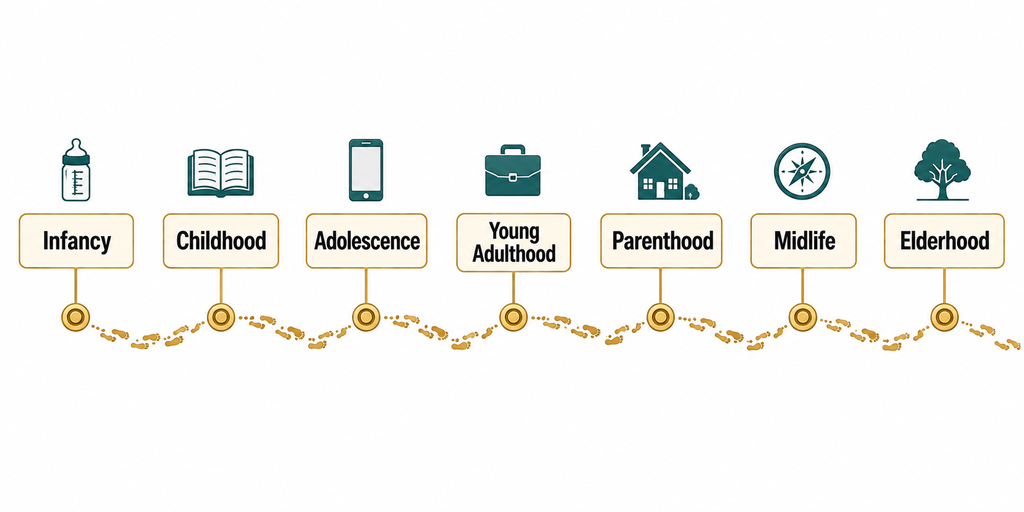
If markets are trails, then human life is the terrain that produces them. Every person who has ever lived moves through the same sequence of developmental phases — seven of them, by this framework’s count — and the phases aren’t cultural, they’re biological and developmental constants that show up in roughly the same order and shape across every era and every culture.
A teenager in fourteenth-century Florence wrestled with the same belonging anxiety as a teenager in Tokyo today. A new parent in ancient Rome lost sleep the same way a new parent in modern New York does. The phase is the constant; the product built to serve it is the variable. Diapers change. Infancy doesn’t.
This is the aerial-view move — the equivalent of Bradford’s balloon. You can’t see the trail from ground level, standing inside your own moment in history. You have to go up and look at the shape that repeats across all of them.
Needs, Wants, and Problems: Where Ideas Actually Come From
Inside each of those seven phases, human motivation splits into three categories: needs, wants, and problems. Needs are what people must have to survive and function. Wants are what people wish they had to thrive. Problems are the friction between what someone has and what they need or want.
Ideas live in the gap between problems and solutions. Not in the need itself, and not in some flash of founder inspiration — in the gap. A new parent needs sleep; wants reassurance the baby is fine; the problem is not knowing whether to check the crib for the fifth time in an hour. Every baby monitor ever sold lives in that gap.
The practical move here is a mapping exercise, not a brainstorm: identify which of the seven phases your customer sits in, then lay out their needs, wants, and problems for that phase specifically, before you let yourself invent a solution. Solutions invented before the mapping tend to be sidewalks across the lawn.
The Feedback Loop: How One Trail Becomes the Next
Here’s where the framework stops being static and starts being genuinely interesting. Ideas don’t just emerge from life phases — they reshape them, and the reshaping creates the next generation of problems.
The automobile solved a transportation problem for the industrial-era adult. Fine. But it didn’t stop there. It created the suburb. The suburb created a new kind of childhood. That new childhood generated the driving license as a cultural rite of passage. The rite of passage generated car insurance, car loans, and an entire teenage driving economy that didn’t exist a generation earlier. One trail became the starting point for the next one, and then the next.
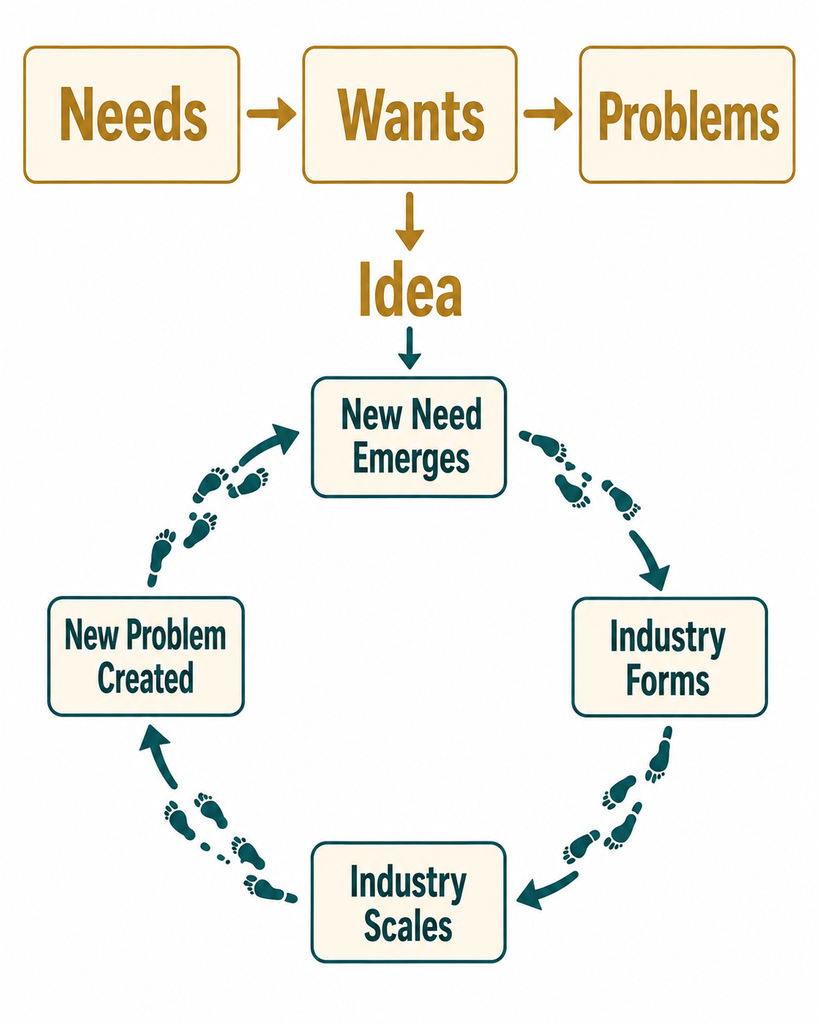
This is the same mechanism the four-stage feedback loop framework describes in more structural terms — a need creates an industry, the industry scales, and the scaling produces financial instruments that reshape the humans who started the whole cycle. The desire-path method explains where the first footprint comes from; the feedback loop explains why it never stays a single footprint for long.
The takeaway for anyone building something now: your solution will spawn the next industry’s raw material, whether you plan for it or not. Ask what your product makes necessary five years out, not just what it solves today.
Why This Explains Loneliness by Design
Not every industry follows a genuine trail. Some pave over one on purpose.
A real desire path solves the actual friction — belonging, connection, competence, safety — and gets out of the way. But plenty of industries have learned there’s more recurring revenue in managing a problem than in resolving it. That’s loneliness by design: building the sidewalk right up to the edge of genuine connection, then quietly rerouting it into a feed, a notification, a mechanism engineered to keep people circling the friction instead of walking through it.
The tell is whether the trail leads somewhere or loops back on itself. Genuine desire paths terminate — they get you to belonging, to competence, to the thing the need was actually pointing at. Engineered dependency doesn’t terminate. It’s designed not to.
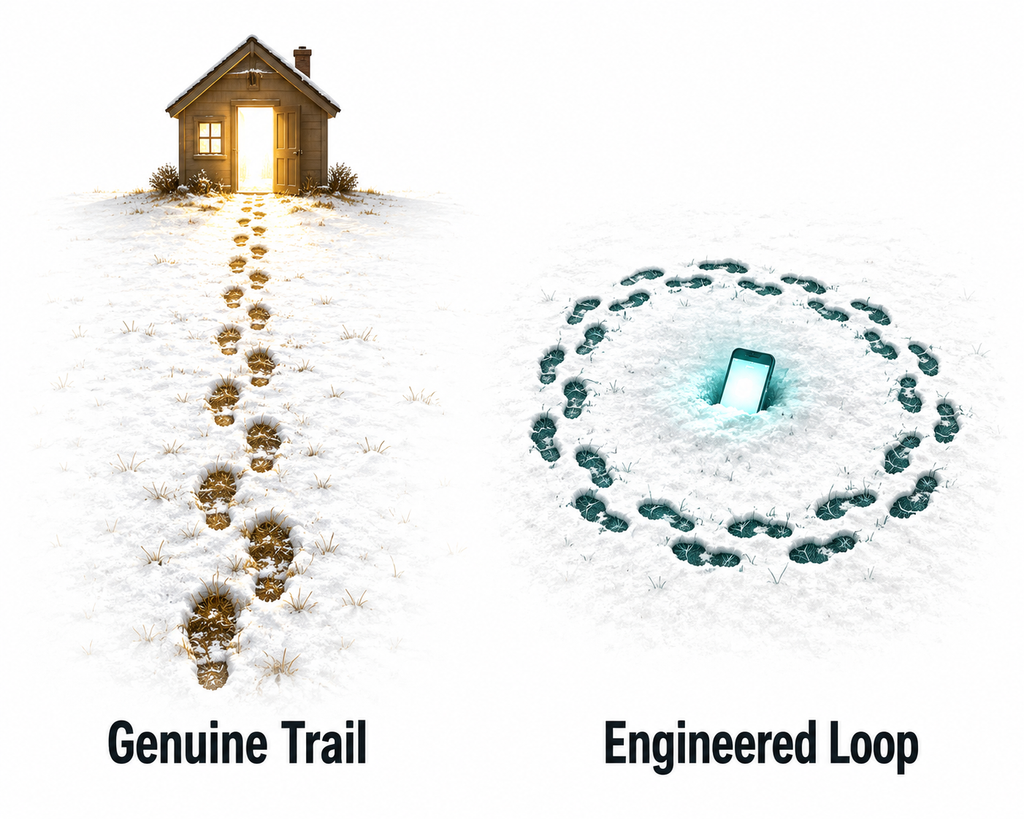
This distinction matters if you’re building anything that touches how people relate to each other, and it’s worth reading against something like the three life phases nobody’s built for, which looks at exactly the kind of generational friction — digital-native adolescence, extended longevity, climate anxiety — that hasn’t been properly paved yet, genuinely or otherwise. The takeaway: before you build in that space, ask honestly whether you’re finishing the trail or fencing people onto it.
How to Read the Map: Applying Bradford’s Question
The structural approach this framework proposes is straightforward: walk through the seven life phases one at a time, map the needs, wants, and problems that define each one, trace the industries those needs have already generated, and examine the financial instruments those industries have produced on top. At every stop, keep asking Bradford’s question — not what should the path look like, but where are people already walking?
Turn that into an actual checklist before your next product decision, not a philosophy you nod at and forget:
- What life phase is this customer actually in, specifically?
- What need, want, or problem in that phase am I addressing?
- What workaround do people already use, badly, for this?
- What will this solution make necessary next — what’s the next footprint it creates?
- Am I finishing a trail, or fencing people onto one?
If you’re mapping this out for a specific business idea rather than an entire industry, the six-step framework for turning human friction into a business is a useful companion — it takes the same “find the friction first” instinct and walks it down to founder-level execution.
Key Takeaways
- The desire-path method comes from Joseph Bradford’s approach to Ohio State’s sidewalks: watch where people already walk, then pave it.
- Every human life moves through the same seven universal phases, and each phase carries its own recurring needs, wants, and problems.
- Ideas live in the gap between a problem and its solution — map the gap before you build.
- Solutions create feedback loops: today’s answer becomes tomorrow’s new problem, and often an entire new industry.
- Some industries pave real trails; others engineer dependency by blocking the natural one — that’s the mechanism behind loneliness by design.
- Bradford’s question — where are people already walking? — works as a literal audit step before any product or strategy decision.
FAQ
What is the desire-path method?
It’s the practice of building products, services, or strategy around behavior that already exists rather than behavior you assume people should adopt — named after Joseph Bradford’s approach to laying campus sidewalks over paths students had already worn into the snow.
Where does the term “desire path” come from?
It’s a landscape architecture and urban planning term for the informal trails people wear into the ground by taking the shortest or most natural route, rather than the one a designer intended.
What are the seven universal life phases?
The framework holds that every human life passes through the same seven biological and developmental phases, in roughly the same order, across all cultures and eras — the specific products serving each phase change over time, but the phase itself doesn’t.
How is this different from ordinary market research?
Market research typically asks people what they want. The desire-path method looks at what people already do, on the theory that behavior is a more honest signal than a stated preference.
Why does the feedback loop matter for founders?
Because every solution reshapes the conditions that produced it, generating a new problem downstream — plan for what your product makes necessary next, not just what it fixes today.
The Trail Doesn’t Lie
Bradford’s balloon ride is the whole method in miniature: go up high enough, look honestly at what people actually do, and stop arguing with the footprints. Most businesses fail not because the idea was bad but because someone poured concrete across open grass while the real trail sat untouched nearby.
Before your next product decision, do the boring thing first. Go find the snow. Look for the footprints already there. Then build.
Sources
- The Human Constant (source chapter for this piece)
- Characterization of the seven life phases as biological and developmental realities occurring in roughly the same sequence across all human cultures and historical periods (framework’s claim, not independently verified)
- The specific example chain: automobile solving transportation problem leading to suburbs, new childhood, driving license as rite of passage, car insurance, car loans, and a ‘teenage driving economy’ (presented as illustrative claim from source material, not verified historical causation)
- Reference to Emma Raducanu’s age/date and ranking details appears only in a linked cross-post’s own content, not asserted as fact by this piece
