



















































Why Middle-Age Reinvention and Legacy Planning Are Still Unsolved Problems

In 2013, the classics scholar Mary Beard went on the BBC’s Question Time and made a calm, evidence-based case about immigration. The response had nothing to do with her argument. Critics went after her appearance instead — one reviewer suggested she was too unattractive for television and should be kept off screens altogether. Beard, then in her late fifties, gray-haired, wearing no makeup, answered the way she always answers: precisely, and without flinching. Her reply set off a conversation that had clearly been waiting years to happen. Middle-aged women, it turned out, had a lot to say about being rendered invisible — and about a marketplace that had never quite figured out what to do with them.
That’s the pattern worth noticing. Middle age is when people look backward and forward at the same time, and that double glance reshapes markets, culture, and identity all at once. It also exposes two problems nobody has actually solved: affordable reinvention and legacy planning for people who aren’t managing eight-figure estates. Middle age reinvention and legacy planning sound like they should be well-served by now — there’s an entire wellness economy, an entire philanthropy industry, entire categories of coaching and certification. And yet the infrastructure keeps missing the people standing in the middle of it.
The Wellness Industry Solved Mortality Anxiety — But Not Reinvention
The global wellness industry is enormous — commonly cited at somewhere around $6.8 trillion a year, though that figure comes from industry-tracking reports rather than a single audited government source, so treat it as a directional estimate rather than a precise count. Most of that spending is driven by middle-aged consumers, and not because they’re fragile. Middle age is when the body starts a serious, ongoing negotiation with mortality: metabolism slows, hormones shift, cardiovascular risk climbs. Organic food, gym memberships, preventive screenings, anti-aging skincare — the whole category is built around extending and preserving what a person already has.
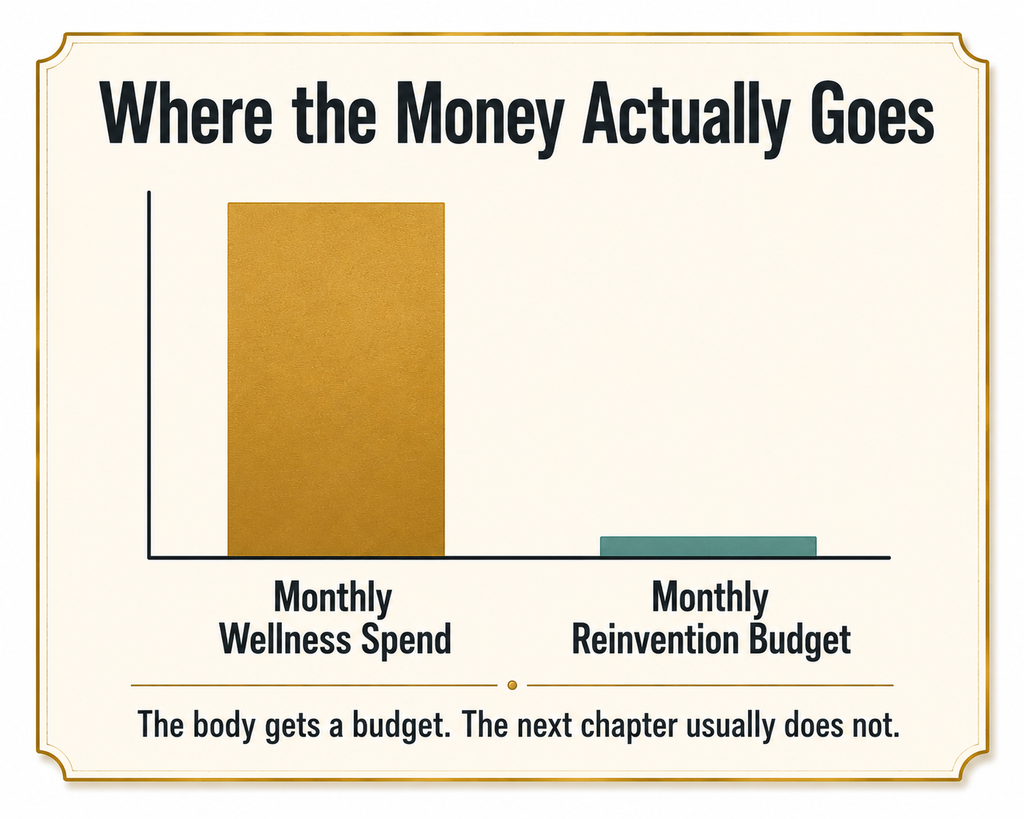
What it isn’t built around is who that person becomes next. A $200 monthly wellness budget can coexist with zero dollars set aside for retraining, a certification, or even a few sessions with a career coach. Wellness spending treats the body as the site of the crisis. But the crisis showing up in a lot of people’s mid-forties isn’t just physical — it’s occupational and existential, and no amount of magnesium supplementation retrains you for a new industry. Worth a genuine line-item check: how much of your “self-improvement” spending is actually funding a different version of the same life, versus a different life.
The Menopause Economy: A Predictable Experience the Market Still Ignores
Menopause is universal for roughly half the population and about as predictable, biologically, as adolescence — studied in medical literature since at least the eighteenth century. The commonly cited estimate that it affects over a billion women globally circulates widely, but it traces back to population projections rather than a single verified count, so it’s best read as a rough order of magnitude, not a hard number. What’s not in dispute is the underserved part: as of the mid-2020s, commercial and clinical infrastructure for menopause — targeted product categories, workplace policy, insurance coverage, even basic physician training — remains thin relative to how many people go through it and how disruptive it is to mood, sleep, cognition, and physical capacity.
Compare that to adolescence, which has an entire economy built around it — puberty education, targeted skincare, school counseling programs, a whole aisle of products. Menopause has comparably universal reach and comparably real effects, and still doesn’t have its adolescence-sized infrastructure. That gap is the clearest evidence in this whole piece that “universal” and “well-served” are not the same thing.
The Re-invention Economy Serves the Already-Credentialed
There’s real infrastructure for reinventing a career: executive MBA programs, professional coaching, certification platforms, LinkedIn’s entire ecosystem of thought-leadership and networking. It’s genuinely useful — if you can afford it. An executive MBA can run well into six figures. Coaching packages are often priced for people who already have a director-level salary to protect. That’s not an accident of the market; it’s who the market was built to serve.
The harder-to-verify claim — that the average professional changes careers, not just jobs, multiple times over a working life — gets repeated often enough that it’s become conventional wisdom, but the data behind it is genuinely murky; job-switching statistics are well documented, full career changes are not tracked nearly as cleanly. What’s not murky is the lived experience: a lot of people in their forties and fifties are quietly rebuilding a professional identity from a lower budget than the reinvention economy assumes they have. If you’re one of them, the practical move is to skip the branded, expensive tier and go straight for the unglamorous one — community college certificates, free or low-cost online coursework, trade apprenticeships — before assuming reinvention requires an MBA-sized bill. The same instinct to rebuild identity from scratch under pressure shows up in other life-stage transitions the market hasn’t built proper infrastructure for either.

Nobel’s Will and the Birth of Legacy as a Middle-Age Instinct
In April 1888, a French newspaper mistakenly reported that Alfred Nobel had died — it was actually his brother Ludvig, in Cannes. The real obituary that ran was brief and dry, something to the effect that the inventor of dynamite, a man who could hardly pass for a benefactor of humanity, had died. It was corrected the next day. A more dramatic version of the story — a headline reading “The Merchant of Death Is Dead” — gets repeated constantly, but no one has been able to pin down where or whether it actually ran; treat that specific headline as folklore layered onto a real incident rather than a documented fact.
The underlying event, though, was real and clearly unsettling: Nobel got an early, unflattering preview of how history intended to remember him. Seven years later he rewrote his will and put the bulk of his fortune into what became the prizes bearing his name. Nobody can say with certainty what moved him. But the timing is hard to ignore, and it’s a clean illustration of something that shows up constantly in middle age: the pull to build something that outlasts you isn’t just financial planning, it’s identity formation with a longer time horizon.
Legacy Planning for the Middle Class: The Gap Nobody Built For
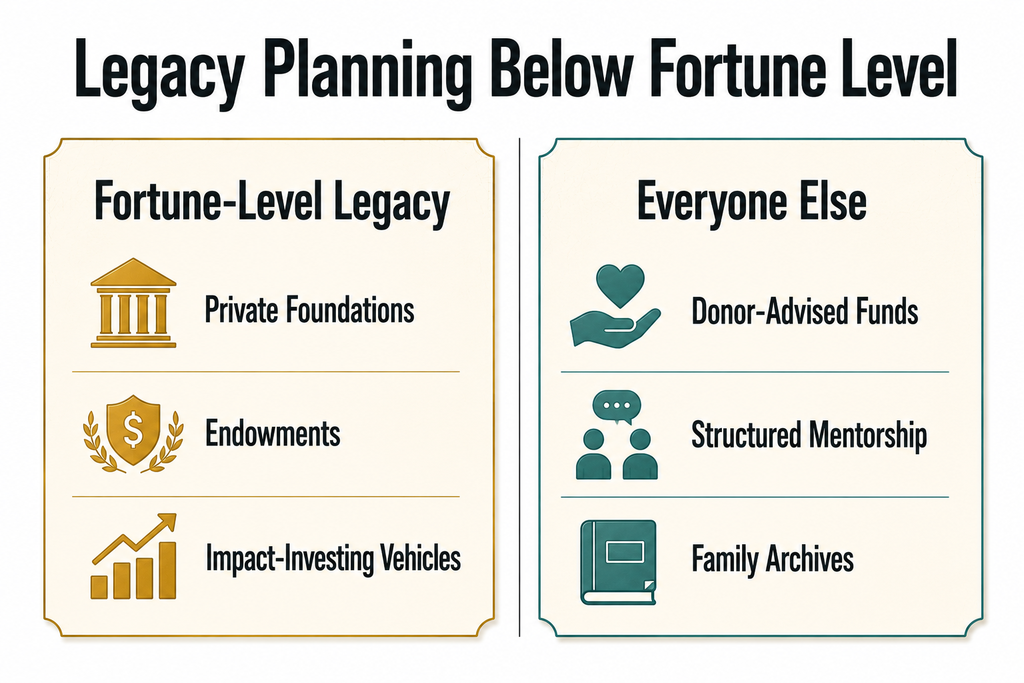
Nobel had a fortune large enough to fund an institution that’s still handing out prizes over a century later. Most people don’t, and the legacy infrastructure that exists — foundations, endowments, impact-investing vehicles — is built almost entirely for that scale of wealth. Below it, the options thin out fast: a will, maybe some scattered charitable giving, and not much structured middle ground.
But legacy doesn’t require a foundation. Donor-advised funds now exist with far lower entry points than a private foundation ever needed. Structured mentorship — formally passing skills or a trade to someone specific, rather than hoping it happens informally — is a legacy vehicle nobody markets as one. Family archives, written histories, recorded oral histories: these are legacy planning too, just without a wealth manager attached. The instinct Nobel acted on at fortune-level scale is the same instinct available to anyone, at any budget, if the tools get named and used deliberately instead of treated as things only rich people do.
Making Reinvention Work at Any Income
Is it too late to change careers in your forties or fifties?
No — but the honest answer is that it’s harder without money behind you, since most of the visible reinvention infrastructure (executive MBAs, premium coaching) is priced for people already earning well. Cheaper entry points exist; they’re just less marketed.
What counts as a legacy if you’re not wealthy?
Anything that outlasts you and carries something forward deliberately — mentorship, a family archive, a skill passed to someone specific, a modest donor-advised fund. The scale is different from a Nobel Prize; the underlying instinct isn’t.
Why is menopause still commercially underserved when it’s this common?
Largely because health markets have historically been built around conditions treated as clinical emergencies rather than universal life transitions, and menopause got filed — for a very long time — under “just aging,” not “underserved market.”
Key Takeaways
- Middle age triggers two parallel reckonings — with the body (wellness) and with identity (reinvention) — and only one of them has a well-funded industry behind it.
- The wellness industry, often estimated in the trillions annually, largely addresses physical decline, not career or identity transitions.
- Menopause is widely described as affecting a very large share of the global population, but even that scale hasn’t produced matching commercial or clinical infrastructure.
- The re-invention economy (MBAs, coaching, certifications) is real but priced for people who are already credentialed, not the median career-pivoter.
- Legacy planning has robust infrastructure at fortune-level wealth and almost none below it — donor-advised funds, mentorship, and family archives are underused substitutes.
Middle age reinvention and legacy planning will stay unsolved as long as the infrastructure keeps assuming everyone going through them has an executive salary or a fortune to leave behind. Most people don’t. The actual move — audit where your wellness dollars are really going, price out the unglamorous reinvention path before the expensive one, and pick a legacy vehicle that fits your budget instead of waiting for one that doesn’t exist yet.
Sources
- The Human Constant — The Reckoning
- Global wellness industry valued at approximately $6.8 trillion annually
- Mary Beard’s 2013 BBC Question Time appearance and the specific critic comment about her appearance
- Alfred Nobel’s brother Ludvig died in Cannes in April 1888 and a French newspaper mistakenly reported Alfred’s death
- The ‘Merchant of Death Is Dead’ headline as an alleged but unverified later embellishment
- Nobel rewrote his will seven years after the 1888 obituary mix-up, leading to the Nobel Prizes
- Characterization of LinkedIn’s ecosystem as central to the re-invention economy
- Menopause studied in medical literature since at least the eighteenth century
- Claim that menopause remains one of the most commercially underserved universal experiences as of the mid-2020s
