










































Needs keep you alive. Wishes make you spend. Every civilization-shifting idea, product, or purchase you can name was born not from necessity but from want — and if you want to understand where money is actually moving right now, the experience economy is the term to know. It describes a simple but underrated shift: people increasingly pay premiums not for things, but for how those things make them feel. Look at your own last ten discretionary purchases. Chances are none of them kept you alive. That’s not a character flaw. That’s the whole economy working as designed.
Needs Keep You Alive. Wishes Make You Spend.
Start with the obvious: nobody needs a concert ticket, a hand-stitched leather bag, or a boutique hotel room with a view. Yet these are exactly the categories where consumers spend the most freely and defend the spending the least. Ask someone why they bought a $400 handbag and they won’t say “utility.” They’ll say something closer to “I wanted it” — full stop, no further justification required.
That’s the tell. Wishes don’t need to explain themselves the way needs do. A need is negotiated against a budget; a wish overrides the budget. And once you notice that pattern in your own spending, you start seeing it everywhere — which is exactly where the next wrinkle in the story comes in.
Maslow Was Half Right — and the Wishlist Proves It
Abraham Maslow’s hierarchy of needs, published in 1943, remains one of the most widely taught frameworks in psychology and marketing. Its core claim — that humans move up a ladder from survival to safety to belonging to esteem to self-actualization — has shaped a century of product strategy. It’s also wrong in one important way: not in identifying the needs, but in insisting people address them in order. They don’t.
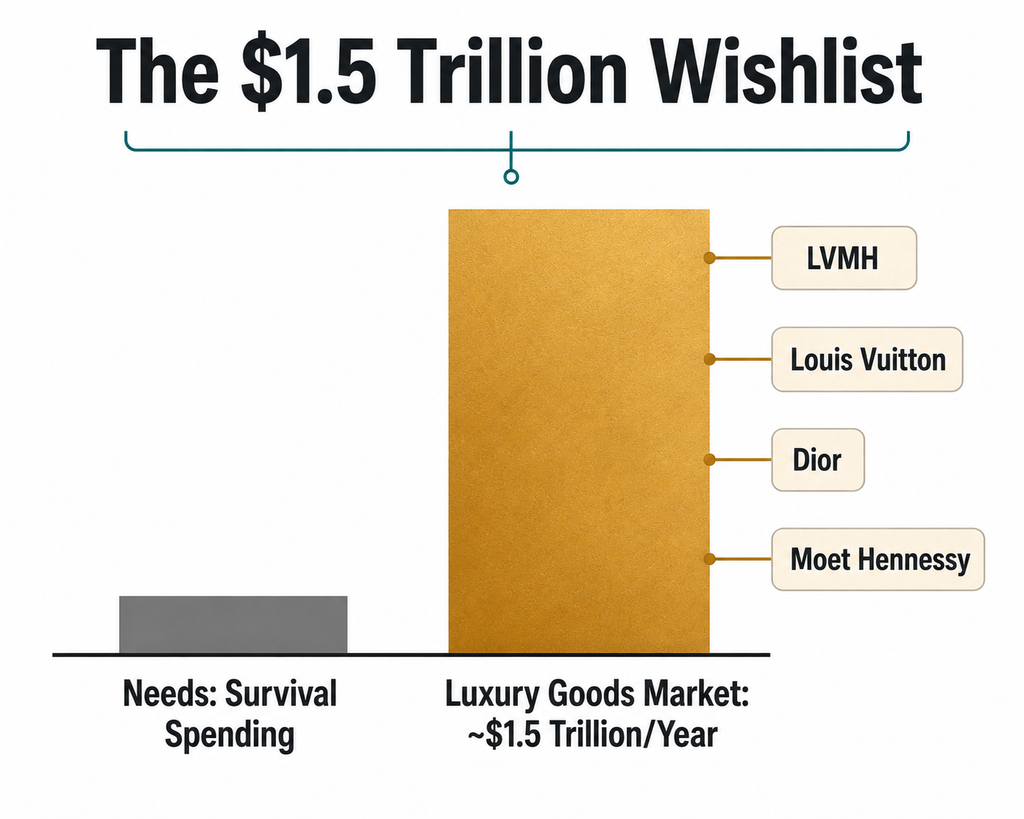
The clearest evidence sits in the luxury goods market, which industry estimates place somewhere in the neighborhood of $300–480 billion a year globally — a figure that varies by which analyst firm you ask and which product categories they count, but the order of magnitude is not seriously disputed. Luxury goods, by definition, serve no survival function. And the company sitting at the center of that market, LVMH — parent of Louis Vuitton, Moët Hennessy, Christian Dior, and dozens of other houses — has at various points been valued in the hundreds of billions of dollars, with founder Bernard Arnault reportedly ranking among the world’s wealthiest individuals in recent years. Exact figures move with the stock price and are worth checking against current reporting rather than treating as fixed, but the scale is not in question: that is hundreds of billions of dollars resting entirely on wishes, not needs.
For marketers, the lesson is blunt: stop assuming customers must satisfy “lower” needs before you can sell them aspiration. The luxury market doesn’t wait for permission from the base of the pyramid. Neither does your customer.
1998: The Year Two Economists Called This
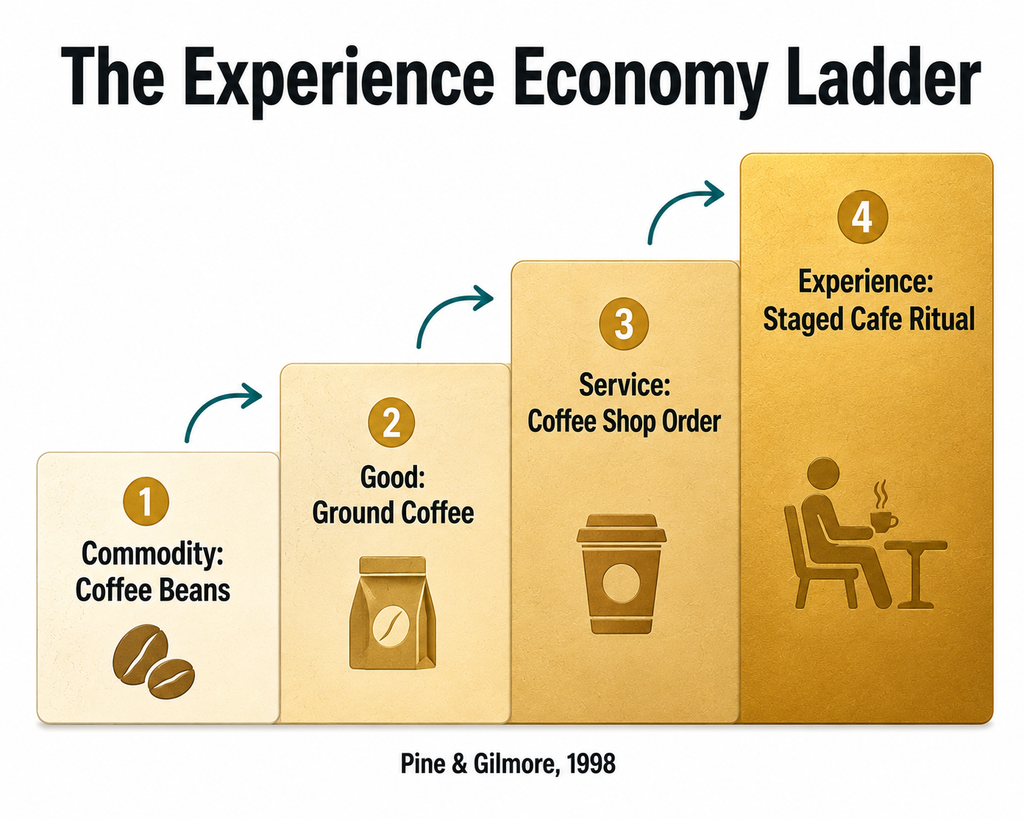
In 1998, economists B. Joseph Pine II and James H. Gilmore published a prediction that has aged unusually well: as goods and services became commoditized — cheaper, more interchangeable, easier to copy — consumers would increasingly pay a premium for experiences instead. Their term for this shift was the experience economy, and the idea was radical enough at the time to require an entire framework to explain it. A cup of coffee, they argued, could be a commodity, a good, a service, or a staged experience — and each step up that ladder commanded a bigger premium, even though the physical coffee barely changed.
What’s striking almost three decades later isn’t that Pine and Gilmore were right. It’s that they may have understated it.
The Eras Tour: Prediction Meets Proof
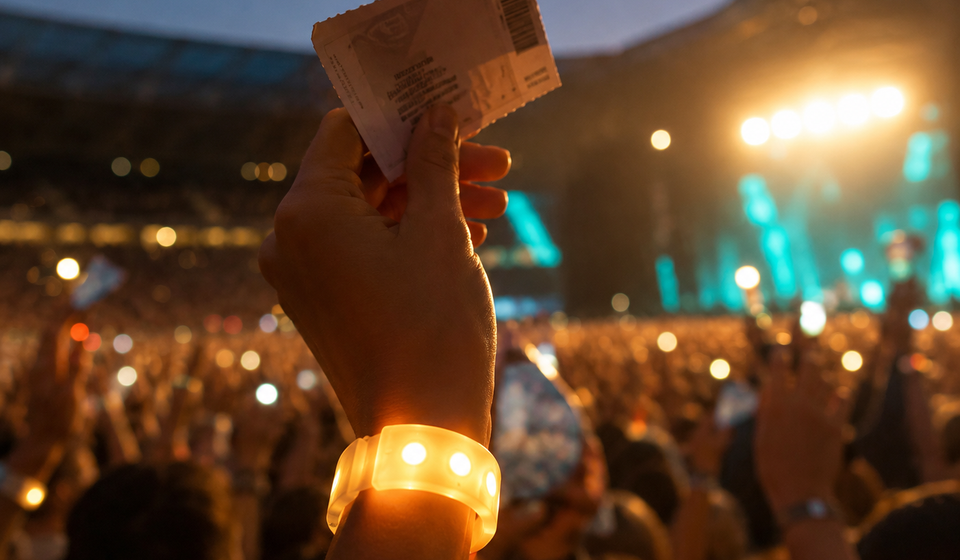
The clearest modern illustration of the experience economy is also the loudest: Taylor Swift’s Eras Tour. Reporting has pegged ticket sales at roughly $2.2 billion, making it the highest-grossing tour on record — a figure widely cited by entertainment and financial press, though as with most tour-revenue estimates it’s built from ticketing and industry data rather than an audited public filing, so treat the exact number as a well-sourced estimate rather than a certified one. Total economic impact — hotels, flights, restaurants, merchandise, local spending in host cities — has been estimated by various outlets at well over $10 billion, though that broader figure depends heavily on which studies and cities are counted, and deserves the same caveat.
Even with the hedges attached, the shape of the story holds. Disney’s theme parks have run on this exact logic for decades. Apple’s retail stores sell a browsing experience as much as a product. Airbnb built an entire “Experiences” product line on top of its original lodging business because customers wanted more than a bed. The common thread: none of these are selling objects. They’re selling a wrapper around an object, and the wrapper is where the margin lives.
Brands still organized around “what do we manufacture” are asking the wrong question. The better one is: what does owning, attending, or using this actually make someone feel — and are we charging for that feeling, or just for the object it comes wrapped in?
Why Status Sells: The Aspiration Machine
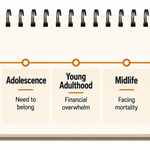
Status-seeking isn’t vanity bolted onto human nature — it runs on the same wiring as adolescent belonging anxiety, the drive to know where you stand in a group and to signal it convincingly. Adults don’t outgrow that drive; they just get more sophisticated channels for it. Brand names, degrees, zip codes, car badges, and vacation destinations all function as signals broadcasting a claim about identity and rank.
Companies that understand this consistently outperform companies that pretend status doesn’t factor into purchase decisions. That doesn’t mean every brand needs to chase luxury positioning — it means every brand should be honest with itself about which need on the wishlist it’s actually serving, and price and position accordingly rather than hiding behind purely functional language.
The Next Wishlist: What’s Still Underserved
Here’s where it gets interesting for anyone building something new. The content of consumer wishes changes generation to generation; the structure doesn’t. People still want status, belonging, beauty, meaning, and transformation — felt with the same intensity as needs, even though none of them are needs.
Three wishes look conspicuously underserved right now: genuine community in an era of digital pseudo-connection, work that feels meaningful rather than merely well-compensated, and a relationship with technology that enhances experience instead of colonizing attention. Those gaps are the whitespace — community-first products, employers who actually deliver on purpose rather than marketing it, and technology built to give attention back instead of extracting more of it. That last wish, about wanting a saner relationship with the tools running our lives, connects to a broader question worth sitting with: whether AI is actually displacing what makes us human or making it more valuable. Whoever answers these three wishes convincingly captures the next decade of the experience economy. Nobody has fully cracked any of them yet.
FAQ
What is the experience economy?
A term coined by economists Pine and Gilmore in 1998, describing the shift from selling commoditized goods and services toward selling memorable experiences that command a premium.
Is the Eras Tour really the highest-grossing tour in history?
By most industry and press estimates as of the tour’s run, yes — reported figures put ticket sales around $2.2 billion, though exact totals vary by source and aren’t independently audited public numbers.
Why does status-signaling matter to marketers?
Because purchase decisions are frequently driven by identity and belonging rather than function. Brands that price and position around that reality tend to outperform those that pretend customers buy purely on utility.
What’s the “next wishlist” in the experience economy?
Genuine community, meaningful work, and a healthier relationship with technology — three underserved wishes that current products and employers have largely failed to satisfy.
Key Takeaways
- Needs and wishes don’t operate on the same ladder — wishes can be spent on without “earning” the right through lower-tier needs first.
- The luxury market, estimated around $300–480 billion annually, exists entirely outside survival necessity.
- Pine and Gilmore’s 1998 prediction that commoditization would push consumers toward paying for experiences has proven directionally correct, and arguably understated.
- The Eras Tour, with reported ticket sales near $2.2 billion and broader economic impact estimated well past $10 billion, is the most visible recent proof point — treat the precise totals as strong estimates, not audited fact.
- Status-signaling is adult belonging anxiety wearing a nicer outfit, and brands that serve it honestly outperform those that ignore it.
- The next frontier: community, meaningful work, and humane technology — three wishes still waiting for someone to serve them well.
If you’re building or marketing anything right now, the actionable move isn’t complicated: figure out which wish on that underserved list your product actually touches, and stop describing it in the language of needs. Nobody lines up overnight, pays a premium, or defends the purchase to friends because it was merely useful.
Sources
- The Human Constant (source chapter for this piece)
- Billboard, Variety, Forbes — Eras Tour ticket sales (~$2.08–2.2B)
- Michigan Journal of Economics, US Travel Association — Eras Tour US economic impact
- Harvard Business Review, “Welcome to the Experience Economy” (Pine & Gilmore, July–Aug 1998)
- Grand View Research, Fortune Business Insights, Straits Research — global luxury goods market size ($300–480B/year)
