



















































Every financial instrument ever created is humanity admitting a problem. Not solving one triumphantly — admitting it, the way you admit you can’t carry something alone. Call it financial instruments as confessions: the idea that money’s entire toolkit — coins, paper notes, insurance, credit — exists because it confesses to a specific, widely shared friction, not because someone set out to invent something clever. The Lloyd’s of London coffee house origin story is the cleanest version of this pattern in financial history: a room full of nervous men, a wall of shipping news, and a bet that turned into an institution insuring the modern world.
Money’s whole history reads this way if you squint. Insurance is just the confession dressed in salt water instead of coin.
Every Financial Instrument Is a Confession
Financial tools don’t arrive because someone brilliant dreamed them up in a vacuum. They arrive because enough people hit the same wall at the same time and someone finally wrote the workaround down.
That’s the lens worth holding onto here, because it changes how you judge new fintech too. A new app or instrument isn’t interesting because it’s clever. It’s interesting because of what friction it’s confessing to. Ask what problem a product admits exists, and you’ll understand it faster than reading its pitch deck.
Barter, Coins, and the Double Coincidence of Wants
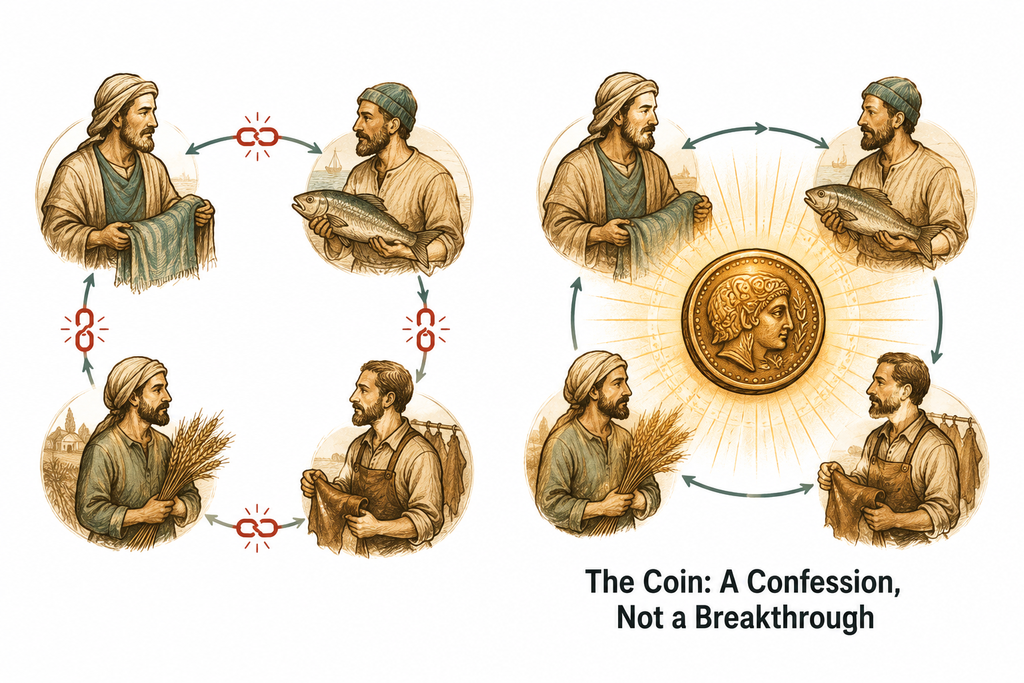
Picture a medieval marketplace. A cloth merchant has fabric and needs fish. The fisherman needs leather. The leather worker needs grain. The grain farmer needs cloth. Everyone there has something someone else wants — in theory the whole system should clear itself out by lunch.
It doesn’t, because the cloth merchant and the fisherman are rarely in the same place holding exactly what the other needs at exactly the right moment. Economists call this the double coincidence of wants, and it’s the specific failure money was invented to patch.
The earliest coins appeared independently in Lydia, China, and India, with Lydia’s electrum coins dated to around 600 BCE and China’s earliest metal coinage plausibly just as old, though historians still debate the exact dating on the Chinese side — not as a triumph of economic theory but as tired traders agreeing on something portable, divisible, and universally trusted. The coin wasn’t a breakthrough. It was a confession: barter is broken, and we need everyone to agree on a fix.
Iron Coins, Jiaozi, and the Weight Problem
By the eleventh century, merchants in Sichuan had their own confession to make. Their currency was iron coin, and iron is heavy in a way silver and copper never are. According to traditional accounts, closing an ordinary trade didn’t mean carrying money — it meant hauling it, sometimes by cart, sometimes with a hired porter, for a transaction a modern wallet settles in a second. The exact weights and exchange rates recorded in popular retellings of this story vary and aren’t easy to independently pin down, but the underlying friction is well documented: iron coin was punishingly impractical for real trade.
Around 1008, sixteen merchant houses in Chengdu stopped hauling the iron and started printing paper instead — notes called jiaozi, each one a promise redeemable for a fixed amount of coin held in reserve. Nobody in government ordered this. Sixteen businessmen, tired of the same physical problem, solved it the same way, in the same city, at roughly the same time.
The takeaway carries forward: solutions to financial friction tend to come from frustrated practitioners, not policymakers sitting in a room theorizing about liquidity. That pattern is about to repeat itself six centuries later, in a coffee house.
Tower Street, 1680s: Gossip Becomes a Hedge
By the late 1680s, Edward Lloyd’s coffee house on Tower Street in London had become the place where ship captains, merchants, and underwriters gathered to trade news of the sea — which vessels had made it home, which were overdue, which had gone down in a storm. Lloyd is generally credited with circulating that shipping intelligence to the patrons who filled his tables, and the same room that carried the news started carrying the deals: merchants willing to bet, for a fee, that a given ship would arrive safely, and shipowners willing to pay that fee rather than absorb a total loss alone.
Marine insurance did not begin as an industry. It began as gossip in a coffee house that a roomful of anxious men turned into a hedge.
That’s the whole Lloyd’s of London coffee house origin in one image: not a boardroom, not a charter, just caffeine, dread, and enough shared information that betting on outcomes became rational. Marine insurance wasn’t designed top-down — it emerged from an informal network trading intelligence, and that’s worth remembering any time someone tells you an entire industry needs a grand architect to exist. Sometimes it just needs a room and a reason to talk.

The Confession Underneath Insurance
Strip away the coffee and the ship logs, and here’s what marine insurance actually admits: no single shipowner could bear a total loss alone, and the future of any given voyage was genuinely unknowable. Storms don’t check a shipping schedule. Neither do reefs.
Insurance doesn’t eliminate that uncertainty — nothing can. It redistributes the cost of it across many shoulders instead of one. That’s the whole mechanism, however many actuarial tables get built on top of it later.
Modern insurance products still solve this same confession. Health insurance, flood insurance, your car policy — all of it still says, underneath the paperwork, “I cannot survive this loss by myself, so let’s share it in advance.” The math has gotten enormously more sophisticated since Tower Street. The confession hasn’t changed at all.
From Coffee House to Global Institution
The informal betting at Lloyd’s hardened over time into Lloyd’s of London, the institution — underwriters, syndicates, formal policies, the whole apparatus. But the pattern that built it didn’t stop at marine insurance. Banking confessed that holding your own paper was its own risk — theft, fire, a lost strongbox — and that someone needed to guard it better than you could alone. Credit cards confessed something more personal: we want things now that we can’t yet afford.
Even a company as dominant as Apple fits the pattern. Apple briefly touched a three-trillion-dollar market valuation intraday in January 2022 — the first company ever to do so, though it didn’t close above that mark until June 2023. Either way, the number says less about engineering brilliance than about how many overlapping human needs one product line can answer at once, across every age bracket that carries a phone. Apple didn’t invent those needs. It read them accurately, the same way Lloyd’s regulars read shipping risk.
Every enduring financial institution starts the same way: an informal fix to a widely shared, specific pain point, built by people annoyed enough to do something about it. Worth remembering next time a pitch deck calls itself revolutionary.
What the Next Confession Might Be
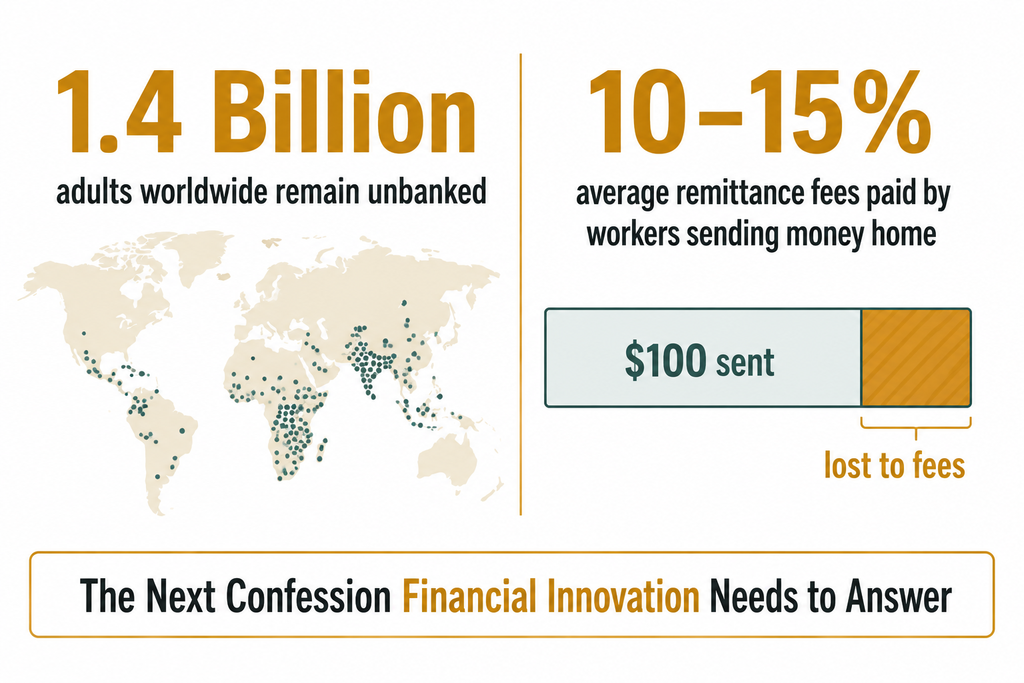
The next great financial instrument is already confessing itself in plain sight. An estimated 1.4 billion adults worldwide remain unbanked, without reliable access to basic financial services (World Bank Global Findex 2021). Workers sending money home to family in developing economies often pay remittance fees that run considerably higher than the global blended average of roughly 6% — bank-channel transfers specifically average closer to 15%, and several high-cost corridors run even higher — a toll that quietly taxes exactly the people who can least absorb it.
That’s not a rounding error. That’s a Tower Street-sized friction waiting for its coffee house. For a longer look at how the gap Lloyd’s left behind still shapes who gets covered and who doesn’t, see who Lloyd’s never reached.
Key Takeaways
- Financial instruments emerge from shared friction, not top-down genius — coins, paper money, and insurance all followed this pattern.
- Marine insurance began informally at Edward Lloyd’s coffee house on Tower Street, where shipping news traded hands alongside side bets on ship arrivals.
- The core confession under any insurance product is the same: no one person can absorb a total, unpredictable loss alone.
- Institutions like Lloyd’s of London start as informal fixes before hardening into formal structures.
- Roughly 1.4 billion unbanked adults and high remittance fees look like the next confession financial innovation needs to answer.
FAQ
What is the Lloyd’s of London coffee house origin story?
Edward Lloyd ran a coffee house on Tower Street in London starting in the late 1680s, where sailors, captains, and merchants gathered to trade shipping news. That informal exchange of information evolved into betting on ship outcomes, which became the foundation of marine insurance and eventually the Lloyd’s of London institution.
Did Edward Lloyd invent insurance?
Not single-handedly, and not by design. He ran a coffee house that became a hub for shipping intelligence; the insurance market grew out of the deals his patrons started making with each other, not from any deliberate plan of his.
Why is marine insurance considered the first modern insurance market?
Because it formalized the practice of spreading a single, potentially catastrophic loss across many parties in exchange for a fee — the basic mechanism nearly all insurance still uses today.
What does “financial instruments as confessions” mean?
It’s a framing for understanding money’s history: each new financial tool — coins, paper money, insurance, credit — exists because it admits a specific, widely shared human problem, rather than because someone set out to invent something impressive.
Is there a modern equivalent to the Lloyd’s coffee house problem?
Arguably yes. Roughly 1.4 billion unbanked adults and costly remittance fees represent an unresolved friction similar in scale to the one that produced marine insurance — a gap explored further here.
Sources
- The Human Constant (source chapter for this piece)
- Earliest coins appearing independently in Lydia (~600 BCE), China, and India
- China’s earliest coinage dating and its contested chronology relative to Lydia
- Jiaozi paper money privately issued by sixteen Chengdu merchants around 1008, later nationalized by the Song government in 1023
- Apple reaching a $3 trillion market cap intraday in January 2022, but not closing above that mark until June 2023
- Confirmation of Apple’s later 2023 close above $3 trillion
- 1.4 billion adults remain unbanked worldwide, World Bank Global Findex Database 2021
- Global average remittance cost (~6.36% as of Q3 2025) versus bank-channel costs averaging ~15%, World Bank Remittance Prices Worldwide
