













































Needs keep you alive. Wishes make you spend. That distinction is the whole engine of the wishlist economy, and most companies still misread it as a footnote.
In 1943, Abraham Maslow proposed a hierarchy of needs, stacked in order of priority, that became one of the most widely taught frameworks in psychology and marketing. It’s mostly right about what humans need. It’s wrong about the order they chase those needs in. People do not climb the pyramid rung by rung, satisfying survival before they reach for status or meaning — they chase all of it at once, often putting the “higher” wishes first. We’ve made that argument in more depth elsewhere, but the short version is enough to reorient how you think about the wishlist economy: understanding what people wish for, not just what they need, is the real key to reading consumer behavior.
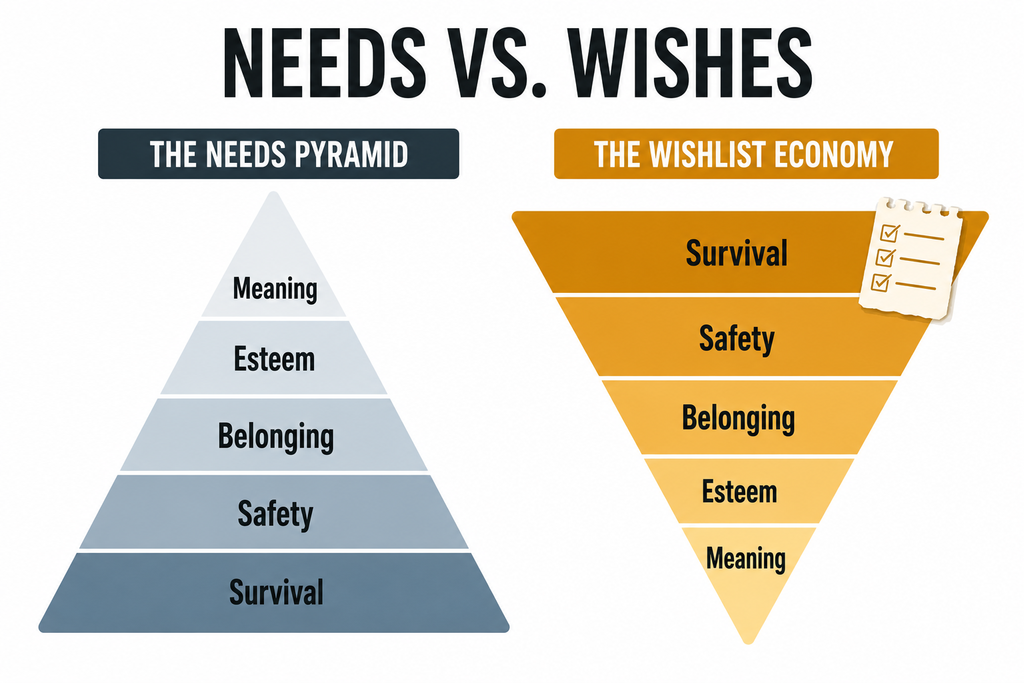
The Wishlist Is Bigger Than the Needs List
Here’s the number that should embarrass every “needs-based” market analysis: the global luxury goods market is worth roughly $1.5 trillion a year. Luxury goods, by definition, serve no survival need whatsoever. Nobody needs a specific handbag to stay alive.
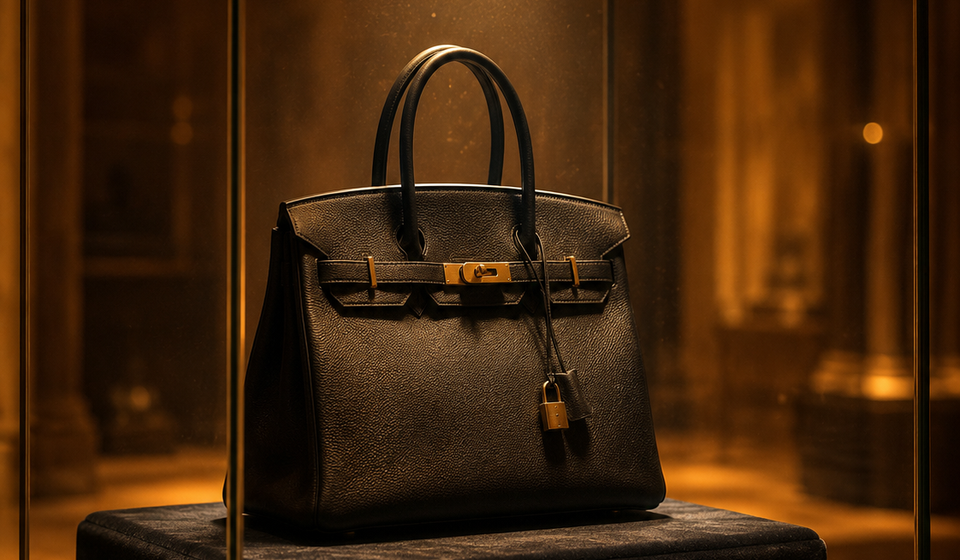
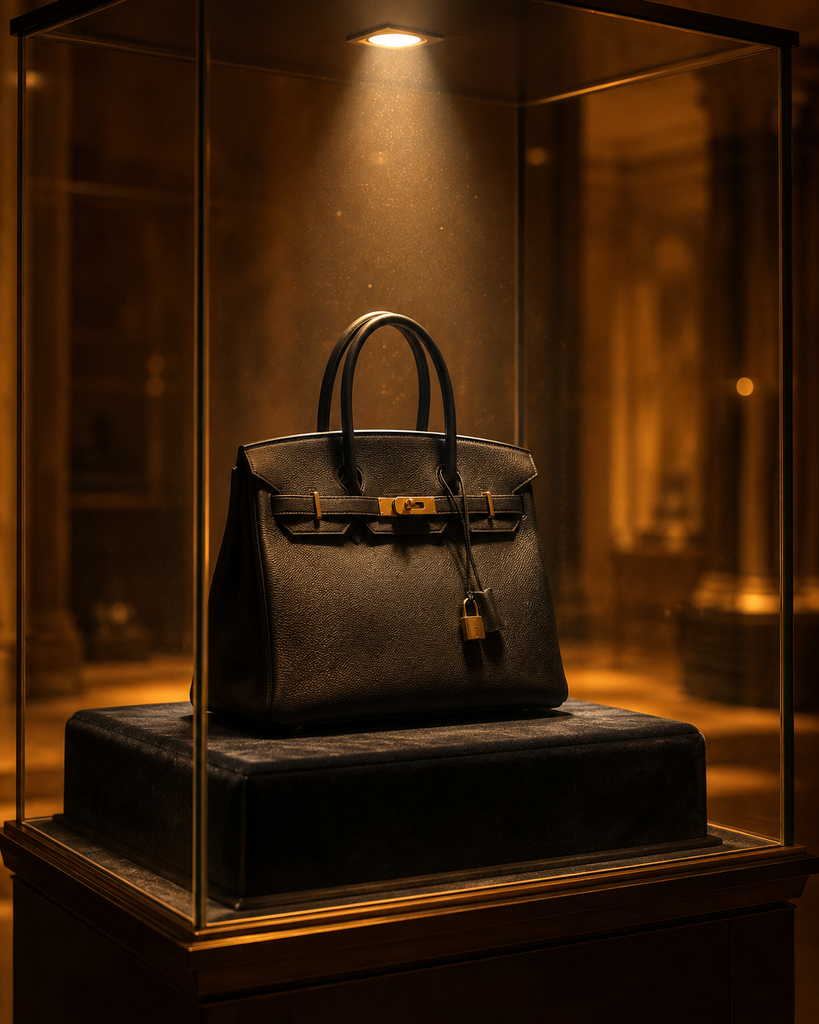
LVMH — parent company of Louis Vuitton, Moët Hennessy, Christian Dior, and more than sixty other luxury brands — was valued at approximately $400 billion in 2023, a run that reportedly made its founder Bernard Arnault the wealthiest person on the planet at various points that year. Strip away the balance sheet language and what you’re left with is simpler and stranger: that entire valuation rests on wishes, not needs. Nobody needed a Birkin bag. Millions of people wanted one badly enough to build an empire around the wanting.
Brands chronically underprice this. They budget for utility and forget that wish-fulfillment is where the real margin lives.
The Experience Economy Proves the Point
In 1998, economists Pine and Gilmore predicted that as goods and services became commoditized, consumers would pay a premium for experiences instead. The prediction held up better than they likely expected.
Disney’s theme parks, Apple’s retail stores, Airbnb’s “Experiences” product — these all monetize a wish rather than a need. So does live music at scale: the Taylor Swift Eras Tour reportedly grossed an estimated $2.2 billion in ticket sales alone, which would make it the highest-grossing tour in history, and its total economic footprint — hotels, flights, local spending — has been estimated at well beyond $10 billion once you count what happened around the shows, not just inside them.
Experiences out-earn products for a specific reason: they deliver status and meaning directly, with no assembly required. A product promises transformation. An experience is the transformation, already delivered, already over, already worth posting about.
Status, Signaling, and the Aspiration Machine
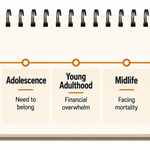
Status-seeking isn’t vanity bolted onto human nature — it’s wired into the same circuitry as adolescent belonging anxiety, the drive to know where you stand in the group. Adults never outgrow it. They just trade it for subtler currency: the right degree, the right neighborhood, the right car, the right destination tagged in the right feed.
Companies that serve that aspiration honestly, at a price that matches the buyer’s actual life phase, tend to beat competitors who either ignore status entirely or overprice it into a costume nobody can afford to wear twice. Read the room wrong in either direction and the wish goes unfulfilled — either the product feels beneath the buyer’s aspiration, or it prices them out of belonging to the group they’re trying to signal membership in.
Problem One: The Wish for Real Belonging
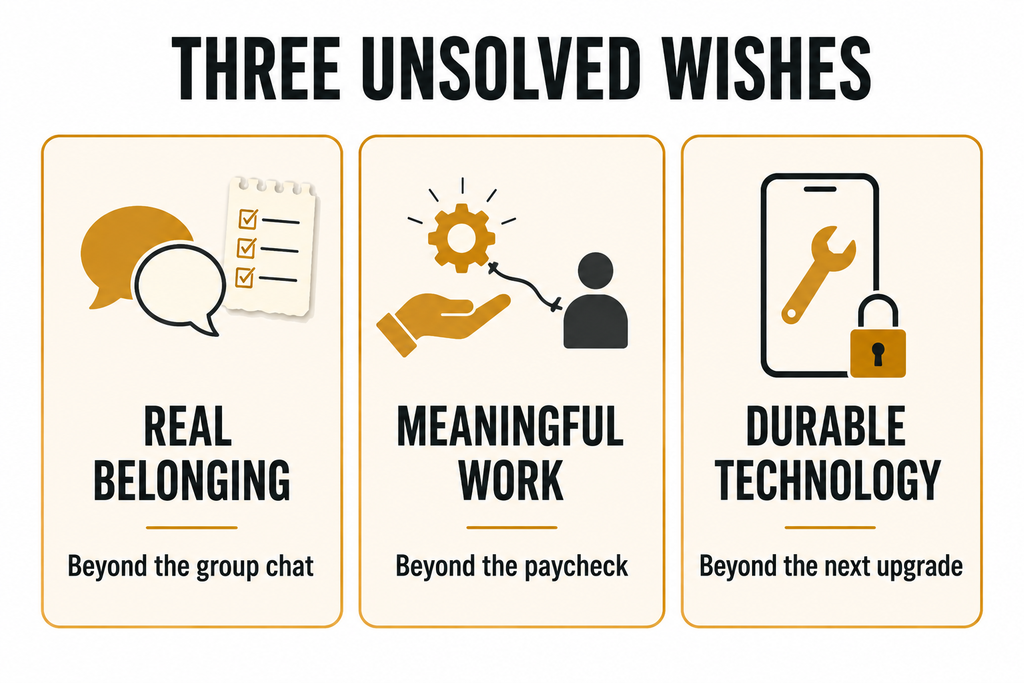
Here’s where the wishlist economy runs out of easy answers. Community is one of the deepest wishes on the list, and most of what gets sold as community is a decent simulation and nothing more.
Group chats, follower counts, algorithmic “communities” curated by engagement metrics — they mimic the shape of belonging without much of its substance. People can have thousands of connections and still feel nobody would notice if they disappeared for a week. That gap — between the appearance of connection and the experience of being known — is exactly the kind of structural mismatch we’ve flagged before in markets that promise ownership but rarely deliver it: a lot of surface-level participation, not much of the real thing underneath.
Every platform that simulates connection without building depth leaves a door open. Whoever designs for real community — smaller, slower, harder to scale, genuinely built around depth rather than reach — has a wide-open market that the feed-optimized incumbents structurally cannot serve.
Problem Two: The Wish for Meaningful Work
Pay solved the needs problem for a lot of people decades ago. It never solved the wish problem.
Plenty of well-compensated professionals report feeling hollowed out by roles that pay well but connect to nothing they can point to and say “that mattered.” Salary satisfies the need for security. It does very little for the wish to matter — to see, concretely, that the work touched something beyond a spreadsheet.
Organizations that make purpose visible — that show an employee the actual person, place, or outcome their work changed — hang onto talent that a raise alone can’t hold. That’s not sentimentality. It’s a straightforward observation: people quit meaning-starved jobs even when the money is good, and the ones who stay longest are usually the ones who can trace a line from their Tuesday afternoon to something real.
Problem Three: The Wish for Durable, Humane Technology
The third unsolved wish is the hardest to sell because it looks, at first glance, like an argument for less. What people increasingly want is technology that respects their time and attention rather than mining it — tools built to be used and then put down, not tools engineered to be impossible to stop using.
Most of the current tech stack was built for the opposite goal. Infinite scroll, autoplay, notification design tuned to interrupt rather than inform — these features exist because engagement is the metric that gets funded, not because they serve the person holding the phone. The backlash is visible in smaller signals: screen-time dashboards nobody asked their phone to build, a resurgent interest in “dumbphones,” and a right-to-repair movement pushing back against products designed to be replaced rather than fixed. None of these are fringe curiosities anymore — they’re early symptoms of a much bigger unmet wish.
That wish is durability in the fullest sense: durable attention, durable trust, durable products that don’t quietly degrade the moment the warranty expires or the next model ships. Whoever builds technology that earns trust over years instead of extracting attention in minutes is going to out-loyalty everyone still optimizing for the next quarter’s engagement numbers. The wishlist economy will eventually reward that patience — it always eventually rewards whatever it’s been starved of.
Key Takeaways
- The wishlist economy runs on wants, not survival needs — Maslow’s sequence is a useful map but a poor description of how people actually spend.
- Luxury and experience markets prove wishes generate outsized economic value; the $1.5 trillion luxury market and the Eras Tour’s reported $2.2 billion in ticket sales alone are two very different-sized examples of the same underlying pattern.
- Status-seeking is biological, not superficial, and brands that price it honestly outperform those that don’t.
- Three wishes remain structurally underserved: real belonging, meaningful work, and humane, durable technology — and each represents open market space for whoever solves it first.
Where This Leaves You
The wishlist economy isn’t a curiosity sitting off to the side of “real” markets built on needs — it’s most of the market, and it’s been that way for a while. The next real opportunity, whether you’re building a product, a company, or a career, probably isn’t in serving a need more efficiently. It’s in noticing which wish everyone else is still faking an answer to, and building the real one.
Sources
- The Human Constant (source chapter for this piece)
- Global luxury goods market valued at approximately $1.5 trillion annually
- LVMH valued at approximately $400 billion in 2023
- Bernard Arnault described as the wealthiest person in the world at various points in 2023
- LVMH ownership of Louis Vuitton, Moët Hennessy, Christian Dior, and ‘more than sixty other’ luxury brands
- Pine and Gilmore’s 1998 prediction of the experience economy
- Taylor Swift Eras Tour grossed an estimated $2.2 billion in ticket sales alone
- Claim that the Eras Tour is ‘the highest-grossing tour in history’
- Eras Tour total economic impact estimated ‘well beyond $10 billion’ including hotels, flights, and local spending
- Abraham Maslow published his hierarchy of needs theory in 1943
