



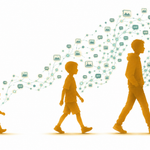








































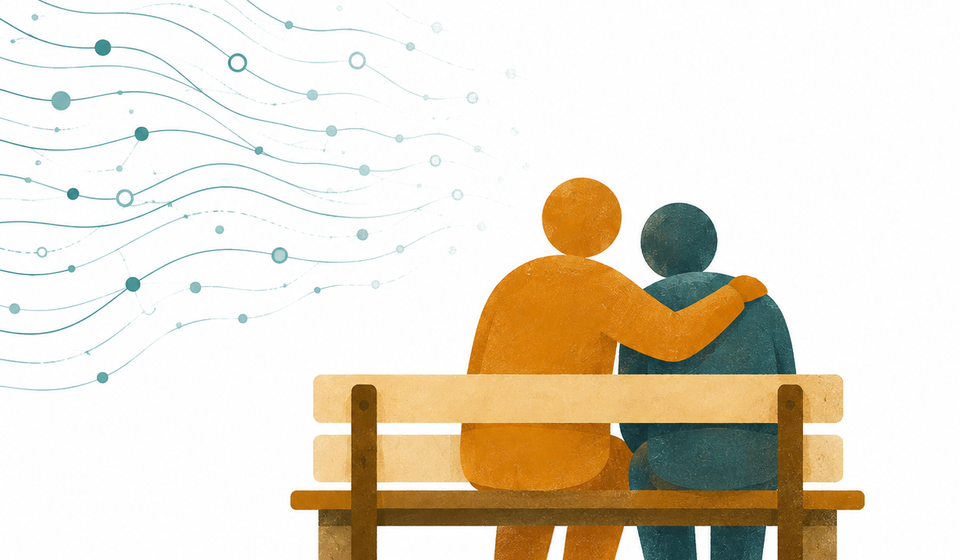

Artificial intelligence changes almost everything about how fast we build. It has not changed who we build for. That distinction matters more now than at any point since the current AI boom started, because the gap between those two facts is exactly where the unsolved AI problems live.
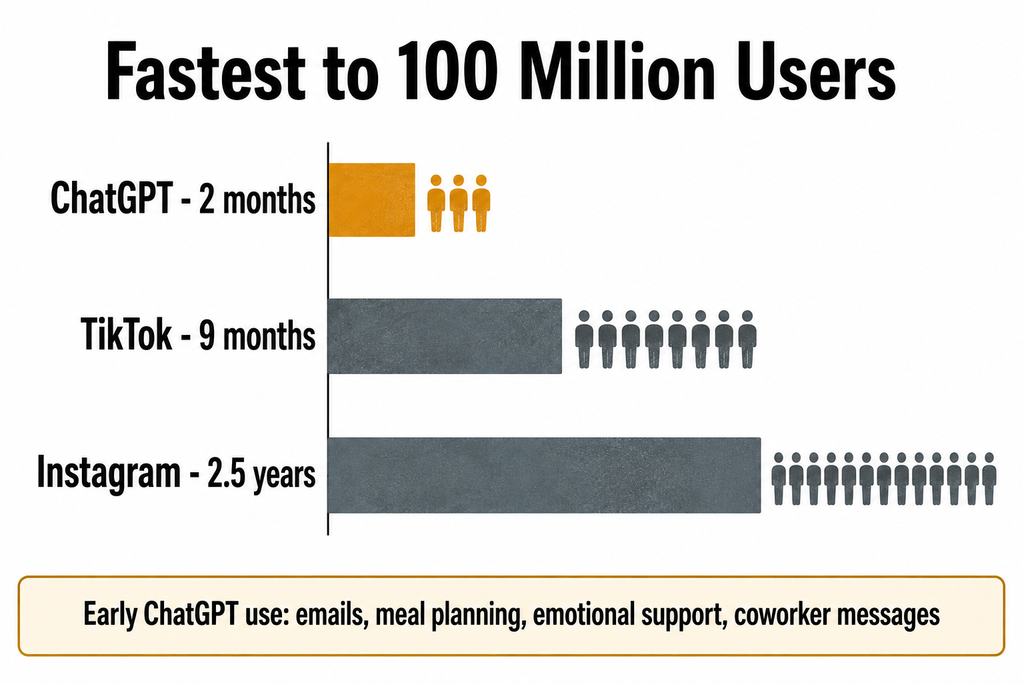
By the end of January 2023, roughly two months after launch, ChatGPT had reportedly reached 100 million users — the fastest adoption curve of any consumer technology on record, ahead of TikTok and Instagram. The obvious question followed: does this remove the human from the center of innovation? Does a machine that can draft, summarize, and reason at scale finally make human judgment optional?
The early usage data said no, loudly. People weren’t opening ChatGPT to architect nuclear reactors or model climate interventions. They were writing emails, planning meals, processing emotions, drafting messages to a difficult coworker. The most capable AI system built to date was, in its first weeks in the wild, mostly a tool for the oldest, most ordinary human problems there are. That’s the premise worth sitting with: the unsolved AI problems we still argue about — crisis detection, collaboration, governance — aren’t AI problems at all. They’re human problems wearing an AI costume.
What AI Actually Changes About the Innovation Cycle
AI doesn’t rewrite the innovation cycle. It compresses it. Three things happen faster:
- Friction identification speeds up. Patterns in behavior and complaint data that once took analysts months to surface can now get flagged in days.
- Development cycles compress. AI-assisted prototyping turns a rough concept into a testable version in weeks, not quarters.
- The barrier to building drops. You no longer need a large engineering team to ship a working first draft of a product.
Put together, a need that once took a decade to identify, validate, and productize can now move from insight to market in months. That’s a genuine shift, and it’s why “AI-powered” gets slapped on everything from meal planners to therapy apps.
But speed is not maturity. A system that ships fast can still be shipping something structurally unfinished — and human-AI collaboration is the clearest place that shows up, because moving fast doesn’t mean the machine and the human are actually working together yet. It usually means the human is working, and the machine is fetching.
Unsolved Problem #1: Pre-Crisis Detection
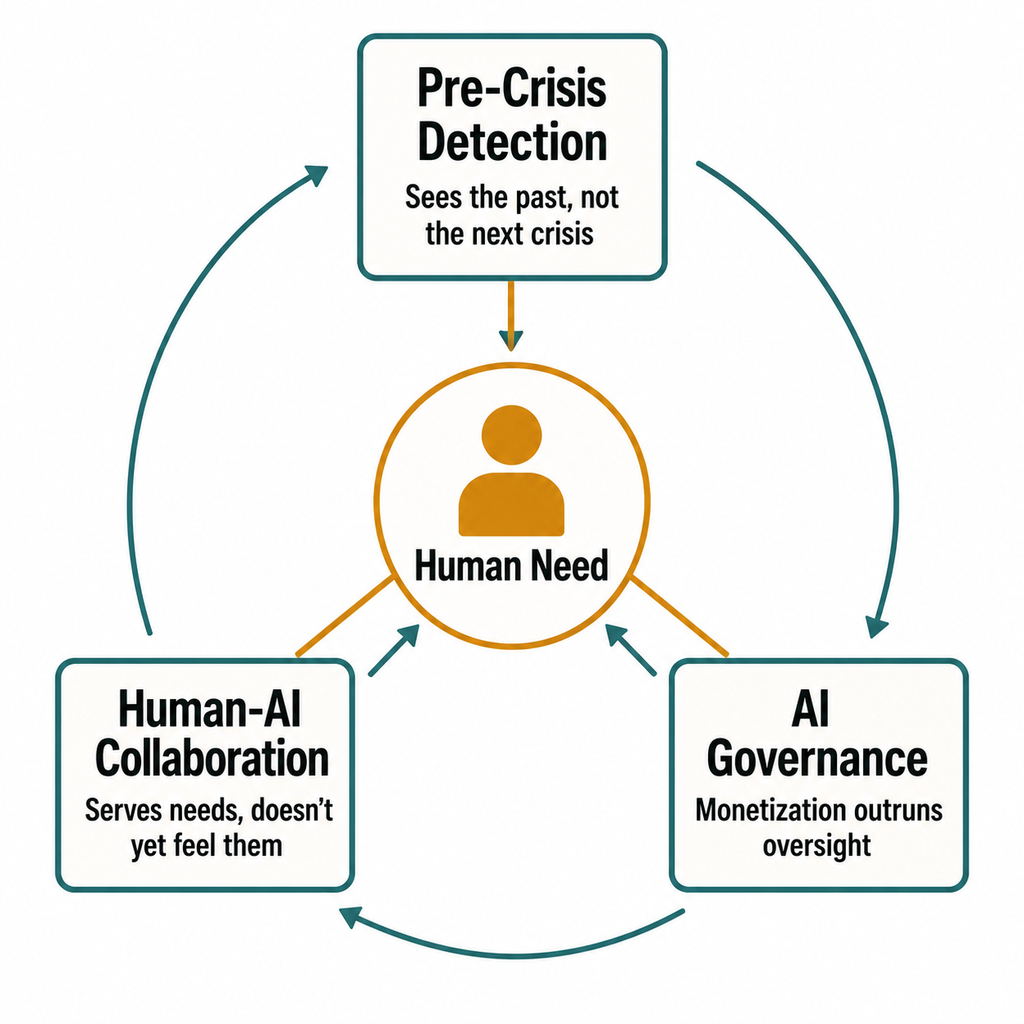
Here’s a blunt way to put it: AI is very good at telling you what already happened, and still unreliable at telling you what’s about to happen before it’s obvious to everyone anyway.
This is a qualitative, contested claim — not a single benchmark result — but it tracks with how these systems are actually built. Most AI models learn from historical data, which makes them strong at pattern-matching against situations that resemble the past and weaker at flagging a genuinely novel escalation with no prior template. A financial system, a public health signal, a supply chain wobble — the pattern that precedes collapse rarely looks identical to the last one.
This is also the flip side of the “faster friction identification” advantage from the section above. AI can surface a friction point quickly. It’s much less certain that AI can tell you which friction points are about to become crises versus which ones are just noise. Teams building on top of these signals should treat an AI-generated alert as a lead worth investigating, not a verdict to act on. The judgment call about which flickers matter still belongs to a person who understands the specific context — because context, not computation, is the scarce resource here.
Unsolved Problem #2: Human-AI Collaboration
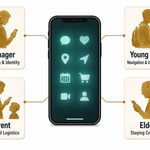
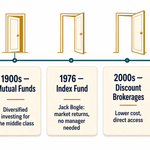
The framework that treats financial instruments as things that emerge from human needs and then loop back to reshape human life — mortgages reshaping homeownership, insurance reshaping how families plan for risk — arguably applies to AI itself. Under this reading, AI functions as a new kind of financial instrument: a technology that identifies a human need, serves it, and monetizes it at a scale no prior tool could match. A recommendation engine that shortens your search for the right product, a streaming algorithm tuned to your mood, a playlist that seems to know your taste better than your friends do — each is, in this framing, a human need being served commercially at volume.
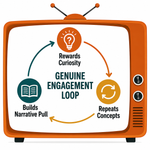
That’s useful and lucrative. It is not collaboration. Serving a need efficiently is transactional — the system matches an input to an output and gets rewarded for accuracy. Collaboration requires something the system doesn’t have: the ability to feel what someone needs before they’ve articulated it, and to weigh that against context a dataset can’t hold. An algorithm can infer your mood from your listening history. It cannot sit with you while you’re anxious about a diagnosis and decide, in that moment, that silence is the right response.
The practical version of this: use AI to handle scale, retrieval, and pattern-matching, and keep a human in the loop for the decisions that hinge on empathy, not just accuracy. That division of labor — this piece’s version of why middle-age reinvention and legacy planning are still unsolved problems makes a similar case for a different life stage — is where “collaboration” actually starts to mean something instead of being a marketing word bolted onto automation.
Unsolved Problem #3: AI Governance
If the financial-instrument framing holds — and it’s a useful lens here, not an established fact — then AI inherits every governance question that comes with financial instruments — who’s accountable when the system gets it wrong, who audits the model, who decides which needs are fair game to monetize and which aren’t.
Nobody has resolved this. Not because regulators are asleep, but because the object being regulated moves faster than the regulation. Picture a food-delivery app’s recommendation model that starts by genuinely saving you time on a Tuesday-night dinner decision, then — three months and a few thousand data points later — has learned exactly which late-night notification gets you to order when you weren’t actually hungry, just tired. Nobody wrote a rule that got broken there. The system just kept optimizing for the metric it was given, and the metric quietly drifted from “serve the need” to “trigger the order.” A recommendation system optimized to serve your desire for time-efficient discovery, per that earlier framing, is also a system that can quietly nudge that desire in directions that serve the platform more than the person. Where’s the line between serving a need and manufacturing one? Current governance frameworks mostly weren’t built to ask that question.
A more useful frame for regulators and builders alike: track where AI is monetizing a human need, not just where it’s demonstrating new capability. Capability gets headlines. Monetization is where the actual leverage — and the actual risk — sits.
The Human Skill AI Cannot Automate
As AI takes over the technical and analytical grunt work of building things, one skill gets more valuable, not less: empathy — arguably the capacity to feel what another person needs, rather than merely calculate it from their data trail. This is a claim about human nature more than a measurable statistic, and it’s worth stating that plainly rather than dressing it up as settled science.
Still, it lines up with everything above. The innovators most likely to build something that matters in this era won’t be the ones with the deepest technical mastery of transformer architectures. They’ll be the ones with the deepest read on what a specific group of humans actually needs — the same instinct that’s driven every useful invention since long before “AI” was a category, a point made at length in 3 trillion-dollar problems the Stone Age never solved. Unsolved AI problems keep turning out to be human problems in disguise because the human never left the center. AI just made it faster to notice.
Key Takeaways
- ChatGPT’s early adoption showed AI being used for ordinary life-phase problems, not moonshots — evidence the human stays central even as tools accelerate.
- AI speeds up three things: spotting friction, compressing development, and lowering the cost of building. None of that equals solving the underlying problem.
- Pre-crisis detection remains unreliable because AI is trained on the past and struggles with genuinely novel escalation patterns — treat its alerts as leads, not verdicts.
- Real human-AI collaboration requires empathy AI doesn’t have; efficient service isn’t the same as partnership.
- AI governance lags because monetization of human need is outrunning oversight — track the money, not just the capability.
FAQ: Common Questions on Unsolved AI Problems
Will AI ever solve crisis detection?
Possibly, in narrow, well-defined domains with rich historical data. But general-purpose early warning against novel crises is still an unsolved AI problem, and there’s no consensus timeline for closing that gap.
Can AI replace human judgment in governance?
No — AI can supply data and pattern analysis for governance decisions, but accountability requires a human who can be held responsible, which a model cannot be.
What does real human-AI collaboration look like in practice?
Picture a hospital triage tool that flags a patient’s vitals as trending toward risk — that’s AI doing what it’s good at, scanning patterns across thousands of charts faster than any nurse could. What makes it collaboration, not automation, is that a nurse still walks over, looks at the actual person, and decides whether that flag means “call the doctor now” or “this patient always runs a little high, it’s fine.” The AI handles scale and repetitive analysis; the person owns the decisions that require empathy, context, and judgment — not a chatbot making the final call alone.
Why do these problems keep getting called “unsolved” instead of “in progress”?
Because progress on speed and capability isn’t the same as progress on trust, oversight, and understanding what people actually need — and those are the parts still missing.
If there’s one thing worth carrying out of this, it’s a simple filter: before you trust an AI system with a decision, ask whether it’s solving a human need or just processing one faster. Those are not the same question, and the answer changes everything about how much you should let it run.
Sources
- The Human Constant (source chapter for this piece)
- ChatGPT reportedly reached 100 million users by end of January 2023, described as the fastest adoption rate of any consumer technology, ahead of TikTok and Instagram
- Characterization of early ChatGPT usage as primarily for tasks like writing emails, planning meals, processing emotions, and drafting messages to coworkers
- Framing of AI as a ‘new financial instrument’ that identifies, serves, and monetizes human needs at unprecedented scale (source’s conceptual framework, not an empirical finding)
- Characterization of Amazon’s recommendation AI, Netflix, and Spotify as examples of AI serving/monetizing specific human needs (time-efficient discovery, mood-matched entertainment, personalized music)
- General claim that AI systems are unreliable at pre-crisis/novel-crisis detection compared to pattern-matching on historical data (qualitative, contested industry claim, not a single study finding)
- Claim that empathy is the key differentiating, non-automatable skill for innovators in the AI era (source’s normative/philosophical claim, not a measurable finding)
