

















































Diners Club, Netflix, and Airbnb: What Their Origin Stories Get Wrong

Every great company has a founding myth, and most of them are lies of convenience. Not malicious lies — the kind you tell at a dinner party because “I noticed a diffuse, poorly-documented market friction over eighteen months” doesn’t make anyone lean forward. That’s the pattern behind the founding myths Silicon Valley loves to repeat: Diners Club, Netflix, and Airbnb all have origin stories that are, to varying degrees, embellished, disputed, or flatly contradicted by the record. And in every case, the real problem underneath the story was still real enough to build an empire on.
That distinction matters more than it sounds like it should. If you judge a company by the polish of its anecdote, you’ll get fooled by good storytellers and miss the boring, well-documented frictions that actually print money.
The Clean Story Every Founder Tells
There’s a reason founding myths converge on the same shape: a single humiliating moment, a flash of insight, a scrappy fix. It’s narratively efficient. It compresses years of grinding, unglamorous problem-recognition into one scene you can tell in thirty seconds on a podcast.
The trouble is that real problems rarely arrive that neatly. They accumulate — in complaint logs, lawsuits, revenue statements, bounced checks — long before a founder notices them, and long before a journalist or a company’s own press team decides to sand the story down into something quotable. What this means practically: judge a company by the problem it actually solved, not by how tidy its founding anecdote sounds. The anecdote is marketing. The friction is the business.
Diners Club: The Forgotten Wallet That Wasn’t Quite What It Seemed
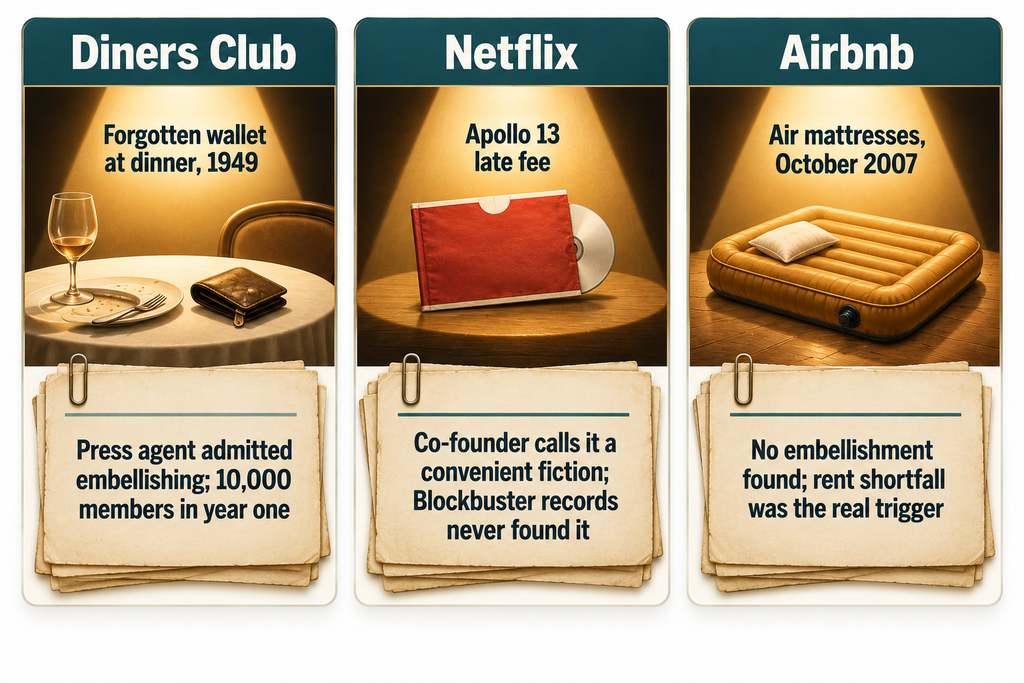
The story Diners Club still tells is charming. In 1949, a New York businessman named Frank McNamara took clients to dinner, reached for his wallet, and discovered he’d left it at home — forcing his wife to rush over with cash. Mortified, he returned the following February with a partner, Ralph Schneider, and a small cardboard card that let him pay by signature instead.
It’s a clean story. Almost too clean, in fact — and the company’s own longtime press agent later admitted he’d embellished it for publicity. Nobody has ever fully settled which version is closer to true.
What’s not in dispute is what happened next: within a year, Diners Club had reportedly signed up ten thousand members. Within a decade, it was an industry. Within half a century, it was a fixture of global economic life. Whether McNamara’s embarrassment at that dinner table was real or invented for the papers, the fear it was selling against — being caught in public with no way to pay — was real enough on its own to build an empire.
Netflix: The Late Fee That Blockbuster’s Records Never Found
Reed Hastings has told a version of the Netflix origin story for years: a forgotten VHS copy of Apollo 13, a forty-dollar late fee from Blockbuster, and the embarrassed drive to the gym afterward where he noticed he paid one flat fee no matter how often he showed up. It’s a good story. It might even be partly true — Hastings has confirmed the late fee itself happened.
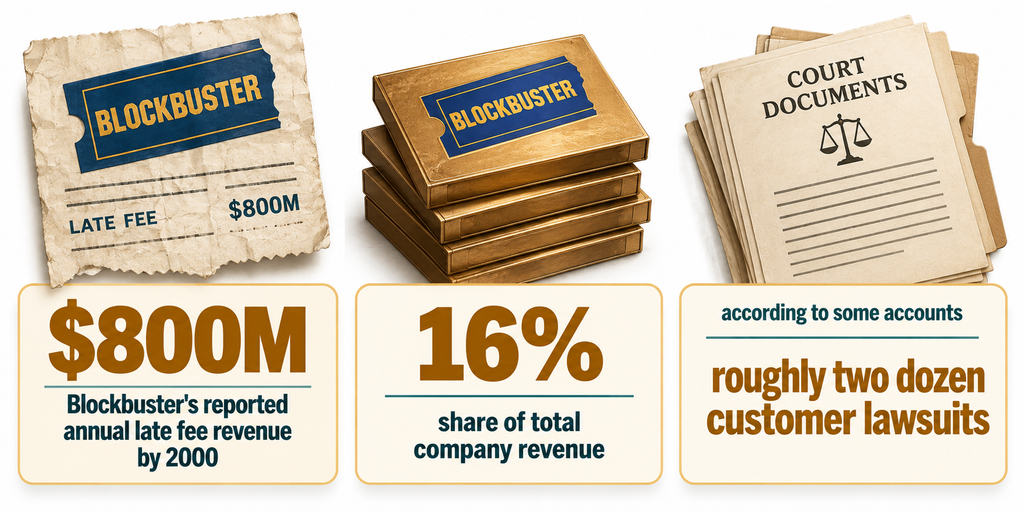
But Netflix’s own co-founder, Marc Randolph, has called the tidy version a “convenient fiction,” and outlets that have looked into it report that Blockbuster’s own records never turned up the specific rental. Here’s the thing, though: the story didn’t need to be true, because the evidence for the underlying problem was already public. By 2000, late fees reportedly accounted for roughly $800 million of Blockbuster’s annual revenue — about 16% of the entire company — and the practice was significant enough that Blockbuster offered to settle 23 separate class-action lawsuits over it in 2005, a package that approached $450 million once coupons, refunds, and legal fees were totaled. The friction was never a secret. It was published, litigated, and complained about for years. It just took someone willing to build a company around removing it, a point explored further in Why Nobody Gets Paid Just for Naming the Problem.
Airbnb: Built From Rent, Not Revelation
Airbnb is the outlier in this trio, and it’s the useful one, because there’s no myth to debunk here — just a landlord problem. In October 2007, Brian Chesky and Joe Gebbia could not pay their rent. A design conference had flooded San Francisco and every hotel in the city was booked solid. So they inflated three air mattresses on their apartment floor and charged $80 a night for strangers to sleep in their living room.
That’s it. No revelation, no whiteboard moment. The sharing economy, in this telling, wasn’t born from technological foresight — it was born from the young-adult housing affordability crisis, the same financial squeeze that’s delayed homeownership and marriage for an entire generation. Airbnb is reportedly now valued at around $75 billion. Some durable companies aren’t built from vision at all — they’re built from acute financial pressure, which is honestly a far more repeatable signal than “vision” ever was, as this breakdown of the six-step framework for turning human friction into a business lays out in more detail.

Why the Embellishment Happens at All
Look across all three stories and the pattern is obvious: founders reach for one clean anecdote because the real cause is diffuse, slow, and boring to narrate. “Sixteen percent of Blockbuster’s revenue came from punitive fees that generated dozens of lawsuits over several years” is true and damning — and useless at a dinner party. “I forgot to return a movie” is false-ish and instantly memorable. Founding myths in Silicon Valley aren’t really about founders lying so much as they’re about compression — turning years of data into a scene.
The risk is that people mistake the scene for the evidence. Watch behavior and data, not the origin story, when you’re trying to figure out whether a company actually solved something real.
How to Spot a Real Invisible Problem (Not Just a Good Story)
There’s a practical checklist buried in all three stories, and it holds up as a general method for separating a real friction from a good yarn:
- Watch behavior, not opinions. Blockbuster could have surveyed customers for years and heard “mildly annoying.” The lawsuits told the real story.
- Read for emotional texture. A late fee is a logistics complaint on the surface. The feeling of being quietly punished every time you interact with a company is the actual problem underneath it.
- Be willing to state the obvious. The best-protected problems often aren’t hidden — they’re sitting in plain sight, dismissed as too simple to be worth building a company around.

Before you trust a founding myth, ask what the lawsuits, the revenue filings, or the rent-due date actually show. That’s a more reliable filter than any anecdote, and it’s the same method the invisible problem framework uses to spot blind spots before they turn into billion-dollar companies.
Key Takeaways
- Diners Club’s forgotten-wallet story was reportedly embellished by its own press agent, but the fear of being caught unable to pay was real — and 10,000 members signed up within a year.
- Netflix’s late-fee origin story is disputed by its own co-founder, but Blockbuster’s reported $800 million in annual late fees (16% of revenue) and 23 settled class-action lawsuits proved the friction existed regardless.
- Airbnb’s story needs no debunking — it was built directly from Chesky and Gebbia’s rent problem in 2007, not a grand vision.
- Across all three, founders reached for one clean anecdote because the real, diffuse cause is harder to tell as a story.
- The reliable signal is data and behavior — lawsuits, revenue, rent-due dates — not how good the anecdote sounds.
Sources
- The Human Constant — The Great Leap
- The Human Constant — The Debt We Chose
- The Human Constant — The Problem That Was Always There
- Frank McNamara’s 1949 forgotten-wallet dinner story and the claim that his wife brought cash
- Claim that Diners Club’s press agent admitted to embellishing the founding story
- Ralph Schneider as McNamara’s Diners Club co-founder
- Reed Hastings’ Apollo 13 VHS late-fee anecdote as a popularized origin story
- Marc Randolph calling the Netflix origin story a ‘convenient fiction’
- Figure that late fees were roughly $800 million of Blockbuster’s annual revenue by 2000
- Blockbuster offering to settle 23 class-action lawsuits over inflated late fees, in a package approaching $450 million, in 2005
- Brian Chesky and Joe Gebbia inflating air mattresses in October 2007 due to a design conference filling San Francisco hotels
- Specific detail that they charged $80 a night
- Airbnb’s valuation of approximately $75 billion
- Characterization of Airbnb as having no embellished/disputed founding story
