













































Retirement used to mean a decade, maybe fifteen years, of golf and grandkids before the end. That math is dead. Centenarians are now the fastest-growing demographic in many developed countries, and nobody selling a retirement product for a 40-year retirement has actually rebuilt the product for it. They just stretched the old spreadsheet and hoped.
That gap is the tell. The final phase of life — the one we used to call “the golden years” like it was a single, short chapter — is now the most underserved market in modern economies. In 2023, the U.S. Surgeon General released an eighty-one-page advisory on loneliness that quietly confirmed what anyone with an aging parent already suspected: the systems built around elder life were designed for a shorter, simpler version of it. They’re now straining under a much longer, more complicated one.
This isn’t another “aging is hard” think piece. It’s three specific, unsolved problems — a disease, a design failure, and a financial instrument that doesn’t exist yet — and what each one means if you’re building products, managing money, or just trying to take care of someone.
Problem 1: Alzheimer’s at Scale, With No Solution in Sight
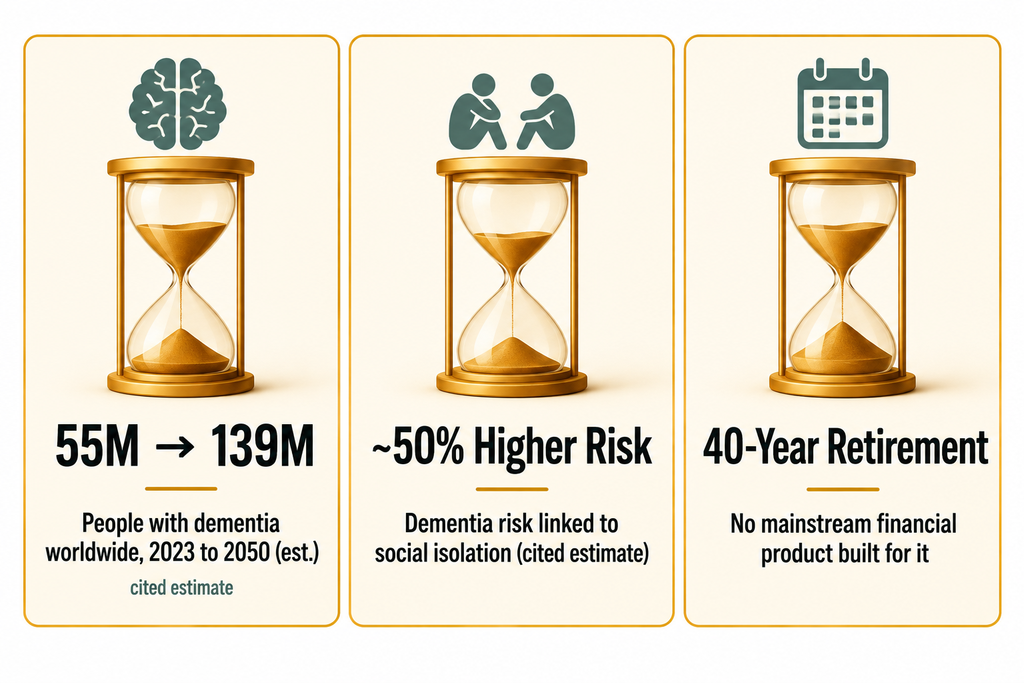
Start with the number that should stop anyone building in health tech: dementia currently affects an estimated 55 million people worldwide. That figure is projected to reach 139 million by 2050. The annual global economic cost is put at roughly $1.3 trillion. These are large, round, unsettling figures, and it’s worth saying plainly that they come from public-health estimates rather than a precise census — the trend they point to is the reliable part, not the last digit.
Here’s the part that actually matters for anyone allocating capital or building a company: despite decades of research and billions of dollars in investment, there is still no reliably effective disease-modifying treatment for Alzheimer’s at population scale. Not a management plan. Not a slowdown drug with modest results in a subset of patients. A treatment that changes the disease’s course for most people who have it. It doesn’t exist yet.
What this means: if your business plan has “and then we cure Alzheimer’s” as a load-bearing assumption, you’re betting against several decades of very well-funded failure. The more defensible opportunity isn’t the cure — it’s the infrastructure around care that has to exist whether or not a cure ever arrives: caregiver support systems, diagnostic tools, home-care logistics, financing for long-duration cognitive decline. Betting on treatment is a moonshot. Betting on care infrastructure is a bet on a certainty.
Problem 2: The Loneliness Industry Built the Wrong Thing
The modern senior living industry solved a real problem — physical safety — and in doing so, created a different one it didn’t see coming. The traditional model is geographically removed from family, age-segregated, and run on institutional schedules. It keeps people safe from falls. It does not keep them connected to anyone.
That tradeoff has a price tag now. Studies consistently link social isolation to elevated dementia risk — estimates vary by methodology, with a meta-analysis of adults 50+ finding roughly 49–60% higher risk and other large cohort studies finding anywhere from 27% to over 60%, but “isolation meaningfully raises dementia risk” isn’t in serious dispute at this point. Isolation isn’t a soft, quality-of-life complaint anymore — it’s a documented clinical risk factor sitting next to cardiovascular disease and premature death on the same list. An entire industry optimized for the wrong variable, and the bill came due in cognitive decline.
Takeaway: elder social platforms need to stop being designed as amenities — a game room, a monthly potluck, a bingo night bolted onto a care facility — and start being designed as clinical infrastructure. Connection isn’t the nice-to-have layered on top of care. For elders specifically, it’s part of the care. Nobody has built the platform that treats it that way, at scale, with the seriousness of a medical intervention. That’s still an open field.
Problem 3: No Retirement Product Is Built for a 40-Year Retirement
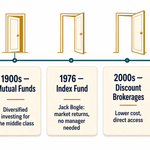
Every retirement product in wide use today — pensions, annuities, the standard 4% withdrawal rule — was shaped by a life expectancy that no longer describes reality for a growing share of retirees. The centenarian population is the fastest-growing demographic in many developed countries. Thirty-plus active years beyond a conventional retirement age isn’t a longer version of the old retirement. It’s a different phase of life that current financial instruments were never designed to hold.
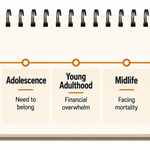
Think about what that actually requires: new financial instruments built for multi-decade horizons instead of ten- or fifteen-year ones, new social frameworks for what community and purpose look like across three or four extra decades, new professional models for people who might work, in some form, into their eighties, and new psychological frameworks for understanding what a life that long is even for. None of that is a rounding error on the existing retirement industry. It’s a different industry that hasn’t been built yet.
Practical angle: if you’re planning your own retirement, or building products for people who are, stop treating year 30 of retirement like year 10 with more gray hair. Treat it as a distinct planning problem — financially, socially, medically — because the products currently on the shelf were priced and designed for a shorter bet than the one you’re actually making.

Why Adaptation Thinking Keeps Failing Elders
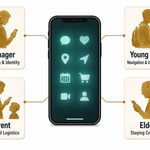
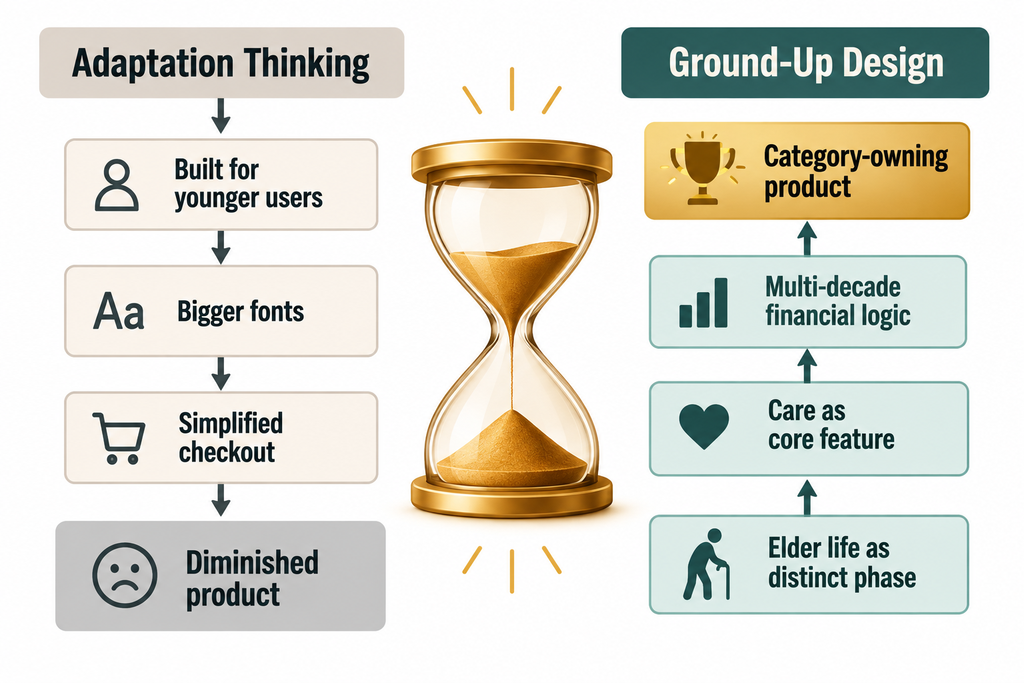
Most consumer technology follows the same lazy pattern: build it for the young and middle-aged, then reluctantly adapt it for elder use by making the font bigger and hiding a few buttons. That’s not product design for elder life. That’s product design for everyone else, with the edges sanded down.
Adaptation thinking produces structurally inferior products because it starts from the wrong premise — that elder life is a diminished version of middle age rather than a distinct phase with its own logic, its own risks, and its own commercial opportunity. A magnified font doesn’t fix a UI that assumes fast reflexes and casual multitasking. A simplified checkout doesn’t fix a financial product built for a 15-year horizon.
What this means: the companies that design for elder life from the ground up — not adapted down, but built up from what that phase of life actually requires — are the ones positioned to capture a market most competitors have simply chosen to ignore. The dedicated “silver economy” is already worth an estimated $4.5 trillion; total consumer spending by adults 60 and over runs closer to $19 trillion today and is projected to reach $34 trillion by 2036. This is the same structural blind spot that shows up across other underbuilt corners of the economy — the unsolved problems in the financial loop piece makes a similar case for elder-care ethics inside financial systems more broadly, and the same financing gap shows up again in who insurance still doesn’t reach. The pattern repeats: whoever treats the “edge case” demographic as the core design brief usually ends up owning the category.
What This Means If You’re Building — or Aging
Line the three problems up and a shape appears. Alzheimer’s has no cure in sight, so the real near-term opportunity is care infrastructure, not treatment. Isolation is a clinical risk, not an amenity gap, so elder social platforms need to be built like medical infrastructure, not a rec-room add-on. And no financial product currently accounts for a 40-year retirement, so the biggest white space in the entire silver economy might be longevity finance, not another wellness app.
For founders: the frontier isn’t where everyone else is already crowding — it’s in the three gaps above, none of which require solving Alzheimer’s outright to build a real business.
For readers with an aging parent, neighbor, or friend: if someone in your life seems increasingly isolated, treat it as the documented health risk it is, not just a quality-of-life concern. A primary care doctor or your local Area Agency on Aging is a legitimate, practical first step toward getting them real support — not a last resort.
FAQ: The Elder Economy’s Unsolved Problems
Why hasn’t Alzheimer’s been solved despite so much research funding?
Because dementia is a complex, likely multi-pathway disease, and decades of drug trials have largely failed to produce a treatment that reliably changes its course at population scale. Some newer drugs show modest effects in specific patient groups, but nothing yet qualifies as a broad disease-modifying cure — which is why care infrastructure, not a treatment breakthrough, is the more realistic near-term bet.
What makes elder loneliness different from loneliness at other life stages?
The health stakes are steeper. Isolation is associated with meaningfully higher dementia risk in older adults specifically — studies put the figure anywhere from roughly 27% to over 60% depending on methodology — on top of well-documented links to cardiovascular disease and early death. Loneliness is unpleasant at any age; in later life, it functions as a measurable clinical risk factor.
Why don’t existing retirement products already account for longer lifespans?
Most were designed decades ago around shorter life expectancies and haven’t been rebuilt for the sharp rise in people living into their 90s and 100s. The result is a structural mismatch: a retirement product for a 40-year retirement essentially doesn’t exist yet in the mainstream financial toolkit, even though the population that needs one is growing fast.
Is the “silver economy” actually a big market opportunity, or just a nice idea?
Genuinely large and structurally underbuilt: the dedicated silver economy is estimated at $4.5 trillion, and total spending by adults 60+ runs around $19 trillion today, projected to hit $34 trillion by 2036 — precisely because most companies treat elder consumers as an afterthought rather than a primary design target. That gap is the opportunity, not a marketing slogan.
Key Takeaways
- Alzheimer’s has no population-scale cure, and likely won’t soon — the real near-term business opportunity is care infrastructure, not treatment.
- Isolation is a clinical risk for elders, associated with roughly 50% higher dementia risk — social platforms for seniors need to be built as health infrastructure, not amenities.
- No mainstream financial product is designed for a 40-year retirement — treat the decades past traditional retirement age as a distinct planning problem, not an extension of the old one.
- Adapting products downward from younger users fails elders structurally — the real opportunity belongs to companies designing for elder life from scratch.
- If someone in your life seems isolated, act on it — a primary care doctor or local Area Agency on Aging is a real, practical first step.
The elder economy isn’t waiting for permission to become the next major market — it’s already the fastest-growing one in plain sight. The only open question is who actually builds for it, instead of just shrinking something else down to fit.
Sources
- The Human Constant — The Long Wisdom
- The Human Constant — The Phases We Have Not Mapped Yet
- WHO dementia fact sheet: 55 million affected as of 2021, projected to reach 139 million by 2050, global annual cost of $1.3 trillion
- Meta-analysis of adults 50+ finding social isolation/loneliness associated with 49-60% higher dementia risk
- UK Biobank cohort study finding social isolation associated with a hazard ratio of 1.62 (~62% higher risk) for incident dementia
- Johns Hopkins study finding socially isolated older adults had a 27% higher risk of developing dementia over nine years
- Silver economy market size: $4.5 trillion dedicated market; $19 trillion in total consumer spending by adults 60+, projected to reach $34 trillion by 2036
