



















































The 1.4 Billion People Still Locked Out of Money

Every financial tool you’ve ever used exists because something else failed first. Coins, paper notes, insurance, credit cards — none of them were invented out of ambition. They were confessions. And right now, the world is sitting on a confession it hasn’t figured out how to make: 1.4 billion adults still can’t access a basic bank account.
Money Has Always Been a Confession, Not an Invention
Picture a medieval marketplace. A cloth merchant has fabric. He needs fish. The fisherman needs leather. The leather worker needs grain. The grain farmer needs cloth. In theory this works — everyone has something someone else wants. In practice it almost never does, because the right two people rarely stand in the same stall at the same moment holding exactly what the other needs.
Economists call this the double coincidence of wants, and it’s the problem money was invented to solve. When humanity invented money, it wasn’t celebrating a breakthrough. It was admitting barter was broken.
That’s the lens worth carrying through the rest of this piece: financial exclusion today isn’t a new kind of problem. It’s the same old friction, unresolved, at a scale of 1.4 billion people.

From Coins to Jiaozi: How Friction Forced Innovation
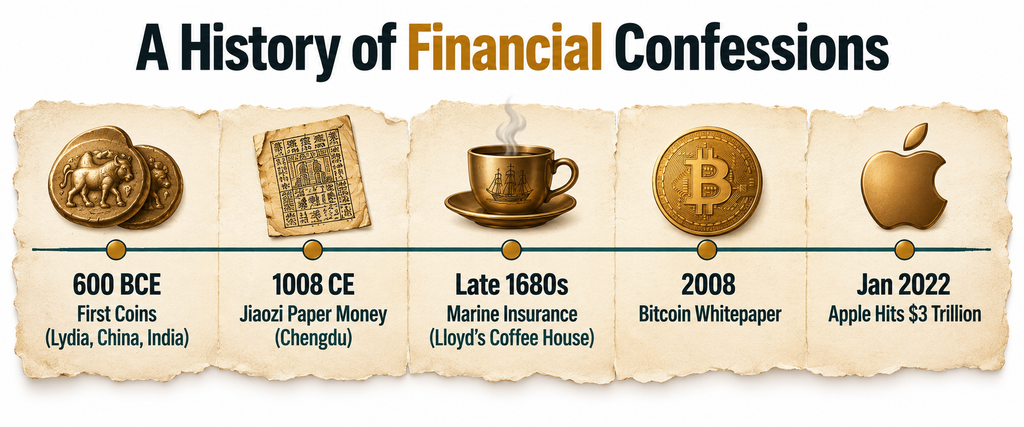
The earliest coins appeared independently in Lydia, China, and India around 600 BCE — not from economic theory, but from traders who needed something portable, divisible, and universally trusted. The coin confessed: barter isn’t enough, and we need everyone to agree on a substitute.
By the eleventh century, merchants in Sichuan had a heavier confession to make — literally. Their currency was iron coin, and iron doesn’t travel light. Closing an ordinary trade reportedly meant hauling coin by cart or hired porter rather than carrying it in a pocket; some historical accounts put the weight of large transactions in the tens of pounds, though the exact figures aren’t independently confirmed. Around 1008, sixteen merchant houses in Chengdu got tired of it and started printing paper instead — jiaozi, notes redeemable for a fixed amount of coin in reserve. Nobody mandated it. Sixteen businessmen just solved the same physical problem the same way, in the same city, at the same time.
The takeaway holds up eight centuries later: financial tools succeed when they remove a specific, physical burden — not when they chase abstract innovation for its own sake.
Insurance, Banking, and Credit: Confessions of Risk and Desire
Marine insurance started as gossip. By the late 1680s, Edward Lloyd’s coffee house in London had become the place where ship captains and merchants traded news of which vessels made it home. Picture the scene: a table crowded with tallow-candle light, a captain just back from the Indies describing a storm that took a rival’s cargo, and a merchant two seats down quietly offering to cover the next ship’s risk for a fee — the whole insurance industry starting as one nervous man calculating odds over cooling coffee. That same room turned news into wagers — merchants betting, for a fee, that a ship would arrive safely. The confession underneath it: no single owner could absorb a shipwreck alone.
Banking confessed something plainer — that holding your own money was its own risk, from theft to fire to a lost strongbox. Credit cards confessed something more intimate: we want things now that we can’t yet afford. Each instrument, in its own era, answered one specific friction experienced by millions of people at once.
The Apple Paradox: Reading Needs Across a Lifetime
In January 2022, Apple briefly became the first company to reach a three-trillion-dollar market cap. Not because it invented human needs, but because it read them accurately across every life stage — the teenager signaling identity, the parent managing household logistics, the elder staying connected. Apple didn’t create demand. It noticed it faster and more precisely than almost anyone else.
That’s the pattern worth borrowing: the next financial breakthrough won’t go to whoever builds the flashiest product. It’ll go to whoever reads the unmet need most accurately — starting with the 1.4 billion people banks have never bothered to read at all.
1.4 Billion People, One Unsolved Confession
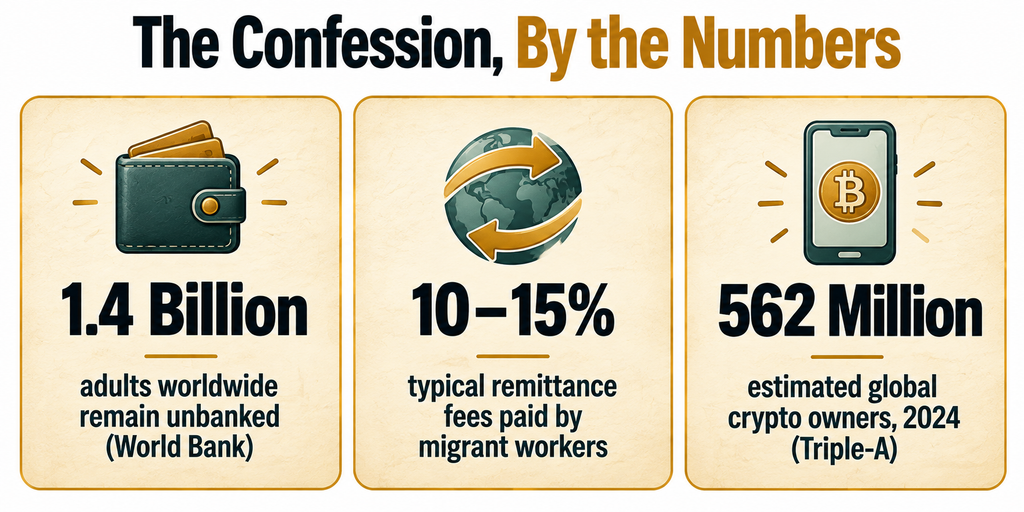
1.4 billion adults remain unbanked worldwide — locked out of the basic financial infrastructure most of this article’s readers take for granted. Workers in developing economies who send money home are commonly reported to lose somewhere in the range of ten to fifteen percent of it to remittance fees, though the exact figure varies by corridor and provider and isn’t a single fixed number. Either way, the friction is real, large, and unsolved at scale.
This is the confession the fintech industry, mobile money operators, and crypto rails are all racing to answer — each one betting it has finally found the modern jiaozi.
Bitcoin, Crypto, and the Confession of Distrust
Satoshi Nakamoto published the Bitcoin whitepaper on October 31, 2008, six weeks after Lehman Brothers collapsed and the global financial system came closer to failure than at any point since the 1930s. The emotion at the center of that moment was distrust — of banks, of regulators, of anyone standing between you and your money. Bitcoin’s real innovation wasn’t the blockchain itself, which had academic roots before Nakamoto; it was pairing that technology to a very specific human need: transacting value without trusting a central authority.
By 2024, industry estimates — notably from crypto payments firm Triple-A — put global cryptocurrency ownership at roughly 562 million people, up from an estimated 420 million the year before. The total crypto market has reportedly peaked above three trillion dollars, back in late 2021, though it has swung wildly since. Treat both figures as directional rather than exact; crypto market data varies by tracker and moves fast.
For the unbanked specifically, crypto is one plausible bypass — no branch, no paperwork, no permission required. But it’s not a clean fix. Volatility, spotty internet access, and low financial literacy all stand between a phone and a functioning wallet.

What Comes Next: Who Solves the Confession First?
History’s pattern is consistent: coins solved portability, jiaozi solved weight, insurance solved catastrophic risk, banking solved custody, credit solved timing. Each confession got answered by whoever removed the friction cheapest and closest to where people actually lived.
The 1.4 billion unbanked are waiting on that same kind of answer now — mobile money, stablecoins, or digital-ID-linked banking, whichever manages to be cheap, local, and boring enough to actually work. Every Financial Instrument Is a Confession lays out the full thesis behind this pattern, if you want the long version. Here’s the short one: watch for tools that quietly remove friction, not the ones chasing headlines. Hype has never once been the thing that closed a financial gap.
What the 1.4 Billion Number Actually Means
What does “1.4 billion unbanked” actually mean?
It refers to adults globally who lack access to a basic transaction account at a bank, credit union, or mobile money provider — meaning no easy way to save, send, or receive money safely.
Why do remittance fees matter for financial inclusion?
Migrant workers sending money home are widely reported to lose a meaningful cut of it to fees — commonly cited in the ten-to-fifteen-percent range, though the exact number depends on the corridor and provider. That’s money never reaching families who often need it most.
Can cryptocurrency actually bank the unbanked?
Potentially, for people with a smartphone and reliable data access. But volatility, patchy connectivity, and low financial literacy remain real barriers — it’s a plausible bypass, not a guaranteed fix.
Is mobile money different from crypto?
Yes. Mobile money (like phone-based accounts run through telecom providers) has already reached large numbers of previously unbanked users in parts of Africa and South Asia, using existing phone networks rather than blockchain infrastructure.
Key Takeaways
- Every financial instrument in history — coins, paper money, insurance, banking, credit — was created to solve a specific, painful friction, not to chase innovation for its own sake.
- Sichuan’s jiaozi notes replaced heavy iron coin around 1008, one of history’s clearest cases of merchants engineering their way out of physical burden.
- Roughly 1.4 billion adults remain unbanked worldwide, and remittance fees reportedly cost migrant workers a significant share of what they send home.
- Crypto ownership has grown fast — reportedly past half a billion people by 2024 — but adoption barriers keep it from being a complete solution for the unbanked.
- The next major financial breakthrough will likely go to whoever removes friction cheaply and locally, not to whoever builds the most hyped product.
The confession has been sitting there for over a decade, plainly stated in the numbers. The only real question is which of us builds the next line of paper money — instead of pretending we already have.
Sources
- The Human Constant — Why Money Is a Confession
- The Human Constant — The New Currencies
- 1.4 billion adults remain unbanked worldwide
- Remittance fees of roughly 10-15% paid by workers sending money home in developing economies
- Earliest coins appeared independently in Lydia, China, and India around 600 BCE
- Sichuan merchants used iron coin currency by the 11th century, and large transactions reportedly required hauling coin by cart or porter due to weight
- Sixteen merchant houses in Chengdu began issuing jiaozi paper notes around 1008 CE
- Edward Lloyd’s coffee house in London (late 1680s) as origin site of marine insurance dealings
- Apple Inc. reached a $3 trillion market capitalization in January 2022, described as the first company to do so
- Satoshi Nakamoto published the Bitcoin whitepaper on October 31, 2008
- Bitcoin whitepaper published six weeks after the Lehman Brothers collapse
- Global cryptocurrency ownership estimated at approximately 562 million people in 2024, up from ~420 million in 2023, per Triple-A
- Total cryptocurrency market capitalization peaked above $3 trillion in late 2021
