



















































Nobody Solved Housing, Debt, or Dating — They Just Built Billion-Dollar Businesses Around the Pain

Every generation gets a promise: work hard, and the friction of adulthood — a place to live, a way to pay for school, a person to build a life with — gets easier over time. That promise quietly broke somewhere along the way, and nobody sent a memo. Instead, the young adulthood problems of housing, debt, and dating got repackaged as products. Nobody solved them. Somebody just figured out how to charge you for coping with them.
That’s the lens for everything below: is this thing actually fixing the friction, or is it a really well-funded way of helping you live with it?
Nobody Solved the Problem — They Sold You a Workaround
There’s a comforting story tech companies like to tell about themselves: we saw a problem and we fixed it. The real story, when you look closely, is usually smaller and stranger than that. Someone hit a wall — financial, logistical, personal — improvised a workaround under pressure, and the workaround happened to scale.
That’s not innovation in the classic sense. It’s arbitrage on unresolved pain. The rent didn’t get cheaper. The job market didn’t get more stable. The dating pool didn’t get less exhausting. What changed is that someone built a business on top of the exhaustion and sold it back to you as convenience.
Keep that distinction in mind as we walk through housing, debt, and dating one at a time, because the pattern repeats with almost suspicious consistency.

Airbnb: Born From Rent, Not Vision (Sharing Economy Origins)
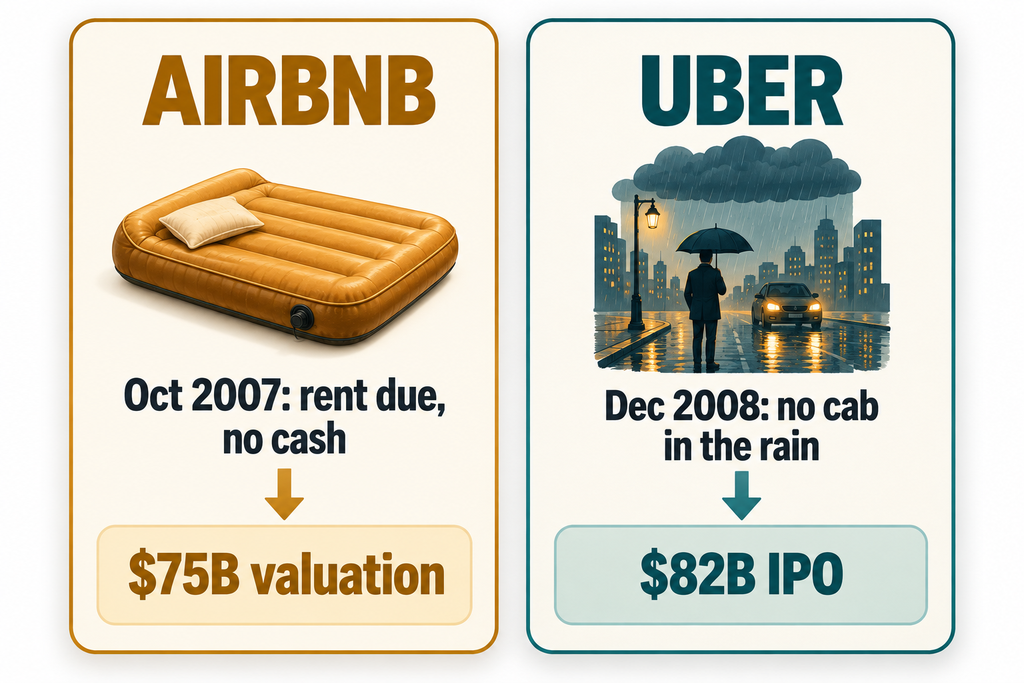
The Airbnb origin story gets told as a scrappy-founders-with-a-big-idea fable. It’s really a story about not making rent. In October 2007, Brian Chesky and Joe Gebbia — broke, with a design conference flooding San Francisco and every hotel booked — inflated three air mattresses on their apartment floor and charged eighty dollars a night for a place to sleep. That’s it. That’s the founding moment of a company reportedly valued at around $75 billion.
The sharing economy’s origin story, in other words, isn’t a technology breakthrough. It’s a housing-affordability crisis with an app bolted on. Two guys couldn’t cover rent, so they turned their living room into inventory.
Here’s what that means if you’re renting in 2026: the affordability crisis that produced Airbnb never got fixed. It got a multibillion-dollar marketplace layered on top of it — one that, in a lot of cities, now competes with long-term renters for the same housing stock. The workaround became the industry, and the industry arguably made the original problem worse in places where short-term rentals eat into supply.
Uber and the Gig Economy: Flexibility as a Consolation Prize
Travis Kalanick’s version of the Uber founding story is a good one: Paris, December 2008, rain, no cab in sight. Reporters who later dug into the company’s early history found a less cinematic root — Garrett Camp already frustrated with San Francisco’s overpriced, hard-to-book black-car services months earlier. Whichever telling is more accurate, the friction underneath is identical: a person with money and a destination and no reliable way to get there. Within about eighteen months, that friction became Uber, which reportedly hit an $82 billion valuation at its 2019 IPO.
Zoom out from Uber specifically and you get the gig economy as a whole. Uber, Deliveroo, TaskRabbit, Fiverr — none of these are primarily technology stories. They’re labor-market stories. Young adults entering the workforce in the 2010s ran into a job market that didn’t offer enough permanent, living-wage work, combined with a smartphone that made on-demand gig labor logistically possible for the first time. Put those two things together and the gig economy wasn’t a lifestyle choice for most people who joined it. It was the option that existed.
“Flexibility” is a nice word for it. But flexibility is often just the marketing term for a labor market that stopped offering anything sturdier. Worth remembering next time an app pitches gig work as freedom rather than what it frequently is: a consolation prize for young adults who couldn’t find a stable job in the first place.
The Debt Generation: Student Debt Crisis by the Numbers
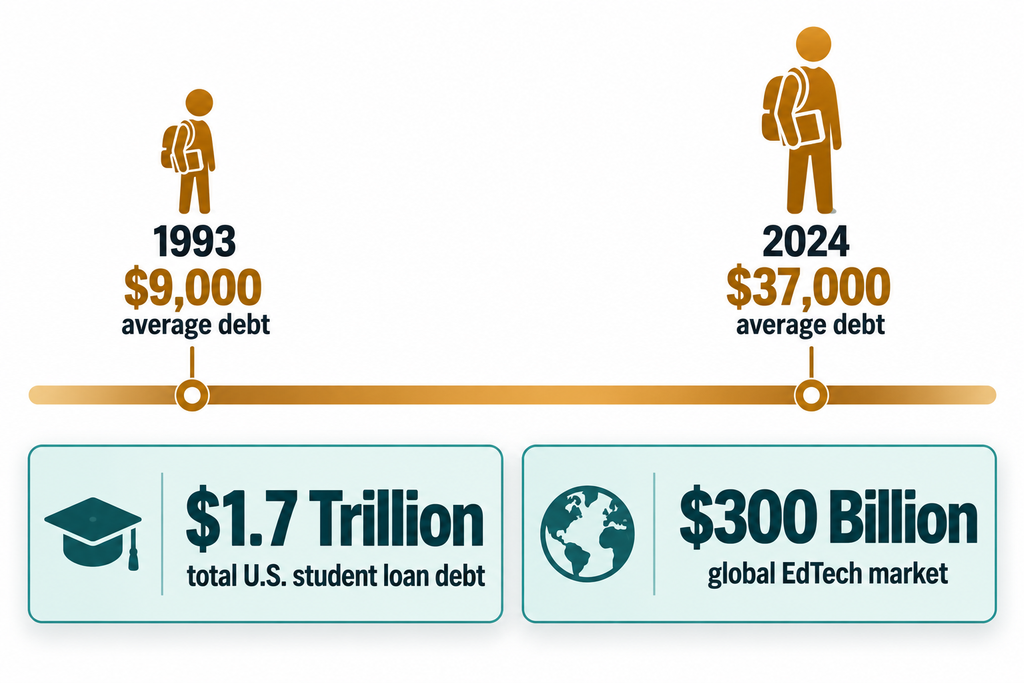
Picture a 22-year-old opening a loan servicer’s app the same week as a college graduation photo shoot — cap and gown in one tab, a six-figure repayment schedule in the other. In 1993, the average American college graduate left school with roughly $9,000 in debt, a manageable number against a starting salary. By 2024, that per-graduate average had climbed to around $37,000, and the national total had reached approximately $1.7 trillion.
Debt at that scale isn’t a line item. It’s a life-phase reshaper. Research consistently links high student debt to delayed homeownership, marriage, and childbirth — a compounding drag on the entire sequence adulthood used to follow, the same kind of instrument-reshapes-the-borrower pattern explored at length here. The federal loan program traces back to 1958’s National Defense Education Act, built to widen access to college. Access widened. So did the bill — and a global EdTech market now worth more than $300 billion grew to answer an emergency, not a broken curriculum.
Credit Cards and BNPL: Monetizing the Fear of Not Being Able to Pay
Diners Club tells its own founding story like this: in 1949, a New York businessman named Frank McNamara took clients to dinner, reached for his wallet, and realized he’d left it at home — his wife had to bring the cash. Mortified, he came back the next February with a small cardboard card and a business partner, Ralph Schneider, and paid by signature instead. It’s a clean story. Almost too clean — the company’s own longtime press agent reportedly admitted later he’d embellished it for publicity, and nobody has fully settled which version is accurate.
What’s not in dispute is what happened next. Within a year, Diners Club had roughly 10,000 members. Within a decade, it was an industry. Within half a century, it was load-bearing infrastructure for the global economy. Embellished origin story or not, the friction it sold against — the fear of getting caught without a way to pay — was real enough to build an empire on.
Picture that same flinch playing out ninety years later, at 1 a.m., on a phone: a $240 pair of shoes in the cart, a thumb hovering over “pay,” and a button offering four payments of $60 instead. Buy Now, Pay Later platforms — Klarna, Afterpay, Affirm — are the same trick wearing a 2010s outfit, built to solve that exact flinch. BNPL doesn’t lower the price. It converts a deterrent into an enabler, splitting the number into pieces small enough to stop feeling real. That’s not affordability. That’s the same 90-year-old confession running on better software.
Dating Built for Matches, Not Relationships (Online Dating Industry)
Match.com launched in 1995 as the first major online dating service, back when telling people you met your partner “on the internet” was something you’d quietly leave out of the wedding toast. Thirty years later, the stigma hasn’t just faded — it’s inverted. Approximately 40% of American couples now report meeting online, and the global online dating industry is worth an estimated $9 billion annually, built on one of the oldest human needs operating during one of the most commercially aggressive life phases there is.
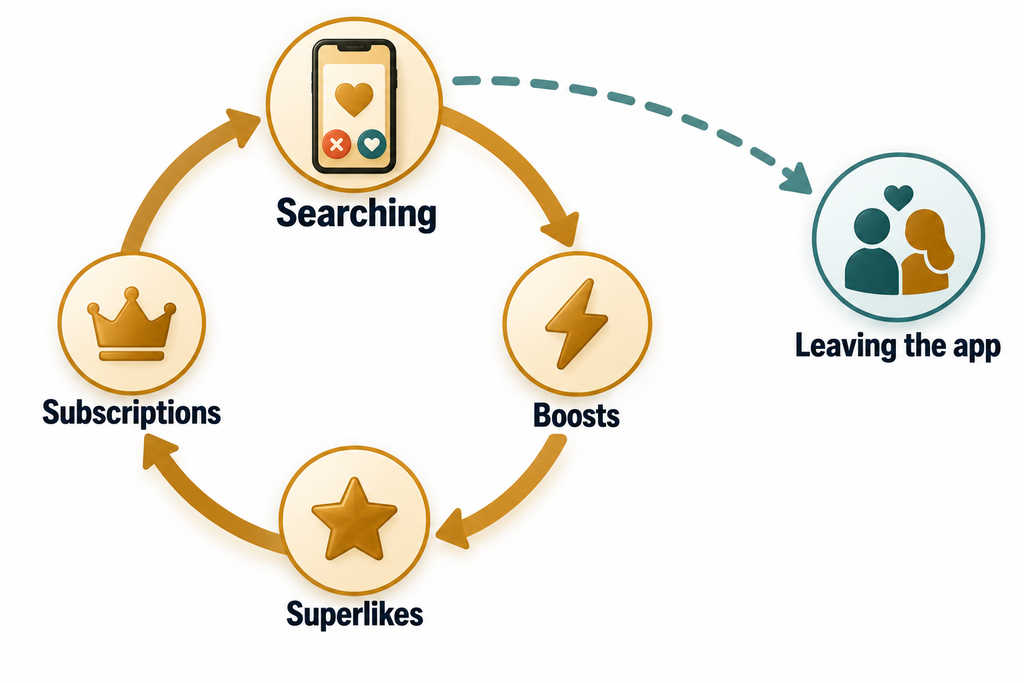
Here’s the part worth sitting with: a dating app’s business model is not actually aligned with you finding someone and leaving. An app makes money while you’re searching — subscriptions, boosts, “see who liked you” paywalls, superlikes. A successful match that takes you off the platform for good is, from a pure revenue standpoint, the outcome the business is least incentivized to optimize for. That doesn’t mean apps are secretly sabotaging your love life. It means the product’s economics reward prolonged engagement, and prolonged engagement and prolonged singleness look, from the inside of the algorithm, almost identical.
Match.com solved a discovery problem — meeting people beyond your zip code and your friend group. It never solved, and was never really built to solve, the resolution problem: getting you to a place where you stop needing the product.
The Pattern: Pain Points Become Product Categories
Line these three up and the shape is unmistakable. Housing friction became a $75 billion rental marketplace. Insufficient stable jobs became a gig economy that reorganized labor markets, tax systems, and social safety nets around the world. Insufficient income became a $1.7 trillion debt pile with a $300 billion EdTech industry responding to it. The fear of being caught without money became credit cards, then BNPL. And the loneliness of an atomized dating pool became a $9 billion industry with every incentive to keep you swiping.
None of these industries lied, exactly. They just found a real wound and built a very good bandage — one you pay a subscription for.
Key takeaways:
– Housing, student debt, and dating friction in young adulthood were never resolved — they were converted into recurring-revenue businesses.
– The sharing economy and gig economy both trace back to affordability and job-stability failures, not visionary innovation.
– Student debt didn’t just grow — it delayed the timeline of adulthood itself, from homeownership to marriage to having kids.
– BNPL and credit cards sell against the same 90-year-old friction: the fear of not being able to pay.
– Dating apps profit from the search, which means their incentives don’t fully align with you finding what you’re looking for and leaving.
Before you praise the next “disruptive” app for solving a problem in your life, ask the sharper question: did this fix the underlying friction, or did it just find a more profitable way for you to keep living with it? That single question is the cheapest financial literacy tool you’ll get all year, and it’s worth applying the next time you sign up for something that promises to make young adulthood easier. If this pattern of unsolved-problems-turned-industries interests you, it shows up just as clearly in ownership, investor literacy, and the products built around young-adult financial risk.
What This Means for How You Spend
Did Airbnb and Uber actually cause the housing and labor problems they built on?
No — the excerpt and reporting behind these origin stories frame them as responses to pre-existing affordability and job-stability gaps, not causes. Airbnb has, however, been widely scrutinized for potentially worsening local housing supply in some markets once it scaled.
Did any of these three industries — housing, debt, or dating — actually make the underlying problem worse, not just profit from it?
Airbnb is the clearest case: in some markets, converting long-term rentals into short-term listings has been linked to measurable upward pressure on local rents, meaning the platform can end up amplifying the very affordability problem it was built on top of, not just profiting from it neutrally.
Are BNPL services actually worse than credit cards?
Not necessarily worse — but they run on the same underlying mechanic: making a cost feel smaller than it is at the moment of decision. Both deserve the same scrutiny you’d apply to any credit product.
Do dating apps want people to stay single?
Not explicitly — but the subscription and engagement-based revenue model means the business benefits more from continued use than from a member finding a match and deleting the app, which is a structural tension worth being aware of.
Sources
- The Human Constant — The Great Leap
- The Human Constant — The Debt We Chose
- Airbnb founding story: Chesky and Gebbia inflating air mattresses in October 2007 during a San Francisco design conference, charging $80/night
- Airbnb valuation figure of approximately $75 billion
- Uber origin story involving Travis Kalanick and Garrett Camp in Paris, December 2008, unable to find a cab
- Alternative account that Garrett Camp was already developing the idea months before the Paris trip due to frustration with San Francisco’s black-car services
- Uber’s 2019 IPO valuation of approximately $82 billion
- Average student debt figure of ~$9,000 for U.S. college graduates in 1993
- Average student debt figure of ~$37,000 for U.S. college graduates by 2024
- Total U.S. student loan debt reaching approximately $1.7 trillion by 2024
- Global EdTech market valued at over $300 billion
- Federal student loan program originating from the 1958 National Defense Education Act
- Diners Club founding story: Frank McNamara forgetting his wallet at a 1949 dinner, returning in February with a card and partner Ralph Schneider
- Claim that Diners Club’s own press agent later admitted embellishing the founding story for publicity
- Diners Club reaching roughly 10,000 members within a year of founding
- Match.com launching in 1995 as the first major online dating service
- Claim that approximately 40% of American couples report meeting online
- Global online dating industry valued at approximately $9 billion annually
- Research claim that high student debt correlates with delayed homeownership, marriage, and childbirth
- Characterization of BNPL platforms (Klarna, Afterpay, Affirm) as emerging in the 2010s specifically to address checkout cart abandonment
