


















































Why ‘Is This Feasible?’ Kills Good Ideas Before They’re Born

Ask “is this feasible?” too early and you will strangle nine out of ten good ideas in the crib. That’s not a motivational poster line — it’s what actually happens in pitch meetings, product syncs, and 2 a.m. notebook sessions every single day. Founders reach for feasibility as a filter before they’ve even finished imagining what they’re filtering. What’s missing isn’t more discipline. It’s a proper idea generation framework — one that forces completeness before it allows judgment.
Airbnb is the cleanest proof of this on record. When Brian Chesky and Joe Gebbia first described the idea — strangers paying to sleep in other strangers’ homes — the reaction inside the room was close to unanimous: this is crazy. No hotel brand. No safety guarantee. A liability lawsuit with a website attached. Feasibility, asked at that moment, returns one honest answer: no.
But feasibility was the wrong question. The right one was about life phase: two broke young adults, one housing affordability crisis. Read that way, the idea wasn’t reckless — it was almost obvious.
What this means for you: the instinct to filter for feasibility first is the single biggest idea-killer in early ideation. Hold it off, deliberately, until you’ve done the imagining work first.

Why Airbnb Sounded Crazy — And Why the Framework Would Have Predicted It Anyway
Market analysts looked at Airbnb’s premise and saw a hospitality business missing the two things hospitality businesses are supposed to have: brand trust and safety infrastructure. Judged against that category, it was crazy. Several investors reportedly said so directly, and the “murder in one of these houses” line associated with an early rejection has become part of Airbnb’s own founding lore.
A life-phase reading starts somewhere else entirely. It doesn’t ask “does this look like a hotel?” It asks “who is under financial pressure right now, and what does that pressure force them to do?” Two people, rent due, an air mattress, a conference in town. That’s not an idea about hospitality. It’s an idea about a specific age bracket colliding with a specific economic squeeze — a friction almost every renter in an expensive city recognizes on contact.
That’s the mechanism this piece is built around, and it’s covered in more structural detail in the six-step framework for turning any human friction into a business, which traces exactly how that early rejection gave way to a business now valued in the tens of billions. The market-fit signal was never going to show up in a feasibility spreadsheet. It showed up in the phase.
Feasibility Bias: The Two Unsolved Problems in How Founders Generate Ideas
Strip away the Airbnb story and you’re left with two structural gaps — call it feasibility bias — that quietly sabotage how founders generate ideas, over and over, industry after industry.
Problem one: founders judge before they finish imagining. The question “is this feasible?” gets asked while the idea is still half-formed — before anyone has mapped what a complete solution would even look like. Feasibility is a resource question. It has no business showing up before the imagination question has been answered in full.
Problem two: founders map the problem too broadly to be useful. “Young adults need housing” isn’t a problem statement — it’s a category. It’s too vague to point toward any specific solution, which means it’s also too vague to properly evaluate. Compare that to: young adults in cities where median rent eats more than forty percent of median income face a mathematically impossible affordability equation, one that forces a trade-off between proximity to work and quality of living space. That sentence has edges. You can design against edges. You cannot design against a vibe.
Practical takeaway: before you judge any idea, run two checks — have you stated the problem with numeric or specific precision, and have you actually imagined the unconstrained, full-form solution? If either answer is no, you’re not ready to ask about feasibility yet. You’re not even ready to reject the idea yet.
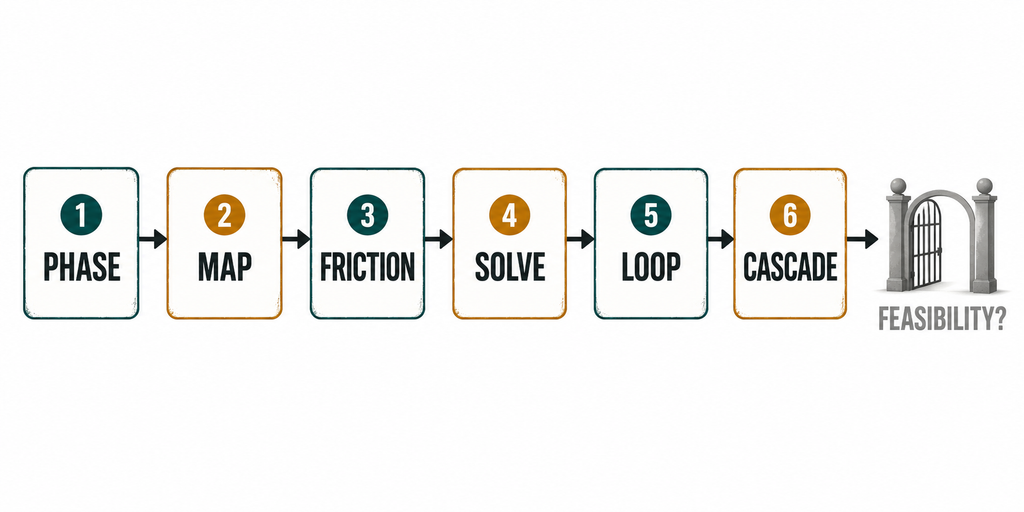
The Six-Step Framework: Phase, Map, Friction, Solve, Loop, Cascade
Here’s the sequence, in order, and why the order itself is the point.
Step One — Choose your phase. Start with the life phase you know most intimately, through direct experience, close observation, or deep research. Personal experience gives you texture no market report replicates — the emotional weight of a need, the specific shape of a friction. But depth of observation can substitute for lived experience; you don’t have to have suffered the problem to see it clearly.
Step Two — Map with specificity. Push past the category-level statement until you hit numbers, thresholds, and edges. The precision of your problem statement caps the precision of your eventual solution.
Step Three — Find the friction. This is where most idea generation quietly goes wrong. “I can never find a taxi” is a logistics complaint — and it’s the complaint that, on the surface, produced Uber. But underneath it sits something else: “I feel powerless and anxious in moments when I need reliable transportation to reach something that matters.” The surface complaint is logistical. The friction underneath it is emotional. You find it by asking “why does this matter?” repeatedly, past the point of comfort, until you hit an answer that’s about a feeling rather than a task.
Steps Four through Six — Solve, Loop, Cascade. Imagine the full, unconstrained solution before you let feasibility into the room. Map the loop — what financial instruments or recurring value does this generate beyond the initial product? Then map the cascade — the downstream effects that ripple outward once the solution exists at scale.
What this means for you: the “why does this matter?” repetition technique isn’t a nice-to-have brainstorming trick — it’s the step that separates a feature idea from a company. Skip it and you’ll build the taxi-hailing app instead of Uber.
For a deeper anatomical breakdown of how a single friction compounds all the way into an industry and its financial instruments, see the eight steps from friction to industry.
Case Study: Applying the Framework to the Childcare Gap
Run the full sequence against a real, unresolved market: childcare.
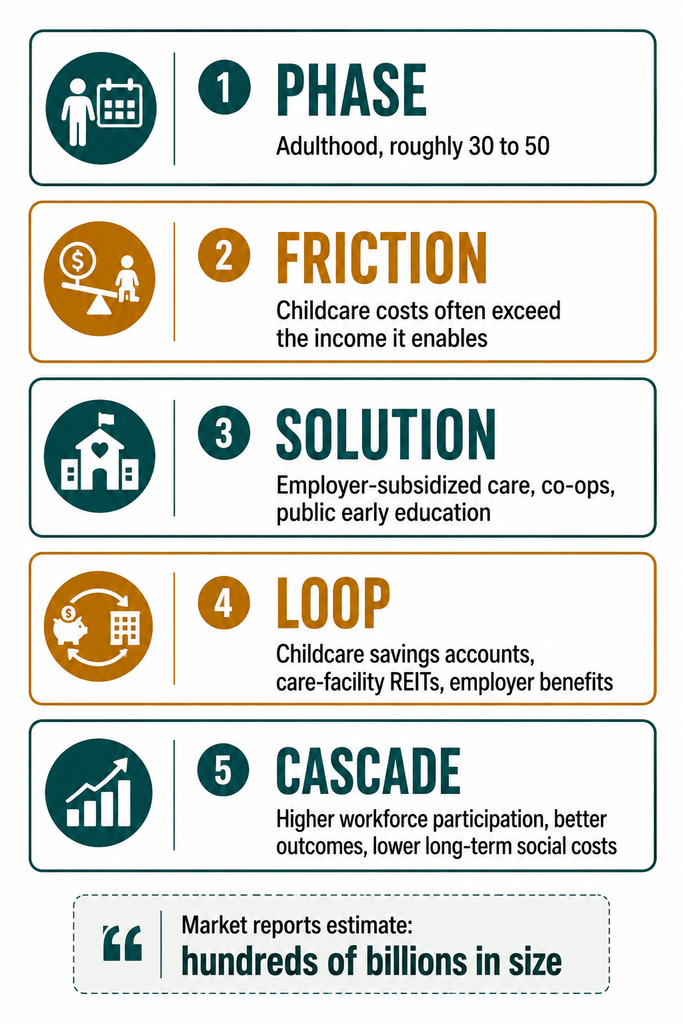
- Phase: Adulthood, roughly 30 to 50.
- Friction: Parents — mothers disproportionately — are forced to choose between career and family, because quality childcare frequently costs more than the income it enables them to earn.
- Full solution (unconstrained): Employer-subsidized childcare, cooperative care models, and universal publicly-funded early education, considered together rather than picking just one.
- Financial loop: Childcare savings accounts, care-facility REITs, and employer benefit products that turn the solution into recurring financial infrastructure, not just a one-time service.
- Cascade: Higher female workforce participation, better child developmental outcomes, and — over roughly two decades — reduced downstream social services costs.
Run through feasibility first, and childcare reform looks like a policy quagmire — regulatory, expensive, politically loaded. Run through completeness first, and it looks like what it actually is: a market industry reports estimate at hundreds of billions of dollars globally, with unambiguous demand and, as of now, no adequate solution.
Practical takeaway: take your own life-phase friction and fill in the same five blanks — phase, friction, solution, loop, cascade — as a repeatable worksheet. It works whether the friction is worth a lemonade stand or a unicorn.
How to Use This Framework Without Killing Your Own Idea Too Early
Sequencing is everything here. Feasibility isn’t banned from the process — it’s just demoted to last.
Picture the same air mattress from the Airbnb story, but now think of your own idea as that mattress: still unmade, still just a shape in the room. Say the friction you noticed is your own — a parent at 11 p.m., laptop open, staring at a daycare waitlist email that just bounced back for the third center in a row. That specific, lived moment is Step One and Step Three already half-done before you’ve written a word. The checklist below is the sequence for inflating the rest of it fully before anyone asks whether it can hold weight.
A working checklist:
- Name the life phase you’re drawing from, and be honest about whether you know it firsthand or from careful observation.
- Write the problem statement until it contains a number, a threshold, or a hard constraint — not a category.
- Interrogate the surface complaint with “why does this matter?” until you hit the emotional friction underneath.
- Design the full, unconstrained solution — resources, regulation, and cost temporarily off the table.
- Map the loop: what recurring value or financial instrument does this generate?
- Map the cascade: what changes downstream, at scale, five and twenty years out?
Only after all six is feasibility allowed to speak. By then it’s answering a much better question — not “should this idea exist?” but “given everything this could become, what’s the smallest version worth building first?”
The direct takeaway: don’t ask “is this feasible?” until you’ve asked “what would fully solve this?” and mapped both the loop and the cascade. Ask it any earlier and you’re not filtering ideas — you’re aborting them.
Putting the Framework to Work Beyond Startups
Isn’t feasibility important eventually?
Yes, unavoidably — nobody builds a company on imagination alone. The point isn’t to delete the feasibility question, it’s to move it to the end of the sequence, after completeness, loop, and cascade have been mapped. Ask it early and it kills ideas that would have survived contact with a real plan.
How is this different from standard brainstorming?
Standard brainstorming usually starts from the solution side — “what could we build?” — and stays at the surface-complaint level, which is exactly the layer Uber’s “I can’t find a taxi” example warns against. This framework starts from a life phase, forces specificity in the problem statement, and requires you to dig to the emotional friction before any solution gets proposed at all.
Can this work outside consumer startups?
The examples here — Airbnb, Uber, childcare — are consumer-facing, but the underlying mechanic (phase, friction, complete solution, loop, cascade) doesn’t require a consumer product to function. Picture a mid-career employee sitting in a benefits-enrollment meeting, glazing over at a wall of acronyms nobody explained — that’s a life phase and a friction just as real as a housing crunch, and it’s exactly the kind of moment an HR-tech founder or a policy team could run through the same six steps. Enterprise tools, public policy, and nonprofit programs all sit on top of some human life phase and some specific friction within it. The framework travels; the examples are just where it’s easiest to see.
What if I can’t find the “emotional core” of a complaint?
Keep asking “why does this matter?” one more time than feels natural. If you stop at the first or second answer, you’ll usually still be describing a task, not a feeling — and tasks make features, while feelings make markets.
Key Takeaways
- Asking “is this feasible?” too early is the single biggest idea-killer in early-stage ideation — defer it deliberately.
- Vague problem statements produce vague solutions; push every idea toward numeric or structural specificity.
- Surface complaints are logistical; the real friction underneath is usually emotional — find it by repeatedly asking “why does this matter?”
- The six-step sequence — Phase, Map, Friction, Solve, Loop, Cascade — puts feasibility last on purpose.
- Run your own friction through the same five outputs used in the childcare case study: phase, friction, solution, loop, cascade.
If you’ve got an idea you already talked yourself out of because it “wasn’t feasible,” it might be worth pulling back out — not to fix the feasibility, but to check whether you actually finished imagining it first.
Sources
- The Human Constant — Reading the Human Map
- Claim that an early Airbnb investor said ‘You guys are crazy… there’s going to be a murder in one of these houses’ as part of the founding rejection story
- Reference to Airbnb founders Brian Chesky and Joe Gebbia by name in connection with the rejection anecdote
- Claim that Airbnb is ‘now valued in the tens of billions’
- Uber origin claim that the surface complaint ‘I can never find a taxi’ produced the company
- Statement that the childcare market is ‘worth hundreds of billions’
- Claim of ‘reduced downstream social services costs over roughly two decades’ from childcare solutions
- General claim that mothers are disproportionately forced to choose between career and family due to childcare costs exceeding enabled income
