




















































3 Problems Nobody’s Solved in Markets: Ownership, Literacy, and Young-Adult Risk

Markets are very good at one thing: removing friction between ambition and capital. They are much worse at a different thing: making sure the people using them actually understand what they’re holding, actually own what they’re told they own, or get products designed for who they really are. There are at least three unsolved problems in markets that four centuries of financial innovation have never actually fixed — real employee ownership, investor literacy, and products built for young-adult risk-taking. Everything else is iteration on top of these gaps.
Four Hundred Years of Democratizing Ambition — and Three Gaps Nobody Closed
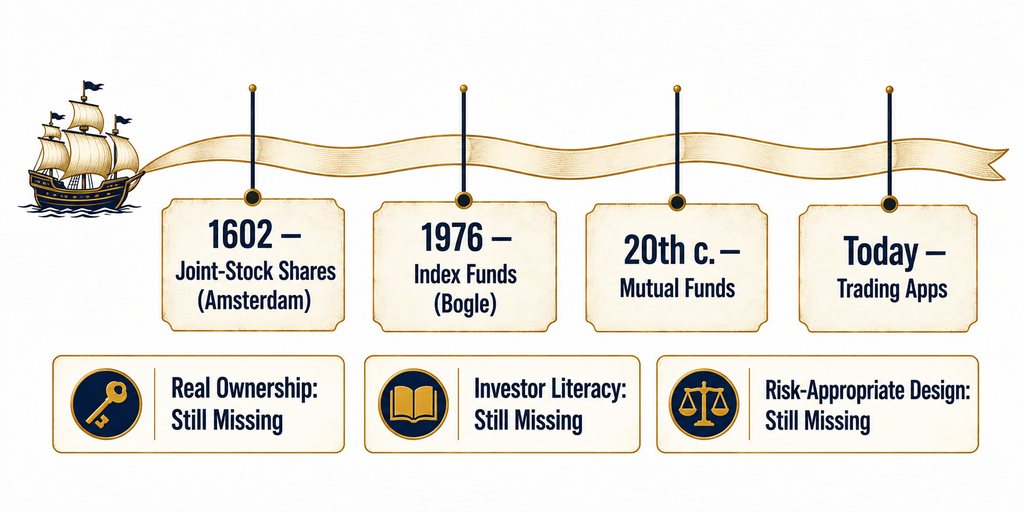
Start in Amsterdam, 1602. The Dutch Republic had a venture too expensive and too risky for any single financier: ships, crews, supplies, months at sea, uncertain returns. The fix was elegant — split ownership into shares, sell them to the public, spread the risk and the reward across many investors. The Dutch East India Company financed itself this way, and the Amsterdam Stock Exchange became the world’s first public equity market. Four centuries later, that same basic mechanism — pool capital, distribute ownership, trade the claims — still underwrites the entire global financial system.
Since then, markets have run an impressive string of access upgrades. Mutual funds brought diversified equity investing to middle-class savers who’d never had a broker’s phone number. Index funds, pioneered by Jack Bogle in 1976, made market-average returns available without paying someone to underperform them. Discount brokerages, and later trading apps, made buying a share as easy as ordering a coffee. Each wave knocked down a wall between ordinary ambition and the machinery that was supposedly built to serve it.
But access was never the whole job. You can hand someone a brokerage account, a stock grant, or a trading app and still leave three things untouched: whether they actually own a meaningful stake in the value they create, whether they understand the risk they’re taking on, and whether the product in front of them was ever designed with their life stage in mind. Four hundred years of democratizing ambition, and these three gaps are still open.
The Original Fix: How Amsterdam Solved Risk-Sharing, Not Ownership
It’s worth sitting with what the 1602 solution actually solved, because it’s narrower than the origin story usually implies. The joint-stock structure solved a capital problem — how do you fund something too big for one person’s wallet — by solving a risk-distribution problem. Spread the exposure across many shareholders, and no single investor is wiped out by one bad voyage.
What it never solved, and never tried to, was ownership for the people doing the actual work. The crews who sailed the ships, loaded the cargo, and took on the physical risk didn’t get shares — historical maritime-labor records (pay ledgers, transport letters, and month letters documenting sailors’ salary arrangements) confirm they were paid fixed wages instead. That split — capital owns, labor gets paid — wasn’t a law of physics. It’s a pattern that traces back at least to 1602, and it’s still the default template underneath modern employment. Every company that hands out a paycheck and calls the equity grant a “nice-to-have” is running a version of that same architecture. Worth noticing: nothing has forced anyone to update it.
Problem 1: Real Employee Ownership Still Doesn’t Exist at Scale
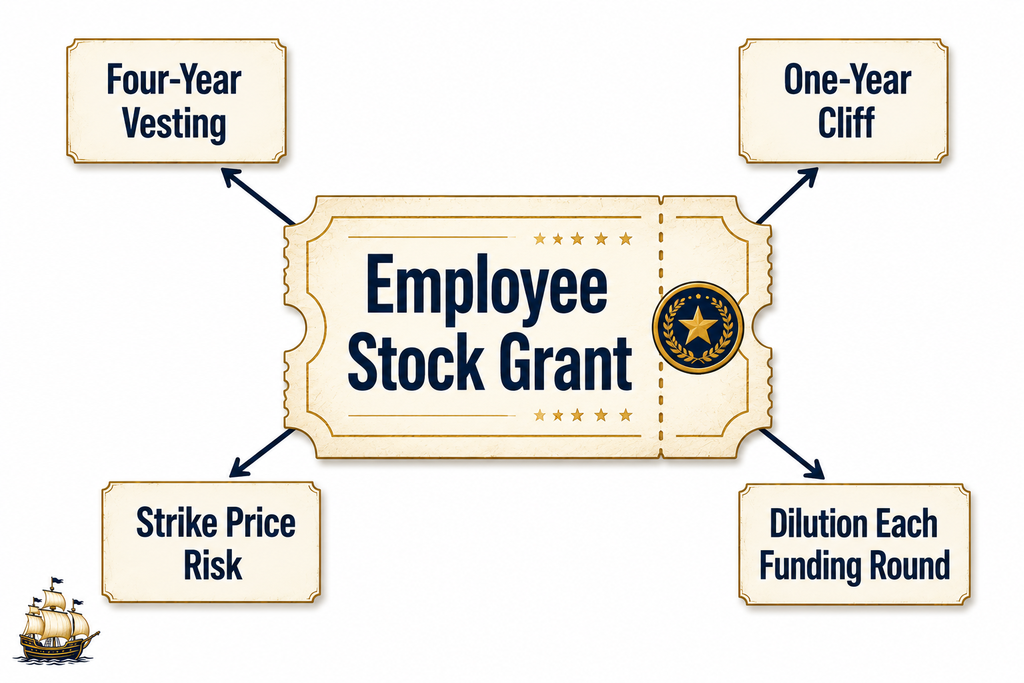
Stock options and employee stock purchase plans get marketed like a stake in the company. Functionally, most of them behave more like a lottery ticket with a vesting cliff attached. Four-year vesting schedules, one-year cliffs, strike prices that can end up underwater, dilution from every subsequent funding round — by the time an employee’s grant is worth anything, it’s often been sliced down to a fraction of what the offer letter implied.
A handful of outlier companies have built genuinely broad-based, meaningful equity programs. They get case-studied endlessly precisely because they’re rare. For most workers, “ownership” is a line item that vests slowly, dilutes quietly, and rarely adds up to real control or real wealth relative to the value they helped create.
The takeaway: if you’re evaluating a job offer or a comp package, don’t just look at the headline number of shares or options granted. Ask what percentage of the company that actually represents, how it dilutes over time, and what happens to it if you leave before the cliff. A big-sounding grant and real ownership are not the same sentence.
Problem 2: Investor Literacy Never Caught Up With Investor Access
Here’s the mismatch nobody priced in: every wave of access-removal made it easier to trade and did almost nothing to make people better at investing. Mutual funds simplified diversification but didn’t teach fee structures. Index funds, since Bogle’s 1976 innovation, made low-cost market exposure the obvious default — but “obvious” only helps you if you know it exists. Discount brokerages and mobile trading apps compressed the distance between impulse and execution down to a few taps.
Access got frictionless. Education did not scale with it. The result, widely described by financial-literacy researchers and advisors, is a generation of investors who can open a position in seconds and have often never been walked through what diversification actually protects against, what a leveraged product does to their downside, or why fees compound the same way returns do.
The takeaway: treat low barriers to entry as a reason to invest more in your own understanding, not less. The easier it is to buy something, the more the burden shifts onto you to know what you’re buying — because the platform certainly isn’t going to slow you down to explain it.
Problem 3: GameStop Showed Us Young-Adult Risk-Taking Isn’t an Anomaly — It’s Undesigned For
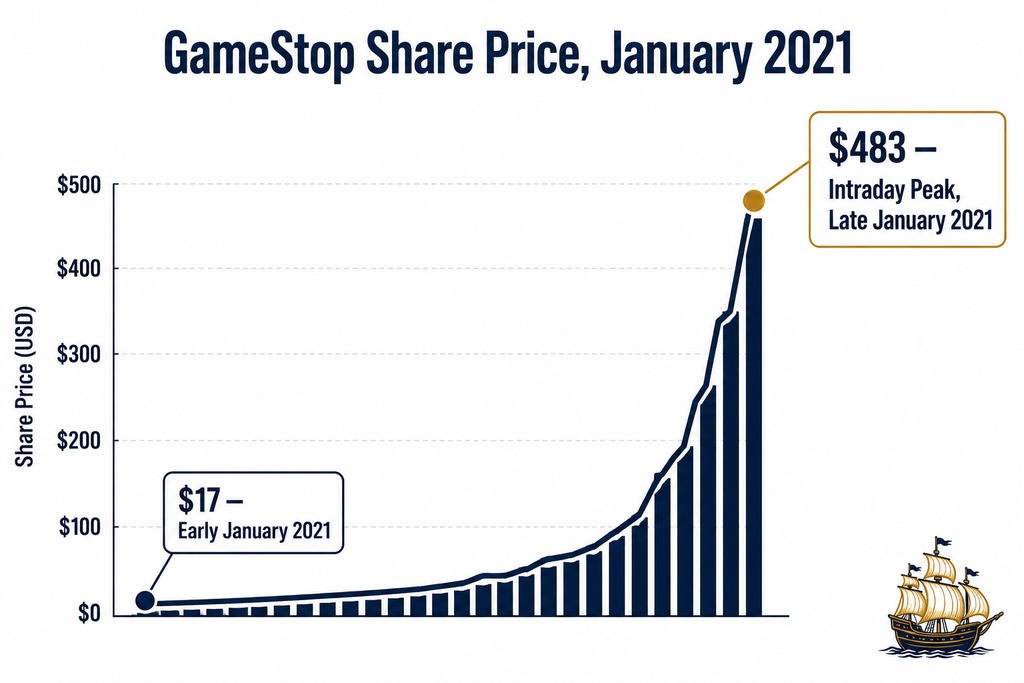
In January 2021, retail investors organizing on Reddit’s WallStreetBets pushed GameStop’s share price from under twenty dollars to an intraday peak of roughly four hundred eighty-three dollars on January 28 — a run reported at well over twenty-fold in under three weeks. Financial media largely treated it as a freak event, a glitch in the system, something to be explained away and regulated against.
It’s better described, though, as a widely-observed demonstration of social proof and collective identity operating the way they’re commonly described as operating at a specific life phase — young adults deploying the social competencies they’ve spent their whole lives building, aimed at a financial system that had never been designed with them in mind. That framing is an interpretation, not a settled psychological finding; no single explanation covers every trader involved. But it’s a familiar life-stage pattern showing up somewhere markets weren’t built to expect it. The same underlying dynamic — a generation shaped by a specific set of formative conditions using unfamiliar tools in ways institutions didn’t anticipate — shows up in other domains too, which is part of what makes the case for building products around distinct life phases worth taking seriously well beyond markets.
The takeaway: platforms and regulators keep treating coordinated young-adult trading as misbehavior to police after the fact, rather than a predictable pattern to design responsibly for up front. Punishing the symptom doesn’t fix the fact that no one built the product for the people actually using it.
Why These Three Problems Are Actually One Problem
Line these up and the pattern is obvious: markets scaled access mechanically — more shares, more funds, more apps — without ever redesigning the incentives, the education, or the product fit for who’s actually on the other end of the transaction now. These are three unsolved problems in markets, but they share one root cause. Access was treated as the finish line. It was only ever the starting gate.
That’s why a fix for any one of them, taken alone, doesn’t hold up. Teach people investor literacy without fixing ownership, and you’ve just built smarter spectators — people who understand the game better while still not owning a meaningful piece of the companies they work for. Fix ownership without addressing risk-design, and you’ve handed young adults real equity stakes inside products that still weren’t built with their behavior patterns in mind. The three problems have to be solved together, because they’re really one problem wearing three costumes.

Key Takeaways
- Markets have iterated on access for four hundred years — joint-stock companies, mutual funds, index funds, discount brokerages — but access isn’t the same as ownership, literacy, or risk-appropriate design.
- Employee ownership at most companies functions more like a lottery ticket (vesting cliffs, dilution) than a genuine stake — check the actual percentage, not the headline grant.
- Investor literacy hasn’t scaled alongside investor access — frictionless trading demands more self-education, not less.
- The January 2021 GameStop surge reflected predictable young-adult social-proof behavior applied to a system never designed for it — not a one-off anomaly.
- Ownership, literacy, and risk-design gaps share one root cause: markets scaled the mechanics of access without redesigning who they actually serve.
What This Means for Your Own Portfolio
What’s the difference between real employee ownership and stock options?
Stock options give you the right to buy shares later at a set price, contingent on vesting schedules and subject to dilution — it’s a conditional bet on the future, not a stake you hold today. Real ownership means a meaningful, largely non-diluted equity position that actually moves with the company’s value. Most compensation packages offer the former while implying the latter.
Why weren’t index funds enough to fix investor literacy?
Index funds solved a cost and complexity problem — you no longer needed to pick stocks or pay active-management fees to get market-rate returns. But knowing an index fund exists, and understanding concepts like diversification, risk tolerance, and fee drag, are separate skills that no product automatically teaches. Access and understanding scaled at very different speeds.
Was the GameStop rally really about young-adult psychology, and not just a fluke?
The magnitude of the move — reportedly from under twenty dollars to an intraday high near four hundred eighty-three dollars on January 28, 2021 — was extreme, and no single explanation covers every trader involved. But the coordination, the identity-driven momentum, and the collective-action pattern are consistent with widely-described social behaviors associated with that life stage, applied to a market that had no product built to anticipate them.
Where This Leaves You
None of these three unsolved problems in markets are going to get fixed by the next app or the next regulatory memo. Ownership, literacy, and risk-appropriate design require actually rethinking who markets are for — not just how fast someone can get into them. If you’re on the receiving end of any of this — evaluating an equity grant, opening your first brokerage account, or watching a Reddit thread turn into a stock move — the useful move isn’t optimism about the system fixing itself. It’s asking sharper questions before you click “buy.”
Sources
- The Human Constant — When Paper Became Power
- Claim that the Dutch East India Company financed itself via the 1602 Amsterdam joint-stock structure, and that the Amsterdam Stock Exchange was the world’s first public equity market
- Attribution of the index fund’s creation to Jack Bogle in 1976
- Claim that crews on Dutch East India Company voyages received wages rather than ownership shares (historical labor-structure claim)
- Independent confirmation of VOC sailors’ wage-based pay structure via pay ledgers, transport letters, and month letters
- Specific figures: GameStop share price moving from approximately $17 to an intraday peak of approximately $483 in January 2021
- Confirmation that GameStop’s intraday peak of $483 occurred specifically on January 28, 2021
- Framing that WallStreetBets coordination on Reddit was the primary driver of the GameStop price surge
