















































BNPL Is a Confession: Why Nobody Can Regulate the Buy Now, Pay Later Boom

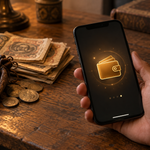
Every “Pay in 4” button at checkout is a confession dressed up as convenience. It admits the price felt too high a second ago, and now, magically, it doesn’t. BNPL regulation is the term regulators keep reaching for, and it keeps slipping out of their hands — because Klarna, Afterpay, and Affirm were never built to be regulated. They were built to be irresistible. Anyone who has clicked “Pay Later” at 11 p.m. has already met the two unsolved problems this piece is about: nobody can price risk for the credit-invisible, and nobody has figured out how to regulate BNPL the way they regulate a credit card. Both problems predate BNPL by decades. BNPL just made them fast, cute, and app-shaped.
From Diners Club to Klarna: Credit’s Recurring Trick
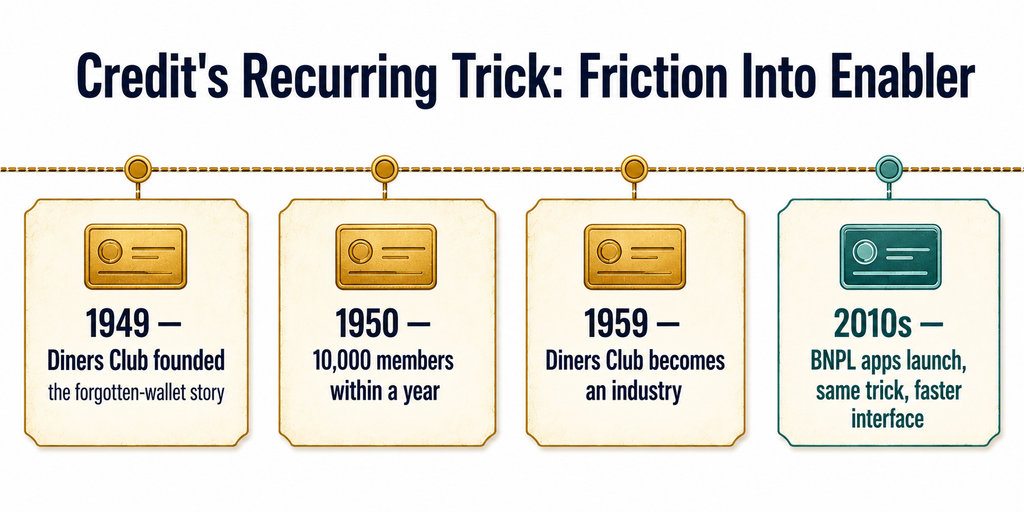
Diners Club tells a founding story so tidy it should come with a wink. In 1949, the story goes, a New York businessman named Frank McNamara took clients to dinner, reached for his wallet, and discovered he’d left it at home — his wife had to bring the cash. Mortified, McNamara returned the following February with a small cardboard card and a partner, Ralph Schneider, and paid by signature instead. It’s a great story. It’s also one the company’s own longtime press agent later admitted to embellishing for publicity, and nobody has ever fully nailed down which parts are true.
What isn’t in dispute is the outcome. Within a year, Diners Club had ten thousand members. Within a decade, it was an industry. Within half a century, it was scaffolding under the entire global economy. Whether McNamara’s embarrassment was real or invented, the friction it was built to sell against — the fear of being caught without a way to pay — was real enough to build an empire on.
That’s the trick, and it’s the only trick credit has ever really needed: take a deterrent — shame, sticker shock, the pause before a purchase — and convert it into an enabler. Diners Club did it with a card. BNPL does it with a checkout widget that splits $200 into four payments of $50 and calls the math a feature. Same trick, faster interface.
The Student Loan Precedent: Debt That Reschedules a Life
If you want to see where the “convert friction into enabler” trick eventually lands, look at student debt. In 1958, the U.S. government created the first federal student loan program under the National Defense Education Act. By 2024, total American student loan debt had reportedly reached somewhere around $1.7 trillion — a figure widely cited but worth treating as an order of magnitude rather than a precise ledger entry. Research has repeatedly linked high student debt to delayed homeownership, delayed marriage, and delayed childbirth.
The student loan didn’t just finance a degree. It rescheduled adulthood for an entire generation, quietly moving milestones from someone’s twenties into their thirties or later.
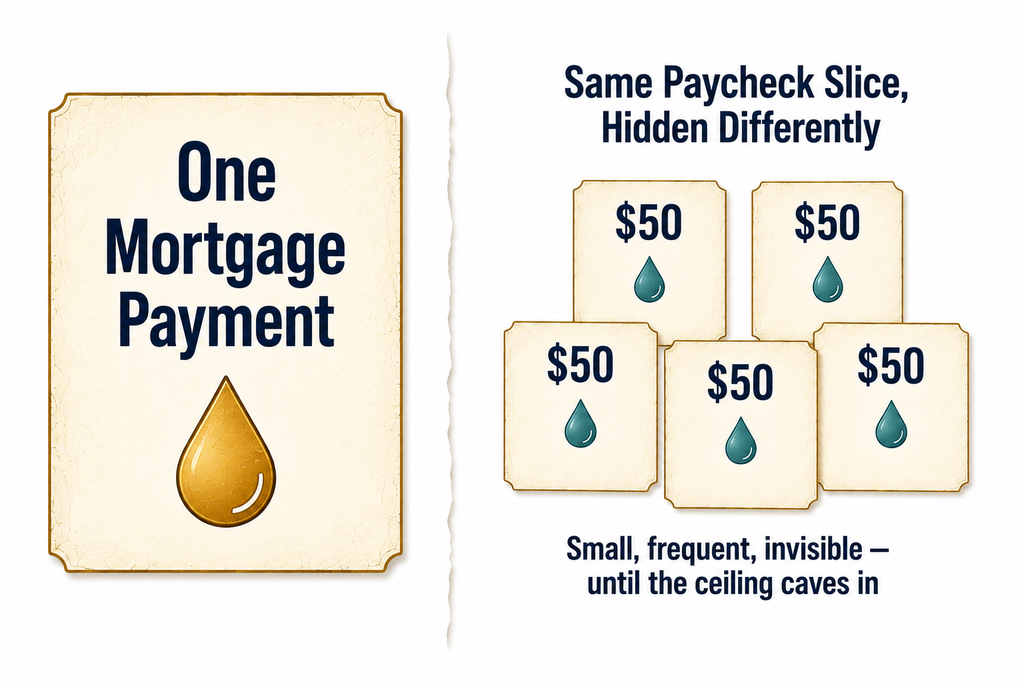
Here’s the uncomfortable parallel: BNPL loans are small. A $50 installment doesn’t reschedule anyone’s wedding. But small, frequent, easy-to-approve debts compound the same way water damage compounds — invisibly, until the ceiling caves in. A handful of $50 installments stacked across five apps looks nothing like a mortgage on paper, but it can eat the same slice of a paycheck a mortgage would, with none of the warning signs a mortgage forces you to confront up front.
Problem One: Pricing Risk for Credit-Invisible Consumers
Every lender’s core job is pricing risk — figuring out who’s likely to pay you back, and charging accordingly. That job gets nearly impossible when the borrower has no credit file to read. Millions of consumers are “credit-invisible” — thin or nonexistent credit histories, often because they’re young, new to the country, or simply don’t use traditional credit products. Traditional lenders handle this by charging more, asking for collateral, or declining outright. All three responses are blunt, but at least they’re honest about the uncertainty.
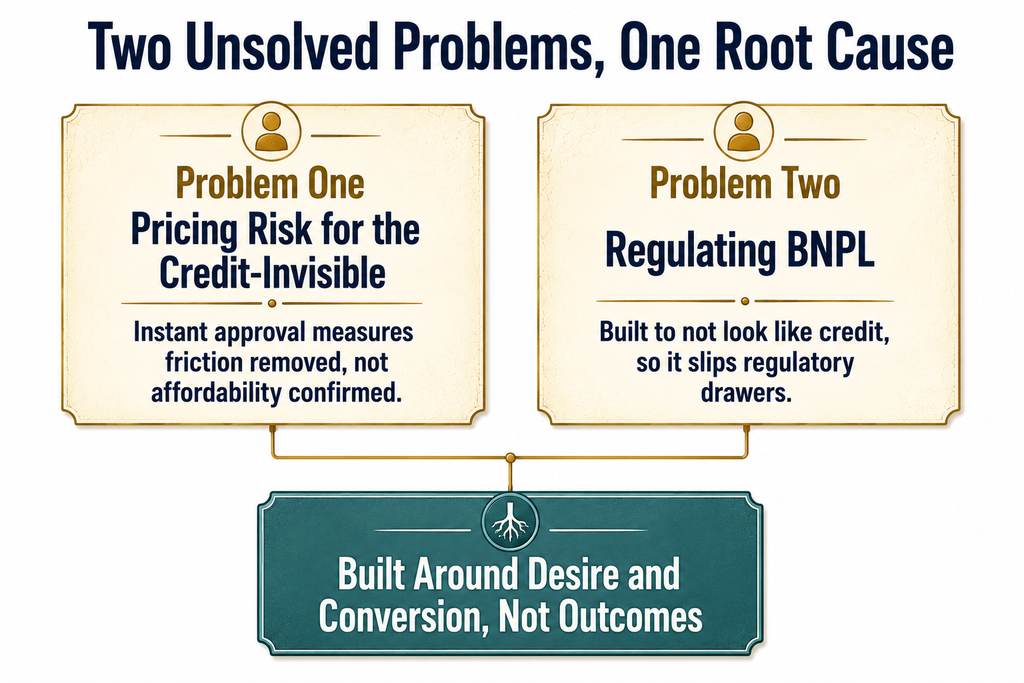
BNPL sidesteps the question instead of answering it. Instant approval at checkout isn’t underwriting — it’s a green light dressed up as trust. A soft credit check, a quick data pull, and you’re through in under ten seconds. That speed is the entire product. But speed isn’t the same as an accurate read on whether you can actually afford four payments of $50 stacked against three other BNPL plans you already have open. If you have a thin credit file, an instant “yes” from a BNPL app isn’t a verdict on your finances — it’s a signal that the friction was removed, not that the math was checked.
The mismatch here echoes a pattern that shows up whenever pricing risk collides with a population nobody has good data on — the same structural gap explored in The $1.3 Trillion Problem Nobody’s Pricing Right, where an entire category of risk goes chronically underpriced simply because nobody built the infrastructure to measure it properly.
Problem Two: Why BNPL Regulation Keeps Missing the Target
BNPL regulation keeps failing for a structural reason, not a political one: BNPL was engineered to not look like credit. It emerged in the 2010s to solve a narrow, specific problem — cart abandonment at the exact moment a shopper sees the total price. Splitting that price into four chunks, often at 0% interest, converts a deterrent into an enabler. It’s a confession: we want the purchase to feel affordable even when it isn’t.
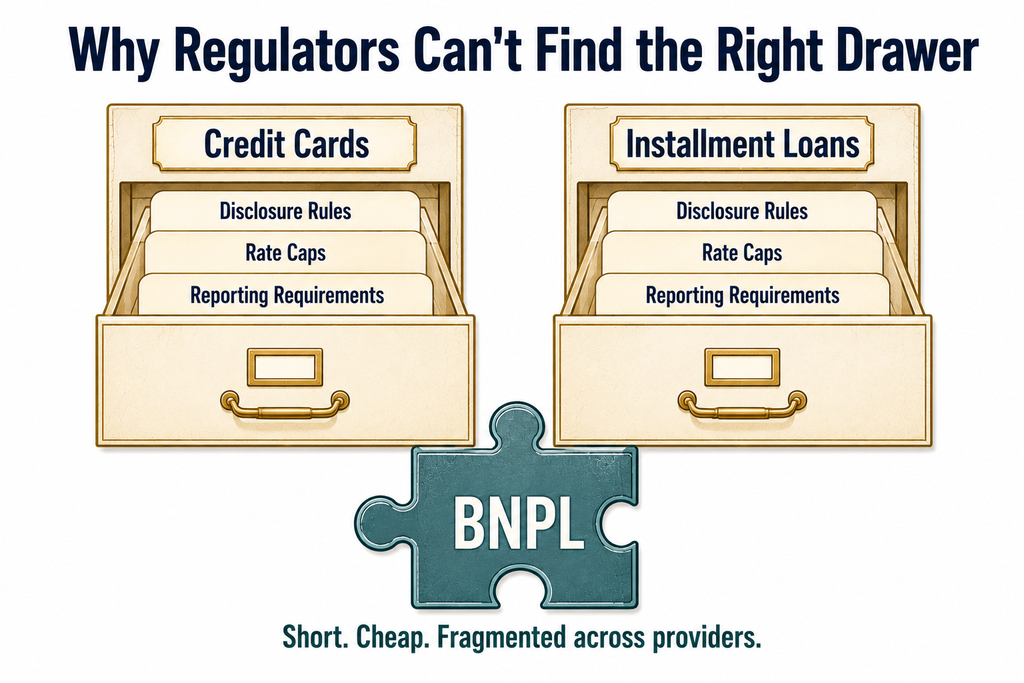
That design choice is also a regulatory loophole. Credit cards trigger a well-worn set of disclosure rules, interest-rate caps, and reporting requirements because they’ve been regulated as “credit” for generations. Many BNPL plans are short-term, frequently interest-free, and split across four or five separate providers a single consumer might be using simultaneously — none of whom necessarily know about the others. A product that’s short, cheap, and fragmented across companies doesn’t fit neatly into any drawer regulators built for cards or installment loans. So don’t assume BNPL is regulated like a credit card just because it feels like one at checkout — as of 2026, oversight varies widely by country and provider, and in the U.S. it remains a genuine patchwork rather than a settled framework.
What Both Problems Have in Common
Pricing risk for the credit-invisible and regulating BNPL look like separate problems. They’re not. Both are symptoms of the same underlying design philosophy: credit products built around desire and conversion, not around outcomes. Instant approval isn’t a failure to underwrite properly — it’s the entire point. A regulatory blind spot isn’t an oversight — it’s a feature that lets growth outrun scrutiny.
The practical rule for consumers is simple: treat any “frictionless” credit product as a signal to slow down, not speed up. Friction, historically, has been the thing standing between a bad decision and a good night’s sleep. When a company spends real engineering effort removing it, ask what they removed it for.
What to Actually Check Before You Tap Pay in 4
Does using BNPL affect your credit score?
It depends on the provider and the country. Some BNPL plans, like certain Affirm loans, have reported to credit bureaus for years; others, like many Klarna “Pay in 4” plans, historically haven’t reported routine on-time payments at all — though missed payments can still get sent to collections and hit your score hard. The reporting landscape has been shifting, with some providers moving toward more consistent bureau reporting as of the mid-2020s, so check the specific plan’s terms rather than assuming.
Who actually counts as “credit-invisible”?
Generally, it’s someone with no credit file at a major bureau at all — not just a low score, but no file to score. That includes many young adults just entering the credit system, recent immigrants, and people who’ve paid for everything in cash for years. It’s a different category from having “bad credit,” and BNPL’s instant-approval model tends to treat both groups the same way: fast yes, thin data.
Is BNPL regulated in the US and EU?
In the EU, revisions to consumer credit rules have moved toward bringing BNPL under similar protections as traditional credit products, with implementation unfolding over the mid-2020s. In the U.S., regulation is more fragmented — federal guidance has waxed and waned, and much of the real enforcement muscle sits with individual states. Neither region has landed on a single, settled answer, which is exactly the second unsolved problem this piece opened with.
Is BNPL actually cheaper than a credit card?
Often, yes, if you pay on time — many plans charge no interest at all. But miss a payment and some plans convert to high fees or refer the balance to collections fast, closer to a payday loan’s downside than a credit card’s. The “interest-free” pitch is true only for the borrower who pays exactly on schedule.
Key Takeaways
- BNPL regulation lags because BNPL was designed to not resemble the credit products regulators already know how to police.
- Credit-invisible consumers get instant BNPL approval, but instant approval measures underwriting friction removed, not affordability confirmed.
- Small, frequent BNPL debts can compound the way student loan debt reshaped an entire generation’s life timeline — just less visibly and on a shorter clock.
- Every “frictionless” credit product removed some friction on purpose; the smart move is to ask what that friction was protecting you from.
- Treat instant approval as a marketing signal, not a financial verdict.
The Confession, Again
Frank McNamara’s forgotten wallet may or may not have happened the way Diners Club tells it. It doesn’t matter. The friction it claimed to solve was real, and so is the friction BNPL solves today. The difference is that a cardboard card in 1950 took a decade to become an industry. BNPL did it in a few years, at checkout, one “Pay in 4” click at a time. Next time that button appears, treat it like what it is — a confession that the price felt too high a second ago — and give yourself the ten seconds of friction the app just spent real money trying to remove.
Sources
- The Human Constant — The Debt We Chose
- Diners Club founding story involving Frank McNamara and Ralph Schneider in 1949, including the forgotten-wallet anecdote
- Claim that Diners Club’s press agent later admitted to embellishing the founding story
- Diners Club becoming ‘an industry’ within a decade and a ‘fundamental feature of global economic life’ within half a century
- 1958 National Defense Education Act as the first federal student loan program
- Total U.S. student loan debt reaching approximately $1.7 trillion by 2024
- Research claim that high student debt correlates with delayed homeownership, marriage, and childbirth
- BNPL platforms (Klarna, Afterpay, Affirm) emerging in the 2010s to address checkout cart abandonment
- Claim that some Affirm loans report to credit bureaus while many Klarna Pay in 4 plans historically have not
- Claim that EU consumer credit rule revisions have moved to bring BNPL under similar protections during the mid-2020s
- Claim that U.S. BNPL regulation is fragmented and largely enforced at the state level
- General claim about millions of consumers being ‘credit-invisible’ due to thin or nonexistent credit files
