





















































Every boom looks inevitable in hindsight and every bust looks obvious in the postmortem. The financial loop framework explains why: it maps how a plain human need gets packaged into an instrument that eventually reshapes the very people it was meant to serve. What it doesn’t do — yet — is tell you when that packaging turns predatory, when it decouples from reality, or when it quietly bleeds into some other loop entirely. Those three gaps aren’t footnotes. They’re the reason smart people keep getting blindsided by markets they thought they understood.

The Financial Loop Framework: A Quick Recap of How Ideas Become Instruments
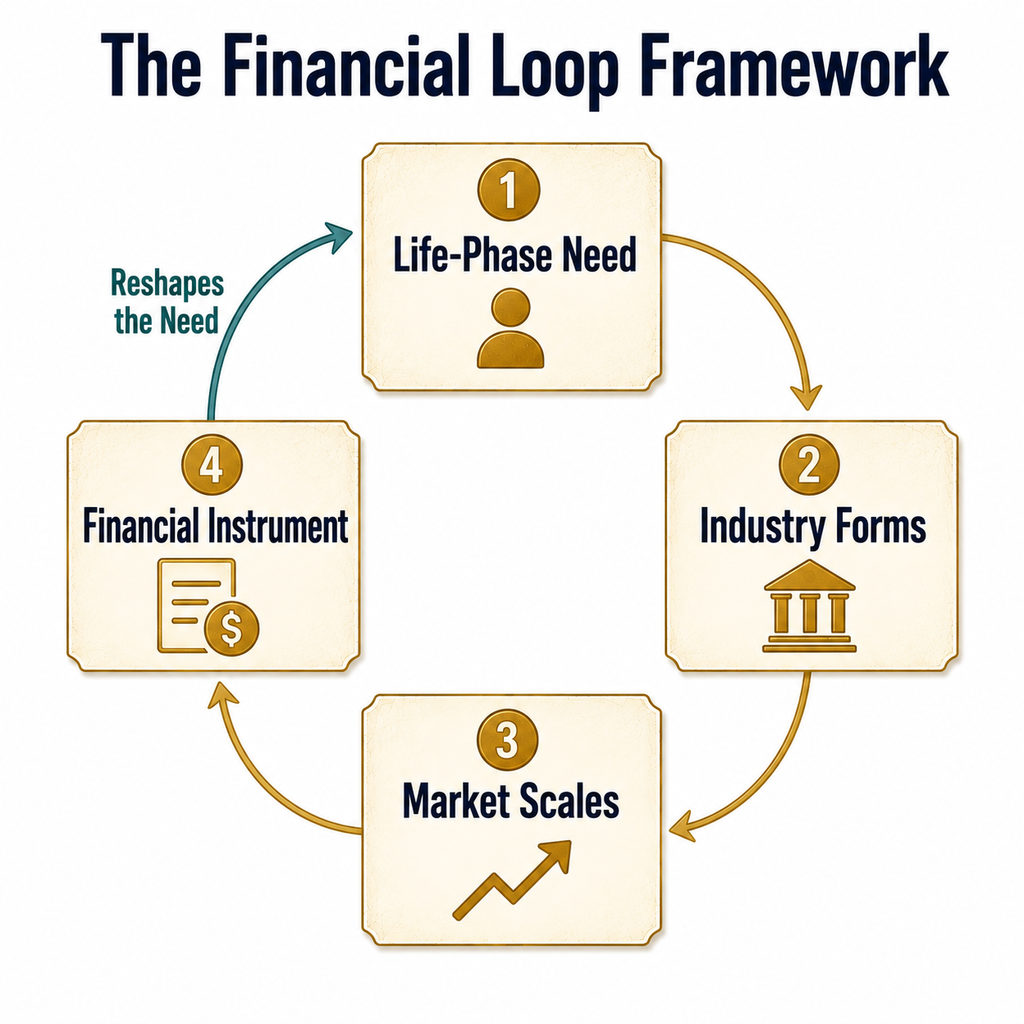
The pattern is deceptively simple, four stages, repeating like a heartbeat: a life-phase need emerges, an industry forms to meet it, that industry scales supply and demand, and finally, financial instruments get built on top of it. Those instruments then reshape the humans they were serving, which resets the loop.
Housing is the cleanest illustration. Adults need shelter — that’s Stage One, nonnegotiable, ancient. Construction supplies it (Stage Two). Real estate scales it into a market (Stage Three). Then mortgages, REITs, mortgage-backed securities, and home equity products arrive (Stage Four) and make homeownership accessible to more people — which drives up demand, which inflates prices, which makes homeownership less accessible again. The loop eats its own tail.
The mobile phone loop follows the same skeleton with a different need. IBM’s Simon, demonstrated in November 1992 and sold commercially through BellSouth by 1994, is widely credited as the first smartphone. By 2023, global smartphone users numbered somewhere around 6.8 billion. On top of that need for connected computing, an entire financial and industrial stack got built: the app economy, gig work, social advertising, streaming, mobile payments. Different need, same four-stage skeleton.
Once you see the pattern, you can’t unsee it. Pick almost any mature industry and you’ll find the same progression, which is exactly the argument laid out in the four-stage feedback loop breakdown. The practical payoff: next time you read about a new fintech category, ask which of the four stages it’s actually in — because that tells you how far the loop has left to run.
Why the Financial Loop Framework Predicts Booms but Not Their Endings
Here’s the uncomfortable part. The framework is genuinely good at telling you which need is about to get financialized next — elder care, young-adult debt, digital identity, whatever’s under the most pressure. It is much worse at telling you when that financialization goes off a cliff.
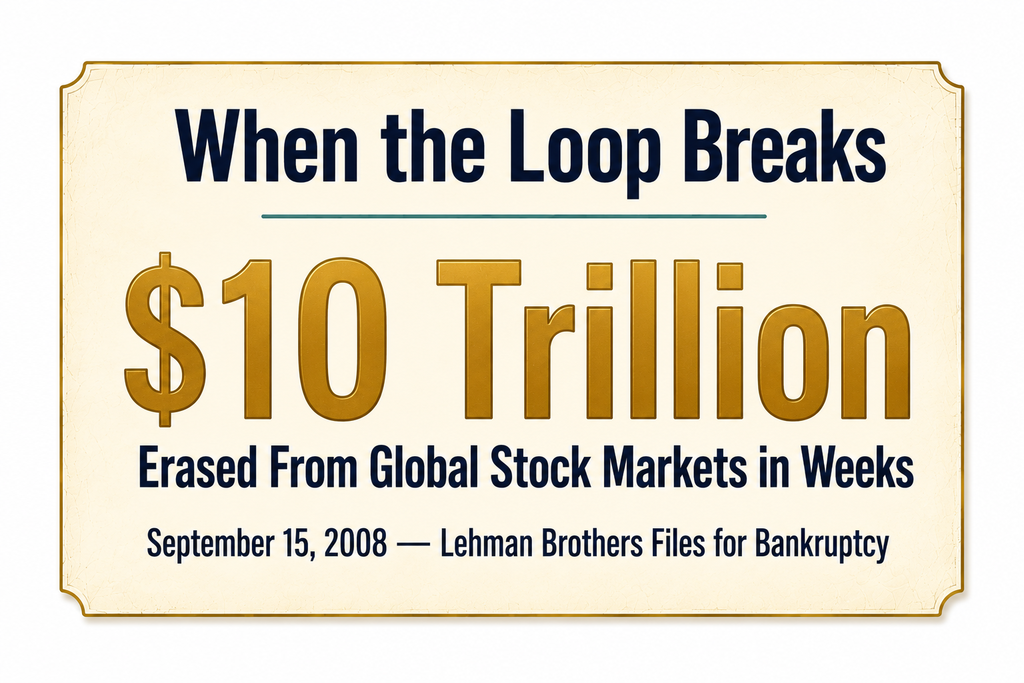
The housing loop is the textbook case, and the ending wasn’t gentle. On September 15, 2008, Lehman Brothers filed the largest bankruptcy in U.S. history. Within weeks, something on the order of ten trillion dollars had vanished from global stock markets. The loop hadn’t broken the pattern — it followed it perfectly, right up until Stage Four instruments became so divorced from Stage One reality that the whole structure collapsed under its own cleverness.
That’s the trouble with a descriptive model: it explains the mechanism beautifully after the fact, but it doesn’t hand you a red light before the crash. Knowing that instruments reshape humans doesn’t tell you which reshaping is healthy adaptation and which is a slow-motion Lehman. That gap is exactly where the three unsolved problems below live, and none of them are academic — they’re live, right now, in categories currently being built.
Problem 1: Ethical Elder-Care Finance
If you’re mapping unmet needs in the mid-2020s, elder life sits near the top of the list — arguably the most intense one, according to the framework’s own logic for spotting where the next loop will form. That’s not surprising. Aging populations, stretched caregiving capacity, and fixed incomes are colliding at scale.
The problem is what happens once finance notices. Elder care is uniquely exposed territory: customers may face cognitive decline, live on fixed or shrinking incomes, and make decisions under end-of-life pressure that no amount of disclosure paperwork meaningfully offsets. An annuity or a reverse-mortgage-style product sold to someone in full possession of their faculties is a normal financial transaction. The same product sold at the edge of consent capacity is something else — and the framework, as it stands, has no built-in ethical brake to distinguish the two.
Nobody has solved this, and it’s not clear a purely financial framework ever could — it may require legal and regulatory guardrails borrowed from outside the loop entirely. Here’s the practical test in the meantime: if you’re evaluating an elder-care fintech product or an annuity structure, ask directly who bears the downside risk when the customer can’t fully consent or comprehend the terms. If the answer is “the customer, eventually,” treat that as a warning label, not a footnote.
Problem 2: Runaway-Loop Detection — Spotting Stage Four Before It Breaks
The second unsolved problem is a detection problem. Stage Four instruments — mortgage-backed securities, in housing’s case — are supposed to serve the need back at Stage One. But instruments can keep multiplying long after they’ve stopped tracking that original need, and nobody has a clean, reliable signal for catching the moment it happens.
Housing is the template failure case, precisely because the warning signs were visible and largely ignored. Mortgage-backed securities kept getting sliced, tranched, and resold well past the point where they reflected actual homebuyer demand or ability to pay. By the time Lehman collapsed, the instrument layer had grown so far past the human need it claimed to serve that the two were barely in contact.
Absent a formal early-warning system, here’s a rough heuristic worth stealing: watch the growth rate of the instrument volume against the growth rate of the underlying need. When instrument issuance is sprinting and the actual life-phase need it’s tied to is walking — or standing still — that gap is your runaway-loop signal. It won’t tell you the exact day things break. It will tell you which loop deserves a closer look before you put money anywhere near it.
Problem 3: Cross-Phase Financial Products — When One Loop Bleeds Into Another
The four-stage model is clean when it’s applied to one life phase at a time. Real life doesn’t cooperate. Young adults today are carrying debt products tied to education and housing at the same time they’re forming identities inside a digital-native life phase that barely existed a generation ago — buy-now-pay-later, creator-economy income, crypto-adjacent savings tools, all layered onto the same person simultaneously.
That’s a cross-phase financial product problem, and the framework doesn’t have a clean answer for it. When one loop overlaps another, the tidy separation between “need,” “industry,” “instrument,” and “reshaped human” starts to blur, because the human being reshaped is standing at the intersection of two loops running at once. A product built to model young-adult debt risk in isolation may miss exactly the digital-native income volatility sitting right next to it — for a closer look at how these overlapping phases are forming, the piece on the three life phases nobody’s built for is worth a read.
The practical flag here is for regulators and investors specifically: anyone modeling risk one phase at a time is set up to be blindsided by contagion that jumps loops. A debt product that looks contained within “young adult finance” might actually be transmitting risk into “digital native identity” products nobody thought to connect it to.
What This Means for Investors, Builders, and Regulators
Pull the three problems together and a short, usable checklist falls out. Anyone building or evaluating a financial product tied to a life-phase need should be asking:
- Who’s vulnerable? If the customer base includes people with diminished capacity, fixed incomes, or limited ability to walk away, treat that as a structural risk, not a marketing footnote.
- What’s the instrument-to-need ratio? Track whether the volume of financial products is outpacing the actual underlying demand. A widening gap is the closest thing to an early-warning light this framework has.
- Does this product span more than one life phase? Map the overlap before scaling. A product that looks isolated on paper may be quietly wired into a second, adjacent loop.
None of this makes the financial loop framework a crystal ball. It’s a pattern-recognition tool, and like any pattern-recognition tool, it’s only as sharp as the ethical and structural questions you bring to it. Used well, though, it turns “why did that market blow up?” into a question you can start asking months or years before the answer becomes obvious.
Reading Your Own Portfolio Through This Lens
Is the financial loop framework predictive or just descriptive?
Mostly descriptive with predictive edges. It’s reliable for identifying which life-phase need is likely to get financialized next, based on where unmet pressure is building. It’s much weaker at forecasting the timing or severity of a collapse once instruments have formed — that’s the gap covered in Problem 2 above.
What’s the fastest way to spot a loop turning vicious before the news does?
Track the instrument-to-need ratio directly rather than waiting for a headline — if the volume of financial products tied to a specific life-phase need keeps climbing while the underlying population that actually needs it stays flat or shrinks, that widening gap is closer to a leading indicator than any single price chart.
Does this framework assume regulators are the ones who should fix a runaway loop?
Not necessarily — the framework flags who’s structurally vulnerable inside a loop, but who’s actually positioned to intervene (a regulator, the industry itself, or just informed individual caution) depends on the specific market. The checklist here is diagnostic, not a policy prescription.
Can the three unsolved problems ever be fully solved?
Possibly not fully — ethical judgment calls, in particular, resist tidy formulas. But sharper heuristics, especially around instrument-to-need ratios and cross-phase mapping, could meaningfully reduce how often people get blindsided, even if they never eliminate the risk entirely.
Key takeaways:
– The financial loop framework tracks four stages — need, industry, scaling, instrument — and is strong at spotting which need gets financialized next.
– It’s weak at predicting when a loop turns catastrophic, as the 2008 Lehman collapse illustrates.
– Ethical elder-care finance, runaway-loop detection, and cross-phase financial products remain genuinely unsolved problems worth watching before you invest, build, or regulate around them.
If you’re evaluating a financial product right now, don’t just ask what need it serves — ask who’s vulnerable inside it, whether its growth has outrun that need, and what other life phase it might be quietly touching.
Sources
- The Human Constant — The Feedback Machine
- Date and claim: Lehman Brothers filed for bankruptcy on September 15, 2008, described as the largest bankruptcy in U.S. history
- Statistic: roughly ten trillion dollars erased from global stock markets within weeks of the Lehman collapse
- Named claim: IBM’s ‘Simon’ device demonstrated in November 1992 and sold commercially via BellSouth starting 1994
- Statistic: approximately 6.8 billion smartphone users worldwide by 2023
- Characterization of mortgage-backed securities as decoupling from homebuyer demand prior to the 2008 crash (general claim, not independently sourced with specific figures)
