




















































The Childcare Math That Doesn’t Work: Mapping the Largest Unmet Market in Adult Life

In 2004, an Amazon engineer named Charlie Ward dropped a suggestion into the company’s internal idea box: what if customers paid a flat annual fee for fast shipping on everything, instead of paying per order? Most suggestion-box ideas die in a spreadsheet nobody reopens. This one reportedly made its way up the chain to Jeff Bezos, and within months Amazon had a real proposal. Amazon Prime launched in February 2005 at seventy-nine dollars a year. The exact internal path the idea took — who saw it, in what room, on what date — isn’t something outside reporting has ever fully nailed down, and it’s worth saying so plainly rather than repeating the tidier version of the story as gospel. What isn’t in dispute is the outcome: an employee noticed that Amazon’s most valuable customers, adults juggling jobs, kids, and mortgages, had almost no spare time, and that saving them a few days of waiting was worth more than saving a few dollars.
That’s the pattern underneath this whole piece. Every burden an adult carries is a market waiting to be built — and childcare costs remain the biggest, most stubborn unmet version of that pattern in modern life. Prime got built. Childcare didn’t. That gap is the subject of everything below.
Every Burden Is a Business Waiting to Happen
Look at your own week. The errands you pay someone else to run, the meals you order instead of cook, the tasks you outsource to a stranger with an app and a five-star rating — none of that is incidental. Each one used to be unpaid adult labor, absorbed silently, until someone built a company around removing it.
That reframe matters for how you read your own frustrations. Your daily annoyances aren’t just friction to tolerate. They’re signals. Somewhere, someone is running the numbers on whether your specific irritation is big enough, common enough, and monetizable enough to become a business. Most of the time the answer is no. Occasionally the answer is Amazon Prime.
Time: Why Adults Pay to Get It Back
Amazon Prime, DoorDash, Instacart, TaskRabbit — each one took a specific, boring adult task and either automated it or handed it to someone else for a fee. Grocery shopping became a checkout button. Furniture assembly became a booking. Dinner became a fifteen-minute wait instead of an hour in the kitchen.
Companies built primarily around returning time to adults now represent an enormous chunk of market value — reasonably describable as a multi-hundred-billion-dollar category when you add up the household names in the space, though any single “trillions” figure for the category as a whole is more a directional estimate than an audited number, and should be read that way rather than cited as precise.
The insight itself — that time is an adult’s scarcest resource — isn’t new. What changed in the early 2000s was infrastructure: broadband, smartphones, logistics networks good enough to make outsourcing an adult task economically viable at scale. Time-saving commerce didn’t invent the demand. It just finally had the plumbing to meet it.
Which makes what comes next stranger. If the plumbing exists to solve almost any adult inconvenience at scale, why hasn’t it touched the one that costs parents the most?
The Childcare Math: A Trap by Design
Here’s the childcare gap in plain numbers. Full-time infant childcare in the United States frequently runs well past twenty thousand dollars a year in higher-cost states and metro areas, and that figure climbs further once you’re covering more than one child — it is not, to be clear, a flat national average that applies evenly coast to coast, but in the places where large numbers of working parents actually live, it’s a realistic and widely cited range. In many major U.S. cities, the cost of full-time childcare for two children exceeds the median rent in that city — a comparison that alone tells you the market is priced for a demographic that mostly doesn’t exist: dual-earner households with disposable income to spare after housing.\
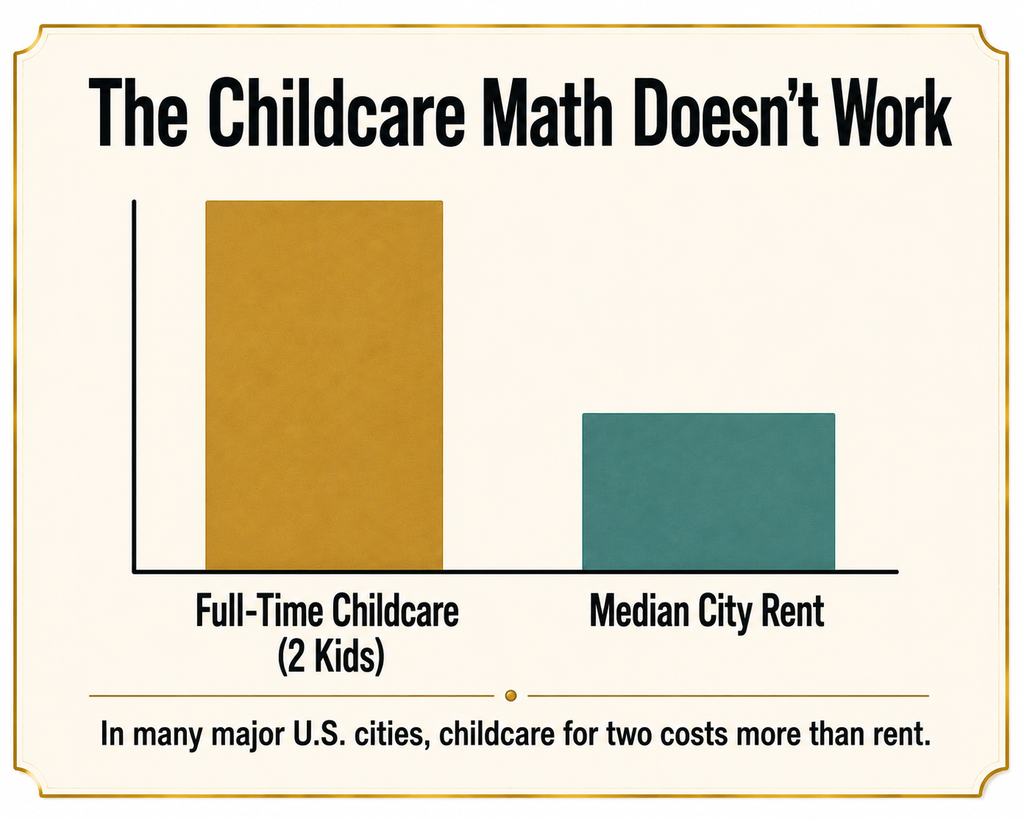
Picture a parent doing this math at a kitchen table, not in the abstract but with actual numbers from an actual daycare quote: the number for two children in daycare is close to a second mortgage payment, except it isn’t optional and it isn’t tax-deductible in any way that meaningfully offsets it. That’s not a hypothetical stretch — it’s the ordinary arithmetic behind a decision millions of parents, disproportionately mothers, are forced into every year.

The result is a trap, and “trap” is the right word, not “inconvenience.” Many parents cannot afford to work without childcare. They cannot afford childcare without working. The two conditions cancel each other out, and the person caught in the middle absorbs the cost — usually by leaving the workforce, which is its own quiet tax on a household’s future earning power.
Why Childcare Hasn’t Had Its Amazon Prime Moment
Here’s the uncomfortable answer: childcare resists the Prime playbook because the thing being delivered isn’t a package, it’s trust in a human being with your child, and trust doesn’t scale the way logistics does.
Shipping got cheaper because software could route trucks better. Food delivery got cheaper because an app could match a driver to an order in seconds. Childcare doesn’t compress that way. A caregiver can watch a fixed, small number of children at a time — regulation sets that ratio for good reason, not as red tape to route around — and every one of those caregivers needs training, background checks, and pay adequate enough that they don’t leave for a job with better hours. Labor is the product. You can’t algorithm your way around a human being’s finite attention on a toddler.
That’s also why the margins are thin instead of healthy. Amazon can absorb losses on shipping because a Prime subscriber buys more stuff over time. There’s no equivalent flywheel for a daycare — the “customer” pays a brutal amount and the provider still isn’t getting rich, because nearly all of that money goes straight into staffing costs. Time-saving commerce got built on tasks that could be optimized. Childcare is a task that can only be staffed, one adult to a handful of kids, indefinitely. That’s why “someone will eventually build the childcare Prime” is a much harder promise than it sounds.
Other Adult Burdens That Became Industries
Childcare’s outlier status is easier to see next to the burdens that did get commercialized.
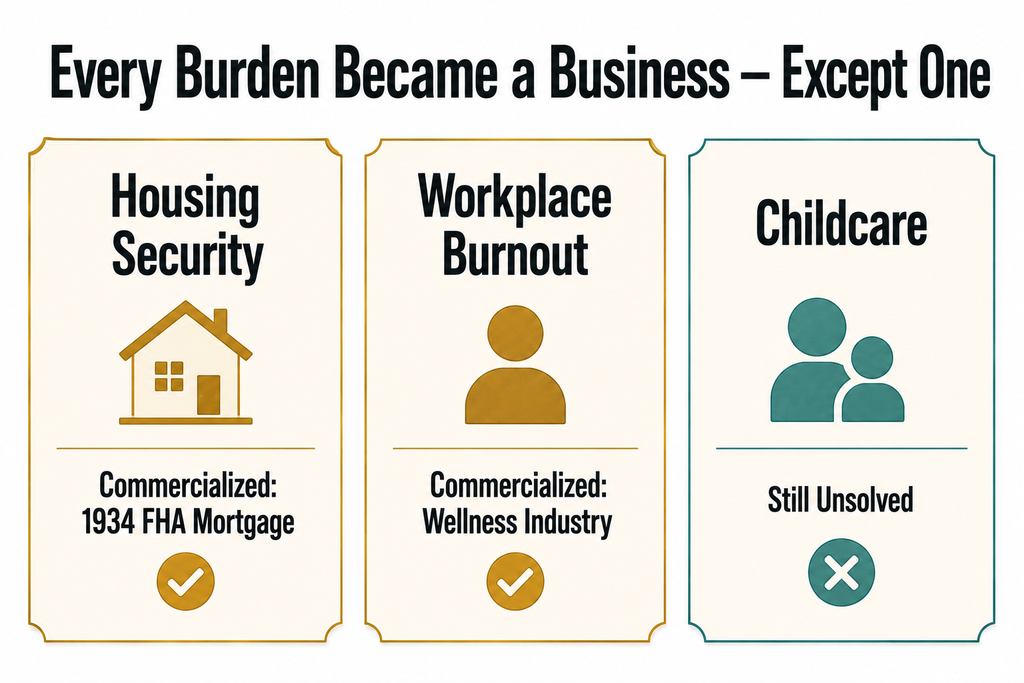
Housing security is the clearest case. In 1934, the Federal Housing Administration helped popularize the long-term, fixed-rate mortgage, at a time when home loans commonly required steep down payments and came due in full within just a few years — the exact terms varied by lender, but the shift toward FHA-backed long-term financing is well documented as a turning point. That single financial instrument turned “owning a home” from a rich person’s transaction into a mainstream adult milestone, and it eventually became one of the most consequential instruments in American financial history — for better when it worked as intended, and for considerably worse when it was overleveraged in the run-up to the 2008 crisis, which by widely cited estimates erased trillions of dollars in household wealth in the United States.
Burnout followed a similar arc. A psychologist named Herbert Freudenberger is generally credited with naming “burnout” in the 1970s, describing what he saw in dedicated workers who went numb and cynical under sustained stress. By 2019, the World Health Organization had formally classified burnout as an occupational phenomenon. Somewhere along that path, the corporate wellness industry emerged to sell relief for it — estimates for the size of the global workplace wellness market commonly land in the tens of billions of dollars annually, figures that move around depending on who’s counting and what counts as “wellness,” but the direction is unmistakable: adult stress became a line item companies sell against.
Security got commercialized. Stress got commercialized. Childcare — arguably the burden with the clearest dollar figure attached to it every single month — largely hasn’t. That’s the anomaly this whole piece is built around, and it’s a useful case study in how ideas move from friction to industry in some categories and stall out completely in others.
What This Means for Parents, Investors, and Policymakers
Three different audiences should take three different things from this.
Parents: don’t wait for a market solution. The economics above explain why one hasn’t shown up yet, and there’s no strong evidence it’s imminent. Employer-sponsored childcare stipends and dependent-care FSAs are real, if partial, tools worth pushing for in any job negotiation — they don’t close the gap, but they narrow it.
Investors: the real opportunity isn’t “disrupt daycare” — that’s the wrong lesson to take from the Prime story. It’s in the adjacent layer: scheduling and staffing software for providers, backup-care networks for employers, tools that make thin margins slightly less thin without touching the caregiver-to-child ratio that regulation rightly protects.
Policymakers: this is the section where “the market will fix it” runs out of road. A cost this structurally resistant to compression — one where the product is human attention, not logistics — is a strong candidate for subsidy, not just innovation. Several countries already treat childcare closer to public infrastructure than private commerce; the United States, largely, still doesn’t.
The common thread: childcare costs remain adulthood’s largest unmet market not because nobody’s noticed, but because the fix this specific gap needs looks more like policy than an app.
Key Takeaways
- Childcare is the clearest case of an adult burden that hasn’t been converted into an affordable, scaled industry, unlike shipping, food delivery, or errands.
- Full-time childcare costs frequently exceed $20,000 a year in higher-cost U.S. regions, and for two children can exceed median rent in many major cities.
- Childcare resists Prime-style disruption because its “product” is finite human attention, not logistics that software can optimize.
- Housing security (via the long-term mortgage) and workplace stress (via the wellness industry) both became commercial categories; childcare largely hasn’t followed the same path.
- Closing the childcare gap likely needs a hybrid of employer benefits and public policy, not a purely market-driven fix.
What Would Actually Fix the Math
Why is childcare so expensive in the first place?
Because it can’t be automated the way shipping or food delivery can. Regulated caregiver-to-child ratios keep quality and safety intact, but they also cap how many children a single staff member can supervise — which means labor costs dominate the price, and there’s no software shortcut around that.
Is there a childcare costs unmet market opportunity for a private company to solve this the way Amazon solved shipping?
Not in the same shape. There’s real room for software that helps providers run more efficiently, but the core cost — paying enough staff to safely watch a small number of children — doesn’t compress the way a delivery route does. Expect incremental tools, not a single company that “fixes” childcare the way Prime fixed shipping.
How does the childcare gap compare to other adult-burden industries like mortgages or wellness programs?
Mortgages and workplace wellness both turned a real adult burden into a functioning commercial category, complete with financial instruments and, in the mortgage’s case, real risk when those instruments were misused. Childcare has the cost pressure of both combined but hasn’t produced an equivalent industry — it remains one of the largest gaps between what adults need and what any market currently supplies at scale.
Will policy or the market close the childcare gap first?
Given the structural reasons childcare resists automation, most signs point toward a policy-driven or hybrid fix — subsidies, employer mandates, public investment — rather than a pure market solution. Anyone waiting for “the childcare Prime” to appear on its own is likely waiting for something the economics of the category won’t produce.
If there’s one thing worth doing with all this, it’s changing what you expect out of the next headline announcing a “childcare innovation.” Ask whether it touches the actual cost structure — staffing and ratios — or just makes booking a spot slightly more convenient. Convenience isn’t the problem here. The math is.
Sources
- The Human Constant — The Weight of Everything
- Charlie Ward is credited as the Amazon engineer who proposed the flat-fee fast-shipping idea that became Prime
- The claim that the Prime idea ‘reportedly’ reached Jeff Bezos and led to a proposal within months
- Amazon Prime launched in February 2005 at $79/year
- Claim that full-time infant childcare frequently exceeds $20,000/year in higher-cost U.S. states
- Claim that childcare for two children exceeds median rent (not median household income) in many major U.S. cities
- Claim that the FHA in 1934 helped popularize the long-term fixed-rate mortgage, replacing loans requiring steep down payments due within a few years
- Claim that the 2008 financial crisis erased ‘trillions of dollars’ in U.S. household wealth (cited as a widely reported estimate)
- Claim that Herbert Freudenberger is generally credited with naming ‘burnout’ in the 1970s
- Claim that the WHO formally classified burnout as an occupational phenomenon in 2019
- Claim that the global workplace wellness market is commonly estimated in the tens of billions of dollars annually
- General claim that several countries treat childcare closer to public infrastructure than private commerce (unspecified/uncited)
