



















































Why a $500B Childhood Industry Still Can’t Fix Learning, Play, or Kids’ Mental Health

Children do not accept the world as it is. Ask a four-year-old why the sky is blue and you’ll get an hour of increasingly specific follow-up questions, each one a small demand that the adult world explain itself. That relentless curiosity is not a cute quirk — it’s the biological engine behind some of the largest industries on earth. Early education, toys, kids’ media, and now EdTech add up to a childhood industry worth well over $500 billion a year. And despite all that money, three problems remain stubbornly, almost embarrassingly unsolved: real personalized learning, digital play that actually lasts, and children’s mental health.
That’s the paradox worth sitting with. An industry this large, built directly on top of children’s hunger to understand the world, still hasn’t figured out how to meet that hunger without either flattening it into a curriculum or exploiting it for engagement metrics. Understanding why helps you tell the difference between a genuine solution and a marketing pitch the next time someone hands you an app.
Froebel’s Kindergarten Bet: Directed Play as Proto-Personalization
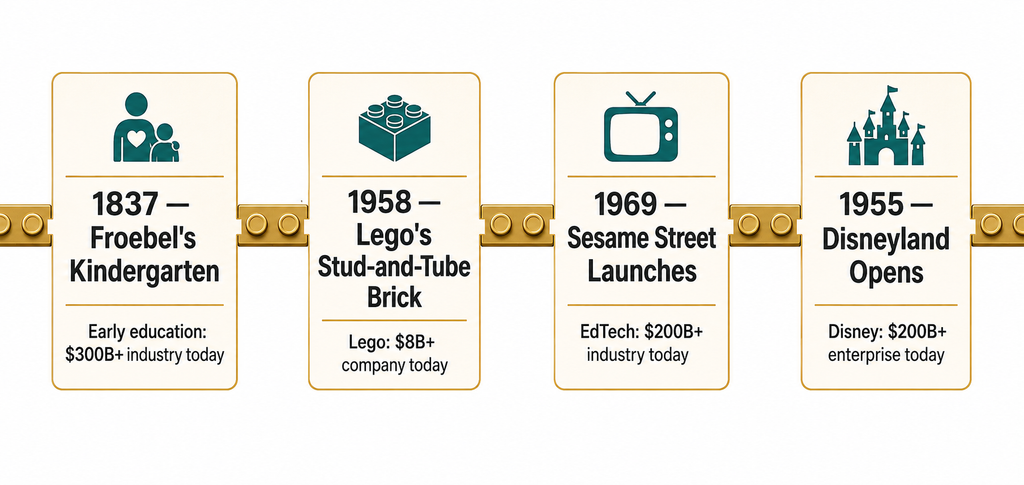
The idea of personalized learning didn’t start with adaptive software. It started in 1837, when Friedrich Froebel opened the world’s first kindergarten in Bad Blankenburg. Froebel’s radical claim was that children weren’t small workers waiting to be disciplined into obedience — they were growing things, and growing things need nurturing suited to their particular shape. That idea was threatening enough that Prussia banned kindergartens outright in 1851, apparently convinced the whole movement was a socialist front in disguise.
Froebel was, in effect, trying to build personalization by hand — one teacher, a handful of children, directed play tuned to each kid’s pace. It worked at that scale because intimacy scales terribly. Today early childhood education is a global industry worth more than $300 billion annually, and the thing that made Froebel’s model work — a teacher who actually knows this specific child — is exactly what got squeezed out as the model industrialized. You can mass-produce a curriculum. You cannot mass-produce attention.
Takeaway: Personalization was the founding promise of early education, not a modern feature bolted on by software. The $300 billion industry that grew out of Froebel’s idea proved the concept works — and proved, just as clearly, that scale is what breaks it.
Lego and the Physics Lesson Nobody Applied to Digital Play
Here’s a case study in what “lasting” actually requires. In 1932, a Danish carpenter named Ole Kirk Christiansen was just trying to survive the Great Depression. He named his company LEGO, from the Danish leg godt — play well. In 1949 the company launched its first plastic brick. It flopped. The bricks didn’t hold together well enough to build anything ambitious, and wooden toys kept outselling them for years.
The real breakthrough didn’t come until 1958, when Christiansen’s son Godtfred patented hollow tubes on the underside of each brick, gripping the studs beneath with real, reliable friction. That’s it. That’s the whole invention. But it solved a problem every kid stacking blocks had always run into: whatever you build, you build knowing it will fall down. The stud-and-tube brick killed that assumption. A creation could survive being carried across a room. It could be added to tomorrow instead of rebuilt from scratch. That patent underlies a company now reportedly worth more than $8 billion.
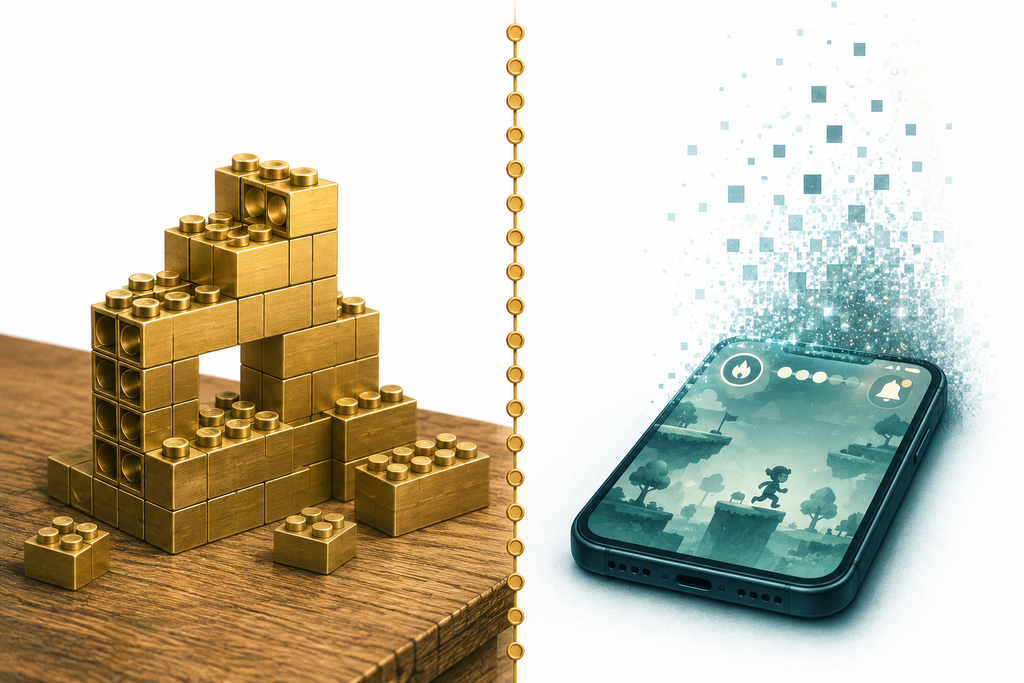
Digital play has never found its version of the stud-and-tube brick. Most apps aren’t engineered for permanence — they’re engineered for return visits. A streak counter is not the same thing as a world that survives being picked back up. Notifications bring a kid back to the app; they don’t let a kid build something that’s still standing next week.
Takeaway: Digital play that genuinely lasts needs its own permanence mechanic, not just a better reason to open the app tomorrow. Most of the industry solved the wrong problem — retention instead of persistence — and mistook the two for the same thing.
Sesame Street Proved Learning and Entertainment Could Merge — But Not That It Would Heal
In 1969, the Children’s Television Workshop launched Sesame Street on a hunch: that kids could absorb academic content the same way they absorb an advertising jingle, almost against their will. The hunch paid off. Children who watched consistently showed stronger letter and number recognition, and the show proved something bigger than any single skill gain — education and entertainment weren’t opposites. That single insight reshaped everything downstream of it and eventually underwrote the EdTech industry now valued at over $200 billion.
But merging learning with entertainment solved for attention and recall, not for wellbeing. That’s the quiet inheritance every EdTech product carries from Sesame Street’s model: success gets measured in minutes watched, questions answered correctly, streaks maintained. None of that is a proxy for whether a child feels okay. This is one of the more persistent EdTech industry problems — the metrics that make a product fundable are not the metrics that make a child healthy, and nobody in the funding chain has strong incentive to notice the gap.
Takeaway: When you’re evaluating a learning app for a kid, ask what it’s actually optimizing for. If the answer is engagement, recall, or streaks, you’re looking at Sesame Street’s grandchild — genuinely useful, but not built to notice how the child is doing.
Disney’s Narrative Immersion and the Unmeasured Cost of Wonder
When Walt Disney opened Disneyland in 1955, most amusement parks were chaotic, slightly seedy affairs built around thrill. Disney’s insight ran the other direction: kids don’t primarily want thrill, they want to be transported — to feel like they’re inside the story rather than watching it from outside. Disneyland was reportedly the first theme park designed from a child’s point of view, and the enterprise that grew out of that bet is now worth an estimated $200 billion. Every dollar of it rests on the same foundation: a child’s wish to disappear into a narrative.
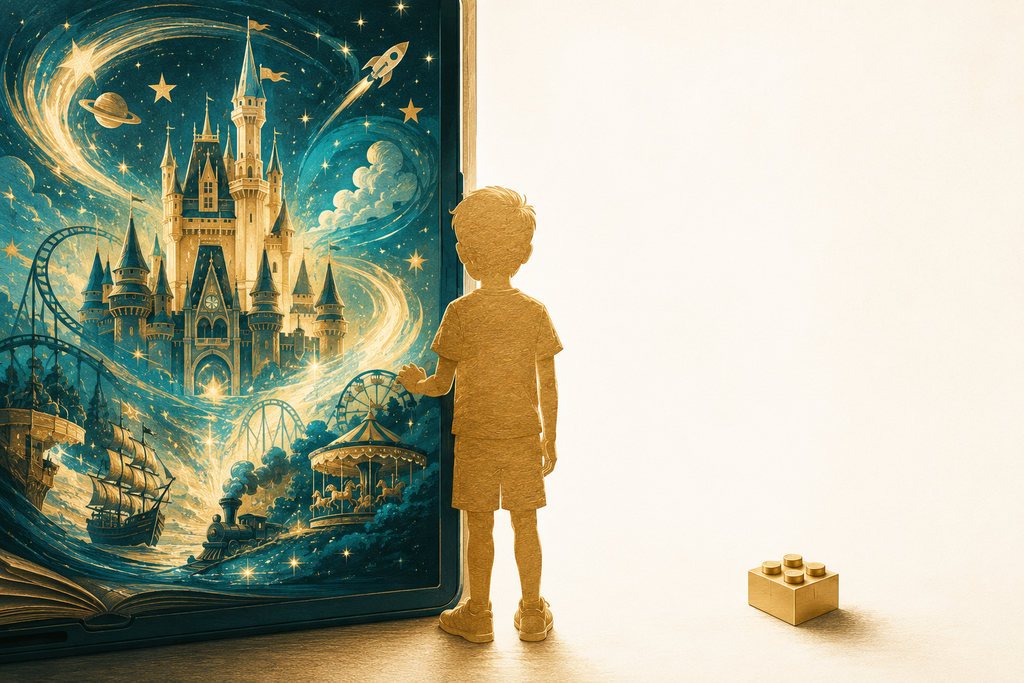
That’s a genuine insight about childhood. It’s also an unresolved question. What does constant narrative immersion — streaming, gaming, endless-story apps — do to a kid’s ability to sit with boredom, or to regulate emotion once the story stops? Nobody who profits from immersion has strong reason to fund the research that might complicate the pitch. This is where kids’ mental health and screens stops being an abstract worry and becomes a design question: immersion that captivates can also overstimulate, and “captivating” is precisely what gets funded.
Takeaway: Weigh narrative immersion against a child’s need for unstructured, boring, self-directed time. A product that never lets a kid’s mind wander isn’t just entertaining — it’s crowding something out.
Three Fortunes, Three Unsolved Problems
Line the four case studies up and a pattern appears. Froebel proved personalization matters, then watched it get diluted at scale. Lego proved permanence matters, and nobody’s ported that lesson to software. Sesame Street proved learning and entertainment could merge, but never asked whether merged content was good for a child’s inner life. Disney proved immersion is what kids actually want, without ever pricing in what constant immersion costs.
Each company solved a real piece of childhood. None of them solved the whole thing, and the child in front of you today still needs true childhood industry personalized learning that survives being industrialized, digital play with the emotional weight of a Lego brick you built yourself, and a mental-health baseline that nobody’s business model directly rewards protecting.
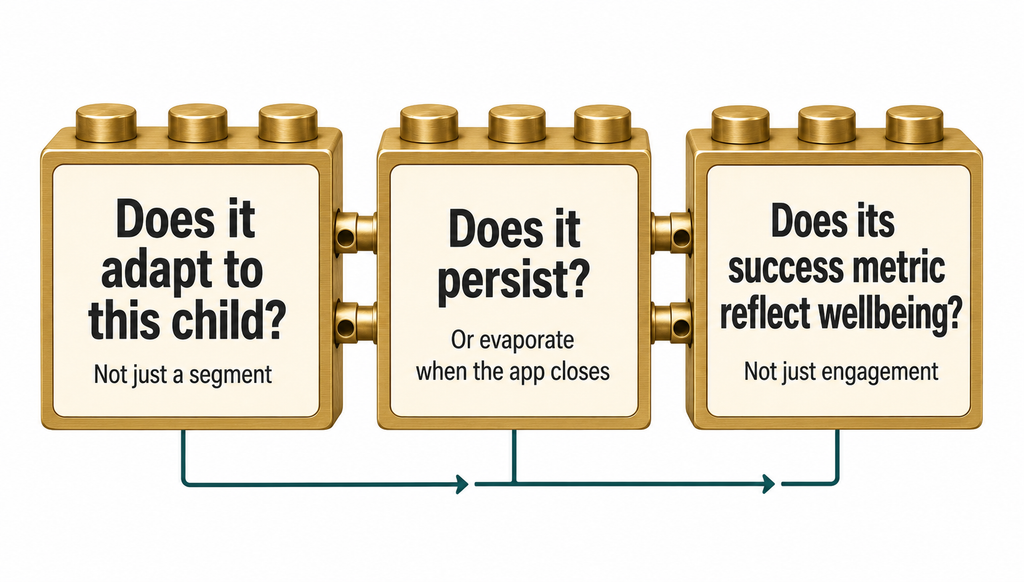
If you’re a parent, educator, or buyer evaluating a new childhood product, ask three questions before you trust the marketing: Does it adapt to this specific child, or just to a segment? Does what gets built or learned persist, or does it evaporate the moment the app closes? And does the product’s own success metric have anything at all to do with how the child feels? If a product can’t answer all three, it’s not solving childhood — it’s just the latest company solving one slice of it, the way Froebel, Lego, Sesame Street, and Disney each did before it. It’s worth noting these gaps aren’t unique to childhood — the same pattern of an industry solving the profitable slice of a life stage while leaving the harder human problem unaddressed shows up in other overlooked life-stage gaps too.
Separating the Marketing From the Mechanics
Why hasn’t personalized learning worked despite billions in EdTech investment?
Because personalization at Froebel’s original scale meant one adult who knew one child well. Software can adapt pacing and content, but it’s approximating intimacy with data, not replicating it. Parents should treat “personalized” as a marketing word until a product shows evidence it changes based on this child, not just a cohort.
What would “digital play that lasts” actually look like?
Something closer to Lego’s stud-and-tube fix than to a better notification schedule — a mechanic where what a child builds or creates survives, compounds, and can be returned to without starting over. Look for products that let a child pick up an old creation rather than ones that just pull them back in with a new prompt.
Is screen time really the main mental-health issue, or is it something else?
The honest answer is that it’s contested, and anyone stating it with total confidence is oversimplifying. What seems more defensible is that the design of the screen time — how immersive, how endless, how emotionally engineered — matters at least as much as the raw hours. When choosing apps, weigh how much room a product leaves for a child’s mind to wander versus how hard it works to keep that from happening.
Key Takeaways
- A childhood industry worth over $500 billion combined has produced real breakthroughs in early education, toys, and kids’ media — but three core problems remain unsolved: personalized learning, lasting digital play, and children’s mental health.
- Froebel’s 1837 kindergarten was an early attempt at personalization that worked at small scale and diluted as the model industrialized into a $300B+ sector.
- Lego’s 1958 stud-and-tube patent solved permanence for physical play; digital play has no real equivalent yet.
- Sesame Street proved education and entertainment could merge, birthing a $200B EdTech industry optimized for engagement, not wellbeing.
- Disney proved kids want narrative immersion, but the cost of constant immersion on emotional regulation remains an open question.
- Evaluate any childhood product on three tests: real personalization, lasting value, and whether its success metric has anything to do with how the child actually feels.
The next time a childhood product claims to have solved learning, play, or wellbeing, hold it up against the company that actually solved something adjacent. If it can’t clear that bar, it’s not a breakthrough — it’s just next quarter’s pitch deck.
Sources
- The Human Constant — The Age of Why
- Friedrich Froebel opened the world’s first kindergarten in Bad Blankenburg in 1837.
- Prussia banned kindergartens in 1851 over concerns the movement was linked to socialism.
- Early childhood education is described as a global industry worth over $300 billion annually.
- Ole Kirk Christiansen founded LEGO in 1932 as a Danish carpenter during the Great Depression.
- LEGO’s first plastic brick (Automatic Binding Brick) launched in 1949 and underperformed.
- Godtfred Christiansen patented the stud-and-tube brick redesign in 1958.
- LEGO is described as a company now worth over $8 billion.
- The Children’s Television Workshop launched Sesame Street on PBS in 1969.
- Claim that consistent Sesame Street viewers showed higher letter/number recognition.
- The EdTech industry is described as valued at over $200 billion.
- Walt Disney opened Disneyland in 1955.
- Claim that Disneyland was the first theme park designed from a child’s point of view.
- The Disney enterprise is described as worth approximately $200 billion.
- Overall framing that the combined ‘childhood industry’ is worth over $500 billion.
- Anecdote of a four-year-old asking why the sky is blue, used illustratively/generically rather than as a specific real event.
