


















































The Seven Phases of Human Life: A Map for Builders and Investors

Every product you’ve ever bought was built on a trail someone else found first. The seven phases of human life are the map of where those trails run — and most builders never bother to look at it before they start paving.
The Man Who (Reportedly) Paved the Footprints in the Snow
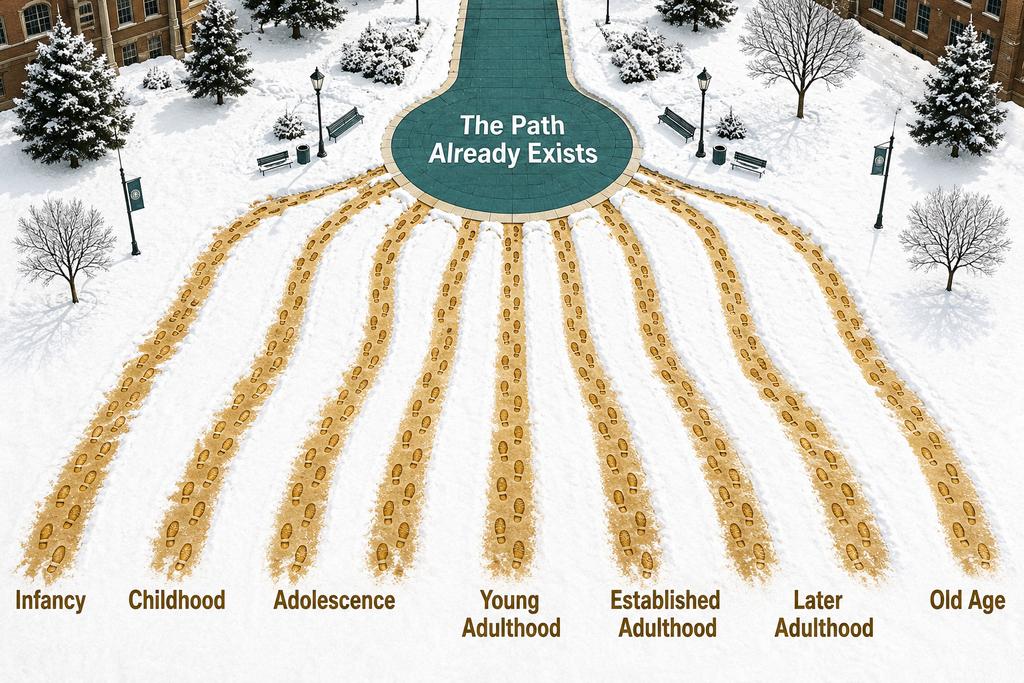
The story goes like this: in 1914, a university architect needed to decide where to put the campus sidewalks. Rather than guess, he waited for winter. When snow fell, students kept walking their usual routes anyway, carving a web of footpaths across the white ground. He sketched the pattern — some tellings say from a hot air balloon — and paved the walkways exactly where the trails already were. He didn’t design the paths. He found them.
The architect most often credited with this account is Joseph N. Bradford, and the story is usually told about Ohio State University’s campus rather than Michigan State’s — the two get conflated often enough in retellings that it’s worth flagging plainly. The balloon detail, in particular, shows up in popular accounts but isn’t something we could independently confirm in any university archive. Treat the anecdote as a well-worn parable, not a court transcript. The parable is what matters here anyway: don’t invent the path. Find where people are already walking, then pave.
That’s the whole discipline behind the seven phases of human life — a framework for finding the trails that already exist in every human lifetime, instead of guessing at where demand should be.
What the Seven Phases of Human Life Actually Are
The seven phases aren’t a marketing segment or a generational label. They’re the developmental stretch every human life passes through, in roughly the same order, regardless of century or continent: infancy, childhood, adolescence, young adulthood, established adulthood, later adulthood, and old age. The names and boundaries shift depending on who’s drawing the map, but the underlying sequence doesn’t move.
Here’s the claim worth sitting with, hedged appropriately: a teenager navigating belonging and status anxiety looks recognizably similar whether you’re picturing Renaissance-era Florence or present-day Tokyo — not because anyone has run a controlled study proving it, but because the pattern shows up illustratively across the historical and cultural record we do have. Same with new parents and sleep deprivation, across eras and cities — it’s an illustrative comparison worth using to make the point vivid, not a cited clinical finding.
The phase is the constant. The product is not. Diapers, tablets, and swaddling cloths are all different paving materials laid over the same trail: an infant’s needs haven’t changed; what’s been sold to meet them has changed constantly. For builders, this reframes the whole exercise. Stop asking “what’s trending in this demographic” and start asking “what phase am I actually building for, and what hasn’t been paved yet.”
Needs, Wants, and Problems: The Engine Inside Every Phase
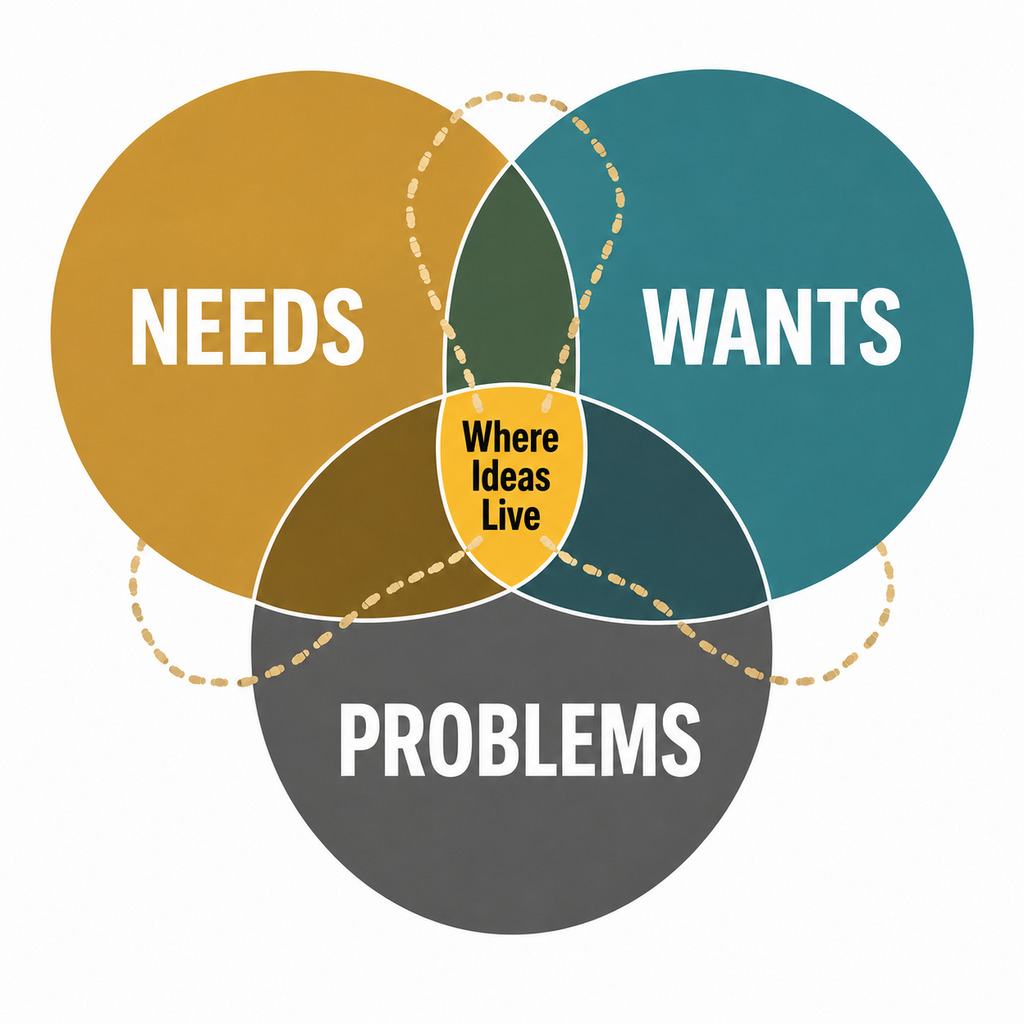
Inside each phase, human motivation splits into three buckets. Needs are what a person must have to survive and function. Wants are what they wish they had to thrive. Problems are the friction between what they have and what they actually need or want. This is the needs wants problems framework in its simplest form, and it’s less a taxonomy than a search tool — ideas live in the gap between the problem and the solution, not in either one alone.
A useful test case: Airbnb didn’t invent travel accommodation as a need. It found a problem sitting inside an existing want — travelers wanted something cheaper and more local than a hotel, and hosts had a want of their own, unused space they’d like to monetize. The friction between those two wants was the opening. If that kind of gap-hunting interests you as a method, it’s worth reading the six-step framework for turning any human friction into a business, which walks through exactly how founders (including Airbnb’s, who famously got told no by investor after investor) turned that friction into a company.
The practical filter for builders and investors is the same either way: name the phase your product serves, then name whether you’re solving a need, servicing a want, or closing a problem gap. If you can’t answer that in one sentence, you’re probably building a feature, not a business.
The Feedback Loop: Why Solutions Create New Trails
The framework isn’t static, and this is the part that separates it from a segmentation chart. Solutions don’t just serve a life phase — they reshape it, and reshaping it opens new trails downstream.
The classic illustration, and it’s worth stating plainly that it’s an illustrative model rather than a single documented causal study: the automobile solved a transportation problem for the industrial-era adult. As the story is usually framed, that solution helped enable the suburb, which reshaped childhood, which helped generate the driving license as a cultural rite of passage, which in turn helped spawn car insurance, car loans, and a teenage driving economy that didn’t previously exist. Each link in that chain is a real and separately observable phenomenon; the tidy causal arrow connecting all of them into one clean sequence is a simplification useful for thinking, not a footnoted history.
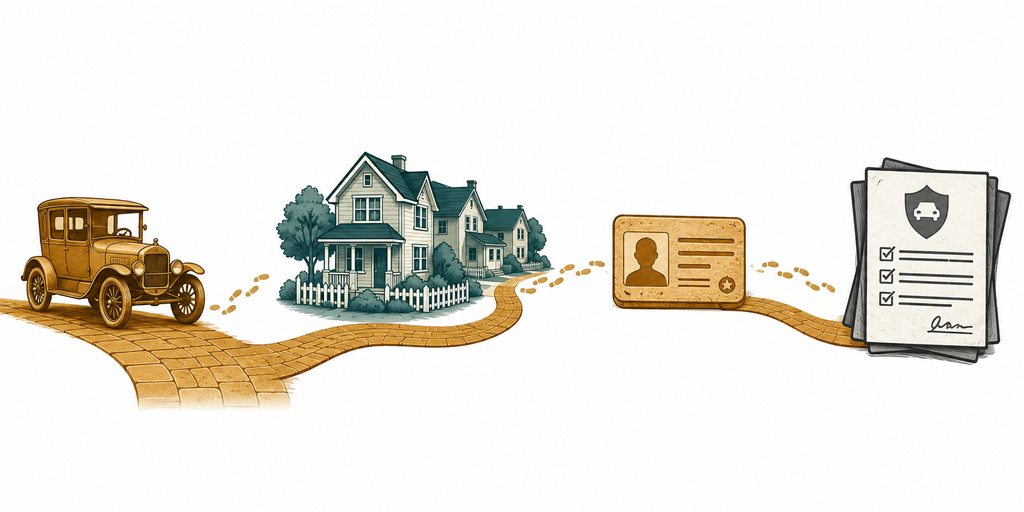
That’s the reframe for the seven phases of human life as an investing lens: the car was the first trail. The driving-license economy was the second one, built on top of it — and in dollar terms, the second- and third-order market built around a solution is often bigger than the original solution itself. Investors chasing the obvious first product frequently miss the bigger, less obvious market it spins off.
How to Read the Map: Applying Bradford’s Question to Your Work
Whatever actually happened on that snowy campus in 1914, the operating question survives the fact-check intact: not what should the path look like, but where are people already walking? Three steps turn that question into a working method:
- Identify the phase. Which of the seven — infancy through old age — does your product actually live in? Be specific; “young adults” is not a phase, it’s a demographic label wearing a phase’s clothing.
- List the unpaved frictions. Inside that phase, what’s the gap between what people need or want and what they currently have? This is where you apply the needs wants problems framework directly, line by line.
- Ask what doesn’t exist yet. What industry, product category, or financial instrument hasn’t been built around this friction? The trail is visible; the pavement isn’t there yet. That gap is the opportunity.
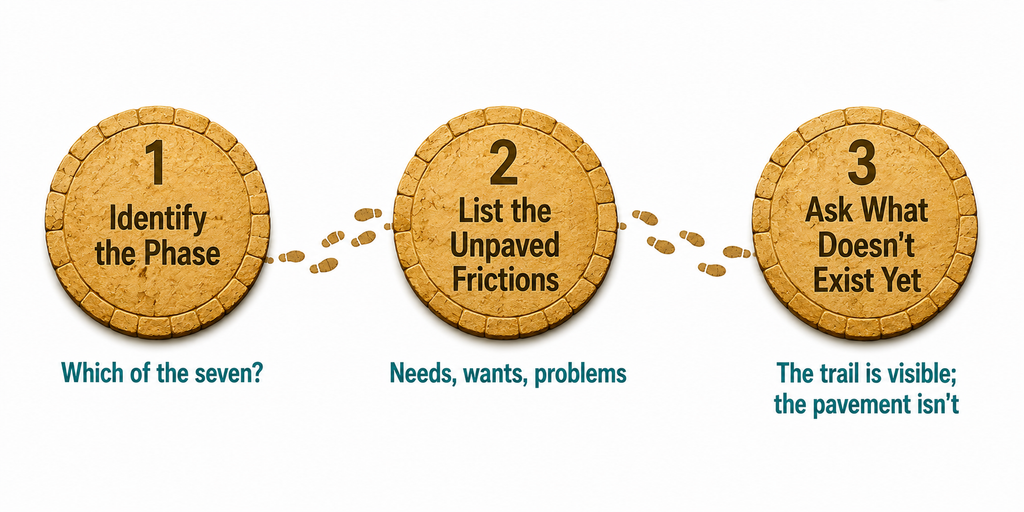
Run this diagnostic honestly and you’ll usually find the harder problem isn’t spotting a trail — it’s admitting you’ve been staring at a well-worn one and calling it “underserved” because nobody’s paved it in your particular material yet.
Why This Isn’t Just Another Market Segmentation Model
Demographic and trend-based targeting expire on a clock. A campaign built around “millennials” or “Gen Z” has a shelf life measured in years, because the label itself is a moving cultural target — today’s millennial marketing playbook already reads dated.
A life-phase business framework doesn’t have that expiration problem, because it’s not targeting a generation — it’s targeting a developmental stage every generation passes through. Adolescence in 2026 looks different on the surface than adolescence in 1996, but the underlying phase — status anxiety, identity formation, peer belonging — is the constant underneath the surface noise. That’s worth taking seriously right now: some observers argue the phases themselves are shifting shape under pressure from AI, extended lifespans, and climate stress, which is a genuinely different conversation from the one this piece is having — see the three life phases nobody’s built for if that’s the angle you’re chasing.
The practical contrast for a builder: segment by demographic and you’re renting attention on borrowed time. Segment by phase and you’re building on ground that doesn’t move.
Key Takeaways
- The seven phases of human life are developmental constants, not trends — infancy through old age, in roughly the same sequence, across eras and cultures.
- The needs wants problems framework is the search tool for finding ideas: name the phase, then name whether you’re solving a need, a want, or the friction between them.
- Solutions reshape the phases they serve and spawn downstream markets — the second-order market is often larger than the first product.
- Phase-based targeting doesn’t expire the way demographic or generational targeting does.
- The founding anecdote behind this framework — an architect paving sidewalks over existing footpaths — is a widely told parable with disputed specifics; treat it as illustrative, not documented history.
Applying the Map Beyond the Theory
How many industries typically map to one life phase?
There’s no fixed number — a single phase like adolescence spans everything from education to fashion to social platforms to financial products like first credit cards. The framework’s value isn’t in counting industries, it’s in the discipline of tracing which frictions in that phase are already served and which aren’t.
How is this different from generational marketing (Gen Z, millennials, boomers)?
Generational marketing segments by when someone was born. The seven phases of human life segment by where someone is developmentally, regardless of birth year. A 45-year-old going through a late-career reinvention and a 45-year-old raising toddlers are in different phases despite being the same age — generational marketing would lump them together; this framework wouldn’t.
Where should I actually start applying this?
Pick one phase you understand personally or professionally. List its needs, wants, and problems using the framework above. Then ask, honestly, which of those frictions still has no good solution. That unpaved gap is your starting brief, not a hypothesis to test — a trail, waiting to be paved.
Sources
- The Human Constant — The Invisible Architecture
- Claim that the sidewalk-paving anecdote is usually attributed to Joseph N. Bradford and to Ohio State University rather than Michigan State
- The automobile-to-suburb-to-driving-license-to-insurance causal chain, presented explicitly as an illustrative model rather than a documented causal study
- Claim that Airbnb investors repeatedly declined to invest, including the specific quoted rejection referenced via the linked cross-post
