



















































Maslow Got the Order Wrong: Why Humans Don’t Climb the Hierarchy of Needs

Maslow’s hierarchy of needs is the most misapplied diagram in psychology. It shows up in marketing decks, HR trainings, and self-help books as a staircase — food and shelter at the bottom, self-actualization at the top, climb one step at a time. But watch what people actually spend money on, and the staircase falls apart. Humans chase wishes and needs at the same time, often with the same paycheck, and the businesses that get this — and the ones that don’t — end up in very different places.
The Hierarchy Everyone Misreads
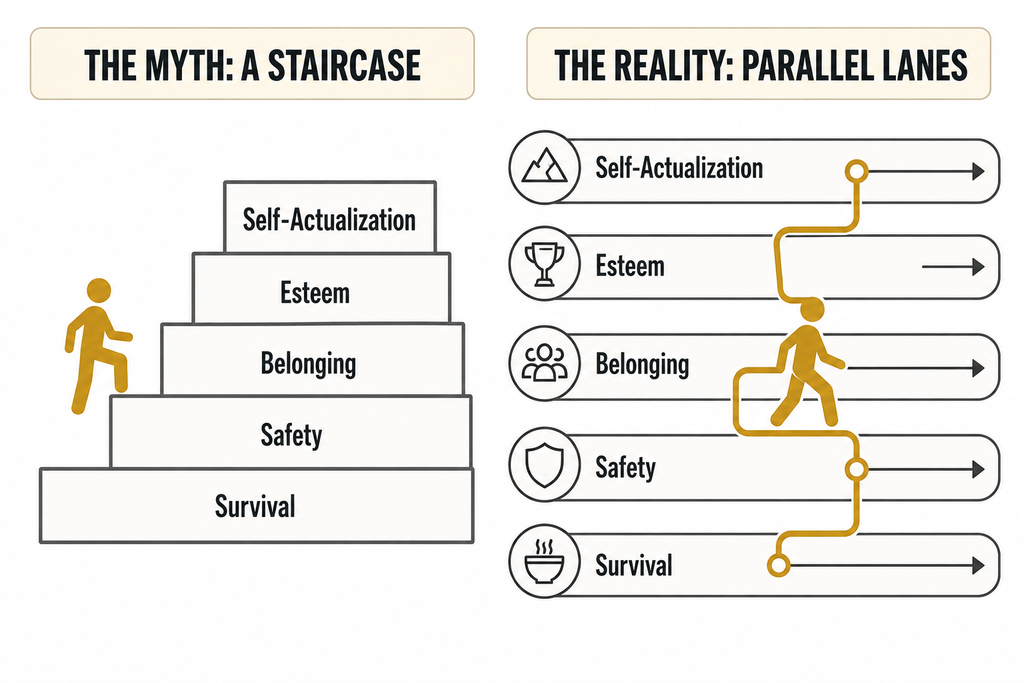
In 1943, psychologist Abraham Maslow published a theory of human motivation that proposed needs arranged in order of priority: physiological survival first, then safety, then belonging, then esteem, then self-actualization at the summit. The framework became a fixture of psychology and marketing curricula, and it’s not wrong about what humans need. It’s wrong about the order in which they go get it.
Real behavior doesn’t wait its turn. People buy concert tickets while carrying credit card debt. They pay for status symbols before they’ve fully funded an emergency fund. They chase meaning and belonging while their “lower” needs are still shaky. Maslow correctly identified the ingredients. He got the recipe’s sequence wrong.
What Maslow Actually Got Wrong
The pyramid implies a gate: you don’t get to want belonging until survival is handled, you don’t get to want self-actualization until esteem is settled. That’s a tidy diagram, but it’s not how motivation actually operates in the wild. Wishes and needs run in parallel circuits, not a queue.
This isn’t a minor academic quibble — it’s the reason so much marketing built on Maslow’s pyramid underperforms. If you assume people only start caring about aspiration once their needs are “handled,” you’ll price, position, and pitch to a customer who doesn’t exist. The real customer is addressing three or four levels of the pyramid simultaneously, usually on the same afternoon.
The Wishlist Is Bigger Than the Needs List
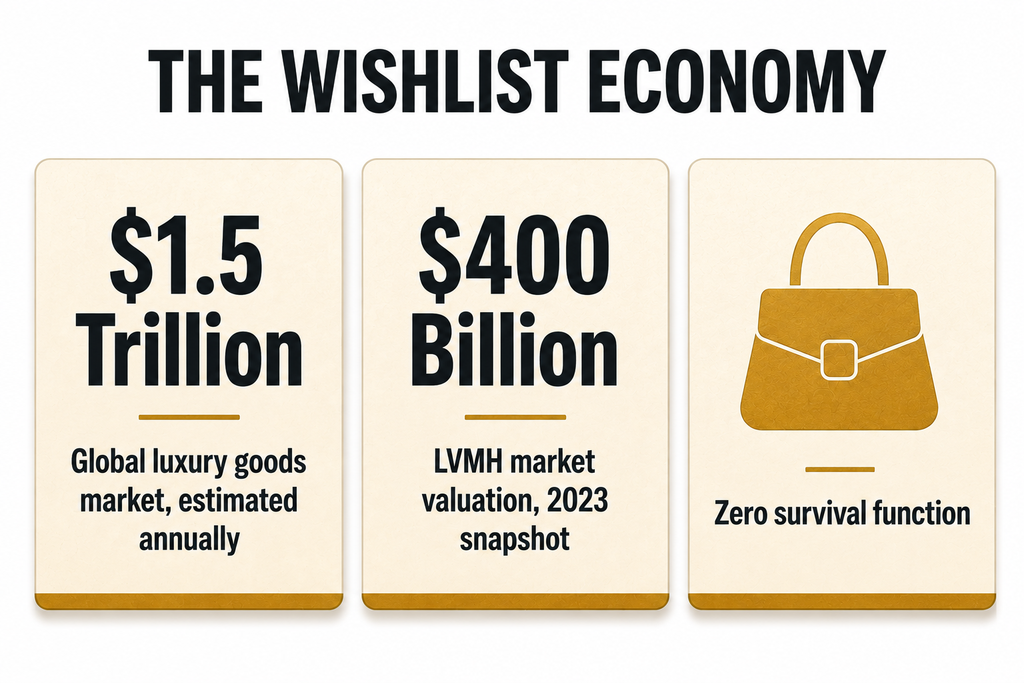
Here’s the plainest evidence: the global luxury goods market is estimated at roughly $1.5 trillion annually. Luxury goods, almost by definition, serve no survival function — nobody needs a monogrammed handbag to stay alive. That’s $1.5 trillion in spending generated entirely by want.
Consider LVMH, the conglomerate behind Louis Vuitton, Moët Hennessy, Christian Dior, and dozens of other luxury houses. In 2023, LVMH’s market valuation was reportedly in the neighborhood of $400 billion — a figure that moves with markets and should be treated as a snapshot, not a fixed number — and its founder, Bernard Arnault, was reported at various points that year to be the world’s wealthiest person, a title that has since traded hands more than once as fortunes and stock prices shift. Precisely how many individual brands sit under the LVMH umbrella changes as the company acquires and divests, so treat any exact brand count as a moving target rather than a fixed fact. What doesn’t move is the underlying point: an enormous share of that valuation rests on wishes, not needs.
Brands that position themselves purely around function — “our watch keeps accurate time,” “our bag holds your stuff” — are competing on the needs list, which is a much smaller and much more commoditized pond. The wishlist is where the money actually is, and it rewards brands willing to sell aspiration instead of utility.
The Experience Economy Proves the Point
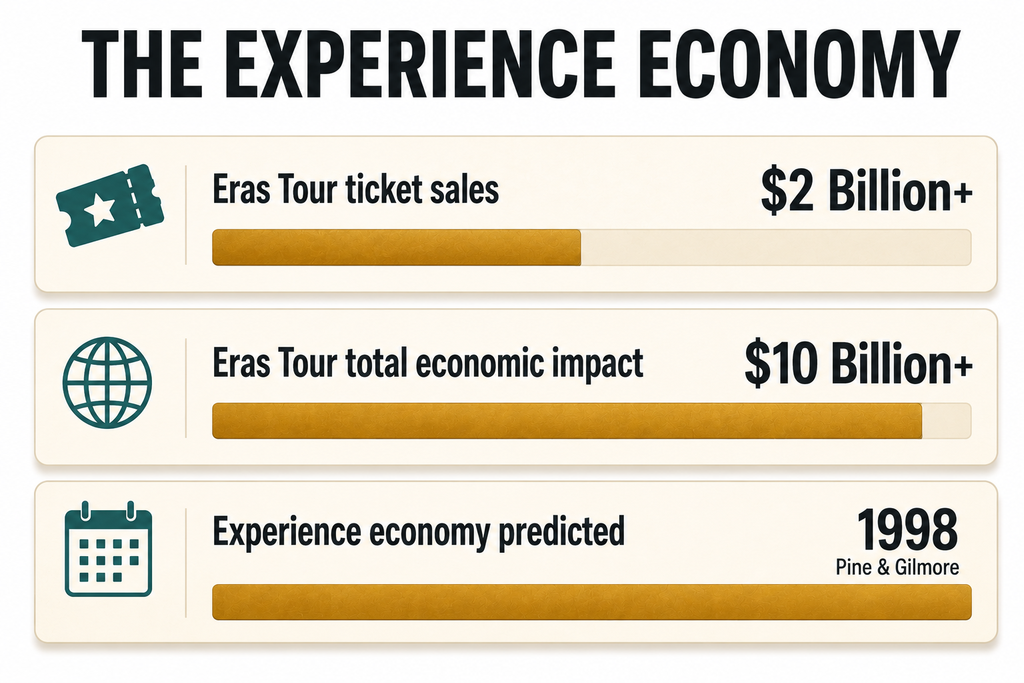
In 1998, economists Joseph Pine and James Gilmore predicted that as goods and services became commoditized, consumers would pay a premium for experiences instead. The prediction held up — arguably better than the authors themselves expected.
Disney’s theme parks. Apple’s retail stores, which function less like electronics shops and more like showrooms for a lifestyle. Airbnb’s “Experiences” product, which sells access to a moment rather than a bed. And the Taylor Swift Eras Tour, which by informed estimates grossed north of $2 billion in ticket sales alone — making it, by most trade-press accounts, the highest-grossing tour in history — with total economic impact, once hotels, flights, and local spending are factored in, estimated well beyond $10 billion. These are directional figures pulled together from touring-industry reporting rather than one audited source, and they should be read as an order of magnitude rather than an exact tally. Even treated conservatively, the number describes a market with no survival function whatsoever.
None of that revenue exists because anyone needed a concert. It exists because a company designed for transformation and memory instead of transaction — and that’s a blueprint, not a one-off. Any business that only optimizes for the transaction is leaving the more lucrative half of the equation — the story someone tells about the purchase afterward — completely on the table.
Status, Signaling, and the Aspiration Machine
The drive for status isn’t vanity bolted onto human nature — some researchers suggest it’s wired to circuitry related to adolescent belonging anxiety, the need to know where you stand in the group. Adults don’t outgrow that. They just trade the schoolyard for brands, degrees, zip codes, cars, and vacation destinations.
That reframes what a lot of “premium” purchases are actually doing. A luxury handbag or a corner-office address isn’t irrational spending sitting on top of rational spending — it’s the same belonging instinct wearing a different outfit. Companies that serve this honestly, at a price point matched to the buyer’s actual life phase, don’t just sell more. They build the kind of loyalty that needs-based competitors can’t touch, because they’re meeting a psychological need the spec sheet never mentions. Ignore that dynamic and you’re not being more rational than your competitors — you’re just missing half the customer.
The Next Wishlist: What’s Underserved Now
The content of people’s wishes shifts by generation. The structure doesn’t. Every era wants status, belonging, beauty, meaning, and transformation — felt with every bit as much intensity as needs, even though nothing about them is required for survival.
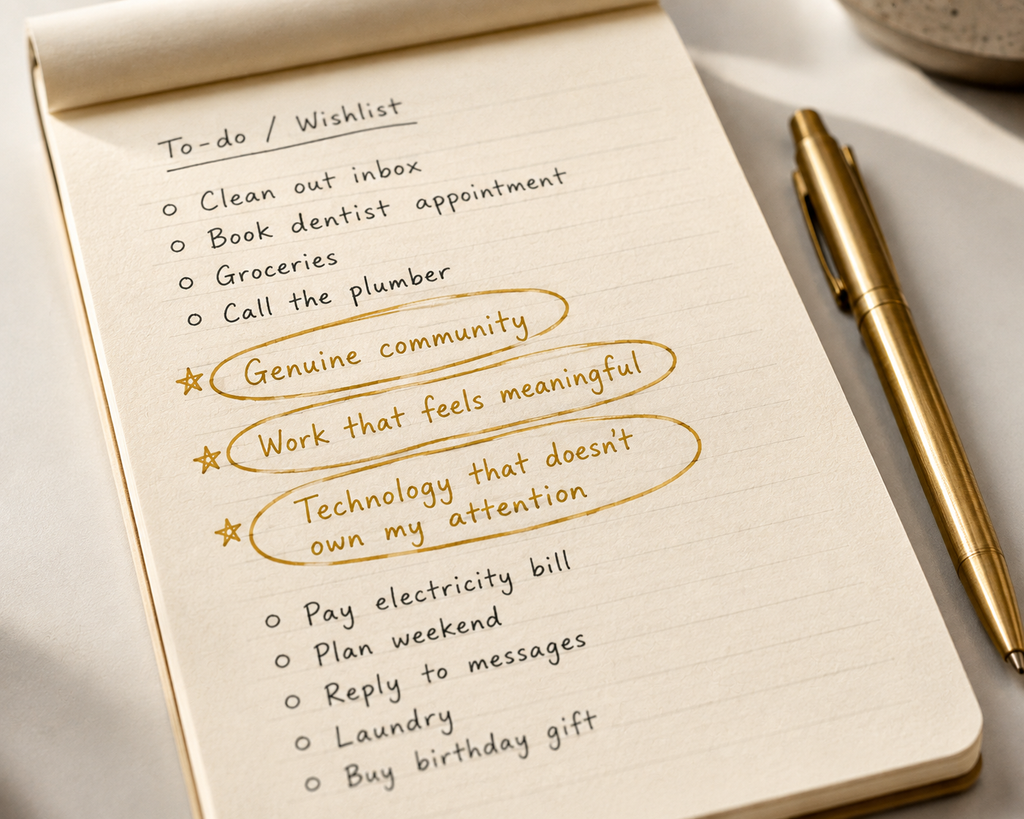
Three specific wishes look underserved right now. First, genuine community, in an era where most “connection” is a notifications feed pretending to be a relationship. Second, work that feels meaningful, not just well-compensated — a wish plenty of employers still treat as a nice-to-have rather than a retention strategy. Third, a relationship with technology that enhances a person’s life instead of quietly colonizing their attention. Each of those is a wishlist item with essentially no dominant player yet, which is precisely the kind of gap that produced the luxury market and the experience economy in the first place — the businesses that noticed early built categories, and the businesses that waited bought their way in later at a premium.
This is also where the Iceberg Model becomes useful: the visible problem customers name (“I want a better app,” “I want a better job”) is rarely the actual wish underneath it, and companies that only solve the visible layer end up building features nobody remembers wanting.
Putting the Wishlist to Work
Is Maslow’s hierarchy of needs still useful today?
Yes, as a checklist of human motivations — it’s still one of the clearest inventories of what people want out of life. It stops being useful the moment it’s read as a sequence, because that’s the part real-world behavior doesn’t follow.
Do needs still matter if wishes drive so much spending?
Absolutely. Needs are the floor, not the whole building. The point isn’t that needs stopped mattering — it’s that wishes matter simultaneously, not afterward, and treating them as an optional layer on top of “real” needs misreads how people actually allocate money and attention.
How should brands apply wish-based thinking in practice?
Stop positioning purely around function and start asking what status, belonging, or transformation a purchase quietly delivers. A product can satisfy a need on the label and a wish underneath it — the businesses that identify both usually outsell the ones that only ever talk about the first.
Doesn’t this just describe luxury brands?
No — it shows up anywhere status or meaning is in play, from a coffee order to a job title to a fitness app. Luxury is just where the wish is easiest to see because there’s no functional justification hiding it.
Key Takeaways
- Maslow correctly identified human needs but wrongly implied people address them in sequence — in practice, wishes and needs run in parallel.
- The global luxury goods market, estimated around $1.5 trillion a year, is built almost entirely on want rather than survival.
- LVMH’s roughly $400 billion 2023 valuation and Bernard Arnault’s reported “wealthiest person” status are real but volatile figures — snapshots, not fixed facts — that still illustrate how much wealth wish-driven spending can generate.
- The experience economy, from Disney to the Eras Tour, shows consumers paying premiums for memory and transformation, not just goods.
- Status-seeking is rooted in belonging anxiety and shows up in brands, credentials, and addresses well into adulthood.
- Community, meaningful work, and a healthier relationship with technology are the most underserved wishes of the current moment — open territory for whoever addresses them first.
Maslow’s pyramid was never wrong about what people want. It was wrong about when they want it. The practical move isn’t waiting for your customer, employee, or product roadmap to “graduate” to the next level — it’s recognizing that the wishlist and the needs list are being worked at the same time, right now, by the same person. Start there.
Sources
- The Human Constant — The Wishlist Economy
- Global luxury goods market estimated at approximately $1.5 trillion annually
- LVMH market valuation reportedly around $400 billion in 2023
- Bernard Arnault reported as the world’s wealthiest person at various points in 2023
- Exact number of brands owned by LVMH (varies by source and over time, not stated as a fixed figure in this draft)
- Pine and Gilmore’s 1998 ‘experience economy’ prediction
- Taylor Swift Eras Tour ticket sales estimated at over $2 billion
- Claim that the Eras Tour is the highest-grossing tour in history
- Eras Tour total economic impact estimated beyond $10 billion including hotels, flights, and local spending
- Maslow published his hierarchy of needs theory in 1943
