


















































The $6.8 Trillion Question: What Is Middle Age Actually Buying?

In 2013, the classicist Mary Beard went on the BBC’s Question Time and made a calm, evidence-based argument about immigration. The response had nothing to do with her argument. One reviewer decided her appearance disqualified her from television altogether — too gray, too plain, too unmade-up to be worth watching. Beard, in her late fifties, didn’t flinch. She answered back with the same precision she’d used on air, and the exchange cracked open a conversation that had clearly been sitting under pressure for years: middle-aged women had been treated as culturally invisible, and they were done pretending not to notice.
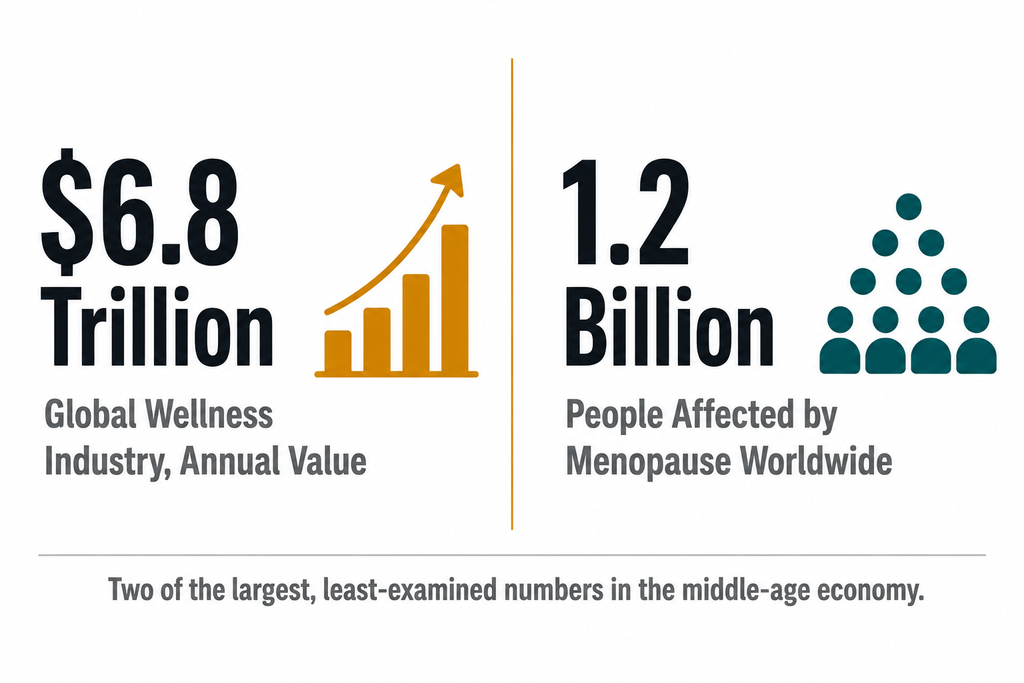
Here’s the part that should embarrass every brand strategist who wrote her off: that same demographic anchors a global wellness industry worth roughly $6.8 trillion a year, alongside a menopause market covering more than a billion people, a philanthropic economy shaped by people rewriting their legacies mid-life, and a booming reinvention industry built on career pivots. Middle age spending is not a rounding error. It’s one of the largest, least-examined forces in the modern economy — and most of the businesses cashing in on it still talk about this life stage like it’s a decline to be managed rather than a market to be understood.
If culture keeps dismissing this group, why does its spending power keep compounding? That’s the real $6.8 trillion question.
The Wellness Industry’s Mortality Conversation
The wellness industry — supplements, fitness memberships, preventive screenings, anti-aging skincare, organic everything — is valued at approximately $6.8 trillion annually, and midlife consumers are widely understood to make up a large and disproportionately influential share of that spending, even if no single official breakdown cleanly assigns a majority stake to any one age group.
The pattern makes intuitive sense once you look at what’s actually happening biologically. Middle age is when the body opens its first serious negotiation with mortality — metabolism slows, hormones shift, cardiovascular risk climbs, joints start sending memos. That’s not fragility. It’s the first moment most people get hard evidence that the body is a finite asset, and finite assets get managed differently than ones that feel infinite.
That reframes what wellness companies are actually selling. Nobody buys a fitness membership because they’re afraid of dying next week. They buy it because middle age is the first life stage where “preserve what I have” starts to outcompete “chase what I don’t.” Products that lean into extension and improvement — more energy, more mobility, more years of feeling capable — outperform products that lean into fear. The takeaway for anyone building in this space: frame the offer around preservation, not panic. Panic gets ignored. Preservation gets a monthly subscription.
The Menopause Economy: A Billion-Person Market Nobody Built
Menopause affects an estimated 1.2 billion women worldwide. Like adolescence, it is a near-universal and predictable transition, and it touches mood, energy, cognition, sleep, and physical capacity. Physicians have been documenting it since at least the eighteenth century — this isn’t an emerging medical mystery, it’s an old, well-charted biological event.
And yet, as of the mid-2020s, it remains one of the most commercially underserved experiences in existence. Think about that combination for a second: a market measured in the billions of people, with centuries of clinical documentation, that most industries still treat as a footnote to “women’s health” rather than a category of its own. That’s not a niche gap. That’s a market someone forgot to build storefronts for.
The practical signal here is louder than the wellness point above: an audience this large, this well-documented, and this consistently ignored is exactly where the next wave of wellness spending is headed. Whoever treats menopause as a design brief instead of an afterthought is going to own a category that’s been sitting empty for two hundred years.
Nobel’s Obituary and the Birth of the Legacy Economy
In April 1888, a French newspaper mistakenly published an obituary for Alfred Nobel — it was actually his brother Ludvig who had died. The line commonly repeated as the paper’s verdict, “The Merchant of Death Is Dead,” is a dramatic flourish historians have never been able to verify actually ran in print. What does hold up is the underlying, stranger fact: Nobel, very much alive, got an unflattering preview of exactly how the world planned to remember him — as the man who invented dynamite, nothing more.
Seven years later, he rewrote his will and used the bulk of his fortune to create the prizes that still carry his name. Nobody can say with certainty what pushed him to do it. But the timing is hard to shrug off.
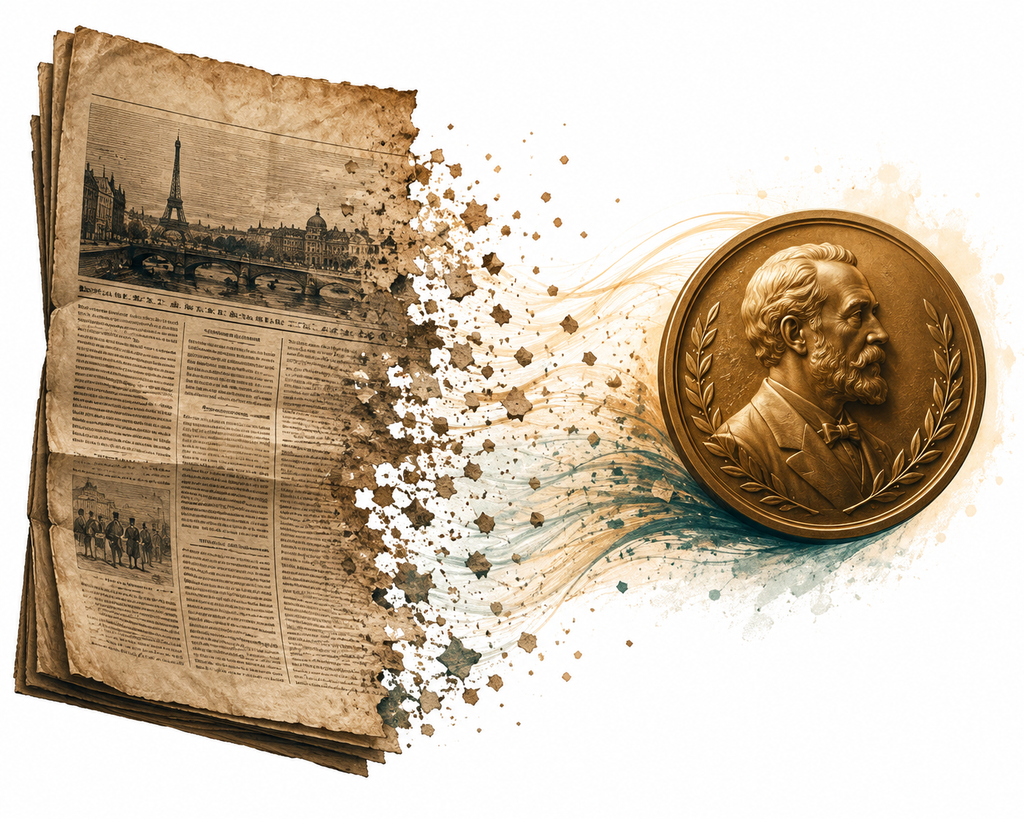
That instinct — build something that outlives the verdict people are already writing about you — is the engine behind a huge chunk of legacy spending today: philanthropic foundations, endowments, impact investing. It’s not charity in the simple sense. It’s identity construction with a longer runway than a single lifetime. Middle age spending, in this light, isn’t only about keeping the body running. It’s about making sure something of you keeps running after you don’t.
The Career Pivot and the Reinvention Economy
The idea of one career from graduation to retirement is functionally dead. Research suggests professionals now change not just jobs but entire industries and professional identities multiple times over a working life. That churn has spawned its own economy: executive MBA programs, life coaching, professional certification courses, and platforms built to help people rebrand themselves mid-career.
LinkedIn is the clearest commercial expression of this shift — a network whose day-to-day traffic runs heavily on people signaling a pivot, not a promotion. Calling it “a middle-age product” outright overstates what any single company’s user data actually proves. But it’s fair to say LinkedIn arguably functions as an infrastructure layer for midlife reinvention, in the same way gyms function as infrastructure for the mortality conversation above. The product doesn’t sell skills. It sells the ability to say, credibly, “I am becoming someone else professionally,” which is a very middle-aged sentence.
For businesses building in this space, the lesson isn’t “teach people new skills.” It’s “help people prove, publicly, that they’ve changed” — that’s the actual purchase happening underneath the coaching fee or the certification badge.
What This Means: Four Markets, One Demographic
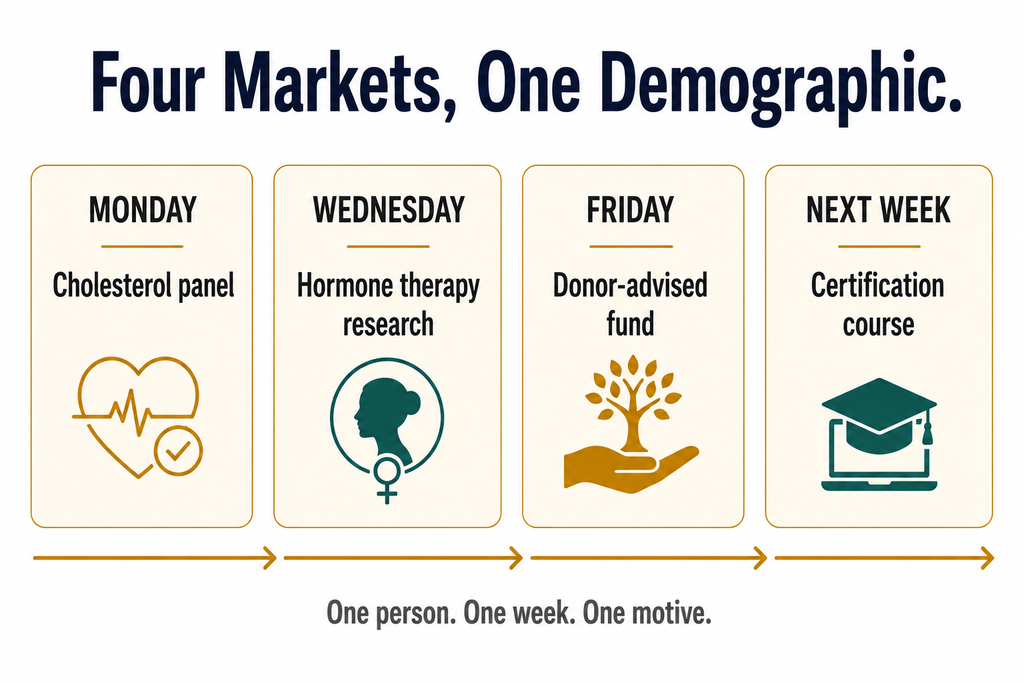
Line up wellness, menopause, legacy, and reinvention side by side and a single portrait emerges. This isn’t a demographic buying maintenance. It’s a demographic buying meaning, using four different vocabularies to say the same thing.
Picture the throughline literally: someone gets a cholesterol panel on Monday, researches hormone therapy options on Wednesday, sets up a donor-advised fund on Friday, and starts a certification course the following week. Four transactions, four industries, one underlying motive — a person negotiating with a body that’s changing, an identity that needs updating, and a legacy that suddenly feels less theoretical. None of it is vanity. All of it is a response to the same realization: time is now visibly finite, and every purchase is a small vote for how the rest of it gets spent.
That’s the lens worth applying to any product aimed at this group. Middle age spending isn’t driven by insecurity about getting older — it’s driven by clear-eyed awareness that getting older is actually happening, and a determination to do something deliberate about it. Products that respect that awareness, instead of exploiting it, are the ones that will still be around when this generation’s spending power peaks. This same pattern — a life-stage friction generating pressure, then a product, then an entire industry — shows up across most major markets, a pattern explored in more depth in The Anatomy of an Idea: The 8 Steps From Friction to Industry.
Reading the $6.8 Trillion Number Correctly
Of the four markets — wellness, menopause, legacy, and reinvention — which is the least proven as an actual opportunity rather than just a narrative?
Reinvention. Wellness and menopause both have hard demand signals — real spending, a real underserved population. Legacy-giving has real dollar flows through foundations and donor-advised funds. Reinvention is the softest of the four — the “multiple industries over a career” framing is a widely repeated pattern, not a single verified statistic, so treat it as directionally true rather than load-bearing.
If I’m building a product for this demographic, which of the four is already the most crowded?
Wellness, by a wide margin — supplements, fitness, screenings, and skincare are mature, competitive categories. Menopause-specific product design is the least crowded relative to its size, which is exactly the gap this piece opens with.
Does bundling menopause in with three “meaning”-driven markets undersell how different a medical need is from a lifestyle purchase?
Fair challenge, worth separating out: legacy and reinvention spending are largely discretionary and identity-driven. Menopause spending sits closer to healthcare — it’s not optional in the way a certification course is. Grouping them together illustrates a shared demographic and a shared pattern of neglect, not that they’re the same kind of purchase.
What’s the strongest counterargument to “middle age is an underserved market”?
That attention has already shifted, and this piece is describing a gap that’s closing faster than it lets on — more menopause telehealth startups, more workplace pilot programs, more midlife-targeted content each year. The honest response: activity has increased, but activity isn’t the same as a mature, competitive market with real product depth — which is still the actual claim here.
Key Takeaways
- The global wellness industry is valued at roughly $6.8 trillion annually, with midlife consumers widely seen as a major — though not precisely quantified — driving force.
- Menopause affects an estimated 1.2 billion people worldwide yet remains commercially underserved relative to its scale and predictability.
- Legacy and philanthropic spending in midlife reflects an identity-building instinct, illustrated historically by the Alfred Nobel obituary episode.
- Career reinvention has become a defining midlife economic behavior, supporting an entire industry of coaching, credentialing, and professional platforms.
- Across all four markets, middle age spending is best understood as identity- and mortality-driven, not vanity-driven — a useful test for any product built for this audience.
Next time a brand pitches you an “anti-aging” product or a “just for her” wellness line, ask the sharper question: is this selling preservation and identity, or is it just selling fear with better packaging? The market that answers that question honestly is the one that’s going to own the next decade of middle age spending.
Sources
- The Human Constant — The Reckoning
- Figure that the global wellness industry is valued at approximately $6.8 trillion annually
- Figure that menopause affects approximately 1.2 billion women worldwide
- Claim that menopause has been medically documented since at least the eighteenth century
- Claim that menopause remains one of the most commercially underserved markets as of the mid-2020s
- Anecdote that a French newspaper mistakenly published Alfred Nobel’s obituary in April 1888 after confusing him with his brother Ludvig
- Claim that the headline ‘The Merchant of Death Is Dead’ is an unverified later embellishment
- Claim that research suggests professionals now change careers/industries multiple times over a working life
- Anecdote about Mary Beard’s 2013 appearance on BBC’s Question Time and the critic who called her too unattractive for television
