




















































Why Prussia Banned Kindergarten: Inside the $300B Business of Childhood

Children do not accept the world as it is. Every question a child asks is an idea waiting for someone brave enough to answer it — and somewhere behind that idea, usually, is a business model. Walk into any room with a four-year-old and ask them why the sky is blue. Then clear your schedule, because you’re about to get an hour of increasingly specific follow-up questions. That’s not a quirky phase. It’s the developmental drive to understand causation, to map the world, to find the rules underneath the surface — and it happens to be the raw material behind some of the largest industries on earth, including the $300B childhood industry built around early education alone.
Children Are Question Machines, and That’s a Business Model
Curiosity isn’t a byproduct of childhood — it’s the engine. Kids interrogate everything because their brains are, quite literally, wired to build a working model of reality as fast as possible. Every industry in this piece figured out how to meet that drive instead of fighting it, and every one of them got paid for the privilege.
That’s worth sitting with before we get to the history, because it reframes the rest of the story. Froebel, Lego, Sesame Street, Disney — none of them invented a new desire in children. They noticed one that was already there and built the scaffolding around it.
Froebel’s Kindergarten and Why Prussia Banned It
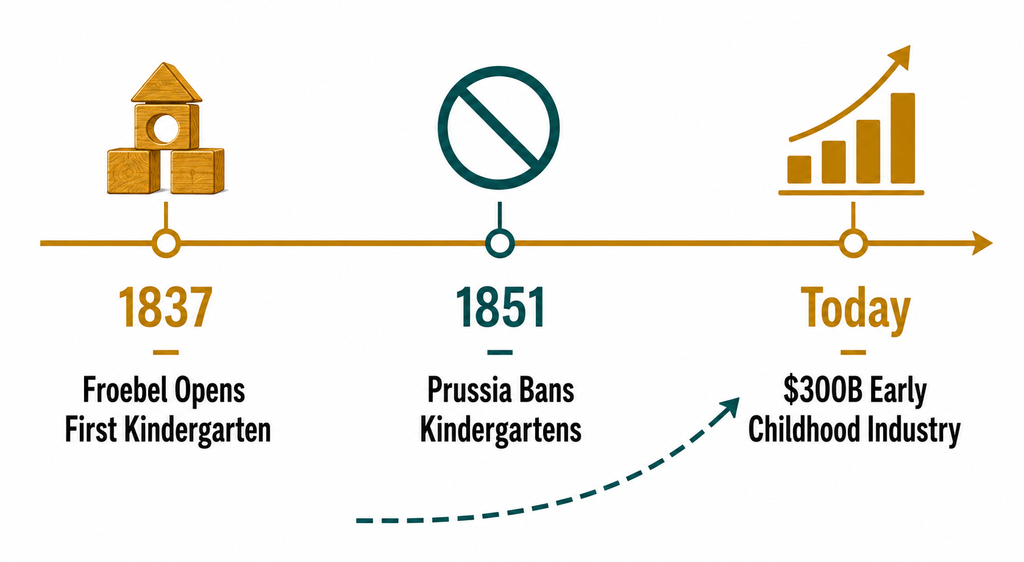
In 1837, Friedrich Froebel opened the world’s first kindergarten in Bad Blankenburg, in what’s now Germany. His argument was radical for the time: children were not small adults to be drilled into obedience, they were growing things, and the right kind of directed play was how they actually learned.
That idea was apparently threatening enough that Prussia banned kindergartens outright in 1851, reportedly out of concern that Froebel’s movement was a front for socialism. Think about that for a second — a government looked at a room full of toddlers stacking blocks and singing songs and saw political subversion. It’s a genuinely absurd episode in education history, and also a useful one: it’s a reminder that resistance to child-centered ideas has often been political, not pedagogical. Nobody was worried the kids would learn badly. Someone was worried about what kind of adults they’d grow into.
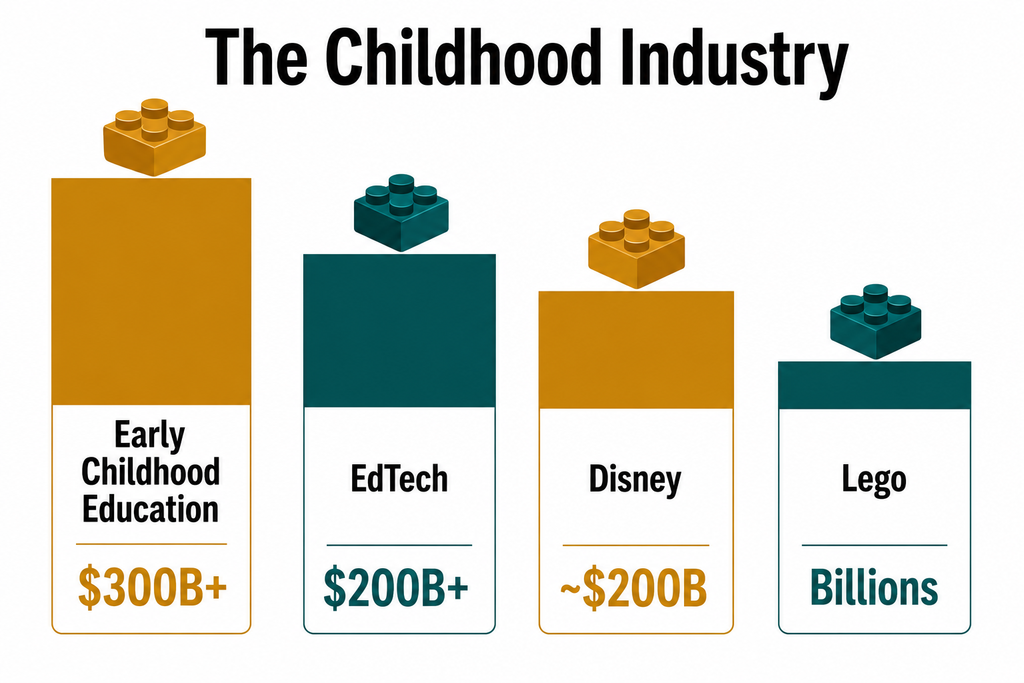
The ban didn’t kill the idea. It just delayed the payoff. Today, early childhood education is a global industry worth more than $300 billion a year — daycare chains, curriculum publishers, toy companies, private preschools, all of it tracing back to a German pedagogue’s insistence that play deserves structure. An idea that once got banned by a government is now one of the largest education markets on the planet.
Lego’s Long Search for a Brick That Actually Held Together
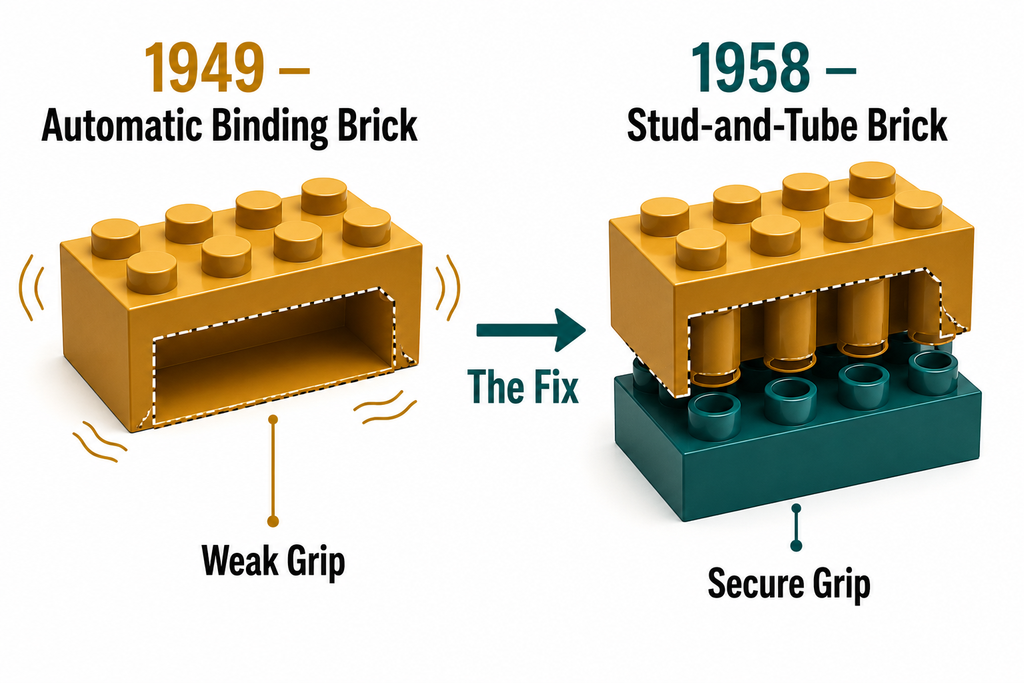
In 1932, Ole Kirk Christiansen was a Danish carpenter trying to keep a business alive during the Great Depression. He named his company LEGO, from the Danish “leg godt” — play well. In 1949, the company released its first plastic brick, the Automatic Binding Brick.
It should have been the breakthrough moment. By most accounts, it wasn’t quite there yet — the bricks were reportedly inconsistent in how well they clutched together, and wooden toys stayed the bulk of Lego’s sales for years afterward. The specifics of exactly what went wrong aren’t something you’ll find nailed down in a single definitive source, but the broad shape of the story — an early plastic brick that underperformed — is well established in how Lego itself has told its own history.
The real fix came almost a decade later, in 1958, when Christiansen’s son Godtfred patented a redesign: hollow tubes on the underside of each brick, gripping the studs of the brick beneath it with real, dependable friction. That single mechanical change solved a problem every kid building with blocks has always faced — that whatever you build, you build knowing it’s going to fall down eventually. The stud-and-tube brick introduced permanence. What a child built could survive being carried across a room, could get added to tomorrow instead of rebuilt from scratch every time. That patent sits underneath a company now worth billions.
The lesson isn’t “plastic was the innovation.” It’s that Lego spent a decade solving for a child’s frustration — the emotional friction of watching your creation collapse — not just chasing a new material. Designing around that friction, not around the substance itself, is what turned a struggling carpenter’s shop into a toy empire.
Sesame Street Proved Kids Could Learn Like They Watch Ads
In 1969, the Children’s Television Workshop launched Sesame Street on PBS, built on a genuinely unproven hypothesis: that kids could absorb academic content the same way they absorbed advertising jingles — through repetition, rhythm, and characters they liked.
It worked, and it worked better than anyone on the project seems to have expected. Children who watched consistently showed stronger letter and number recognition than peers who didn’t. But the bigger win wasn’t the test scores. It was proving that education and entertainment weren’t opposite forces fighting for a kid’s attention — they could be the same thing, delivered at the same time.
That single insight reshaped nearly every category of children’s media that came after it, and it’s the ground floor of today’s EdTech industry, now valued at well over $200 billion. Every app that gamifies a spelling lesson is running Sesame Street’s original playbook. The show reframed education as something that could be as sticky as an ad jingle — and EdTech has been leaning on that principle for over five decades.
Disney and the Business of Being Inside a Story
When Walt Disney opened Disneyland in 1955, most amusement parks of the era were chaotic, slightly seedy affairs — a scattering of rides with no connective tissue between them. Disney’s bet was different: kids don’t primarily want thrill, he reasoned. They want narrative immersion — the feeling of stepping inside a story rather than just riding past it.
Disneyland is widely credited as the first modern theme park, and its defining trait was that every inch of it was built around that immersive, story-first logic rather than ride density. Whether it was truly the first park anywhere conceived from a child’s point of view is a harder claim to pin down with certainty, so it’s worth holding loosely — but the design philosophy itself, prioritizing story over spectacle, is well documented and became the template the entire theme park industry has copied since.
The Disney enterprise that grew out of that bet is now valued at roughly $200 billion. Every dollar of it still rests on the same foundation Walt started with: a child’s wish to be transported somewhere else, not spectacle for its own sake.
The Common Thread: Childhood as Infrastructure
Line these four stories up and a pattern falls out. Froebel didn’t invent curiosity, he built a room for it. Lego didn’t invent building, it solved the moment a build falls apart. Sesame Street didn’t invent attention, it borrowed the mechanics of advertising to hold it toward something useful. Disney didn’t invent imagination, it built physical space around it.
None of these companies engineered a new desire in children. They found a desire already running at full speed — to question, to build, to learn, to imagine — and built infrastructure underneath it. That’s the actual throughline of the $300B childhood industry and its neighboring markets: durability beats novelty, because a product built on something a child is already wired to do doesn’t need to keep reinventing itself to stay relevant. This is the same underlying pattern behind how friction turns into an industry over time — a human need meets pressure, and eventually someone builds the product, and then the market, on top of it.
If you’re building anything for kids — a product, a curriculum, a piece of content — the practical takeaway is blunt: stop trying to manufacture desire and start building around the one that’s already there.

The Pattern Behind Froebel, Lego, and Disney
Is Disney’s $200 billion value really attributable to this one insight?
Not attributable to it alone — Disney is also a film studio, a media conglomerate, and a licensing machine. What the immersion insight explains specifically is why the theme-park division works the way it does, and why competitors that just add more rides without the narrative layer haven’t matched it.
The Prussian ban was political, not pedagogical — does that pattern show up elsewhere?
Often. Ideas that quietly shift how children are raised tend to draw institutional suspicion faster than ideas that just entertain them — an early kindergarten reads as ideology to a nervous government in a way a toy or a TV show doesn’t. Lego, Sesame Street, and Disney all sailed through without a ban; Froebel’s version of the idea was the one that touched authority directly.
Which of these four companies took the longest to actually cash in on its own insight?
Froebel, by a wide margin — roughly a century and a half between the first kindergarten and early education becoming a formal multibillion-dollar sector, versus Lego’s roughly decade-long gap between its 1949 brick and 1958 fix, or Sesame Street turning its 1969 bet into results within a few seasons.
If I’m building something for kids, which of the four models should I actually copy?
Depends what’s broken. Froebel’s model (build room for existing curiosity) fits when the product’s problem is rigidity. Lego’s (fix the one mechanical frustration) fits when the concept is right but execution fails on one detail. Sesame Street’s (borrow attention mechanics for a better end) fits distribution problems. Disney’s (build the whole world, not just the object) fits when the product is competing on feeling, not function.
Key Takeaways
- Children’s drive to question and understand the world isn’t incidental — it’s the raw material the $300B childhood industry is built on.
- Friedrich Froebel opened the first kindergarten in 1837; Prussia banned the concept in 1851 over fears it was politically subversive, not because it failed pedagogically.
- Lego’s early plastic bricks reportedly struggled to hold together; the 1958 stud-and-tube patent solved the real problem — a child’s frustration when a build collapses.
- Sesame Street proved in 1969 that education and entertainment could be fused, laying groundwork for today’s EdTech industry.
- Disneyland’s 1955 bet on narrative immersion over ride-based spectacle helped build an enterprise now valued at roughly $200 billion.
- The common thread: durable childhood businesses build around what kids are already wired to do, not around manufactured novelty.
Next time you watch a kid interrogate a puddle, a brick, or a cartoon, don’t just smile at it. Ask what it would look like to build something around that exact instinct — because someone already made $300 billion doing it.
Sources
- The Human Constant — The Age of Why
- Claim that Friedrich Froebel opened the world’s first kindergarten in Bad Blankenburg in 1837
- Claim that Prussia banned kindergartens in 1851 over fears of socialism
- Claim that early childhood education is a global industry worth over $300 billion annually
- Claim that Ole Kirk Christiansen founded Lego in 1932 during the Great Depression
- Claim that Lego released the Automatic Binding Brick in 1949 and that it failed to hold together reliably
- Claim that Godtfred Kirk Christiansen patented the stud-and-tube brick redesign in 1958
- Claim that Lego is now a company worth over eight billion dollars / billions
- Claim that the Children’s Television Workshop launched Sesame Street on PBS in 1969
- Claim that Sesame Street viewers showed higher letter and number recognition
- Claim that the EdTech industry is valued at over $200 billion
- Claim that Walt Disney opened Disneyland in 1955
- Claim that Disneyland was designed specifically from a child’s point of view (presented as widely credited but uncertain)
- Claim that the Disney enterprise is now valued at approximately $200 billion
