





















































On September 15, 2008, Lehman Brothers filed for bankruptcy and the global financial system came closer to total collapse than at any point since the 1930s. Governments were printing money to bail out the same banks whose failures had caused the crisis. Just over six weeks later, on October 31, 2008, someone using the name Satoshi Nakamoto published a nine-page document called “Bitcoin: A Peer-to-Peer Electronic Cash System.” That timing is why Bitcoin was created the way it was: not as a technology bet, but as a direct response to a very old human emotion sitting at the center of that moment — distrust.
Key takeaways
- Bitcoin’s whitepaper landed 46 days after Lehman Brothers collapsed — a financial system meltdown, not a technology conference, is the actual origin event.
- Satoshi Nakamoto’s real insight wasn’t the blockchain itself, which had academic precedent. It was pairing that technology with a specific, urgent human need: transacting value without trusting any central authority.
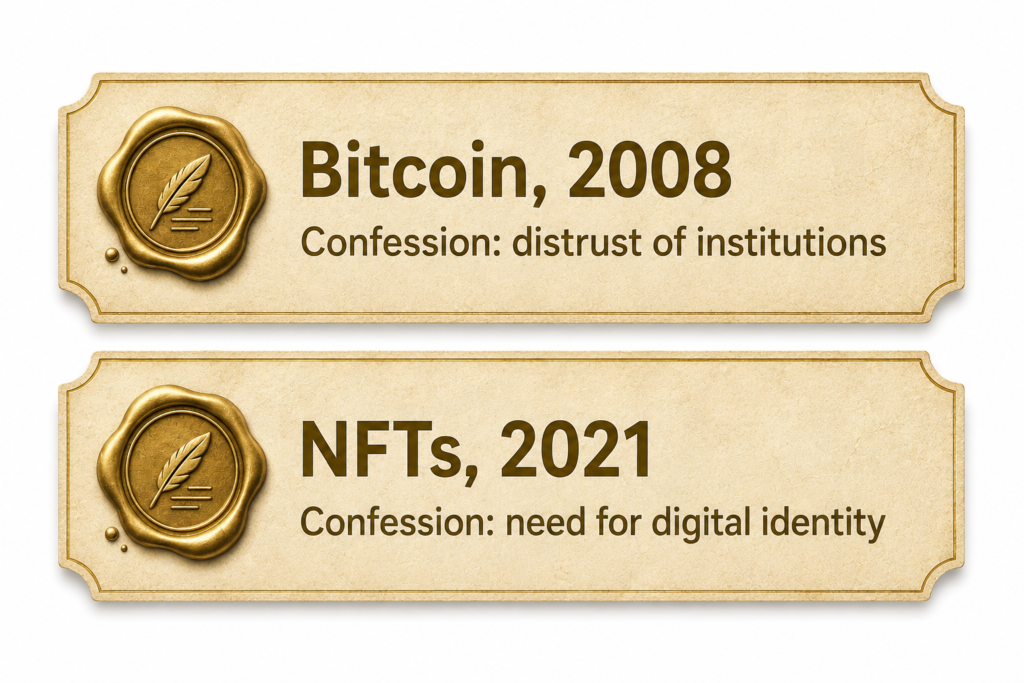
- Every new financial instrument reveals something about what people actually need or fear. Bitcoin revealed distrust. NFTs, a decade later, revealed something different: the need to own and display identity in digital space.
- The practical takeaway: a new product or feature that takes off unexpectedly is often telling you something true about a fear or need your users have — the same way Bitcoin’s rise told you something true about 2008.

The real reason Bitcoin was created
Here’s the framing worth sitting with: a genuinely new financial instrument doesn’t usually appear because of a clever technical insight in isolation. It appears because a technology finally lines up with something people are quietly admitting they need. Satoshi Nakamoto’s real contribution wasn’t the blockchain — cryptographic building blocks like it already existed in academic research. The actual insight was recognizing that a huge number of people, in the exact aftermath of 2008, needed a way to transact value without trusting any central authority ever again. Bitcoin was distrust, encoded.
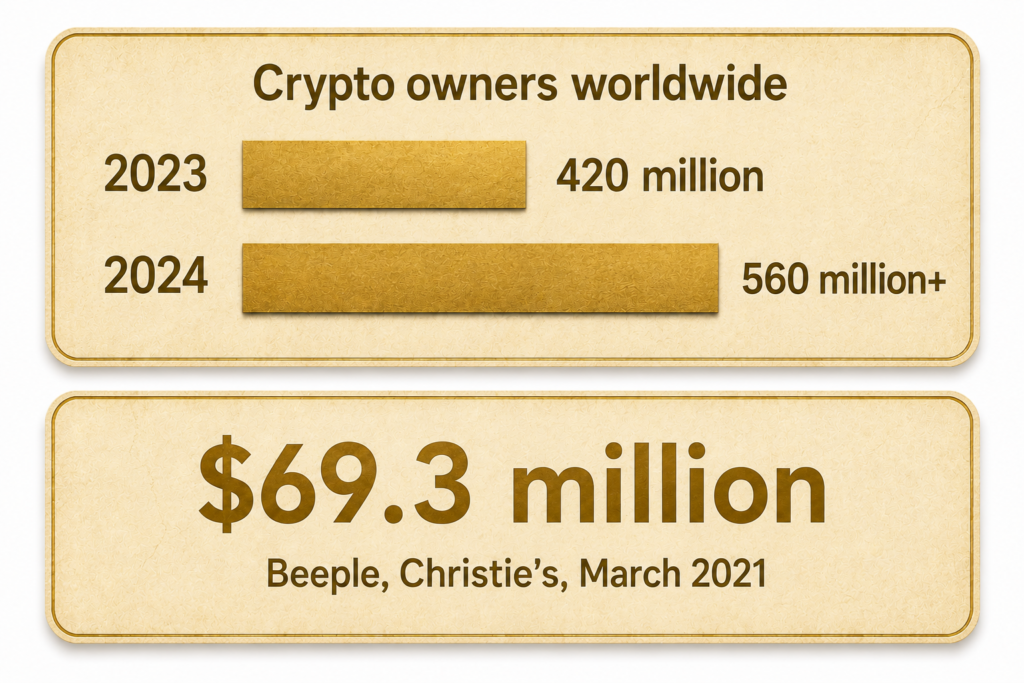
Move forward to March 2021 and a completely different instrument makes a different confession. Digital artist Beeple sold a single digital artwork, “Everydays: The First 5,000 Days,” at Christie’s for $69.3 million. The buyer received no physical object — only a non-fungible token certifying digital ownership. The need behind that sale isn’t new either: it’s the need to own something that expresses identity and confers status, applied for the first time to something that exists only on a screen.
Two instruments, thirteen years apart, revealing two different things people actually needed: to not have to trust anyone, and to be able to show who they are. (For a framework on spotting the real, submerged need underneath what people say they want, see our Iceberg Model piece.)
What the numbers actually say
Crypto ownership didn’t stop growing after 2008 — it kept compounding. Roughly 420 million people worldwide held cryptocurrency in 2023; by 2024 that had grown to more than 560 million, close to 7% of the entire global population. Beeple’s $69.3 million sale wasn’t a one-off curiosity either — it made him the third-most-expensive living artist at the time, and it remains the reference point every NFT sale since has been measured against.
These aren’t small numbers attached to a niche idea. They’re the scale a confession reaches once the underlying need turns out to be real and shared by millions of people, not just the person who first named it.
What is your product confessing?
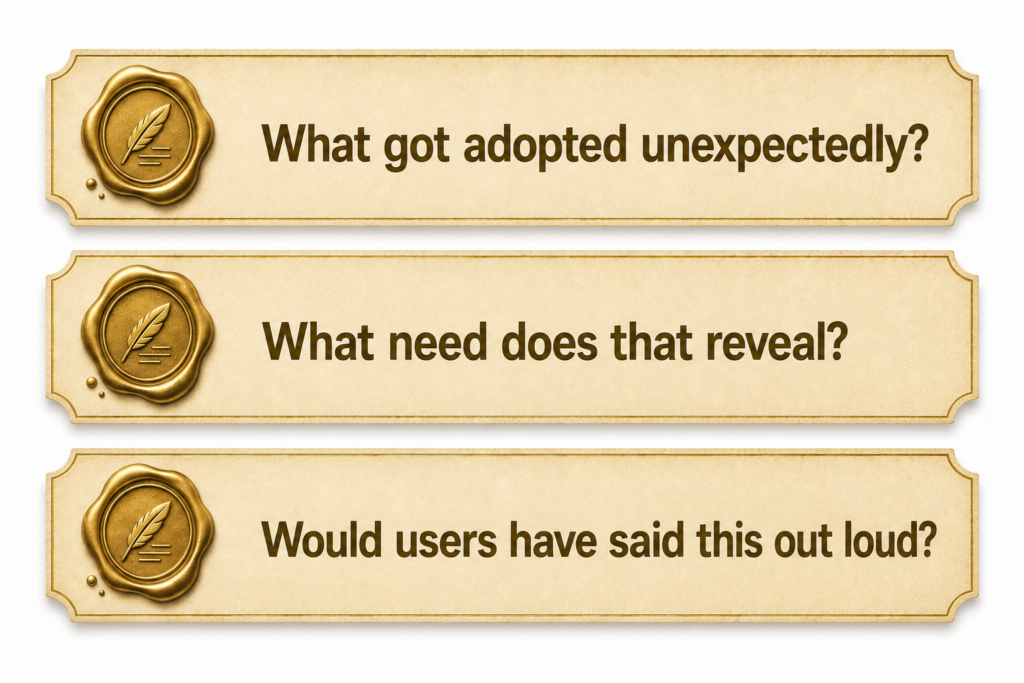
If a financial instrument reveals what people actually need, the same lens works on a smaller scale for anything that unexpectedly takes off. When a feature you built for one reason gets adopted for a completely different one, or grows faster than anything else you’ve shipped, that’s rarely random. It’s usually telling you something true and specific about a need or fear your users have that they wouldn’t have stated directly if you’d just asked them.
Run the audit on your own product: has anything you’ve shipped been adopted in a way you didn’t originally design for? If so, don’t treat that as noise to correct. Treat it as a confession, and go find out what it’s actually admitting. (For what happens when an entirely new technology reshapes what people need next, see our what AI changes and what it doesn’t piece.)
Reading Your Own Product’s Confessions
How would I actually apply the ‘confession’ framing to my own product, not just to Bitcoin or NFTs?
Run a simple audit: has anything you’ve shipped been adopted in a way you didn’t originally design for, or grown faster than anything else without an obvious reason? If so, treat that as a confession rather than noise — it’s usually telling you something true about a need or fear your users have that they wouldn’t have stated if you’d just asked them directly.
Does the “confession” framing apply to every new financial instrument, or just these two? The book applies it more broadly — new instruments across history tend to trace back to a specific human need or fear finding a viable mechanism for the first time. Bitcoin and NFTs are simply two of the clearest, most recent examples.
Is crypto ownership growth actually still accelerating? As of the most recent data available, yes — global ownership grew roughly 33-34% year over year into 2024, though growth rates in fast-moving markets like this are worth re-checking periodically rather than treated as a fixed number.
Try this
Look back at whatever you’ve shipped in the last year. Find the one thing that got used differently than you expected, or grew faster than anything else on the roadmap. Don’t ask what you did right. Ask what that adoption is actually confessing about a need your users have that they never said out loud. That question is where the next real instrument — financial or otherwise — usually starts.
Sources:
- Adapted from The Human Constant, Chapter 14 — “The New Currencies”
- A Decade After Lehman Brothers Died: Satoshi, Bitcoin, and Wall Street — Bitcoin.com News
- Crypto Ownership Report 2024: Global Adoption Trends — Triple-A
- How Many People Own Crypto in the World? — CoinLedger
- Beeple NFT work sells for $69.3m at Christie’s — The Art Newspaper