




















































Emma Raducanu turned eighteen on November 13, 2020, in the middle of a pandemic that had closed her school and cancelled the version of adolescence everyone before her had taken for granted. She spent those formative years talking to friends through screens instead of hallways. Ten months later, ranked 150th in the world and playing in one of her first Grand Slam main draws — reports on exactly which one vary, so take the “first or second” detail as roughly right rather than gospel — she won the 2021 US Open without dropping a set. It was, by most tennis histories, the first time a qualifier had won a major in the Open Era. Her social following went from thousands to millions in days.
That’s not really a tennis story. It’s a preview.
Raducanu became, almost by accident, the face of a life stage that didn’t exist for anyone born even ten years earlier: full adolescence lived and broadcast inside networked platforms, under pandemic conditions, at planetary scale. Nobody wrote her a manual for that. Nobody could have. And the same is true, in different ways, for a widening set of human experiences that our institutions — pension systems, mental health infrastructure, career ladders — were simply never built to handle. That gap is what we mean by longevity infrastructure: the financial, medical, and social scaffolding a much longer life actually requires, most of which doesn’t exist yet.
This piece is about three of those gaps at once, and why the businesses, policies, and personal decisions that fill them are going to matter more than almost anything else in the next few decades.

Three New Human Phases, Three Missing Playbooks
There’s a useful way to think about this: humans are now living through phases that have no historical precedent, and each one is generating needs nobody has fully built products, policies, or professions around yet.
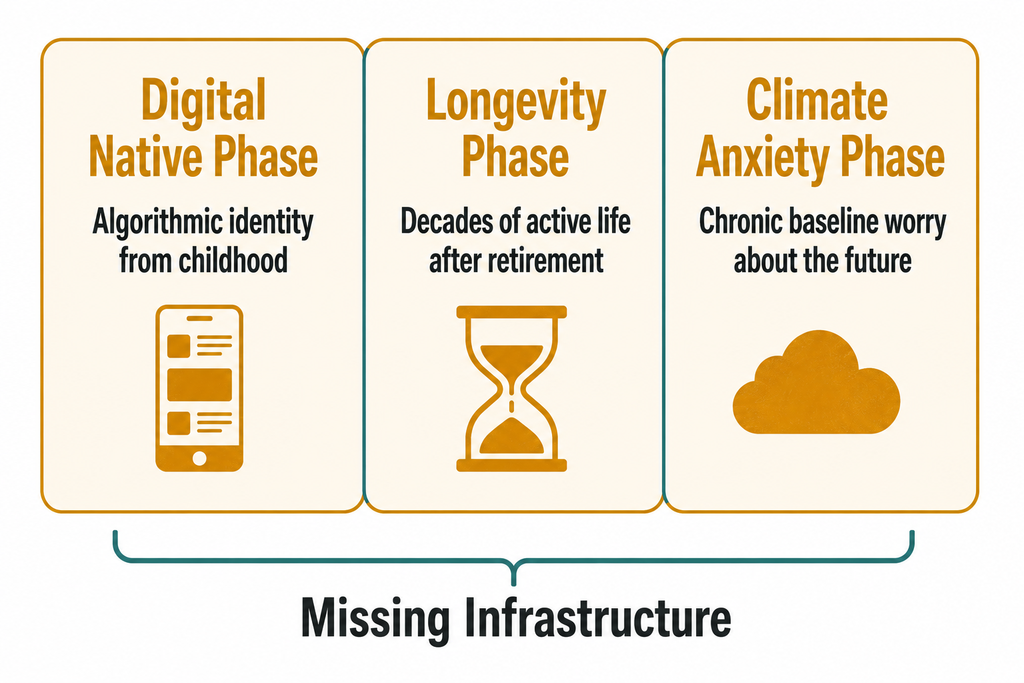
Three stand out. The digital native phase — growing up with an algorithmically curated identity from early childhood. The longevity phase — decades of active life after what used to be “retirement.” And the climate anxiety phase — a generation carrying chronic, baseline dread about a livable future as a fact of daily psychology, not a passing mood.
None of these is hypothetical. All three are already reshaping how people spend money, choose careers, and decide whether to have kids. What they share is this: the systems meant to support people through them were designed for a different century’s version of a human life.
The Longevity Phase: Building Infrastructure for a Forty-Year Retirement
For most of human history, “old age” ended things quickly — the elder phase rarely stretched past the sixth or seventh decade of life. That math has changed. The population of people living past 100 has been growing steadily across developed countries for decades, and demographers broadly expect that growth to continue, even if the exact pace and rankings shift depending on which country and dataset you’re looking at.
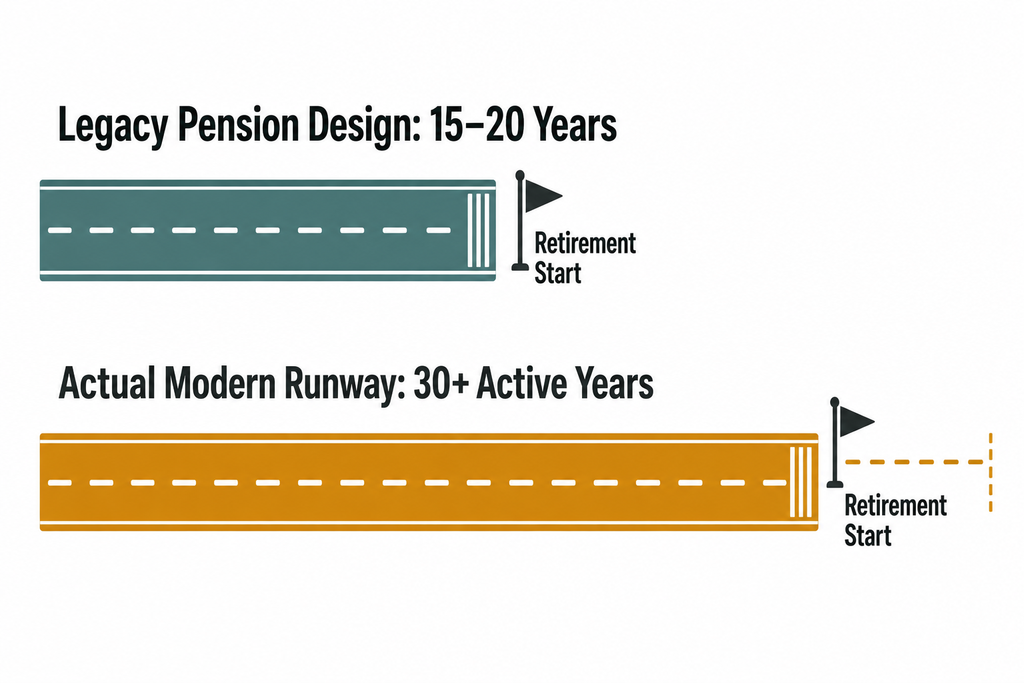
What that means practically: a lot of people alive right now are going to spend thirty-plus active years beyond the age their grandparents’ pension plans assumed they’d be dead by. And here’s the uncomfortable question worth sitting with — not as settled fact, but as the live design problem it actually is: were the retirement financial products you’re relying on actually built with a forty-year runway in mind, or a twenty-year one? Most legacy pension and annuity structures took shape in an era when “retirement” meant a decade, maybe fifteen years, not a third of an adult life. That’s a strong reason to treat any retirement plan built before this decade with some skepticism about whether its assumptions still hold.
If you’re approaching retirement — or advising someone who is — that’s the question to actually ask your advisor, not “am I saving enough,” but “saving enough for how many years, and who decided that number, and when.” The seven phases of human life framework is a useful way to map out what “enough” even means once the old assumptions stop applying.
The Climate Anxiety Phase: When Worry Becomes a Market
In December 2021, The Lancet Planetary Health published a study surveying 10,000 young people aged sixteen to twenty-five across ten countries about how they felt about climate change. Fifty-nine percent said they were very or extremely worried. Three in four said the future felt frightening. Those are the study’s own reported figures, and they’re worth treating as a striking data point from one large survey rather than a permanent, universal statistic — but even taken cautiously, they describe something real and widespread.
This isn’t eco-grief after a wildfire or a flood. It’s a standing psychological condition — anxiety that doesn’t wait for a disaster to trigger it, because the disaster is understood to already be underway, just distributed unevenly across time and geography.
Chronic anxiety like that generates needs that a pamphlet about recycling doesn’t touch: the need for a sense of agency inside a problem that dwarfs any individual action, and the need for community — people to carry the weight with, rather than alone. Products and organizations that offer actual, tangible things to do, alongside people to do them with, are addressing something real. Ones that just deliver more information about the crisis are, if anything, making the baseline anxiety worse. If you’re building in this space, or looking for where to put your attention as an individual, that distinction — agency versus more data — is the whole ballgame.
The Digital Native Phase as Context, Not Just Backdrop
It’s tempting to treat the digital native phase as background noise to the other two — the internet stuff everyone already talks about. That undersells it.
Consider, illustratively, someone who came of age with a phone in hand from early childhood: their sense of identity has been shaped, continuously, by algorithmic feedback — likes, follower counts, recommendation engines deciding which version of them gets amplified. That’s not a variation on the adolescence people over forty remember with a different soundtrack. It’s a structurally new condition, generating needs — algorithmic literacy, some form of digital identity ownership, wellbeing tools built for life under social metrics — that simply didn’t exist as categories a generation ago.
Here’s what matters for this piece: that person doesn’t get to deal with the digital native phase in isolation. They’re also going to live an unusually long life, and they’re carrying climate anxiety as a baseline condition, not a phase they’ll age out of. All three pressures land on the same person, at the same time, compounding rather than taking turns. That’s a genuinely new situation, and it’s a big part of why “just be resilient” advice from an earlier generation lands so badly with the one living through it now.
Where the Playbook Gaps Create Opportunity
Line up all three phases and a pattern falls out: each one is a vacuum where infrastructure used to be. Financial infrastructure hasn’t caught up to how long people now live. Psychological infrastructure hasn’t caught up to a generation whose identity is algorithmically mediated from childhood. Communal infrastructure hasn’t caught up to anxiety that doesn’t have a single triggering event to resolve.
Vacuums like that are, bluntly, where the next generation of durable businesses gets built — not by chasing a trend, but by taking an unmet human need seriously enough to design for its actual shape. New financial instruments built around decades-long time horizons. New community structures built around shared climate commitment rather than shared geography. New literacy tools built for people who’ve never known an offline identity. None of that is speculative “future of work” talk — the needs already exist; the products mostly don’t.
If you’re an entrepreneur, a policymaker, or just someone trying to plan your own next thirty years, treat these three gaps as design briefs rather than abstractions. Longevity infrastructure isn’t a buzzword — it’s the literal, unbuilt scaffolding a hundred-year life requires, and somebody is going to build it. For a broader version of this same instinct — spotting where a human need has outpaced the products built to meet it — the human constant framework is a useful lens to apply well beyond these three phases, and the fuller breakdown of the three phases themselves is worth reading in the companion piece on the digital native, longevity, and climate anxiety phases.
Building the Infrastructure That Doesn’t Exist Yet
What is longevity infrastructure, concretely — not as a buzzword?
It’s the specific stuff that doesn’t exist yet: annuity and pension products modeled on forty active years instead of fifteen, healthcare financing that assumes decades of post-work life, and professional or social structures for people who might have three or four distinct “careers” after age 60. Right now, most of that is being improvised by individuals rather than provided by institutions.
Is climate anxiety an official diagnosis?
Not in the way, say, generalized anxiety disorder is — clinicians and researchers are still working out how to classify it. What the Lancet Planetary Health survey captured was self-reported worry at a scale (majority-level, among the youth surveyed) that’s hard to dismiss as a fringe reaction, whatever the eventual clinical label ends up being.
Why would a retirement plan built ten years ago already be outdated?
Because life expectancy assumptions and product design both lag behind how long people are actually living, and that gap widens every year a plan isn’t revisited. It’s less a specific product flaw than a structural one — worth an honest conversation with whoever manages your retirement savings.
Which of the three gaps — financial, psychological, or communal infrastructure — is the most immediately buildable?
Financial infrastructure is the most concrete starting point, since it mainly requires re-underwriting existing products like annuities, pensions, and insurance around realistic decades-long horizons rather than inventing an entirely new category. Communal and psychological infrastructure are just as real, but harder to build because they require new social structures, not just new spreadsheets.
Key Takeaways
- The 100-year life is arriving faster than the institutions meant to support it — that gap is what “longevity infrastructure” actually refers to.
- Retirement products built for a fifteen-to-twenty-year runway deserve real scrutiny if you’re planning for thirty-plus active years past traditional retirement age.
- Climate anxiety functions as a chronic condition for a large share of young people, not an occasional reaction — and the products worth paying attention to offer agency and community, not just more information.
- The digital native phase isn’t separate from the other two — for a lot of people it’s happening at the same time, compounding rather than taking turns.
- Every one of these gaps is also a design brief. The businesses, policies, and personal decisions that take them seriously now have a real head start.
The playbook for the 100-year life isn’t going to appear on its own. Someone has to write it — and the ones who start now, treating these three phases as a map instead of a mood, are the ones who’ll have a head start when everyone else catches up to the obvious.
Sources
- The Human Constant — The Phases We Have Not Mapped Yet
- Emma Raducanu turned eighteen on November 13, 2020
- Claim that Raducanu’s 2021 US Open run was in one of her first Grand Slam main draws (exact count hedged as unverified)
- Claim that Raducanu won the 2021 US Open without dropping a set
- Claim that Raducanu was the first qualifier (male or female) to win a Grand Slam in the Open Era
- Claim that Raducanu’s social media following grew from thousands to millions within days
- Claim that the centenarian population has been steadily growing across developed countries and is widely expected to continue (framed as hedged, not ranked as ‘fastest-growing’)
- Claim that most legacy pension/annuity products were designed around a 10-15 year retirement horizon rather than a 40-year one (framed as analytical claim, not verified fact)
- Lancet Planetary Health study: published December 2021, surveyed 10,000 people aged 16-25 across 10 countries
- Statistic: 59% of surveyed youth reported being very or extremely worried about climate change
- Statistic: three in four (75%) of surveyed youth said the future felt frightening
- Framing claim that a child growing up with a phone from early childhood has identity shaped continuously by algorithmic feedback (presented as illustrative, not a specific named individual)
