



















































3 Trillion-Dollar Problems the Stone Age Never Solved: Energy, Food, and Bookkeeping

Before money, before language, before civilization — a human needed something. That need became the first idea. And if you trace the three biggest industries on Earth today back far enough, you land in the same place: a cave, a field, and a clay tablet, all wrestling with problems nobody has actually closed. These are the trillion-dollar problems Stone Age humans first tried to solve — energy, food security, and bookkeeping — and they’re still open.
The Oldest Idea in the World Wasn’t Art
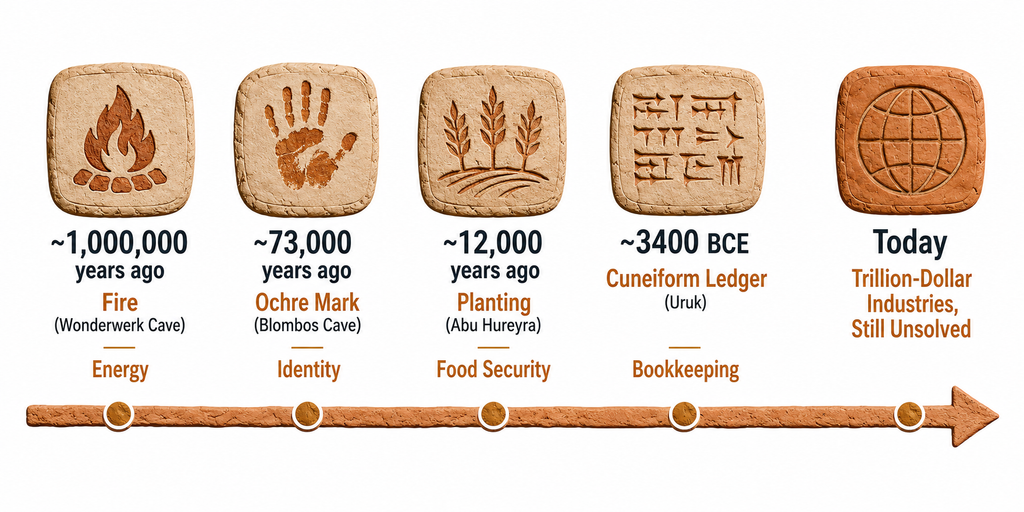
Seventy-three thousand years ago, in a cave overlooking the Indian Ocean at the southern tip of Africa, someone picked up a piece of red ochre and scratched a deliberate pattern of lines into it. Archaeologists uncovered this piece — now known as the Blombos Cave ochre — in the 1990s, and it’s regarded as the oldest known intentional mark-making in the human record.
Here’s the thing about that mark: it probably wasn’t art for art’s sake. The same layer of the cave held dozens of pierced shell beads, stained with the same red pigment, worn smooth from being strung and carried. Elsewhere in the cave, ochre shows the wear of a working pigment — ground down, mixed with fat, rubbed onto skin. This wasn’t a doodle. It was a system.
Put the pieces together and a plausible story emerges: a human wearing an ochre-marked shell was answering a question before anyone spoke a word — are you one of us? As hunter-gatherer groups spread and crossed paths more often, that question stopped being casual. Guess wrong about a stranger and you could lose access to food, shelter, or your life. The mark solved the friction of strangers.
That’s not decoration. That’s infrastructure. And it’s the premise this whole piece runs on: every product, ancient or modern, starts as a response to a pressure nobody’s solved yet. Energy, food, and bookkeeping are three pressures still running.
The Anatomy of an Idea: A Framework That Still Applies
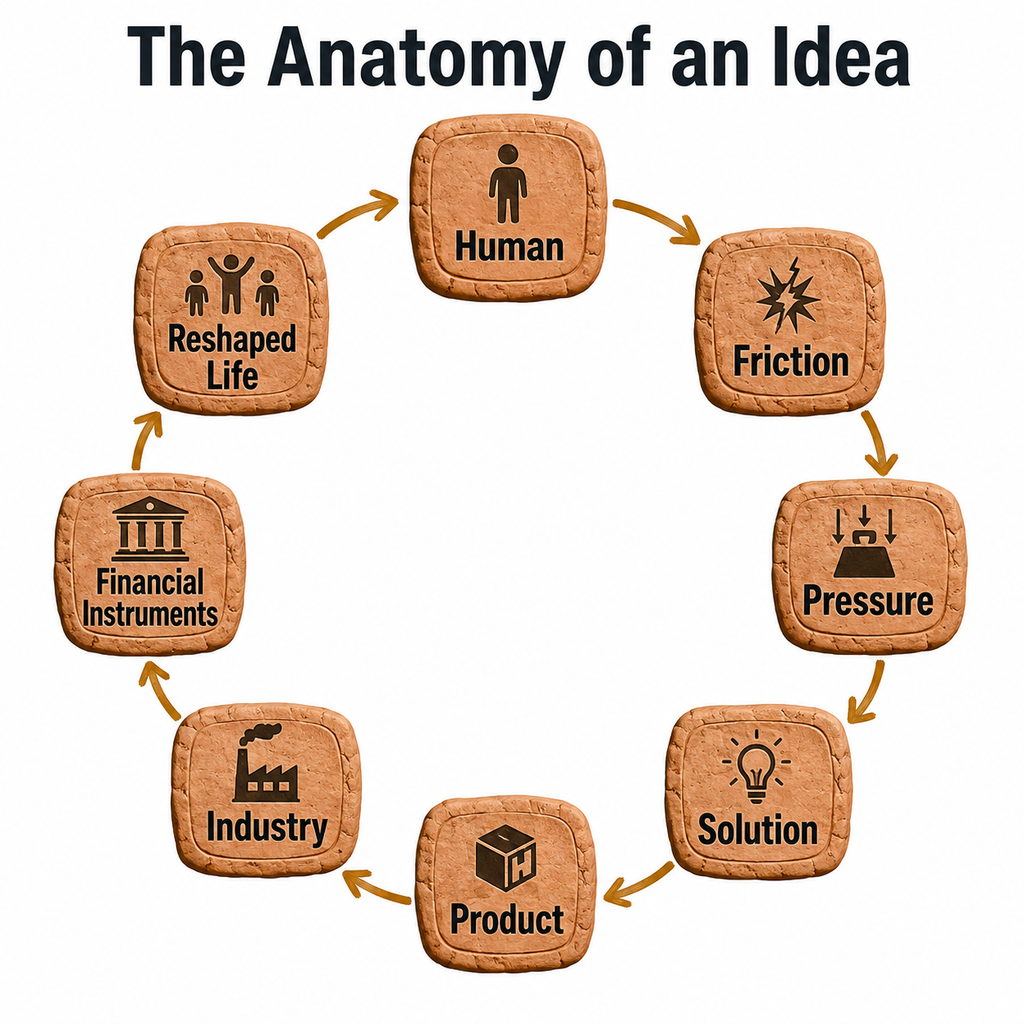
Every idea in history — from a sharpened stone to a large language model — follows the same shape. A human, in a specific phase of life, hits friction: a need unmet, a want unsatisfied, a problem that won’t quit. The friction builds pressure. The pressure forces a solution. The solution becomes a product. The product becomes an industry. The industry spins up financial instruments — loans, contracts, futures markets, whatever the era supports. And those instruments reshape how people live, which creates new friction, and the cycle starts again.
This isn’t a metaphor dressed up as a theory. It’s a pattern you can check against practically anything, and I’ve laid it out in more detail in The Anatomy of an Idea: The 8 Steps From Friction to Industry. Use it as a checklist next time you’re sizing up a startup pitch or trying to figure out why an “old” industry keeps minting billionaires: find the friction, find the human, and you’ll usually find the real business model underneath the deck.
Problem One: Energy — Fire and the Freezing Human
Fire wasn’t a eureka moment. It was the answer to a problem every human in a cold climate faced every single night for hundreds of thousands of years: don’t freeze. Archaeologists date controlled fire use to roughly a million years ago at Wonderwerk Cave in South Africa, and getting there wasn’t a flash of genius — it was generations of trial, failure, and cold.
What fire actually delivered was bigger than warmth. It gave light after dark, protection from predators, and cooked food — which made calories easier to absorb and, over evolutionary time, may have supported the growth of larger brains. It hit every life phase at once: warmth for the infant, light for the hunter, safety for the elder, a gathering point for everyone else. Fire was the first product built to solve more than one problem simultaneously, which is more than most Series A pitches can claim.
Now zoom forward. Energy is a multi-trillion-dollar sector — grids, pipelines, solar farms, battery megafactories, entire geopolitics built around who controls the fuel. The fuel changed. The problem didn’t. “Give me reliable, safe energy on demand” is the same ask a human made of a campfire, just routed through a transformer now instead of a flint spark.

Problem Two: Food Security — Abu Hureyra and the End of Luck
At Abu Hureyra, a settlement on the banks of the Euphrates, archaeologists found something rare: direct evidence of the moment a population stopped gathering wild seeds and started planting them deliberately. It happened over generations, and reportedly it happened because the old way stopped working. As climate patterns shifted and animal herds turned unpredictable, somewhere around twelve thousand years ago, hunger-by-chance became unbearable. A bad season could no longer just be waited out.
The Neolithic Revolution gets taught like a lightbulb moment. It reads more honestly as a population that ran out of patience with luck. Planting was a bet against randomness, and it’s the same bet every agri-tech company, crop-insurance underwriter, and supply-chain logistics platform is still making. Food security today isn’t about whether we know how to grow food — we do, at scale most Stone Age farmers couldn’t imagine. It’s about volatility: droughts, wars, shipping bottlenecks, a single blocked canal turning into a global grain-price spike. The problem Abu Hureyra tried to solve — take chance out of eating — is still generating trillion-dollar industries because chance keeps finding new ways back in.

Problem Three: Bookkeeping — The Receipt That Started Writing
Around 3400 BCE, in the Mesopotamian city of Uruk, someone pressed a reed stylus into wet clay to log how much barley had gone into that week’s beer. It wasn’t a poem. It wasn’t scripture. It was a receipt — jars of beer, measures of grain, names of workers owed their rations. A temple administrator, drowning in a growing city’s transactions, needed a memory bigger than his own head.
That tablet is considered the oldest known writing on Earth. Not literature — an inventory. Cuneiform, the script that would eventually record the Epic of Gilgamesh and the Code of Hammurabi, was invented first to solve the same headache a small business owner feels every quarter: too many transactions, not enough memory.
Follow that thread forward and you land on double-entry bookkeeping, spreadsheets, ERP software, and the modern fintech industry — all still chasing the same friction. Every accounting startup pitch that promises to “reduce reconciliation errors” is, structurally, the same idea as that Uruk administrator’s clay tablet. Different medium, identical panic.
Why None of These Problems Are Actually Solved
Here’s the uncomfortable part: none of these three problems are closed. They’re just wearing better materials now. We didn’t solve energy — we built grids, and now we argue over whether those grids can survive a heat wave. We didn’t solve food security — we built agribusiness and global shipping, and a war on the other side of the planet can still empty a shelf. We didn’t solve bookkeeping — we built accounting software, and companies still collapse from ledgers nobody actually reconciled in time.
The pressure that pushed a human to grind ochre into a signal 73,000 years ago is the same category of pressure driving venture capital into climate tech, agri-fintech, and accounting AI right now. Same friction, different materials — that’s the whole arc of this piece, and it’s not a coincidence. It’s the mechanism.
Practical takeaway: if you’re building or evaluating a product, don’t ask “is this new?” Ask which ancient friction it’s actually chasing. Energy, food security, and bookkeeping keep producing trillion-dollar markets precisely because they were never fully solved — they were only ever managed, generation after generation, one better material at a time. If your idea addresses one of these three, you’re not entering a saturated market. You’re entering the oldest unfinished business humans have.
Key Takeaways
- The Blombos Cave ochre engraving, dated to roughly 73,000 years ago, is considered the oldest known intentional mark-making — likely a solution to the friction of identifying strangers, not decorative art.
- Every idea follows the same eight-step anatomy: human, friction, pressure, solution, product, industry, financial instruments, reshaped life.
- Fire (controlled use dated to roughly a million years ago at Wonderwerk Cave) was humanity’s first multi-purpose energy solution — and energy remains unsolved, just running on different fuel.
- Agriculture at Abu Hureyra, emerging roughly twelve thousand years ago, was a bet against unpredictability — the same bet modern food security and agri-tech markets are still making.
- Cuneiform writing, reportedly originating around 3400 BCE in Uruk as a beer-and-grain ledger, marks bookkeeping as one of humanity’s oldest unsolved administrative problems.
- Energy, food security, and bookkeeping remain open, trillion-dollar frictions — the materials changed, the underlying problems didn’t.
Applying the Pattern to Your Own Idea
What are the three trillion-dollar problems from the Stone Age that are still unsolved?
Energy (reliable warmth, light, and power), food security (consistent access to food despite unpredictable conditions), and bookkeeping (tracking transactions accurately as scale grows). Each traces back to a specific ancient breakthrough — controlled fire, deliberate planting, and early writing — that addressed the problem without ever fully closing it.
What is the Blombos Cave ochre, and why does it matter here?
It’s a piece of red ochre engraved with deliberate lines, discovered in a South African cave in the 1990s and dated to roughly 73,000 years ago. It’s widely considered the oldest known example of intentional mark-making, and it likely functioned as an identity signal rather than decoration — the first recorded instance of a human solving a social friction with a physical product.
Why does the “Anatomy of an Idea” framework matter for modern business?
Because it strips a pitch down to its actual mechanism: what friction is this solving, for what human, at what point in their life? If you can’t answer that clearly, the product probably won’t hold up once the novelty fades.
Is food security actually a bigger industry problem today than in the Neolithic era?
It’s a different-shaped problem at a much larger scale. Global supply chains reduce daily uncertainty for most people compared to hunter-gatherer life, but they introduce new fragility — a single disrupted shipping route or extreme weather event can still ripple into shortages, echoing the same unpredictability early farmers were trying to escape.
How would I actually use this framework to evaluate a new startup idea?
Skip “is this new?” — almost nothing really is. Ask instead which of the three ancient frictions — energy, food security, or bookkeeping and trust-tracking — the idea is really chasing, just in modern materials. An idea that can’t be traced back to one of those three isn’t necessarily bad, but it also isn’t tapping into demand that’s already proven itself for tens of thousands of years.
If any of this has you rethinking what “old” versus “new” even means in business, it’s worth reading the fuller account of that Blombos Cave signal and what it says about the same problem you’re solving today — because the pressure hasn’t changed, only the packaging.
Sources
- The Human Constant — The Oldest Idea in the World
- Blombos Cave ochre engraving dated to approximately 73,000 years ago, discovered in the 1990s
- Attribution of the Blombos Cave excavation leadership/interpretation to archaeologist Christopher Henshilwood (named in source excerpt, not independently verified here)
- Claim that pierced shell beads found in the same cave layer were stained with ochre and worn from stringing
- Interpretation that the ochre mark functioned as an identity/kinship signal (an inferred, not certain, archaeological interpretation)
- Controlled use of fire dated to approximately one million years ago at Wonderwerk Cave, South Africa
- Claim that cooked food from fire use may have supported larger brain growth over evolutionary time
- Abu Hureyra settlement on the Euphrates as site of transition from foraging to deliberate planting, dated to roughly twelve thousand years ago
- Cuneiform tablet from Uruk recording beer/grain rations dated to around 3400 BCE, described as the oldest known writing
- Claim that cuneiform script later recorded the Epic of Gilgamesh and the Code of Hammurabi
- Characterization of the Uruk tablet as created by a temple administrator overwhelmed by tracking a growing city’s transactions
