


















































The Lego Brick That Almost Failed: A Physics Lesson in Product Permanence

In 1949, Lego released a brick that was supposed to change everything. It didn’t. The plastic was right, the color was right, the idea was right — and the thing still fell apart in a kid’s hands. That’s the uncomfortable start to the story behind Lego brick product permanence, and it’s worth sitting with, because most product failures don’t look like failures. They look like almost-products, shipped a decade too early.
The Brick That Wasn’t Supposed to Work
Ole Kirk Christiansen built his company on wood, not plastic. He’d named it LEGO — from the Danish “leg godt,” play well — after clawing his way through the Great Depression as a carpenter. In 1949, his company took its biggest swing yet: the Automatic Binding Brick, Lego’s first plastic interlocking block, and by every reasonable expectation, the moment plastic toys arrived for good.
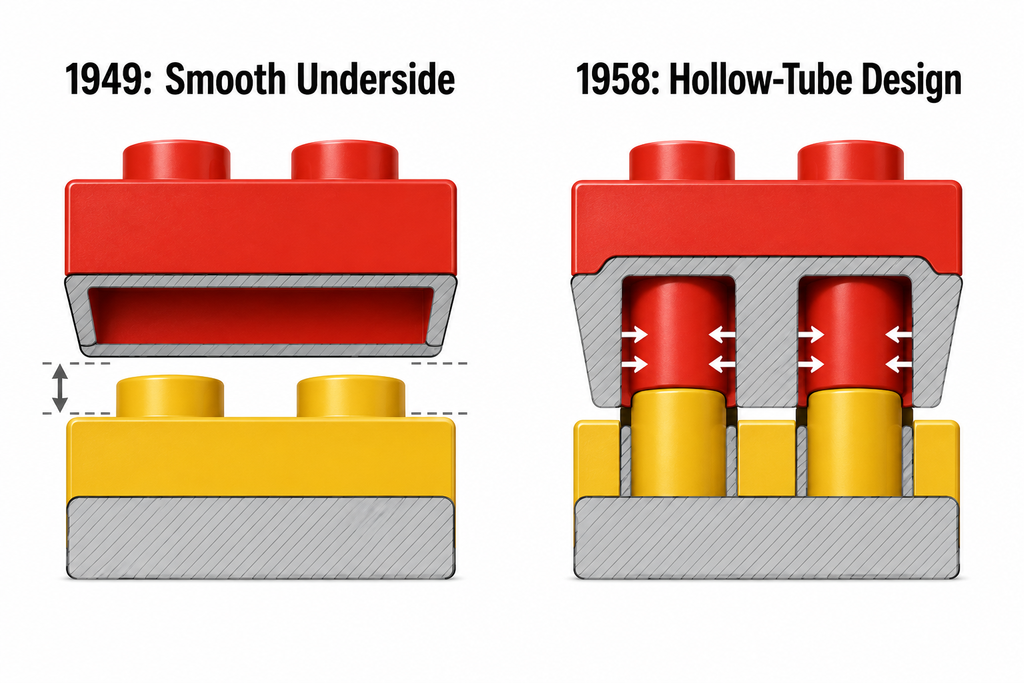
It should have been the breakthrough. It wasn’t. The bricks looked the part but didn’t grip. Stack them more than a few pieces high and the whole structure had a way of surrendering to gravity, which is a brutal thing for a toy built entirely around the promise of building.
Here’s the lesson hiding in that failure: a product can nail every visible attribute — material, color, price, distribution — and still lose on the one mechanical detail the user actually needed. Nobody buying that first brick cared that it was plastic. They cared whether it stayed put.

Why ‘Almost Right’ Wasn’t Good Enough
For close to a decade, that gap mattered. By Lego’s own account of its history, wooden toys remained a meaningful part of the company’s business well into the 1950s — a detail worth flagging as the company’s own telling of its story rather than an independently audited sales breakdown, since no outside record of the exact split has been confirmed. But the direction of the story is not in question: the plastic brick that was supposed to be the future spent years failing to earn that title.
That’s the part of the story most retellings skip, because “our revolutionary product took nine years to actually work” isn’t the kind of line that goes on a company timeline. But it should be, because it’s the realistic version of most breakthroughs. A product’s core promise has to survive real-world handling — a kid stacking, dropping, dragging a half-built tower across a rug — not just a clean demo table. Lego’s demo table looked fine. The rug did not.
1958: The Patent That Changed Everything
The fix came from Christiansen’s son, Godtfred, and it wasn’t a new color or a new shape. It was a redesign of the one part nobody outside the factory would ever consciously notice: the underside of the brick.
In 1958, Godtfred patented hollow tubes molded into the bottom of each brick, gripping the studs of the brick below through real, reliable friction. That single mechanical change is the patent behind Lego brick product permanence — not a marketing idea, not a new market, a friction fix. It solved the one problem every kid stacking blocks had quietly lived with forever: that whatever you built, you built knowing it would fall down.
That’s the part worth underlining for anyone building a product today. Sometimes the fix isn’t a new feature bolted onto the front of the thing. It’s re-engineering the single mechanism the entire product secretly depends on, and leaving everything else alone.
Permanence as the Actual Product
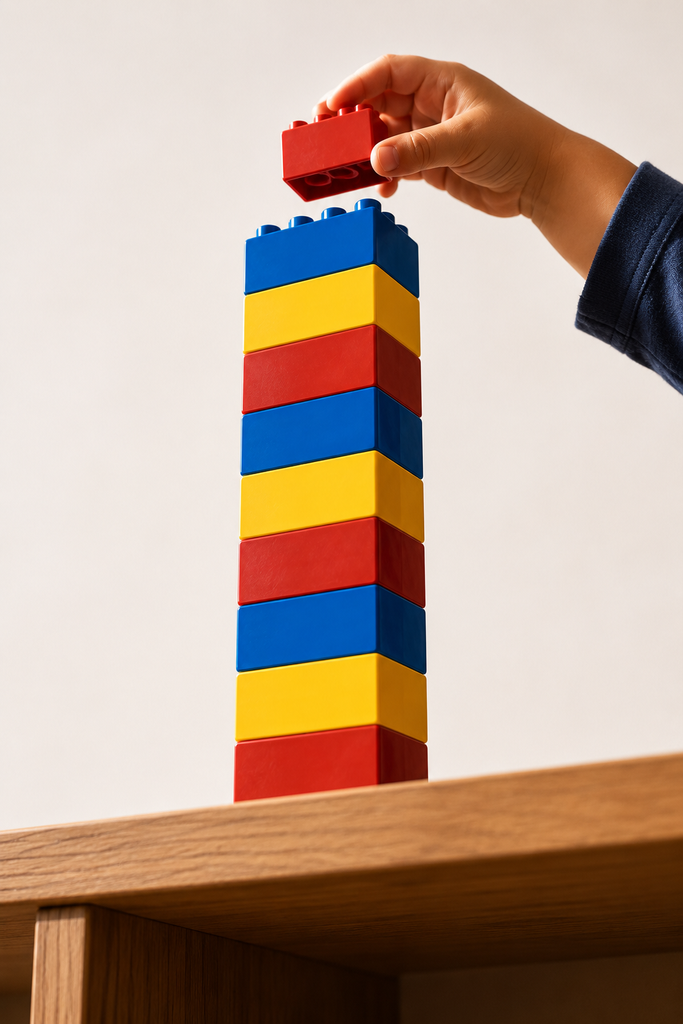
Here’s the real claim, and it’s a bigger one than “Lego fixed a design flaw.” The stud-and-tube brick introduced permanence. What a child built could now survive being carried across a room. It could sit on a shelf overnight and get added to tomorrow instead of rebuilt from scratch.
That’s not a minor engineering win — this is the moment Lego brick product permanence became the company’s real asset. Before 1958, a Lego structure was a performance: built, admired, and dismantled inside the same afternoon, like a sandcastle with a ten-minute tide. After 1958, a Lego structure was an object. It had a future. A kid could walk away from it and trust it would still be there.
If you’re building anything meant to be lived with rather than consumed once, ask yourself the same question Godtfred effectively answered: what does “permanence” mean for your product, and does your current version actually deliver it, or just look like it does?
From Near-Failure to a Multibillion-Dollar Company
By the source account of Lego’s history, that 1958 patent is the foundation under a company now described as worth over eight billion dollars — a figure that comes from the company’s own historical narrative rather than a single audited public valuation, and worth treating as a directional number rather than a precise one, but the scale of the claim is the point: a friction fix on the bottom of a plastic brick is, by that account, sitting underneath a multibillion-dollar business.
Picture the counterfactual for a second. If Godtfred had shipped a cosmetic update instead — a new color line, a licensing deal, a marketing push around the existing brick — Lego almost certainly stays a mid-tier Danish toy company, remembered the way you remember a toy you had once, not a toy you still buy for your own kids. Instead, the company bet on the boring, invisible fix, and that bet is why the brand outlived its inventor.
For founders sitting on their own version of the 1949 brick — a product that’s close, that demos fine, that just doesn’t quite hold — the metric worth watching isn’t how fast people try it. It’s whether it survives actual use. Adoption without durability is just a longer runway to the same failure. The Iceberg Model breaks down why so many products solve a surface-level problem instead of the structural one underneath it, and Lego’s decade-long detour is basically that argument played out in plastic.
The Broader Pattern: Childhood Products Built to Last
Lego isn’t the only childhood-facing industry built on a single structural insight rather than a pile of features. Friedrich Froebel opened the first kindergarten in 1837 on the belief that children weren’t small workers to be drilled but growing things to be nurtured through directed play — an idea considered radical enough that Prussia banned kindergartens in 1851 over fears it was political indoctrination in disguise. Sesame Street, over a century later, bet that children could absorb academic content the same way they absorbed advertising jingles, and proved that education and entertainment weren’t opposites at all.
Different products, different decades, same underlying move: figure out how children actually engage with the world, then build the mechanism — physical or narrative — that respects it. Lego’s mechanism happened to be a hollow plastic tube. It’s not a flashy answer. It’s the correct one, which is a different thing entirely.
Key Takeaways
- The 1949 Automatic Binding Brick looked like a breakthrough but failed on the one detail that mattered: grip.
- Nearly a decade passed before Godtfred Christiansen’s 1958 stud-and-tube patent fixed the underlying mechanical problem with friction, not a new feature.
- That redesign introduced permanence — the idea that what a child builds can survive being carried, shelved, and added to later.
- By the company’s own historical account, that patent underpins a business now described as worth over eight billion dollars, a figure best read as directional rather than precisely audited.
- The takeaway for builders: durability isn’t a feature you add later. It’s often the whole value proposition.
What the Stud-and-Tube Fix Teaches Beyond Lego
How do you actually tell, before shipping, whether your product has its own “grip problem” like the 1949 brick did?
Watch what happens under real, repeated use rather than a clean demo — a demo table doesn’t reveal a grip problem, a kid dragging a half-built tower across a rug does. The practical version: find the single mechanism your whole promise secretly depends on, then stress-test just that one thing under the worst realistic handling, not the best-case pitch scenario.
Nine years is a long gap between a flawed launch and the fix — would a company survive that today, against faster competitors?
Less likely, and that’s a real limitation of drawing a straight lesson from this story. Lego operated in a slower-moving, less-competitive toy market with no venture-backed rival racing to out-execute the fix first. A modern startup with the same nine-year gap between “close” and “actually works” would very likely lose the category to someone else before Godtfred’s equivalent patent ever got filed.
Is “permanence” always the right value proposition, or are there products where the opposite — impermanence — is actually the point?
Plenty. Sandcastles, fireworks, a limited-run pop-up, or a 24-hour social media story all sell precisely because they don’t last — the scarcity of the moment is the product. Permanence was the right fix for Lego because its promise was specifically about building something durable; it would be the wrong fix for something whose entire appeal is that it’s fleeting.
The piece connects Lego to Froebel and Sesame Street — what’s actually different about Lego’s version of the pattern?
The other two solved an access or format problem — Froebel built a space for existing curiosity, Sesame Street borrowed an existing attention mechanic. Lego’s problem was purely mechanical and hidden: the underside of a brick nobody was consciously looking at. It’s the only one of the three where the entire fix was invisible to the end user by design, which is exactly why it took so long for anyone to diagnose.
The Real Lesson
Lego didn’t win because it made a colorful plastic toy. Every competitor in 1949 could do that. Lego won because, nine years late, it fixed the one mechanical detail its entire promise depended on — and then let that fix quietly compound for decades. If you’re building something right now that “mostly works,” the Lego brick’s decade in limbo is worth remembering: almost-permanent isn’t a milestone. It’s just a longer way of saying not yet.
Sources
- The Human Constant — The Age of Why
- Claim that the Automatic Binding Brick (1949) failed to hold together well enough to build ambitious structures, per the source excerpt
- Godtfred Christiansen’s 1958 patent for hollow-tube stud-and-tube brick design
- Claim that Lego is ‘now worth over eight billion dollars,’ as stated in the source material, not independently verified against a current audited valuation
- Ole Kirk Christiansen founding Lego in 1932 as a Danish carpenter during the Great Depression
- Claim that Friedrich Froebel opened the first kindergarten in Bad Blankenburg in 1837
- Claim that Prussia banned kindergartens in 1851 over fears of political/socialist indoctrination
- Claim that Sesame Street was built on the hypothesis that children absorb academic content the way they absorbed advertising jingles
