



















































On May 2, 2023, U.S. Surgeon General Vivek Murthy released an 82-page advisory with a title that reads more like a diagnosis than a report: “Our Epidemic of Loneliness and Isolation.” Buried in it is a number that should stop any builder mid-scroll — chronic social isolation raises an older adult’s risk of developing dementia by roughly 50%. That’s not a wellness statistic. That’s a demographic-scale medical risk factor, sitting on top of a population wave that, quietly, already arrived: sometime around 2018, people over 65 outnumbered children under 5 globally for the first time in recorded history — not “by 2030,” a milestone some sources still describe as approaching, but already behind us, and the gap has widened every year since. The eldercare tech gap isn’t a future problem. It’s a market that’s already trillions of dollars deep and still being built for the wrong decade of someone’s life.
Key takeaways
- Chronic loneliness in older adults is a measurable dementia risk factor, not just a quality-of-life issue — the Surgeon General’s 2023 advisory put a number on it: roughly 50% higher risk.
- Dementia alone costs the global economy about $1.3 trillion annually today, with 55 million people currently living with it — a figure expected to reach 139 million by 2050.
- The over-50 U.S. economy AARP once sized at $8.3 trillion has already grown to $12.5 trillion by 2024 — most builders are still working from the old number, if they’re working from a number at all.
- The practical takeaway: if your product’s total addressable market feels smaller than it should, check whether you’ve quietly excluded the fastest-growing, best-capitalized demographic in the world because you assumed it wasn’t your user.
The loneliness epidemic is a clinical risk, not a mood problem
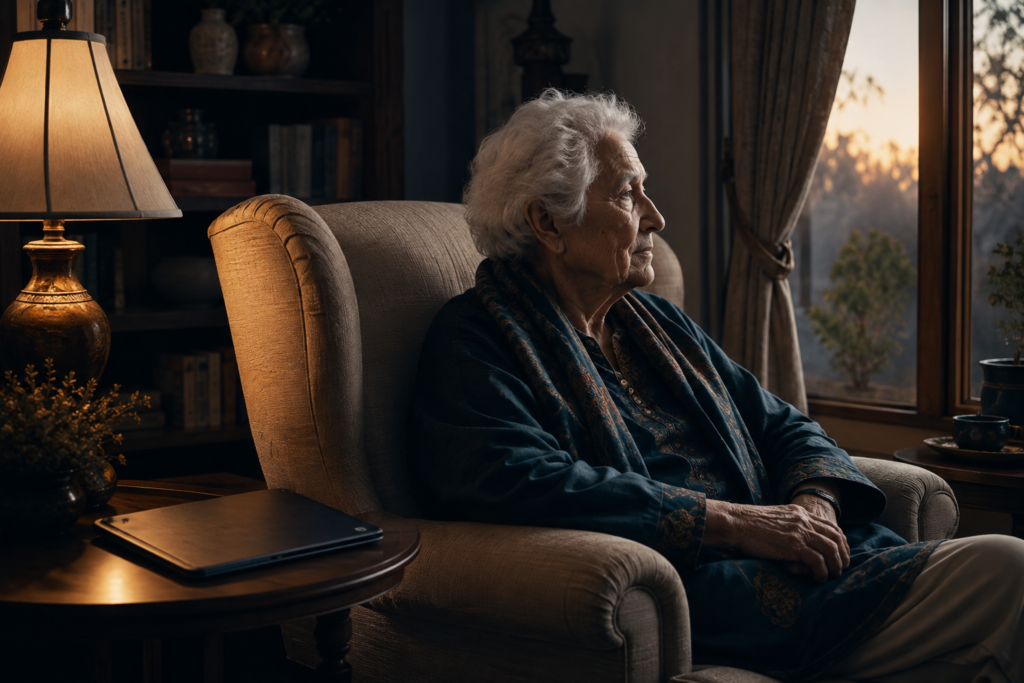
The Surgeon General’s advisory didn’t just flag loneliness as unpleasant — it documented that its physical health effects are comparable to smoking up to 15 cigarettes a day, with dementia as one of the specific, measurable consequences for older adults. That reframes the entire senior-living industry’s founding assumption. The traditional nursing home model — geographically removed from families, age-segregated, run on institutional schedules — was built to solve a physical safety problem. It solved that one. In the process, it created a psychological one it was never designed to address: an inadvertent paradox where the facilities meant to protect older adults are often the exact places engineering their isolation.
Loneliness, in other words, isn’t a soft problem sitting outside the healthcare industry’s real business. It’s inside it, generating downstream cost, and almost nobody is pricing it as the clinical risk factor it actually is.
The $1.3 trillion problem, sized correctly
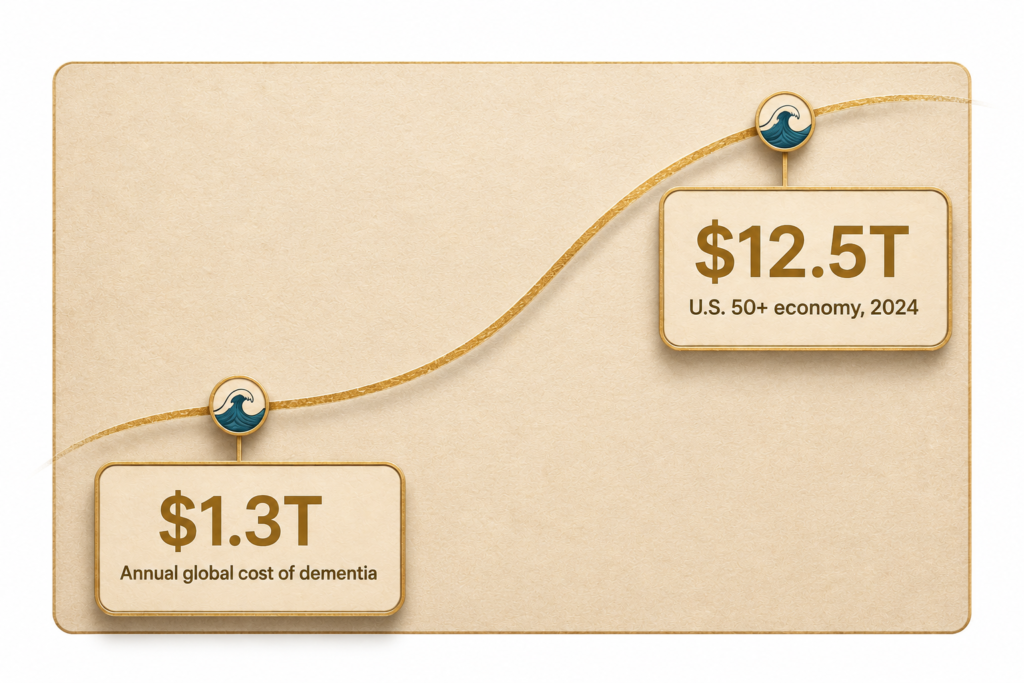
Here’s where the title earns itself. Dementia currently affects approximately 55 million people worldwide, a number projected to reach 139 million by 2050 as the population ages. The direct global economic cost of that disease alone — care, lost productivity, medical spending — runs to roughly $1.3 trillion a year, right now, not as a future projection.
Layer the demographic wave on top of that single-disease number and the picture gets bigger fast. AARP’s often-cited estimate of the U.S. “longevity economy” — Americans 50 and older — put that group’s annual economic activity at $8.3 trillion in 2018. If you’ve seen that figure quoted recently, it’s already out of date: by 2024, the same measure had grown to $12.5 trillion, large enough to rank as the world’s third-largest economy behind only the U.S. and China outright. Most people building for “the eldercare market” are still sizing it off the smaller, older number, when the real one has grown by half in six years.
That’s the eldercare tech gap in one sentence: a market that’s simultaneously $1.3 trillion in unaddressed medical cost and $12.5 trillion in active spending power, and an industry still treating it as a rounding error next to whatever’s being built for 25-year-olds this quarter.
Why elder tech keeps failing the people who need it most — the eldercare tech gap, explained
Most consumer technology follows the same path: designed for the young and middle-aged first, then reluctantly adapted for older users through larger fonts and simplified menus. That adaptation mentality is the actual mechanism behind the eldercare tech gap, and it reliably produces inferior products — not because the underlying technology is wrong, but because “make it bigger” isn’t the same exercise as “design for a different phase of life with its own commercial logic.”
The counter-example is worth naming directly: ElliQ, a care-companion device from Intuition Robotics, launched commercially in 2022 built specifically around proactive, empathetic interaction for older adults living independently — not a repurposed tablet app with a bigger font, a device conceived from the ground up for that phase of life. It’s a useful proof point, not a fully proven market yet — the AI-companion category for elders is still young, and market-size estimates for it vary enormously across research firms depending on how narrowly “companion robot” is defined, from the low hundreds of millions to several billion, so treat any single precise figure there skeptically. What’s not in question is the direction: products built for elder life as its own category, not a diminished version of middle age, are still the exception rather than the norm across the industry.
This is the same submerged-need pattern our Iceberg Model piece covers — the visible product (a monitoring app, a senior-living unit, a companion device) is never the whole story; the real thing being purchased is dignity, autonomy, and the ability to stay connected on your own terms. And it’s the same identity-driven-spending mechanism we traced through baby formula and sneakers in our piece on markets that look nothing alike but sell the same underlying need — different life stage, same pattern: the literal product category is rarely where the real market size actually comes from.
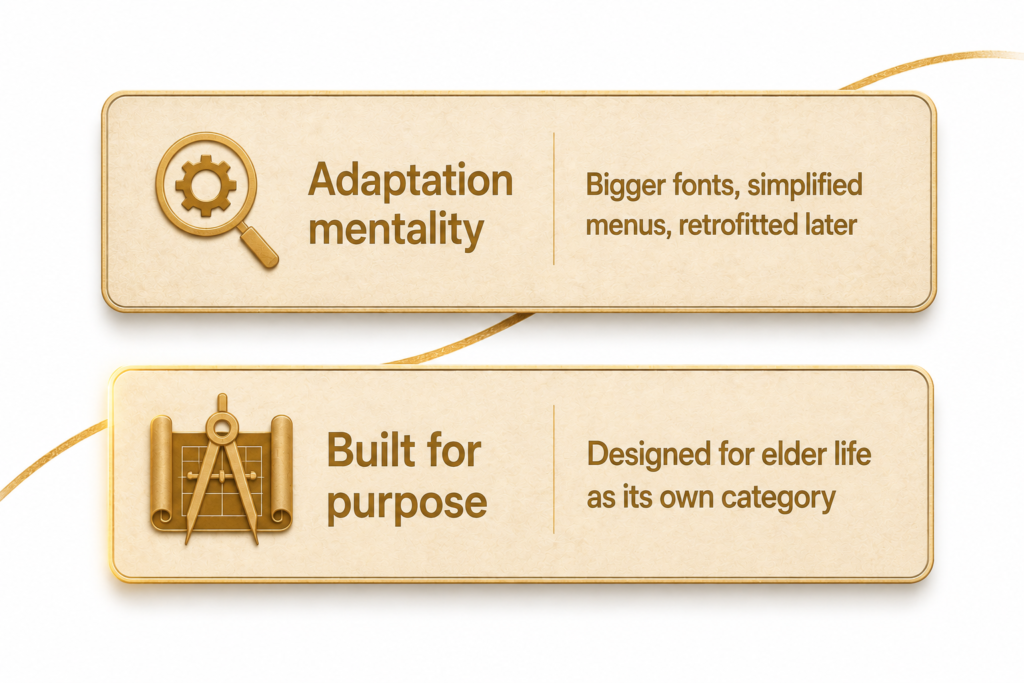
What ‘Built for Purpose’ Actually Looks Like
Is ElliQ the only real example of ‘built for purpose’ elder tech, or are there others?
It’s the clearest single example cited here, but the more useful takeaway isn’t the specific device — it’s the pattern: a product conceived from the ground up for elder life as its own category, not a repurposed, bigger-font version of a younger person’s app, is still rare enough industry-wide that one device is notable. The gap itself is the opportunity, not ElliQ specifically.
Didn’t the “65-outnumbers-under-5” crossover happen already — why do some sources still say “by 2030”? Different sources describe different milestones. The under-5 crossover already happened, around 2018, per UN population data. Some 2030-dated projections refer to a related but distinct milestone — the point at which the 65-and-over population overtakes a different comparison group (children under 10, or the total under-18 population, depending on the source). Worth checking which comparison a given “2030” claim is actually making before citing it.
Is ElliQ representative of a real market yet, or a niche example? More proof-of-concept than proven mass market right now — it’s a real, commercially available product with real adoption, but the AI-companion-for-elders category as a whole is still small relative to the broader eldercare economy. Its value here is as a directional example of what “built for purpose” looks like, not a claim that the category has already scaled.
Try this
Pull up your own product’s user personas. If there’s no persona over 65, ask why — not as a diversity checkbox, but as a market-sizing question: you may be excluding a demographic that’s already outspending the group you did design for. If you do have an older-adult persona, check whether their version of the product is a genuine design decision or a retrofit of the same interface with a bigger font. That difference is the entire eldercare tech gap in miniature.
Sources
- Adapted from The Human Constant, Chapter 10 — “The Long Wisdom”
- Our Epidemic of Loneliness and Isolation — U.S. Surgeon General’s Advisory (HHS)
- Dementia — WHO fact sheet
- Age Structure — Our World in Data
- Longevity Economy® Outlook: Economic Impact of Americans 50-Plus — AARP
- Intuition Robotics Launches ElliQ for Commercial Sale — PR Newswire

Leave a Reply
You must be logged in to post a comment.
Show Comments