





















































In 2004, an Amazon software engineer named Charlie Ward was annoyed. He kept having to click an extra button to qualify for free shipping on orders over $25. So he dropped a suggestion into Amazon’s internal idea system: what if customers just paid one flat fee at the start of the year, and shipping was free for everything after that? Most suggestion-box ideas die quietly, filed and forgotten. This one reached Jeff Bezos. He pulled a group of executives together at his Medina home that November and told them to have a real proposal ready within months. Amazon Prime launched on February 2, 2005, at $79 a year. This is a story about internal ideas as an innovation channel — and about exactly how rare it is for one to actually survive the trip from a suggestion box to a CEO’s desk.
Key takeaways
- Amazon Prime started as an annoyed engineer’s suggestion-box complaint about a shipping-fee button, not a strategic bet from leadership.
- The idea’s survival wasn’t luck — it required someone senior to actually be monitoring the suggestion box, and a fast path from “interesting idea” to “real proposal.”
- Most organizations have a suggestion box. Almost none have the second part: a channel that gets a good idea in front of someone who can greenlight it within months, not years.
- The practical takeaway: if you want your own team’s suggestion box to matter, audit what actually happens to an idea after it’s submitted — not whether the box exists.

The pattern behind Prime
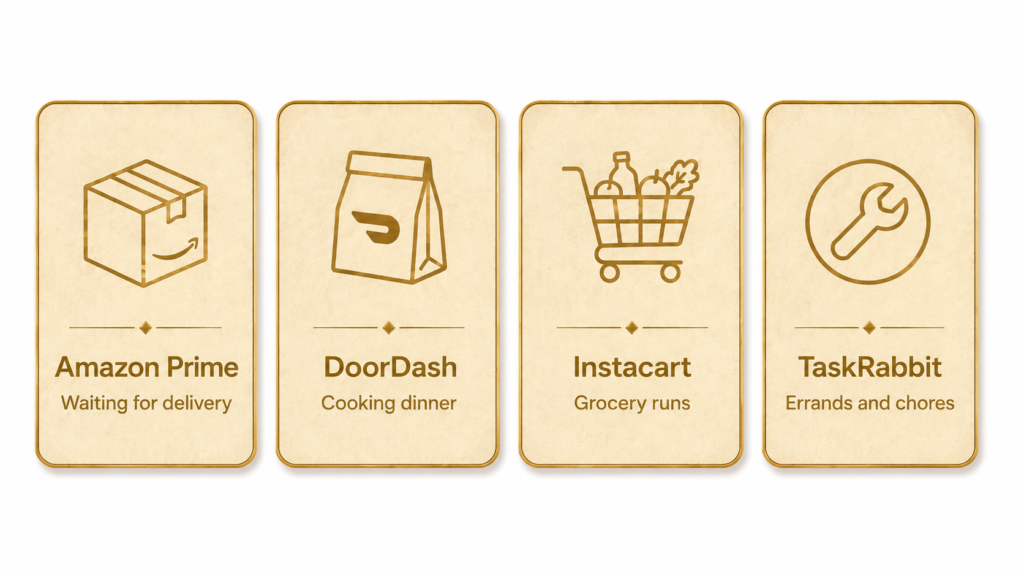
Prime wasn’t really about shipping. It was about time. Amazon’s most valuable customers weren’t the ones counting pennies on delivery fees — they were adults juggling jobs, kids, and mortgages, for whom a few saved days mattered more than a few saved dollars. That’s the same insight underneath DoorDash, Instacart, and TaskRabbit: each took one specific adult task and automated or outsourced it. None of them invented the idea that time is an adult’s scarcest resource. What changed in the early 2000s was that the technology to act on that insight at scale finally existed.
The real innovation channel isn’t the box
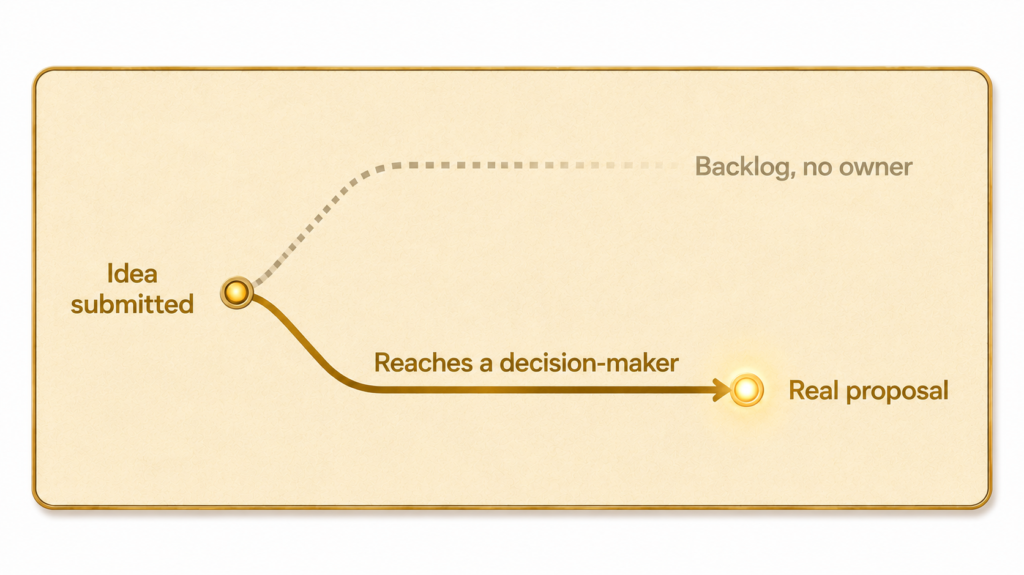
Here’s the part of the story that gets skipped over: most companies have some version of an internal suggestion system, and almost none of them produce an Amazon Prime. That’s not because employees at other companies have worse ideas. It’s because the box itself isn’t the innovation channel — what happens after submission is. At most companies, an idea like Charlie Ward’s gets logged, maybe acknowledged, and then quietly dies somewhere between an inbox and a backlog nobody owns.
What made this one different was two specific things, not one. First, someone senior enough to greenlight real work was actually reading the box — Bezos monitored it directly, rather than delegating it to a system that filtered ideas before they reached anyone with authority. Second, when he found something worth pursuing, there was a fast path to a real proposal: a meeting within weeks, a deadline of months, not a review cycle measured in quarters. Most organizations have neither of those. They have the box. They don’t have the channel. (This is the internal, organizational mirror of a pattern we’ve covered before — see our Founder Pain as Market Signal piece for what it looks like when the person with the idea and the person with the authority to act on it are the same founder.)
Build the channel, not just the box
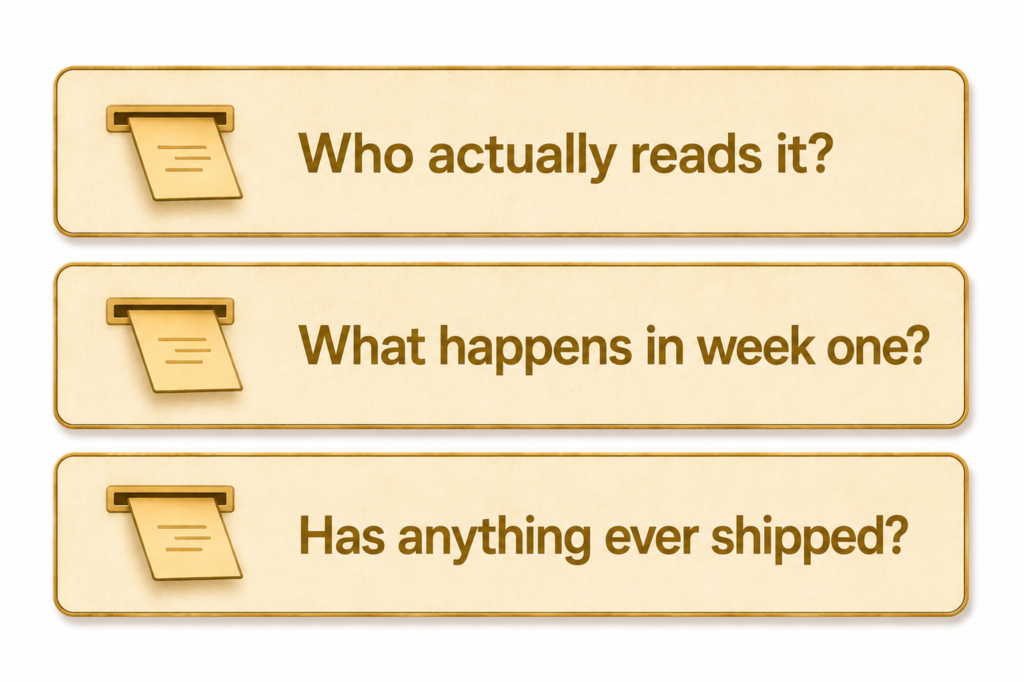
If you run a team or a company, the audit here isn’t “do we have a way for people to submit ideas.” Almost everyone does. The real questions are narrower: does anyone with real authority actually read what comes in, on a predictable cadence, not just when someone remembers to check? When something looks genuinely promising, is there a defined next step — a meeting, a deadline, an owner — or does it sit until someone champions it themselves? And critically: has an internally-submitted idea ever actually shipped at your company, or does the box exist mostly for morale?
If the honest answer to that last question is “we’re not sure,” that’s the actual finding. The suggestion box isn’t the innovation channel. The channel is whatever happens in the weeks after someone submits something good — and at most companies, nothing does. (For a more systematic version of turning a raw idea into something real, see our Six-Step Framework piece.)
Could This Happen at Your Company?
Isn’t this just a story about Bezos being unusually hands-on? Partly, but the generalizable lesson isn’t “have your CEO read everything” — it’s that someone with real authority has to be in the loop early, and there has to be a fast, defined path from “interesting” to “real proposal.” That’s an organizational design choice, not a personality trait.
Does this only work at a company Amazon’s size? It’s actually easier at a smaller company — fewer layers between a suggestion and a decision-maker. The failure mode Amazon avoided (an idea dying in an unowned backlog) gets worse as headcount grows, not better.
What if leadership genuinely doesn’t have time to read every submission? Then the fix isn’t “read everything” — it’s a lightweight triage step with a real deadline, so promising ideas surface within weeks instead of relying on someone senior stumbling across them by chance.
Try this
Pull up whatever internal idea or feedback channel your team already has. Find the most recent genuinely good suggestion in it. Now trace exactly what happened to it after submission — who saw it, when, and what happened next. If you can’t answer that in under a minute, you don’t have an innovation channel. You have a box.
Sources:
- Adapted from The Human Constant, Chapter 8 — “The Weight of Everything”
- 10 years later, Amazon releases every Prime number — except the one everyone cares about — GeekWire
- 10 years later, Amazon celebrates Prime’s triumph — The Seattle Times