




















































The First Generation Born Online Has No Way to Own Their Own Identity

Emma Raducanu turned eighteen on November 13, 2020, deep inside a pandemic that had closed her school and cancelled the version of adolescence everyone before her had taken for granted. She spent those formative months connected to friends through screens rather than shared rooms. Ten months later, ranked 150th in the world and playing in only her second Grand Slam main draw, she won the 2021 US Open without dropping a single set — reportedly the first qualifier, male or female, to win a major title in tennis’s Open Era. Her social media following reportedly grew explosively in the days that followed, though the exact scale and speed of that spike isn’t something any single authoritative source has pinned down. What’s not in dispute is the shape of the moment: a teenager’s identity, formed largely on screens, got multiplied by algorithms faster than she — or anyone — could manage it.
That’s the sharp edge of a much bigger, much less telegenic problem: digital identity sovereignty. Who owns the record of who you are, when that record started accumulating before you could consent to it?
Emma Raducanu and the Birth of a New Human Phase
Raducanu is useful here not because her story is unique, but because it’s legible. Most of her generation’s screen-mediated adolescence happens without a Grand Slam trophy attached, which means it happens without anyone noticing. She’s the visible tip of an otherwise invisible shift: a cohort whose sense of self was built, tested, and broadcast through platforms before they had the tools to manage what that broadcast would mean for them long-term.
Strip away the trophy and the ranking, and what’s left is the actual condition: adolescence lived in public, curated by systems the adolescent didn’t design and can’t opt out of.
What Is the Digital Native Phase?
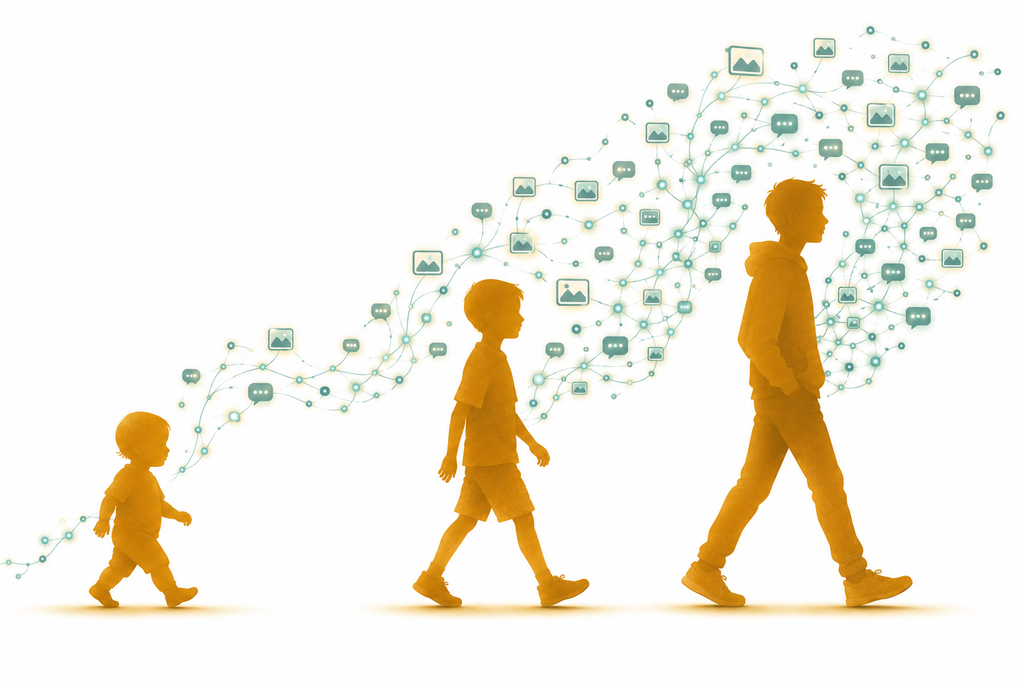
Call it the digital native phase — a genuinely new developmental condition, not a rebranded version of the adolescence your parents worried about. It’s defined by persistent, algorithmically curated identity starting in early childhood. Not “kids use the internet a lot.” Something structurally different: a self that exists, from the start, as data being shaped by systems optimized for engagement rather than development.
Previous generations of “kids these days” panics — comic books, television, video games — involved media kids consumed. This is media that consumes and reshapes them back, continuously, through recommendation engines with no stated obligation to their wellbeing.
Why This Generation Has No Precedent to Learn From
A child born in 2010 has never had an offline self to return to. There’s no “before,” no baseline the way a Gen Xer might remember childhood before the internet existed as a daily presence. That absence of a “before” is the whole problem in miniature: there’s no prior generation’s coping model to borrow, no established law built for this exact situation, no parenting wisdom that transfers cleanly.
Parents keep reaching for their own adolescence as a map. It doesn’t work. You cannot navigate a lifelong algorithmic footprint using instincts formed by a landline, a Trapper Keeper, and maybe a dial-up modem. What’s needed instead is new literacy — specific, teachable skills — not nostalgia dressed up as rules.
The Three Missing Needs: Literacy, Sovereignty, Wellbeing
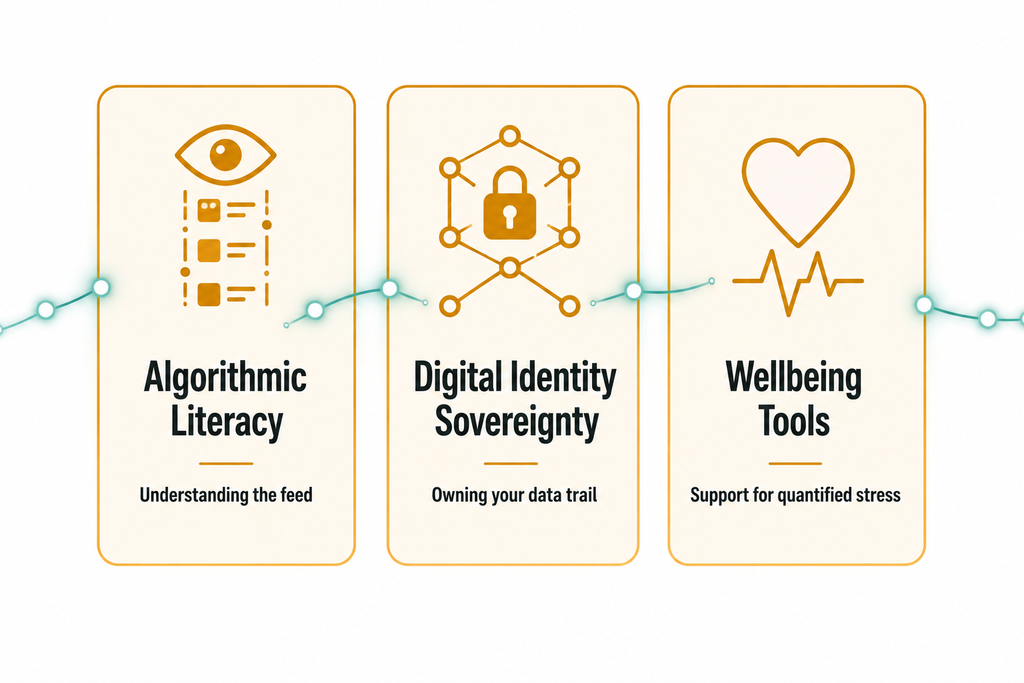
The digital native phase generates three distinct needs, and treating them as one vague “screen time” problem is exactly how you fail to solve any of them:
- Algorithmic literacy — understanding that a feed is not a neutral window onto the world but a system making constant, invisible choices about what you see and, by extension, who you become.
- Digital identity sovereignty — the ability to see, control, and ultimately own the data trail that constitutes your public self.
- Psychological wellbeing tools built specifically for the stress of living under quantified, metric-driven social feedback — likes, follower counts, algorithmic reach — that older mental-health frameworks were never designed to address.
These are three separate design problems requiring three separate sets of tools. A screen-time timer solves none of them.
This same three-part gap — something a $500B childhood industry has had two decades to address and largely hasn’t — shows up again when you look at why the childhood industry still can’t fix learning, play, or kids’ mental health: the money exists, the incentives to solve it properly don’t.
A Useful Parallel: How Other New Life Phases Reveal Unmet Needs
This pattern isn’t new, even if the digital native phase is. New human conditions keep outrunning the institutions built for older ones.
Take the Longevity Phase: the centenarian population is reportedly the fastest-growing demographic across many developed countries, and people are increasingly spending decades beyond traditional retirement age in reasonably active health. Financial products built around a couple of decades of retirement weren’t designed with that kind of extended runway in mind — an industry gap that’s been widely discussed rather than precisely quantified, and it’s fair to hold that claim loosely rather than as a hard fact about every product on the market.
Or the Climate Anxiety Phase: a study published in The Lancet Planetary Health in December 2021 surveyed 10,000 young people aged sixteen to twenty-five across ten countries and reportedly found 59% very or extremely worried about climate change, with three in four saying the future felt frightening. That’s not a passing mood. It’s a chronic condition existing products weren’t built to address.
The pattern holds: retirement products weren’t built for forty-year retirements, mental-health frameworks weren’t built for climate dread, and identity infrastructure wasn’t built for a lifelong, involuntary data trail. Institutions catch up slowly. Kids don’t get to wait for them.
Ownership Without Consent: The Core of the Sovereignty Problem
Here’s the actual failure mode, stated plainly: children’s data, images, and behavioral profiles get captured and monetized before they’re old enough to consent to any of it, let alone control the narrative that gets built from it.
A toddler’s photos land in a platform’s training data. A ten-year-old’s viewing habits get fed into a recommendation engine that will still be shaping their feed at twenty-five. None of that required their agreement, because none of it was designed to ask.
Sovereignty, in this context, means something specific: the ability to see your own data record, edit it, and exit it. Most major platforms now offer download tools and some deletion options for account holders — that much is real and improving. What’s much less settled is whether a minor, or a parent acting for them, can meaningfully audit and unwind everything a platform’s ecosystem of trackers, partners, and ad networks has already inferred about them. That gap — between “you can download your posts” and “you can actually own your inferred profile” — is where sovereignty currently breaks down.
What Parents and Institutions Can Actually Do Now: Raising Kids Online Without a Map
Picture a parent sitting down with a thirteen-year-old and actually walking through a platform’s privacy settings together — not lecturing about screen time, but opening the data-download tool and looking, line by line, at what’s been collected. Most parents have never done this. Most kids have never been asked to. Raising kids online means starting here, not with another rule.
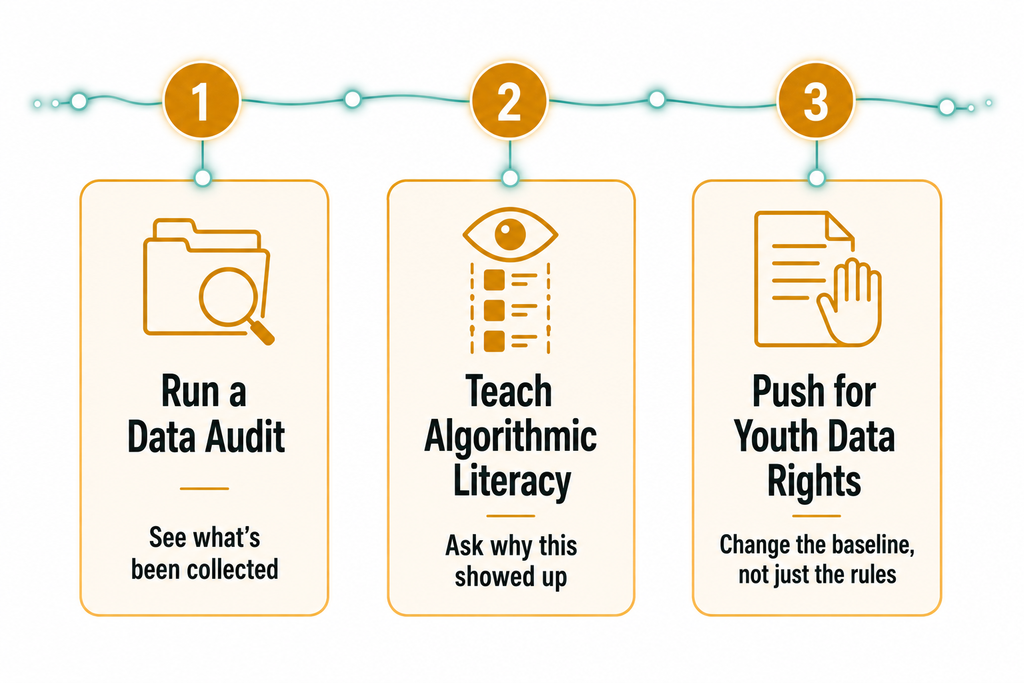
That’s the starting move, and it’s more useful than another rule about bedtime phone bans:
- Run a data audit. Use the platform’s own export tools to see what’s actually been collected. It’s usually more than anyone expects, and seeing it is the first step toward treating it as something to manage.
- Teach algorithmic literacy early, and concretely. Not “the algorithm is watching you” as an abstraction, but sitting down and asking: why did this specific video show up? What did clicking it just teach the system to show next?
- Push for youth data rights, not just parental controls. Controls put the burden on individual families to manage a structural problem. Legislation and platform-level defaults change the baseline for everyone, which is the level the problem actually operates on.
None of this fixes digital identity sovereignty overnight. But it’s the difference between treating a generation’s defining condition as something to manage deliberately versus something that just happens to them while the adults argue about screen time.
Raising a Kid in the Algorithm Era
What does digital identity sovereignty actually mean?
It’s the ability to see, control, and meaningfully own the data trail — photos, behavior, inferred preferences — that platforms build into a profile of who you are, rather than having that profile exist entirely outside your control.
Is the digital native phase the same thing as being a “digital native”?
No. “Digital native” used to just mean comfortable with technology. The digital native phase describes something structurally new: identity that’s persistently, algorithmically curated from early childhood onward, not just a comfort level with devices.
Can parents actually get their kids’ data deleted from platforms?
Partially. Most major platforms let users download and delete their own posts and account data. Far fewer offer a real way to see or remove what’s been inferred about a child by advertising and recommendation systems built on top of that data — which is the part sovereignty actually depends on.
What’s the single most useful first step a parent can actually take this week?
Sit down with your kid and open the platform’s own data-export tool together — not as a lecture, but literally looking line by line at what’s been collected. Most parents have never done this, and most kids have never been asked to; it turns the abstract idea of “the algorithm” into something concrete you can both actually see.
Key Takeaways
- The digital native phase is a genuinely new developmental condition, not a rebrand of ordinary adolescence.
- Kids born around 2010 have no offline “before” to return to, so older coping models and parenting instincts don’t transfer.
- The unsolved problem set has three distinct parts: algorithmic literacy, digital identity sovereignty, and wellbeing tools built for metric-driven stress.
- Sovereignty specifically means the ability to see, edit, and exit your own data record — most platforms only partially deliver this today.
- Concrete first moves exist now: run a data audit together, teach algorithmic literacy as a specific skill, and push for youth data rights legislation rather than relying on parental controls alone.
Raducanu’s trophy made her story visible. Most kids won’t get that kind of visibility, which is exactly why digital identity sovereignty can’t wait for a headline moment to force the issue — it needs parents and institutions building the literacy and the leverage now, before the data trail is already fifteen years long.
Sources
- The Human Constant — The Phases We Have Not Mapped Yet
- Claim that Emma Raducanu turned eighteen on November 13, 2020
- Claim that she was the first qualifier, male or female, to win a major title in tennis’s Open Era
- Claim that her social media following grew explosively in the days following her US Open win (magnitude/speed unverified)
- Claim that the centenarian population is the fastest-growing demographic in many developed countries
- Claim that a study published in The Lancet Planetary Health in December 2021 surveyed 10,000 young people aged 16-25 across ten countries
- Claim that three in four surveyed young people reported the future seemed frightening
- Claim that most major platforms offer data download and some deletion options for account holders
