


















































Why Schools Only See the Mental Health Crises That Scream Loudest

A student breaks down crying in the hallway, and within minutes there’s a counselor, a call home, a plan. A student sits quietly in the back row, turns in every assignment, and slowly stops raising their hand — and nobody calls anyone. That’s the school mental health gap in one image: the system is remarkably good at responding to what it can see, and almost blind to what it can’t.
This isn’t a story about schools not caring. It’s a story about what schools are built to notice, and what falls outside that field of vision entirely.
The Crisis Schools Are Built to Notice
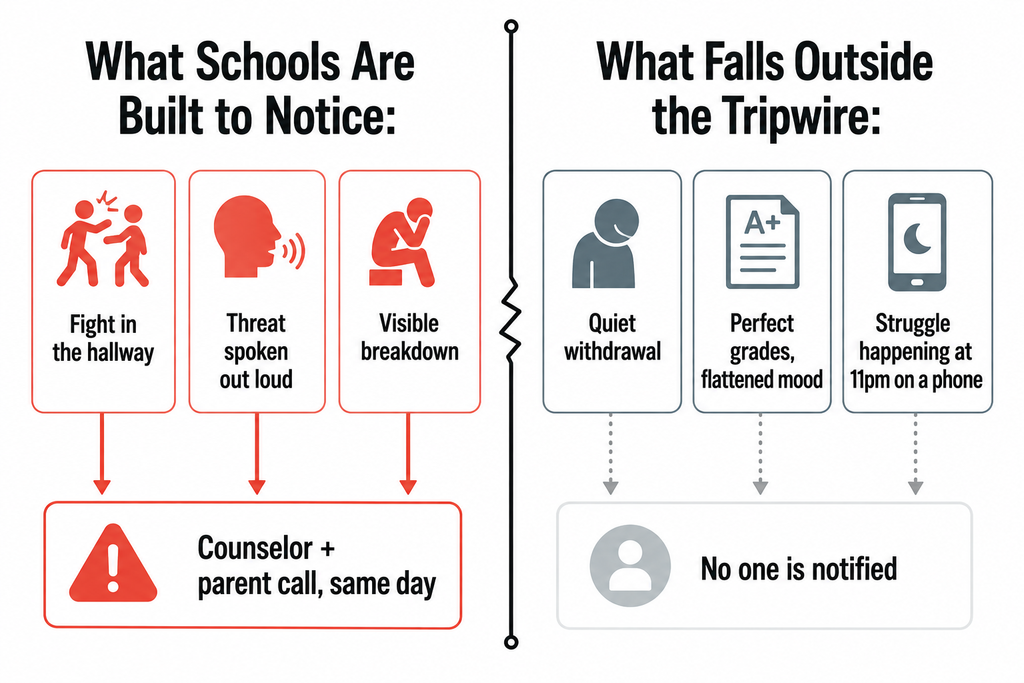
Every school has a protocol for the loud stuff. A fight in the cafeteria, a student threatening self-harm out loud, a screaming match in a classroom — these trigger a well-worn sequence: pull the student aside, notify an administrator, loop in a counselor, call a parent. The machinery exists, and when it activates, it generally works.
But that machinery is a tripwire system. It responds to disruption, not distress. And most struggling students never trip the wire, because their suffering doesn’t look disruptive — it looks like nothing at all. The kid who’s quietly falling apart but still gets B-pluses. The kid who stops eating lunch with friends but sits calmly through every class. The kid whose worst moments happen at 11 p.m. on a phone, invisible to any adult standing in a hallway.
Schools aren’t failing to build interventions. They’re building interventions for the wrong signal.
Why the Adolescent Brain Makes Struggle Invisible
Here’s the part that actually explains the gap, not just describes it. The adolescent brain isn’t wired the way an adult brain is when it comes to social pain. It cannot reliably tell the difference between social exclusion and physical danger. An adult who shows up underdressed to a work event feels a flicker of embarrassment and moves on. A teenager who wears the wrong thing to school can experience it as something closer to a threat to survival.
That’s not melodrama — it’s neurology. And it explains why the outward presentation of adolescent distress so often looks like the opposite of distress. Withdrawal reads as maturity. Overachievement reads as diligence. A teenager who’s terrified of social exclusion may respond by disappearing quietly rather than acting out loudly, because acting out risks the very exclusion they’re already panicked about.
Quiet compliance can carry exactly as much pain as visible acting-out. The difference is that one gets a hallway pass to the counselor’s office, and the other gets a gold star.
The Belonging Machine Kids Bring Into the Building
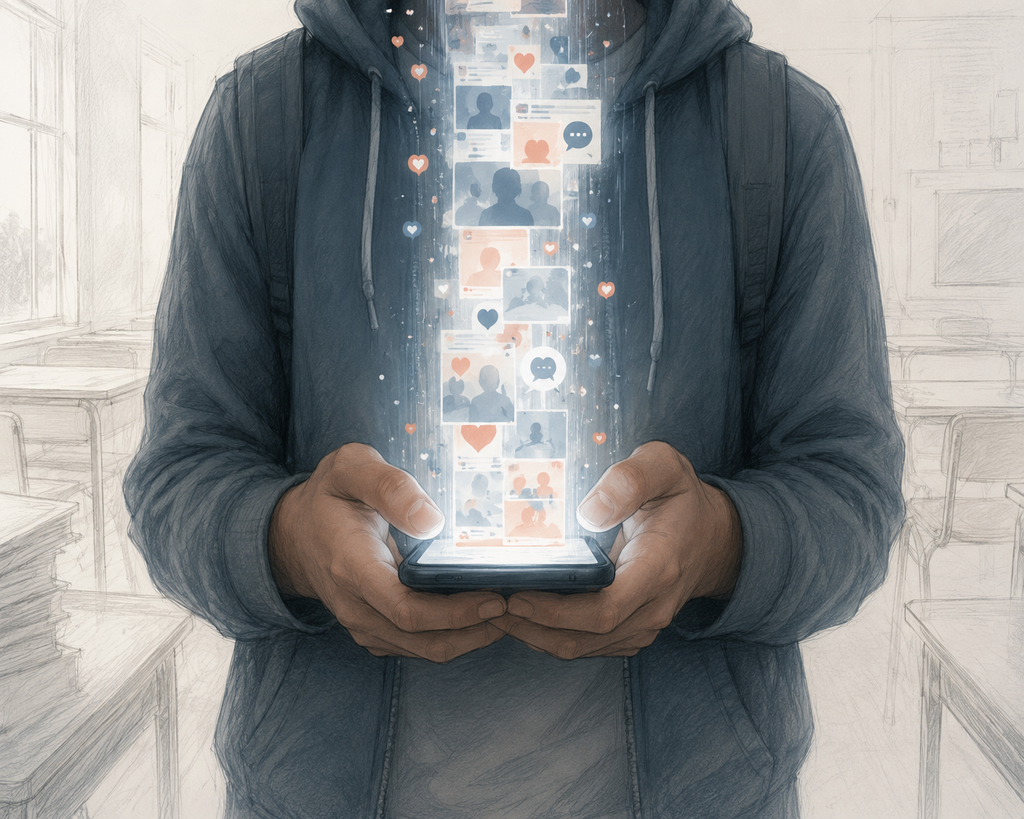
None of this starts at the school gate, and none of it stops there either. Teenagers today walk into first period carrying a belonging infrastructure in their pocket that’s been decades in the making. MTV, launched in 1981, was the first platform built to broadcast teenage identity back at teenagers. Then came MySpace, then Facebook, then Instagram, then TikTok — each iteration a more efficient machine for the same job: performing identity, signaling belonging, and harvesting social validation in return.
TikTok’s recommendation engine, which serves content matched precisely to a user’s revealed preferences, is arguably the most sophisticated belonging machine yet built. It doesn’t wait for a teenager to ask “do I fit in?” — it’s already answering, continuously, all day, whether or not anyone’s watching over their shoulder.
That matters for the gap specifically because a student who seems fine in a classroom might be having the worst social experience of their week on a device that never enters the building. Schools evaluate students against a physical, bounded environment. Teenagers now live inside a social environment with no edges — a pattern that’s part of a broader shift explored in the three life phases nobody’s built for, where growing up digitally-native reshapes adolescence itself.
What the Facebook Files Revealed About the Scale of the Problem
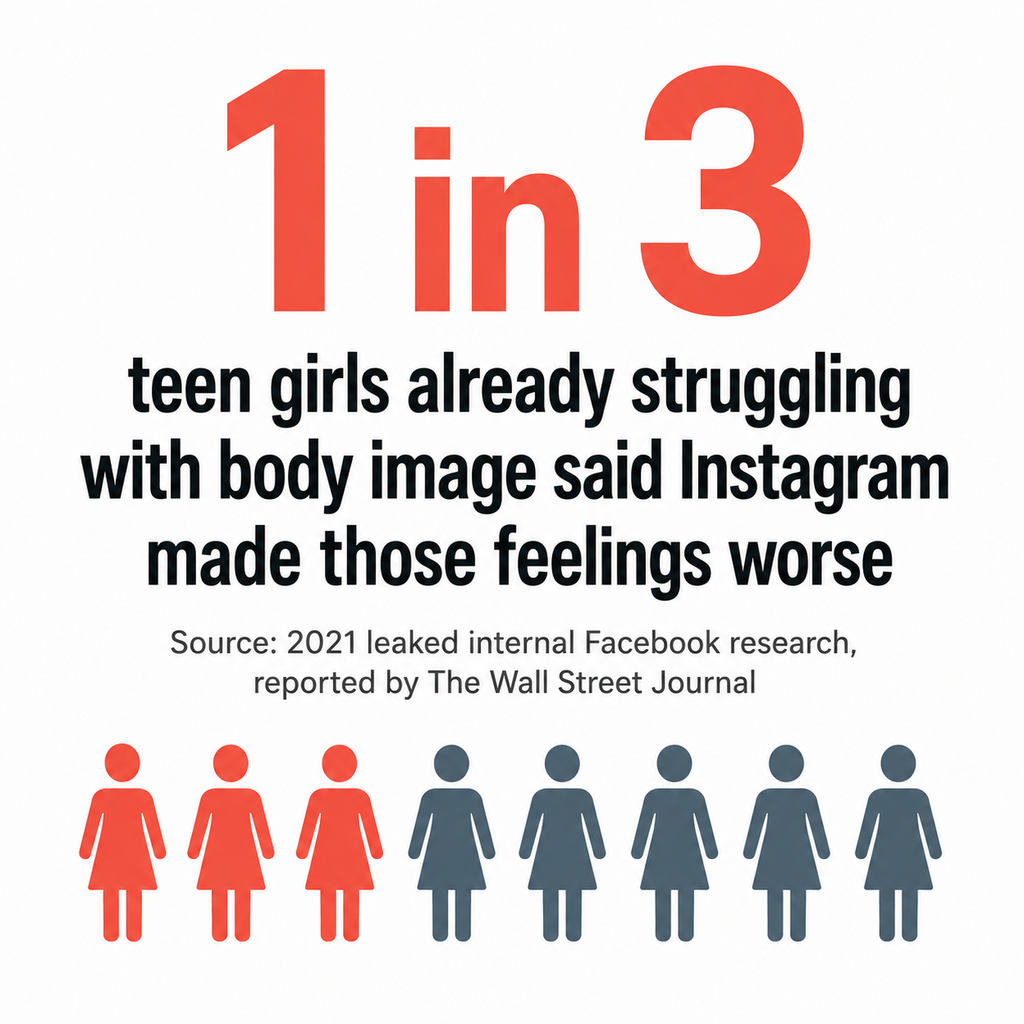
It’s worth being precise here rather than just alarmed. In 2021, leaked internal research from Facebook, reported by the Wall Street Journal, found that among teen girls who already struggled with body image, roughly one in three said Instagram made those feelings worse — not teen girls broadly, but a subset already experiencing difficulty. Meta pushed back on how that finding was characterized in press coverage, and that distinction is worth holding onto. But even the narrower, more defensible version of the finding is damning on its own: a platform’s own internal researchers documented that it was worsening something as serious as body image distress in a population already vulnerable.
Zoom out and the dollar signs get harder to ignore too. The global mental health market is projected, by various industry estimates, to approach roughly $600 billion by 2030, with a meaningful share of that growth tied to unmet adolescent psychological needs — a generation navigating belonging machinery at a scale no previous generation faced, without matching tools to manage the emotional fallout.
Put those two facts side by side and the takeaway for a school mental health gap conversation is blunt: what shows up in a counselor’s office is a fraction of what’s actually happening to students. The rest is happening somewhere schools were never built to see.
Why Loud Crises Get Resources and Quiet Ones Don’t
This isn’t a mystery once you look at how institutions allocate attention. Schools triage by visibility and liability. A student in visible crisis creates immediate legal and safety exposure — ignore it, and the consequences are obvious and severe. A withdrawn student creates no such exposure. There’s no incident report to file on a kid who’s just quietly sadder than they used to be.
So counselor time, already stretched thin across caseloads that can run into the hundreds at many schools, flows toward whoever is loudest right now. That’s not a moral failing on the part of counselors — it’s what a reactive, referral-based system produces by design. If a student has to make a scene to get help, the students least likely to make a scene are the ones least likely to get help.
The practical fix isn’t “hire more counselors and hope,” though that helps. It’s building proactive touchpoints — universal check-ins, brief wellbeing screenings built into the normal rhythm of a school year — so that a quiet student gets a moment of adult attention on a schedule, not only in an emergency.
Closing the Gap: What Schools, Parents, and Students Can Actually Do
The single most useful shift here is normalizing support before crisis, not after. Waiting for a breaking point as the entry ticket to help guarantees that the quiet strugglers, almost by definition, wait too long.
A few concrete moves that don’t require reinventing a school system:
- Talk to a school counselor early, even for something that doesn’t feel like “enough” of a problem yet. Counselors can help with concerns well below crisis threshold — that’s literally part of the job, not a misuse of it.
- Loop in a pediatrician. Physical checkups are a natural, low-stigma moment to raise mood, sleep, or appetite changes that might otherwise go unmentioned.
- Know that helplines exist for exactly this — the in-between. They’re not just for the worst moment; they’re for the moment before that.
- For caring adults, watch for the quiet stuff, not just the loud stuff: a student who used to sit with friends and now eats alone, a kid whose grades stay perfect while everything else about them goes flat, someone who’s suddenly always “fine” in the clipped way that means they’re not.
If someone in your life is a teenager currently wrestling with body image, social comparison, or online pressure, the same rule applies: support exists that doesn’t require things to fall apart first.
What Parents and Students Can Actually Do
How can I tell if a quiet student is actually struggling?
Watch for changes in pattern more than mood: withdrawal from friends they used to spend time with, sudden perfectionism that feels more like anxiety than ambition, or a flattened “I’m fine” that shows up every time. Struggle in adolescence often hides behind competence, not behind obvious sadness. This is part of why teen social media and mental health concerns are so easy for schools to miss — the visible signals just aren’t there.
How do I talk to a school counselor about a concern that doesn’t feel like an emergency?
Just say that. Counselors would rather hear about a concern early and low-stakes than only after it’s escalated. Framing it as “this might be nothing, but I wanted to flag it” is a completely normal and welcome way to open that conversation — and it’s exactly the kind of student wellbeing support systems are meant to offer before a crisis, not just after one.
Is social media the cause of the teen mental health crisis?
It’s a significant contributor, not the sole cause. The leaked Instagram research is genuinely concerning, but it measured a specific, already-vulnerable group, not teenagers as a whole. Social media functions as an amplifier of adolescent belonging pressures that have always existed — it didn’t invent the need to belong, but it did build the most efficient machine yet for exploiting it.
Key takeaways
– The school mental health gap exists because school systems are built to respond to visible crisis, not quiet distress.
– Adolescent brains process social exclusion as danger, which is why struggle often looks like withdrawal or overachievement, not acting out.
– Belonging pressure now follows students everywhere via social platforms, meaning school is only a fraction of the picture.
– Leaked internal research and market data both point to a much larger unmet need than what schools currently see.
– Closing the gap means normalizing support before crisis — counselors, pediatricians, and helplines are all reasonable first steps, not last resorts.
The next time a student in your life seems unusually fine, unusually quiet, unusually put-together — don’t take it at face value. Ask anyway.
Sources
- The Human Constant — The Belonging Wars
- Claim that James Dean died on September 30, 1955, at age 24, driving his own Porsche to a weekend race
- Claim that Rebel Without a Cause opened in theaters about four weeks after James Dean’s death
- Claim that MTV launched in 1981
- Claim that Marlon Brando wore jeans in The Wild One (1953) and James Dean wore them in Rebel Without a Cause (1955), catalyzing denim’s cultural shift
- 2021 leaked internal Facebook/Instagram research reported by the Wall Street Journal finding that roughly one in three teen girls already struggling with body image said Instagram worsened those feelings
- General claim that school counselor caseloads can run into the hundreds at many schools (unsupported specific figure, presented as illustrative)
