















































In April 1888, Alfred Nobel opened a French newspaper and found himself dead. This is the real, if less dramatic, root of the Nobel Prize obituary mistake story — a mix-up that historians can confirm happened, wrapped around a famous headline they can’t confirm at all. The paper had the wrong brother. Nobel’s brother Ludvig had died in Cannes; Alfred was very much alive to read the notice meant for someone else. Whatever Nobel felt reading it, we don’t get to know for certain — but the timeline that follows is documented, and it’s worth taking seriously on its own terms.
That distinction — what’s confirmed versus what’s legend — matters more here than in most stories, because the legend is the reason you’ve probably heard of this at all.
A Man Reads His Own Obituary
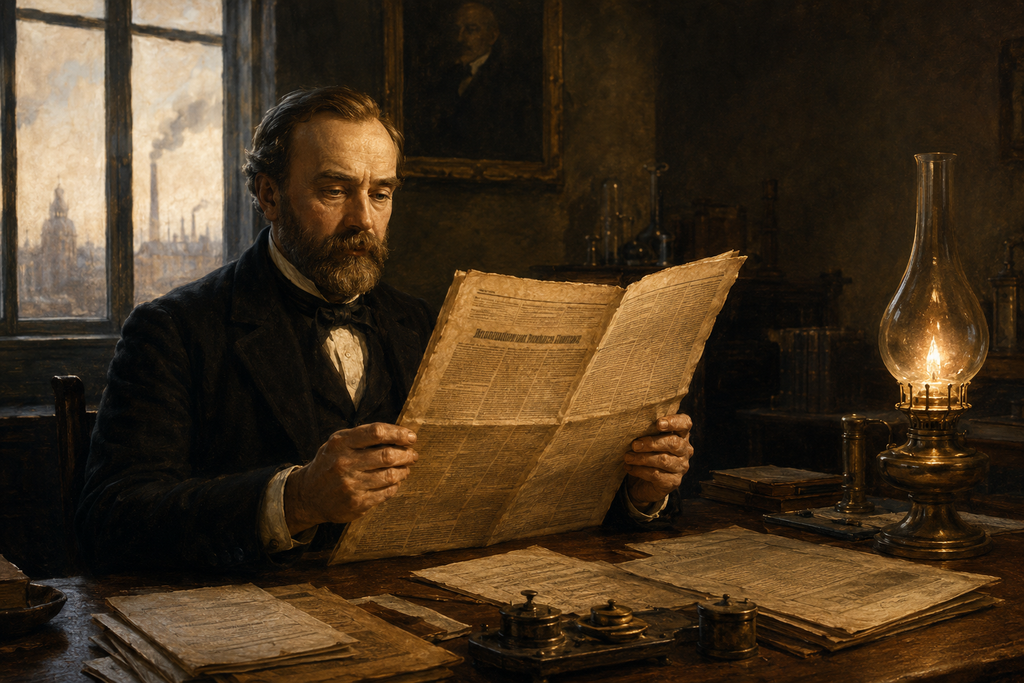
Picture the scene only in outline, because that’s all the record supports: a newspaper error, a name swapped for a brother’s, and a man forced to see, however briefly, how the world was already sizing him up. Nobel was an industrialist best known for inventing dynamite. An obituary is supposed to be the one thing you never get to read. He read his anyway.
For readers, the lesson isn’t really about Nobel’s specific reaction — it’s about what a small, correctable error can do regardless of who it happens to. A misprint, a wrong name, a moment of premature reckoning: these things get fixed on paper quickly, but they don’t always get fixed in the mind that fast. Sometimes a correction runs and the correction is still not the end of it.
What the Obituary Actually Said
Here’s where the popular version and the documented version split, and it’s important to be precise about which is which.
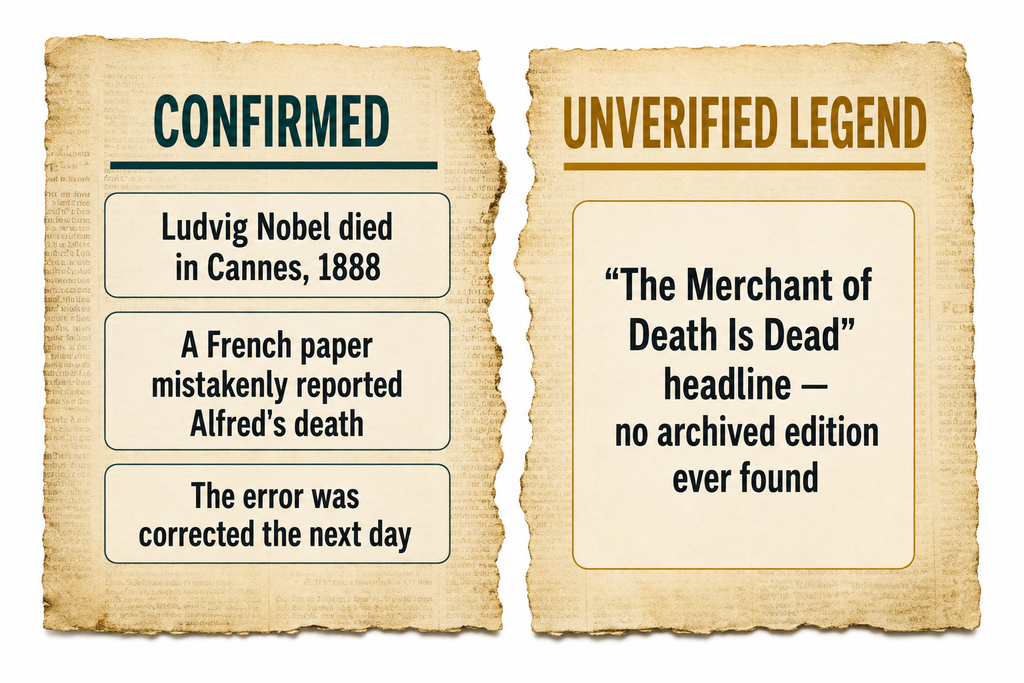
The real obituary was short and dry — a line to the effect that a man who could hardly be called a benefactor of humanity had died, described as the inventor of dynamite. According to the source material this piece draws on, it was corrected the next day once the paper realized Ludvig, not Alfred, had died.
The far more famous version — a headline reading “The Merchant of Death Is Dead” — is the part you should be skeptical of. It’s a vivid, quotable line, and it’s the version that gets repeated in speeches and listicles. But historians have never been able to verify that it actually ran anywhere. No confirmed archived edition, no citation trail back to a real 1888 newspaper page. It may be a later embellishment that got attached to a real, blander story because the real story wasn’t dramatic enough for retelling.
So: the mistaken obituary is real. The correction happening quickly is real. The “Merchant of Death” headline is, as far as anyone can currently document, folklore.
Why the Story Persists Even If the Headline Is a Myth
If the famous headline probably never ran, why does the story keep getting told with it attached?
Because the underlying incident doesn’t actually need the embellishment to be unsettling — it just needs the embellishment to be memorable. A man mistaken for dead, catching an unflattering glimpse of his own legacy while still alive to do something about it, is already a striking premise. “Merchant of Death Is Dead” just gives that premise a punchline sharp enough to survive in oral retelling, PowerPoint decks, and commencement speeches, whether or not it was ever set in actual type.
That’s the pattern with most legends: they persist not because they’re accurate but because they compress something true into a single unforgettable line. The emotional truth here — the fear of being remembered for the wrong thing — doesn’t require a verified headline to land. It just needed one, eventually, to travel.
Seven Years Later: The Will That Changed Everything
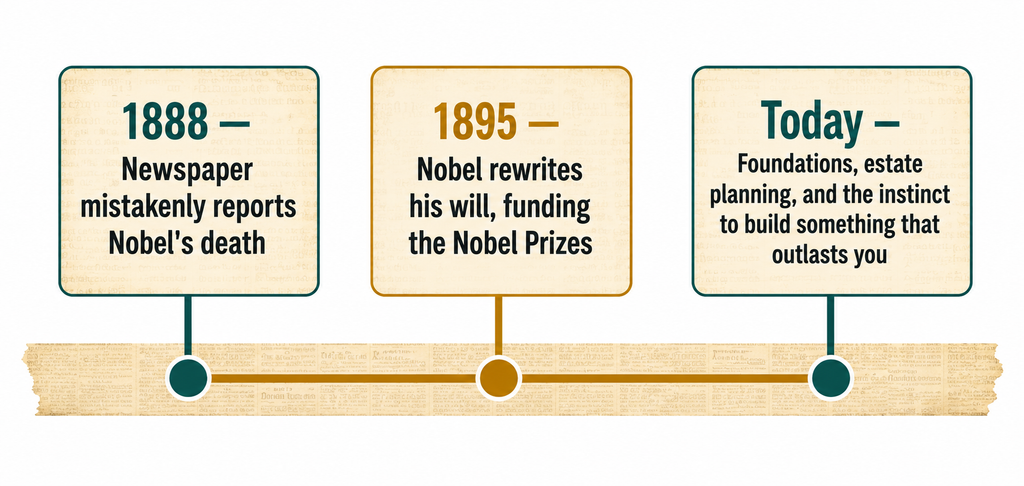
Seven years after the obituary mix-up, in 1895, Nobel rewrote his will. The bulk of his fortune was redirected into what would become the Nobel Prizes — awards that now carry his name into rooms full of physicists, chemists, writers, and peacemakers, rather than munitions catalogs.
Nobody alive can tell you definitively why he made that choice, and the honest position is that motive here is inferred, not documented. The source material is careful on this point, and so is this piece: correlation isn’t proof of causation, even when the correlation is this good a story.
But the timing is hard to wave away. A man gets an early, unflattering preview of his own eulogy. Seven years later, he rewrites the ending. If you’re the kind of person who puts off legacy planning because there’s always more runway left, that gap is worth sitting with — it wasn’t a slow, decades-long plan. It looks, from the outside, like a decision that crystallized after a jolt.
The Middle-Aged Instinct to Build Something That Outlasts You
Nobel wasn’t unique in kind, just early and extreme in degree. Somewhere in the middle stretch of a working life, a lot of people start asking a version of the same question he seems to have asked: what happens to the identity I built once I’m not around to defend it?
That question, at scale, is now an entire economic category. Philanthropic foundations, impact investing, structured estate planning — these are Nobel’s pivot rerun millions of times over, minus the dynamite and minus the newspaper mix-up. The instinct is the same: identity wants an expression that outlives the person carrying it.
This isn’t confined to fortunes the size of Nobel’s. It shows up in a fifty-year-old rewriting a will after a health scare, or a mid-career professional starting a scholarship fund instead of buying a second house. The same instinct that pushes people toward eldercare planning and long-term-care decisions for aging parents runs on this logic too — legacy isn’t just what you leave, it’s the infrastructure you build so someone else doesn’t inherit a mess. If you want a sense of how expensive that infrastructure gap actually is at a societal level, the eldercare tech market’s pricing problem is a useful place to see the same instinct playing out in dollars and unmet demand rather than in wills and prizes.
The practical angle, whether you’re 35 or 65: legacy decisions don’t usually arrive on schedule. They arrive after something knocks you sideways, and the only real choice is whether you’ve already done enough thinking beforehand that the decision, when it comes, isn’t a scramble.
Key Takeaways
- The 1888 obituary mix-up was real: a French newspaper reported Alfred Nobel’s death when it was actually his brother Ludvig who had died.
- The real obituary was short and dry, and per the source record it was corrected the next day.
- The famous “Merchant of Death Is Dead” headline has never been verified by historians as having actually run — treat it as embellishment, not documented fact.
- Seven years later, in 1895, Nobel rewrote his will to fund the prizes now bearing his name — the connection to the obituary is a plausible inference from timing, not a proven cause.
- The episode is an early, extreme version of a pattern still playing out today: middle age as the point when identity starts seeking an external, lasting expression — funding foundations, rewriting wills, building something that outlasts the builder.
What’s Actually Provable Here
Did the “Merchant of Death Is Dead” headline really run in a newspaper?
There’s no confirmed evidence that it did. Historians have not been able to verify that this exact headline appeared anywhere in 1888. It’s widely repeated but appears to be a later, dramatized addition to a real but much duller story.
Who actually died in April 1888?
Alfred Nobel’s brother, Ludvig Nobel, died in Cannes. A French newspaper mistakenly reported it as Alfred’s death instead.
Does this pattern only apply to someone with Nobel-level wealth?
No — the same instinct shows up at any scale: a fifty-year-old rewriting a will after a health scare, or a mid-career professional starting a small scholarship fund instead of buying a bigger house. The mechanism, an event that makes mortality concrete followed by a decision to build something lasting, doesn’t require a fortune, just a jolt.
Was the original obituary corrected quickly?
Yes — according to the historical account this piece is grounded in, the error was corrected the next day, once it became clear it was Ludvig, not Alfred, who had died.
If there’s one thing worth taking from a story built half on documented fact and half on a headline nobody can find, it’s this: the parts that are verifiable are usually the more interesting ones anyway. Before you repeat the dramatic version of any legacy story — your industry’s, your family’s, or your own — it’s worth asking which parts you could actually prove.
Sources
- The Human Constant — The Reckoning
- Claim that in April 1888 a French newspaper mistakenly reported Alfred Nobel’s death instead of his brother Ludvig’s.
- Claim that the real obituary described Nobel dryly as a man who could hardly be called a benefactor of humanity, inventor of dynamite.
- Claim that the ‘Merchant of Death Is Dead’ headline has never been verified by historians as having run in any publication (presented as unverified, not confirmed false).
- Claim that Alfred Nobel rewrote his will in 1895, redirecting the bulk of his fortune to create the prizes now bearing his name.
- Implied claim/inference that the 1888 obituary incident influenced Nobel’s 1895 will change (explicitly framed as unproven inference in the piece).
