


















































1.2 Billion Women, Zero Strategy: Inside the Menopause Economy

In 2013, the classicist Mary Beard sat on the BBC’s Question Time panel and made a calm, well-evidenced argument about immigration. That’s not what people remembered. One reviewer decided her looks were the real story, declaring her too unattractive for television and suggesting she be kept off it. Beard was in her late fifties, gray-haired, wearing no makeup — and she answered the same way she argued: precise, unbothered, unmoved. The exchange went well beyond a media dust-up. It became a public referendum on a question a lot of women had been asking quietly for years: what happens to a woman’s visibility once she stops looking twenty-five?
The uncomfortable answer is that middle-aged women don’t just disappear from television panels. They disappear from product roadmaps, marketing budgets, and R&D pipelines. That’s not a cultural footnote — it’s a market signal, and businesses have been ignoring it for decades. Call it what it is: the menopause economy is a market hiding in plain sight, sized in the billions, and almost nobody has bothered to build for it.
Middle Age: Where the Wellness Industry Makes Its Money
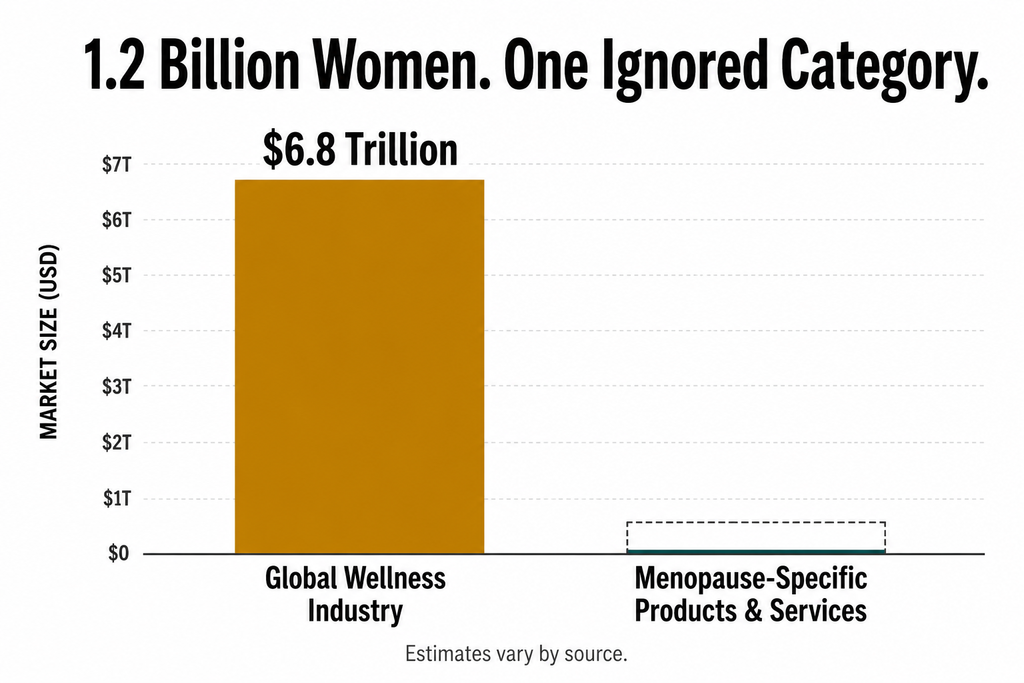
Here’s the part that makes the neglect so strange. Wellness spending isn’t thin on middle-aged customers — it’s built on them. Industry estimates commonly put the global wellness industry’s annual value at roughly $6.8 trillion, a figure that circulates widely in market reports though it’s worth treating as a directional estimate rather than an audited number. And the engine behind that spending isn’t twenty-somethings chasing six-packs. It’s people in their forties, fifties, and sixties confronting the first real evidence that the body doesn’t run forever — slowing metabolism, shifting hormones, rising cardiovascular risk.
Organic food. Fitness memberships. Preventive screenings. Anti-aging skincare. Nearly every wellness category that exists was built around one basic instinct: extend, improve, preserve what you’ve got, now that you’ve noticed you won’t have it forever.
Which makes the next fact genuinely strange, not just unfortunate. Middle-aged women consumers already prove, category after category, that they’ll spend to manage a bodily transition when someone builds the product. Menopause is the one transition nobody built the product for.
Menopause Market: 1.2 Billion Women, One Ignored Category
Menopause affects an estimated 1.2 billion women worldwide. It is universal, biological, and predictable — as reliable an event as adolescence, with comparable effects on mood, energy, cognition, sleep, and physical capacity. Doctors have documented it since at least the eighteenth century. This isn’t an emerging condition someone just discovered. It’s one of the oldest, best-studied life transitions humans have.
And yet, heading into the back half of the 2020s, it remains one of the most commercially underserved human experiences on record — a genuinely underserved market that menopause represents almost by default. A market this large, this predictable, and this well-documented should have mature, competitive product categories by now — specialized medical devices, robust workplace policy, a crowded field of consumer brands fighting for share. It largely doesn’t. That gap between “obviously enormous” and “barely served” is exactly where the opportunity sits.
Why This Gap Persists: Other Life Stages Got Built Into Industries
The frustrating thing is that middle age, as a life stage, absolutely can generate serious industries — when someone takes it seriously.
Take legacy-building. In April 1888, a French newspaper mistakenly published an obituary for the industrialist Alfred Nobel, confusing him with his brother Ludvig, who had actually died. The most dramatic version of that story — a headline reading “The Merchant of Death Is Dead” — is the one most often repeated, but historians have never been able to confirm it actually ran; it looks like a later embellishment layered onto a real, more mundane incident. What’s better documented is what came after: seven years later, Nobel rewrote his will and used the bulk of his fortune to establish the prizes that still carry his name. Nobody can say with certainty what pushed him to do it, but the timing is hard to dismiss as coincidence. That mid-life instinct — the need to leave something that outlasts you — has since become an entire philanthropy economy: foundations, endowments, impact investing, all monetizing the same psychological pivot point.
Career reinvention tells a similar story. It’s now common wisdom that people rarely stay in one career from graduation to retirement, though the precise, oft-repeated claim that the average professional changes industries “multiple times” doesn’t trace back to a single verifiable study, so it’s worth treating as a widely believed pattern rather than a hard statistic. What’s not in dispute is that an entire industry has grown up around the idea: executive MBA programs, professional certifications, life coaching, career-transition platforms. Someone looked at the mid-life itch to become something else and turned it into a product category.
So the pattern is clear: legacy-building got an industry. Reinvention got an industry. Menopause — arguably more universal and more biologically certain than either — got a gap. That’s not a feasibility problem. It’s a market failure of attention.
What a Real Menopause Economy Would Look Like
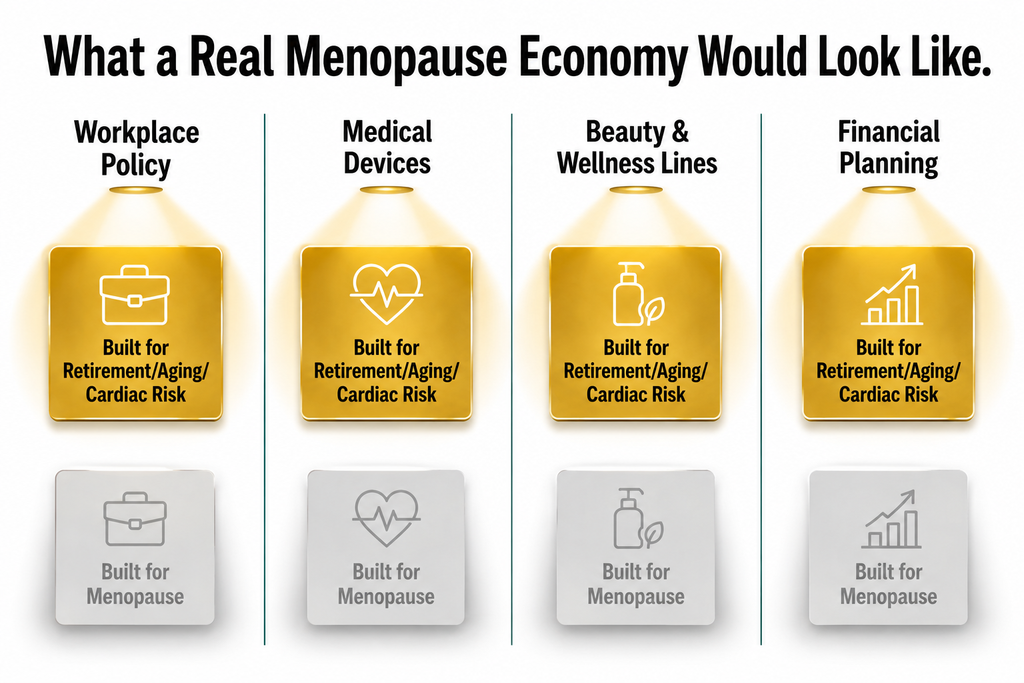
If businesses actually built for this the way they built for legacy and reinvention, a few categories would look very different:
- Workplace policy. Most employers still have no formal menopause policy at all — no flexibility guidance, no manager training, nothing written down. A handful of employers, mostly in the UK where menopause workplace policy has gotten more public attention in recent years, have started publishing formal guidance; the fact that this counts as newsworthy tells you how rare it still is.
- Medical product design. Compare this to how aggressively the industry designs around, say, cardiovascular risk in middle age — statins, monitoring devices, entire specialty clinics. Menopause-specific medical devices and diagnostics remain thin by comparison, despite decades of clinical documentation on the condition itself.
- Targeted beauty and wellness lines. Anti-aging skincare is a mature, crowded category. Products formulated specifically around menopausal skin and hormonal shifts are a much newer, thinner shelf.
- Financial planning. Retirement planning is a fully built financial-services category, with products, advisors, and marketing built entirely around one predictable life event. Menopause, an equally predictable event that often coincides with peak earning years and major health costs, has nothing comparable.
None of this requires a leap of imagination — it requires businesses to treat menopause as a demographic certainty worth designing around, exactly the way they already treat retirement.
This is, in miniature, the same pattern that turns friction into industry: a widespread human problem sits unaddressed until someone finally builds the product, and then an entire market follows. Menopause is still waiting for that moment.

What a Real Menopause Economy Would Actually Require
Which of the four categories — workplace policy, medical product design, beauty lines, or financial planning — is furthest along right now?
Workplace policy, marginally — a small number of UK employers have begun publishing formal menopause guidance in the last few years, which is itself notable mainly because it’s still rare enough to make news. Financial planning is furthest behind: there’s no menopause-equivalent of a retirement calculator or dedicated advisor specialty yet, despite the life stage being just as predictable.
Isn’t this the same story as the broader “women’s health research gap”?
No, and that distinction matters. The women’s-health-funding conversation is usually about missing research — conditions that are understudied or misdiagnosed. Menopause isn’t that; it’s been clinically documented since the eighteenth century. The gap here isn’t knowledge, it’s that nobody built commercial infrastructure around knowledge that already exists.
What would actually prove this gap is closing, not just getting talked about more?
Watch for the boring signals, not the headlines: a mainstream retailer carrying a dedicated menopause aisle the way it carries a baby aisle, an insurer adding menopause-specific coverage as a standard line item, or a financial-planning product that treats it as a scheduled life event the way a 401(k) glide path treats retirement. Media coverage is a leading indicator; those three are the actual market showing up.
Could a brand get this wrong the way “anti-aging” marketing got aging wrong?
Easily. The anti-aging category built itself around shame — sell women a way to disguise a normal biological process. A menopause economy built the same way just repeats that mistake with a different word on the label. The opportunity here is specifically in treating it the way retirement planning treats retirement: a known, practical transition to plan for, not a flaw to hide.
Key Takeaways
- The menopause economy touches an estimated 1.2 billion women worldwide but remains commercially underdeveloped relative to its scale.
- The global wellness industry, often estimated near $6.8 trillion annually, is powered substantially by middle-aged women consumers spending on other transitions — proof the money and the willingness to spend both exist.
- Other middle-age life stages — legacy-building, career reinvention, retirement — became full industries. Menopause, despite centuries of medical study, largely didn’t.
- Real growth categories are visible: workplace policy, menopause-specific medical products, targeted beauty and wellness lines, and financial planning built around this life stage.
- The gap isn’t a mystery of demand. It’s a failure of attention — and that’s precisely what makes it an opportunity.
Mary Beard didn’t ask to become a symbol of anything; she just answered a question about immigration and got told she looked wrong for television. But the reaction she triggered is the same reaction the market has been having toward middle-aged women for decades: noticing them just long enough to look away. Businesses that stop looking away first won’t just do right by 1.2 billion women. They’ll get there before their competitors even notice the market exists.
Sources
- The Human Constant — The Reckoning
- Mary Beard’s 2013 appearance on BBC’s Question Time and the specific critic comment about her appearance
- Global wellness industry valued at approximately $6.8 trillion annually
- Claim that menopause affects approximately 1.2 billion women worldwide
- Claim that menopause has been medically studied since at least the eighteenth century
- 1888 French newspaper’s mistaken obituary of Alfred Nobel (confusing him with brother Ludvig)
- Claim that Nobel rewrote his will seven years after the mistaken obituary to create the Nobel Prizes
- Characterization of some UK employers publishing formal menopause workplace policies in recent years
- General claim that menopause-specific medical devices/diagnostics and targeted beauty lines are less developed than comparable middle-age product categories
