



















































Desire Paths: The 1914 Snow Trick Behind Every Great Product Decision

There’s a story that gets passed around design and product circles about a university architect named Joseph N. Bradford, who is often credited with deciding where to put sidewalks at a Midwestern campus by watching where snow melted first under student footsteps. As the story goes — and it’s worth saying up front that the details of it are more legend than documented history — Bradford didn’t guess where paths should go. He waited, watched where people actually walked, and paved over the trails they’d already worn into the ground. Whether or not it happened exactly that way, the idea behind it is the whole reason this piece exists: it’s the cleanest metaphor going for desire paths, and for how good products actually get found instead of invented.
Desire paths are the informal trails people wear into grass, dirt, or snow by ignoring the “official” route and taking the one that actually makes sense. Every campus has them. Every park has them. And every product category has an equivalent, if you know where to look.

What Is a Desire Path, Really?
Literally, a desire path is a trail carved by repeated human behavior rather than by design. Nobody plans it. Nobody approves it. It just appears, because enough people made the same choice enough times that the choice left a mark.
Metaphorically, that’s the whole thesis: buried underneath every market, every product category, and every “innovative” idea is a pattern of human behavior that already existed before anyone built anything for it. People were already improvising a workaround. They were already gathering in group chats to do what an app should be doing. They were already carrying two devices because neither one alone did the job. The trail was there. Somebody just hadn’t paved it yet.
The practical version of this for anyone building something: before you design a route, go check where people are already walking. Don’t ask “what should users do?” Ask “what are users already doing, badly, with duct tape?” That gap between the improvised and the official is where the real opportunity sits.
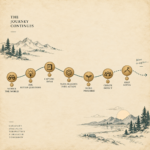
The Seven Life Phases: This Framework’s Own Taxonomy
One way to organize that search is to look at human life as a sequence of recurring phases — childhood, adolescence, early adulthood, parenthood, midlife, later career, and old age, broadly speaking. This piece treats that as a seven-phase model, but it’s worth being precise about what that is: it’s this framework’s own organizing taxonomy, not an established finding from developmental psychology. There’s no scientific consensus that human life breaks into exactly seven universal, biologically fixed stages identical across every culture and century — that’s a useful lens, not a proven law.
What is reasonably uncontroversial is the softer version of the claim: certain kinds of friction — status anxiety in adolescence, exhaustion in new parenthood, the search for purpose after a career peak — show up again and again across very different times and places, even if the specific texture of each experience varies with the culture doing the experiencing. The phases are a rough map, not a settled science. Treat them as a way to organize where to look for desire paths, not as a claim about human nature you’d want to cite in a thesis.
Needs, Wants, and Problems: Where Ideas Actually Live
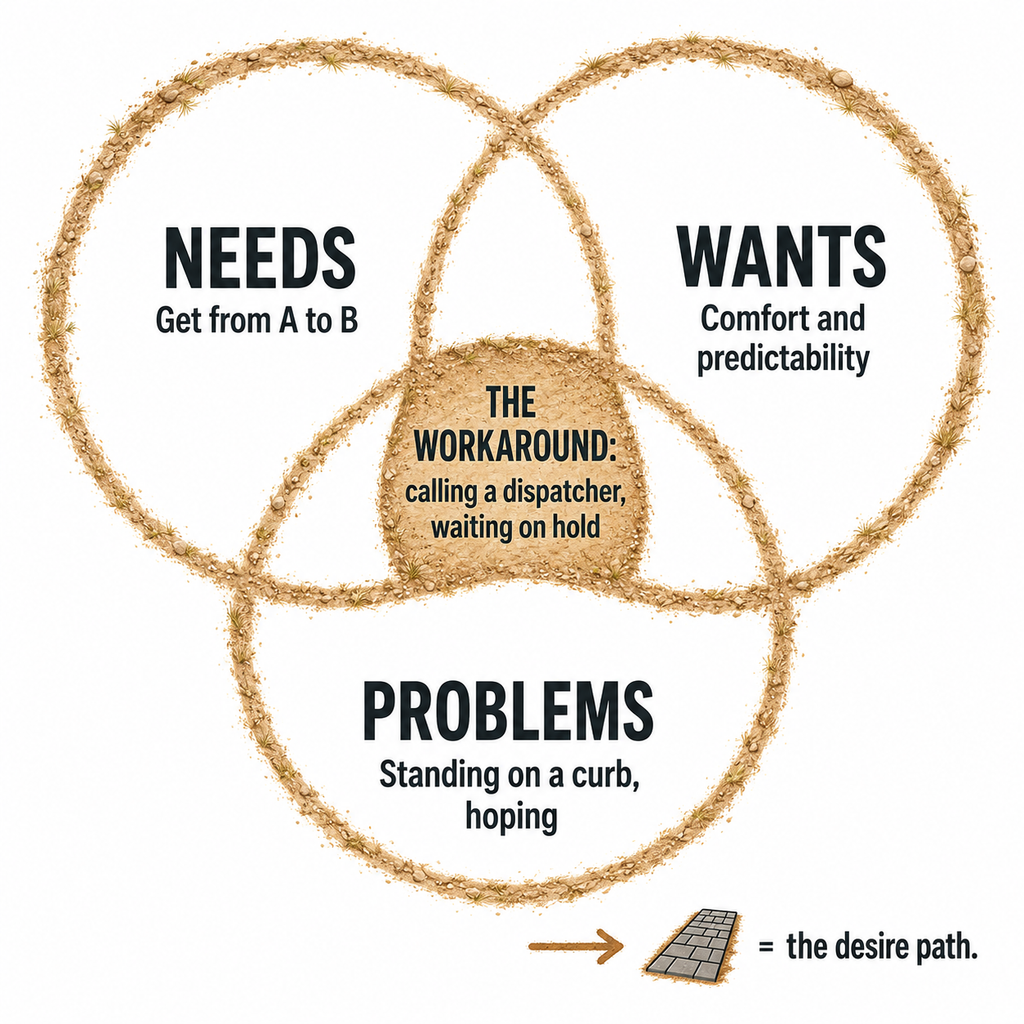
Within any life phase, people are working with three categories of motivation. Needs are what they must have to function. Wants are what they wish they had to thrive. Problems are the friction between what they have and what they need or want.
Ideas live in that friction — specifically in the gap between the problem and whatever clumsy fix people have cobbled together on their own.
Take something mundane: before ride-hailing apps existed, the need was simple — get from A to B without a car. The want was comfort and predictability. The problem was standing on a curb, arm out, hoping. People solved it badly for decades: calling a dispatcher, waiting on hold, hoping the cab showed up at all. That workaround — the phone call, the wait, the uncertainty — was the desire path. Nobody had to invent the need for a ride. It was already worn into the pavement. The app just paved over a trail that millions of frustrated commuters had already made.
That’s the pattern worth stealing: map your audience’s needs against their wants against their actual, current problems, and look hard at whatever improvised, annoying workaround they’re already using. That workaround is the trail. Your job is to notice it, not invent a replacement for something nobody was walking toward in the first place.
The Feedback Loop: How Every Solution Paves a New Trail
Here’s the part that makes this dynamic instead of static: solving a problem doesn’t close the loop. It opens a new one.
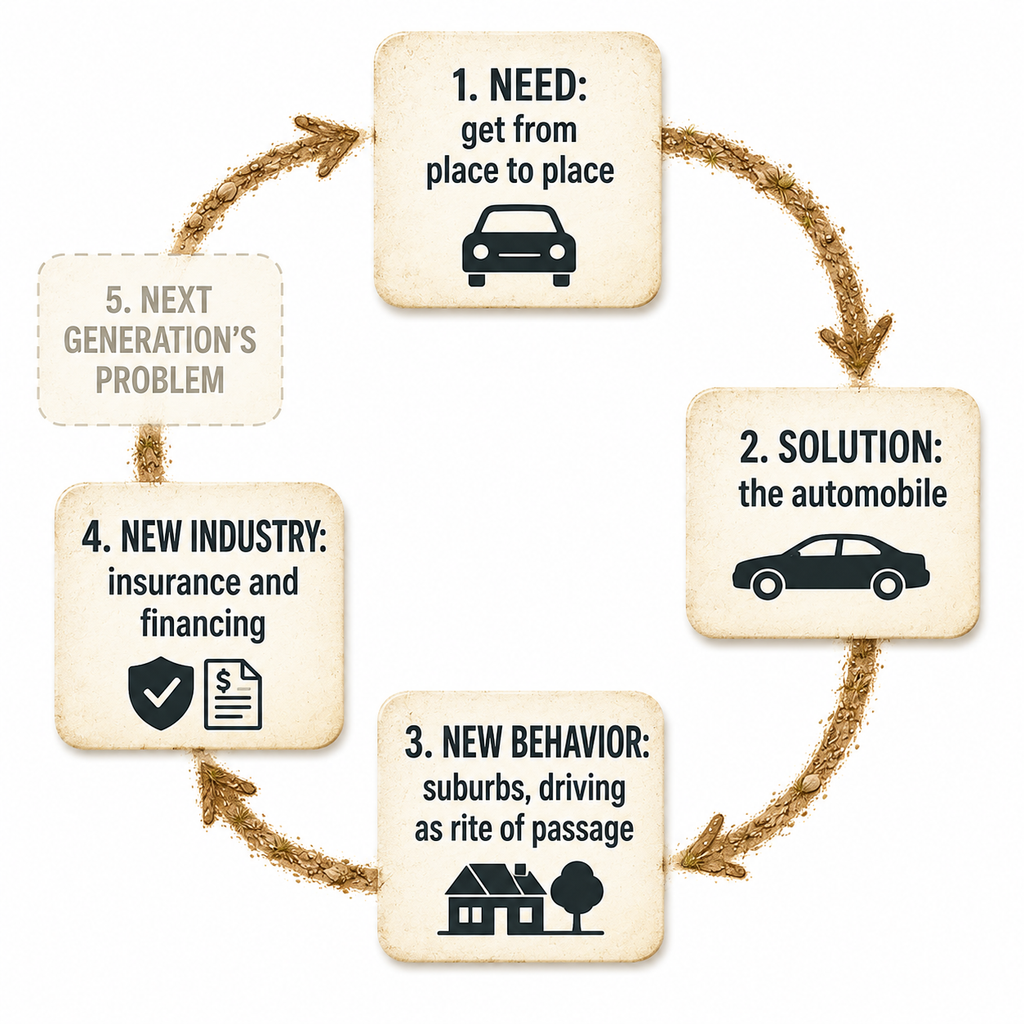
The automobile is the go-to illustration for this, and it’s worth stating plainly rather than over-hedging: cars solved a transportation problem, and in the decades that followed, a lot of downstream change showed up — suburban growth, new patterns of adolescent independence, the driving test as a coming-of-age ritual, entire industries around insurance and financing. Historians would rightly point out that suburbanization and driving laws were shaped by zoning policy, cheap land, postwar economics, and a dozen other forces, not by the car alone. But the shape of the loop still holds: a solution to one generation’s problem tends to seed the next generation’s problems. That’s the mechanism worth remembering even when the exact causal chain is messier than a clean one-line story. This framework’s four-stage feedback loop breaks that mechanism down in more detail — how a need becomes an industry, and how that industry eventually produces the financial instruments that reshape the next generation’s behavior.
The takeaway for anyone building something: don’t treat your product as an endpoint. It’s a new trailhead. The moment you solve a problem well, you’ve created a new set of behaviors, and somewhere in those behaviors is the next desire path waiting to be noticed.
Bradford’s Question, Applied to Your Product
Whatever actually happened on that campus in 1914, the question attributed to Bradford is the useful part, and it survives the hedge intact: not “what should the path look like?” but “where are people already walking?”
Applied to product work, that means auditing the workarounds before you write a single feature spec. Look at the spreadsheet someone built to track what your software won’t. Look at the Slack channel people created because your onboarding flow didn’t answer their questions. Those aren’t edge cases to dismiss — they’re desire paths, and they’re telling you exactly where to pave.
Concretely: before the next roadmap meeting, go find three places where your users have built their own workaround instead of using the feature you gave them. That list is worth more than a quarter of speculative brainstorming, because it’s not a guess. It’s a trail somebody already wore into the ground.

Key takeaways:
– Desire paths are trails formed by repeated behavior, not design — physical or otherwise.
– The “seven phases of life” here is this framework’s own organizing lens, not settled science — use it as a search tool, not a citation.
– Ideas live in the gap between a need/want and the clumsy workaround people already use to solve it.
– Every solved problem tends to create new ones — plan for the next trail, not just the current one.
– Before designing anything, audit existing user workarounds. That’s the map.
Reading the Trail Before You Pave It
What is a desire path in product design or UX terms?
It’s an existing behavior pattern — a workaround, a hack, an informal habit — that reveals what users actually want, as opposed to what a team assumed they wanted when designing the “official” route.
How is this different from regular user research?
Traditional research often asks people what they’d like. Desire-path thinking looks at what they’re already doing without being asked — which tends to be more reliable, since behavior is harder to fake than a survey answer.
Does this apply outside physical or digital product design?
Yes. The same logic shows up in business strategy, policy, and even personal habits: wherever people repeatedly improvise around an official system, there’s a trail worth studying instead of ignoring.
Is the seven-phase life model a scientific framework?
No — it’s best understood as this framework’s own organizing taxonomy for grouping recurring life-stage friction points, not a peer-reviewed developmental model.
The next time you’re staring at a roadmap, skip the guessing. Go find the trail people have already worn into your product, and pave it.
Sources
- The Human Constant — The Invisible Architecture
- The characterization of human life as breaking into exactly seven universal, biologically fixed developmental phases consistent across all cultures and eras — explicitly labeled in the piece as the framework’s own taxonomy, not scientific consensus
- The claim that the automobile’s introduction led in sequence to suburban growth, a new form of childhood, the driving license as a rite of passage, and the car insurance/financing industry — presented with a caveat that historians attribute this to multiple factors, not a single linear chain
- The general claim that ride-hailing apps replaced an earlier common practice of phoning a dispatcher and waiting for a cab (used as a general, non-sourced illustrative example rather than a specific documented case)
