




















































The Four-Stage Feedback Loop: Why Some Industries Eat Their Own Progress

Ideas become products. Products become industries. Industries become instruments. Instruments reshape humans. Then the cycle begins again. That’s the feedback loop every mature industry runs, and it has exactly four stages: a life-phase need (stage one), an industry that provides for it (stage two), that industry scaling supply and demand (stage three), and the financial instruments that emerge around it (stage four) — instruments that then reshape the very need that started the loop. Here’s the part most explanations of this skip: the loop isn’t automatically virtuous. Run it on two different industries and you get two completely different outcomes — one that makes its original need easier to meet, and one that makes it harder.
Key takeaways
- The feedback loop has four stages: need, industry, scaled supply and demand, and the financial instruments that emerge — which then reshape the need itself.
- The smartphone loop is virtuous: an unmet need got easier to meet as the loop ran, expanding into a genuine app economy.
- The housing loop is vicious: the instruments meant to make homeownership more accessible ended up inflating prices and making it less accessible — the loop worked against its own starting purpose.
- The practical takeaway: before building on top of an existing loop, figure out which direction it’s actually running — toward the need getting easier, or harder.
The smartphone loop: a virtuous cycle
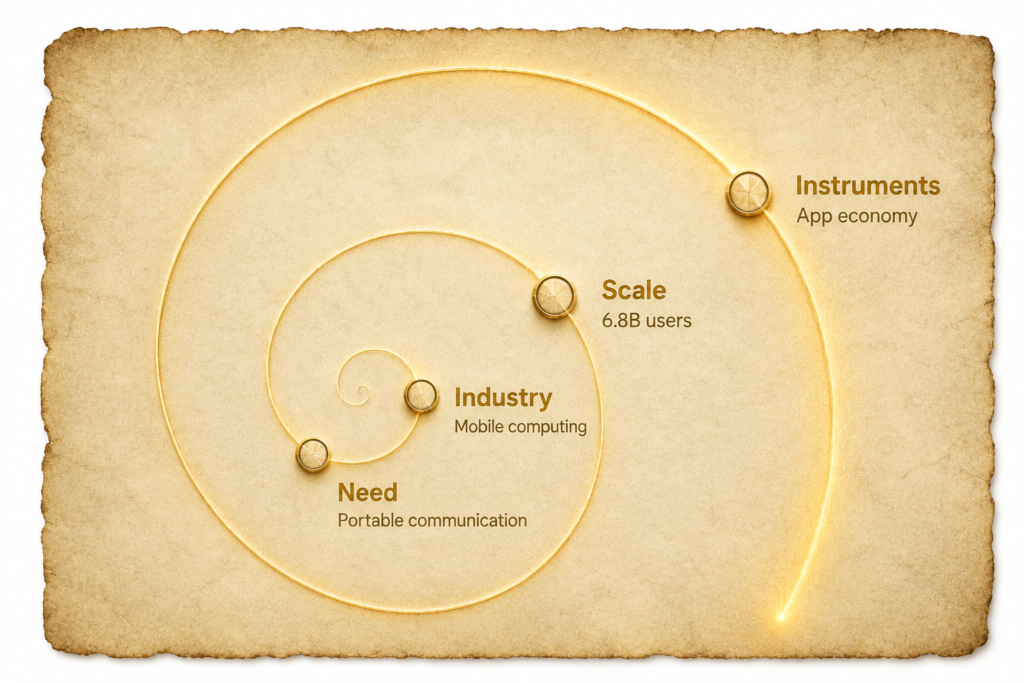
In November 1992, IBM engineers demonstrated a prototype at the COMDEX trade show called Simon — a touchscreen device that made calls, sent faxes, and ran a handful of built-in apps. It reached consumers in August 1994 through BellSouth Cellular, and it’s widely credited today as the first commercially available smartphone. Run the feedback loop on it: stage one, a need for portable, integrated communication and computing. Stage two, an industry — mobile computing — begins providing for it. Stage three, that industry scales dramatically; by 2023, roughly 6.8 billion people worldwide carried a smartphone. Stage four, the financial instruments emerge around it: app stores, in-app purchases, mobile advertising, subscription models — a mobile app market now valued at over $500 billion annually.
That’s a loop that fed itself in a genuinely useful direction. Each stage made the original need — portable access to communication and information — easier and cheaper to meet, not harder. The instruments that emerged (app economics, mobile payments) didn’t undermine the original demand; they expanded what was possible to build on top of it.
The housing loop: a vicious cycle
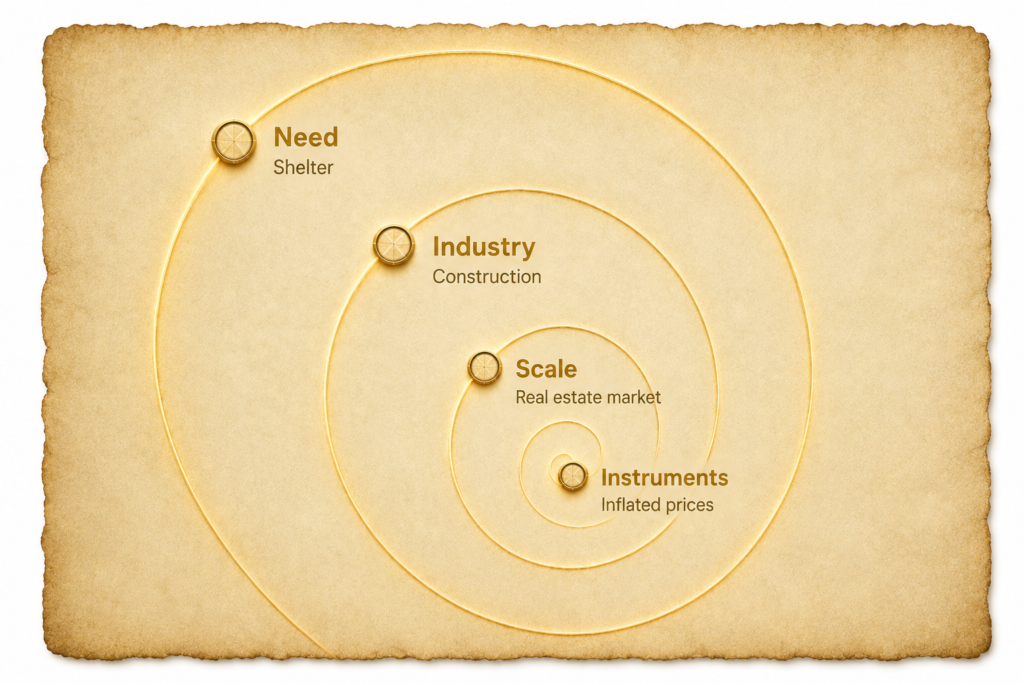
Run the same four stages on housing and the direction reverses. Stage one: adults need shelter — one of the most emotionally powerful needs of adult life. Stage two: the construction industry provides it. Stage three: the real estate industry scales supply and demand around it. Stage four: mortgage products, real estate investment trusts, mortgage-backed securities, and home equity loans emerge as the instruments. Here’s where it turns vicious — those instruments made homeownership accessible to a broader population, which increased demand, which inflated prices, which made homeownership less accessible again. The loop didn’t just reshape the need. It worked against the exact thing it was originally built to solve.
The catastrophic version of this loop closing is well documented: those same mortgage instruments, packaged and resold as securities, were central to the 2008 financial crisis. When Lehman Brothers filed for bankruptcy on September 15, 2008 — the largest bankruptcy in U.S. history — roughly $10 trillion was erased from global stock markets within weeks. (We covered the other major instrument born from that exact moment of institutional distrust in our Six Weeks After Lehman Brothers Collapsed, Bitcoin Was Born piece — a different instrument, generated by the same crisis, in the opposite direction from the housing loop’s collapse.)
Auditing your own feedback loop
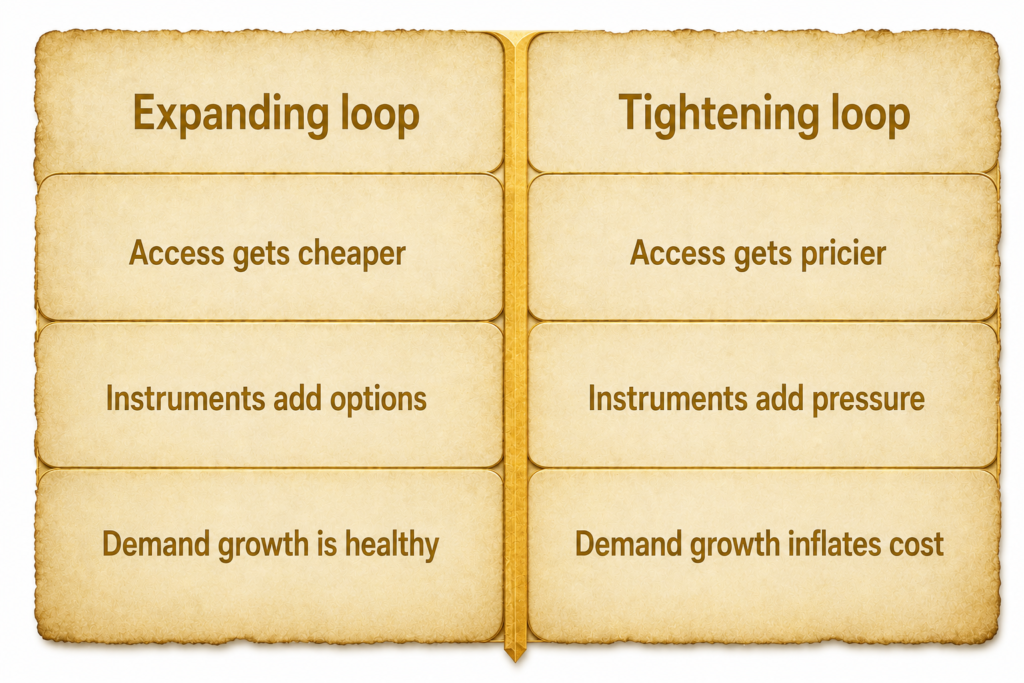
Before you build a product, a feature, or a company on top of an existing industry’s momentum, it’s worth running this same audit. Is the loop you’re joining currently expanding — making its core need easier and cheaper to meet as it scales — or is it tightening, where the instruments built around it are quietly working against the original need? Both loops look identical at stage one and stage two. They only diverge once the financial instruments in stage four start feeding back into demand. (This is the same mechanism the Anatomy of an Idea piece calls “reshaped life” — this piece is really a close-up on what determines which direction that reshaping actually goes.)
The honest audit question isn’t “is this a good industry to build in.” It’s “as this loop’s instruments mature, does the original need get easier to meet, or does meeting it get more expensive for the people who need it most.” Housing answered that question the hard way. Don’t wait for your own answer to arrive the same way.
Spotting Which Stage You’re Actually In
Is the housing loop actually “vicious,” or just a normal supply-and-demand story? It’s more specific than ordinary supply and demand — the instruments themselves (mortgage-backed securities, REITs) actively expanded the pool of buyers competing for the same limited housing stock, which is what accelerated the price inflation. Ordinary supply and demand doesn’t usually have a stage-four financial-instrument layer actively pouring more demand into a fixed supply.
Can a loop switch from virtuous to vicious over time? Yes — that’s arguably what happened with housing itself; homeownership access genuinely improved for decades before the instrument layer eventually outran the underlying supply. A loop’s direction isn’t fixed at stage one, and it’s worth periodically re-auditing rather than assuming an early-virtuous loop stays that way.
How is this different from the six-step framework or the anatomy of an idea? Those two are about how an idea starts and what happens to it as it becomes something bigger. This framework is specifically about what happens once an industry already exists and generates financial instruments — and whether those instruments loop back to help or hurt the need that created them in the first place.
Try this
Pick an industry or product category you’re currently building in, or considering building in. Name its stage-four instruments — the specific financial products, subscriptions, or investment vehicles that have emerged around it. Then ask honestly: as those instruments have matured, has the original need gotten easier or harder for ordinary people to meet? If you don’t know the answer, that’s the actual research task before you build anything else on top of it.
Sources:
- Adapted from The Human Constant, Chapter 11 — “The Feedback Machine”
- How IBM invented the smartphone, then abandoned it — Fast Company
- Smartphone Users Statistics 2026 (Global Usage Data) — DemandSage
- Global Mobile Application Market — Astute Analytica
- Collapse of Lehman Brothers — EBSCO Research
